
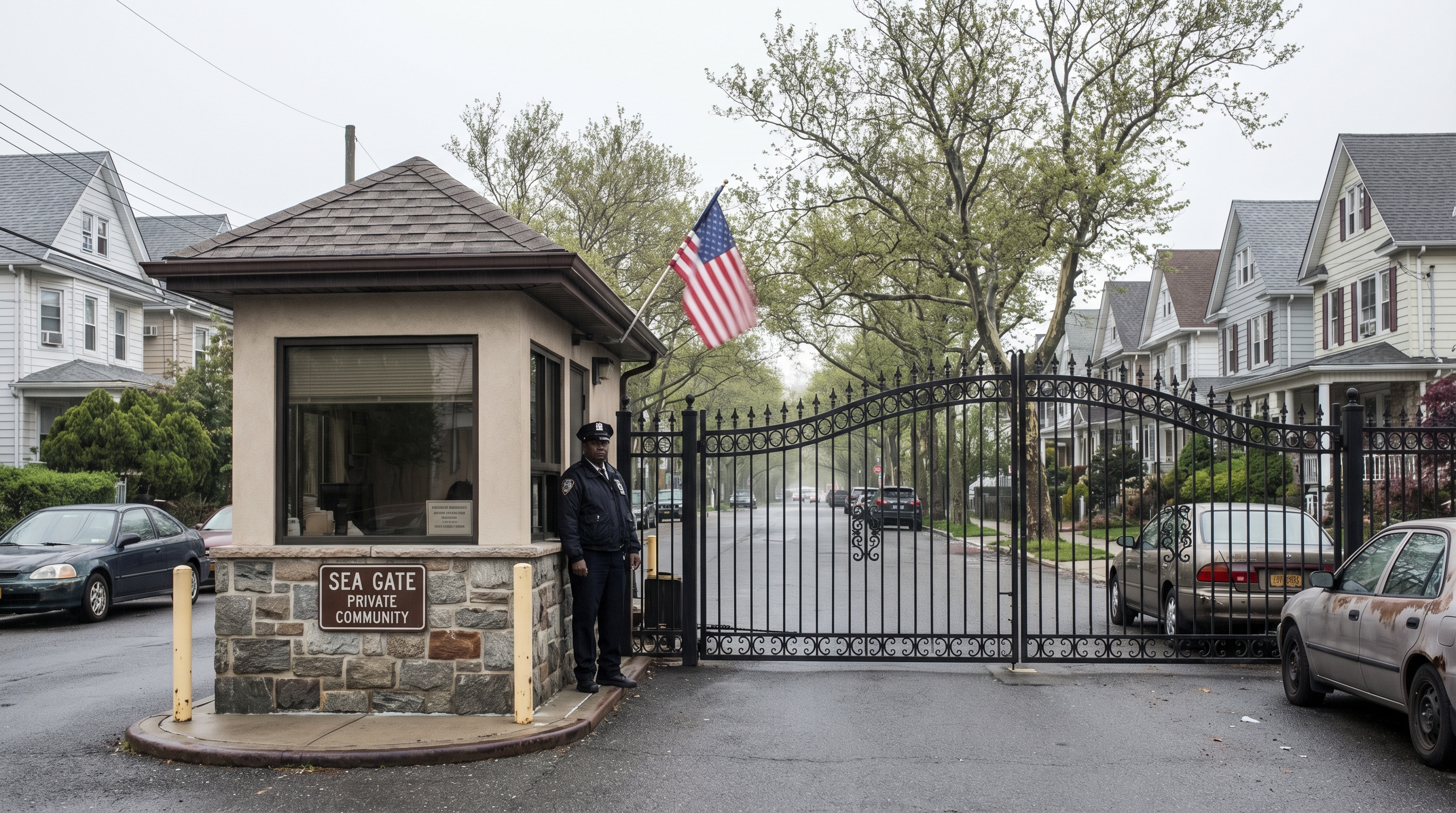
Sea Gate is the kind of place New York City does not admit it contains. Inside a guarded iron gate at the western end of the Coney Island peninsula, about 850 houses sit on a 90-acre private enclave surrounded on three sides by water. The Atlantic Ocean runs along the south. Gravesend Bay runs along the north. The Narrows stretches to the west toward Staten Island and the open harbor. The streets inside are private property, maintained by the Sea Gate Association and patrolled by its own Public Safety Department. You cannot drive through without authorization. You cannot walk in without being a resident or a guest.
Most New Yorkers have never seen the inside of this neighborhood. That combination of complete privacy and an extraordinary waterfront position, inside New York City’s most urban borough, creates one of the most genuinely singular residential environments in the country.
Sea Gate’s housing stock spans 130 years of American residential taste without a planning committee in sight
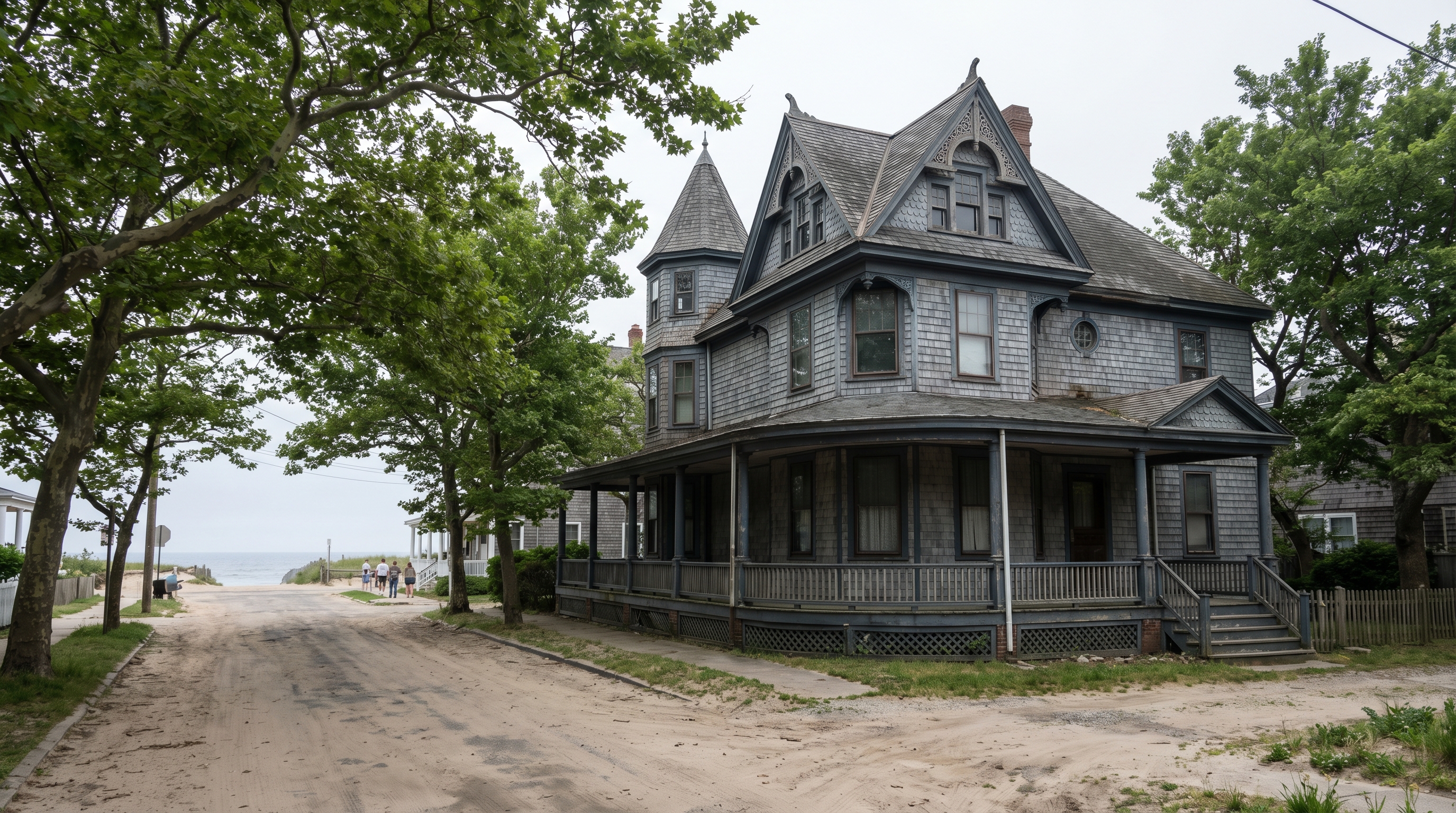
The approximately 850 houses in Sea Gate were built across more than a century with no coordinating aesthetic vision and no developer imposing a master plan. The result is an architectural collection that cannot be replicated: shingled Victorian Queen Anne cottages from the 1890s sitting beside Spanish Mission Revival villas from the 1920s, next to brick Colonial houses from the 1940s, next to contemporary glass-box homes rebuilt after Hurricane Sandy in 2012. A private residence designed by William Van Alen, the architect of the Chrysler Building, is somewhere on these streets. Almost no one outside Sea Gate has seen it.
The oldest houses along Surf Avenue near the gate and on Atlantic Avenue along the oceanfront are gabled Victorians with wraparound porches, decorative shingling, and asymmetrical rooflines that were already old when Isaac Bashevis Singer arrived in 1935 and rented a room for $4 a week. Singer found a community of Yiddish poets, labor activists, and intellectuals that helped shape his earliest years in America. His room in Sea Gate was his first American home. He later won the Nobel Prize in Literature.
This history is embedded in the physical fabric of the neighborhood. The buildings that Singer walked past in 1935 are still standing. Some have been renovated, some have been left untouched, and some were replaced by entirely new construction after Sandy reshaped the community a decade ago. The range of surfaces and finishes inside Sea Gate houses reflects this layered history in practical terms: old-growth pine floors from 1899 down the street from new porcelain tile laid in 2015, original plaster walls beside modern drywall, Victorian woodwork beside stainless steel appliances.
House cleaning in a Victorian-era community requires more than one product and one mop
A cleaning approach that works in a modern high-rise apartment will damage the original surfaces inside a Sea Gate Victorian. Old-growth pine and fir floors from the late 19th century are often finished with wax rather than polyurethane. Water and all-purpose sprays applied to wax-finished wood will strip the finish and raise the grain. Plaster walls, which make up the interior surfaces of Sea Gate’s oldest houses, respond differently to moisture than modern drywall. The carved decorative woodwork on Victorian door frames and crown moldings collects dust in ways that require a soft brush, not a damp cloth.
Our house cleaning teams ask about surface types before arriving. They carry separate products for wax-finished hardwood, polyurethane hardwood, stone, tile, plaster, and modern painted drywall. They clean top-down so dust from high shelves and decorative moldings never settles onto already-cleaned floors below. Plaster walls get a dry or barely damp wipe. Wax floors get a barely damp microfiber mop and a cleaner formulated for wax finishes, not the pH-neutral floor spray designed for modern surfaces. These are not special requests. They are the default approach for homes built before 1950.
For post-Sandy new construction homes, the surfaces are entirely different and so are the methods. Engineered hardwood, porcelain tile, and quartz countertops each require their own cleaner. We note what is in your home during the first visit so every subsequent recurring appointment uses the same products on the same surfaces.
The salt air does something to every surface in Sea Gate that inland homes do not experience
Living on a peninsula surrounded by water on three sides means salt deposits accumulate in Sea Gate at a rate that Brooklyn neighborhoods a few miles inland never encounter. Salt crystallizes on window tracks, door frames, and metal fixtures. It mixes with sand tracked in from the private beach and acts as an abrasive on hardwood and tile when left to dry. It speeds the corrosion of metal hardware and collects in the crevices of exterior-facing woodwork.
Sea Gate residents who have moved here from elsewhere in Brooklyn notice this quickly. The housekeeping rhythm is different. High-traffic entry areas need more frequent attention. Window tracks near exterior walls need to be cleaned differently from interior windows. Metal fixtures near the shoreline need wiping with products that will not accelerate oxidation. If you bring outdoor furniture inside during winter or after storms, it carries salt residue that will transfer to floors and rugs.
We have cleaned enough coastal Brooklyn homes to know what salt exposure looks like and how to address it without damaging the surfaces underneath. Entry points get an extra pass. Window tracks get cleared rather than wiped over. Metal surfaces get appropriate products. The process is not complicated but it requires knowing what you are looking at.
A deep clean in a Sea Gate house built in 1900 is a different project than a standard apartment cleaning
A proper deep cleaning of a Victorian-era Sea Gate home means reaching crown molding at heights that require an extension handle, pulling salt and dust from behind radiators on multiple floors, cleaning inside original built-in cabinets that have collected decades of residue, and scrubbing tile grout in bathrooms that has not been addressed in years. The baseboards in these houses are typically taller and more ornate than modern construction, which means more surface area and more detail work. The windows are frequently larger and the sills wider, which means more accumulation.
We have cleaned well over 100,000 homes across New York City, including a substantial number of Victorian and pre-war single-family houses throughout Brooklyn. The work that a deep clean requires in a Sea Gate Victorian is not surprising to our teams. It is what we expect going in.
For seasonal rentals, move-in and move-out cleaning between tenant turnovers is some of our most common work in Sea Gate. Beach traffic leaves behind sand and salt that concentrates in showers, on bathroom floors, and in kitchen grout. A thorough turnover clean covers cabinet interiors, appliance interiors, and bathroom grout alongside all the standard surfaces, with interior windows available as an add-on when the glass has taken a season of salt. We can coordinate timing with checkout and check-in schedules.
The private beach is one of a very small number in New York City
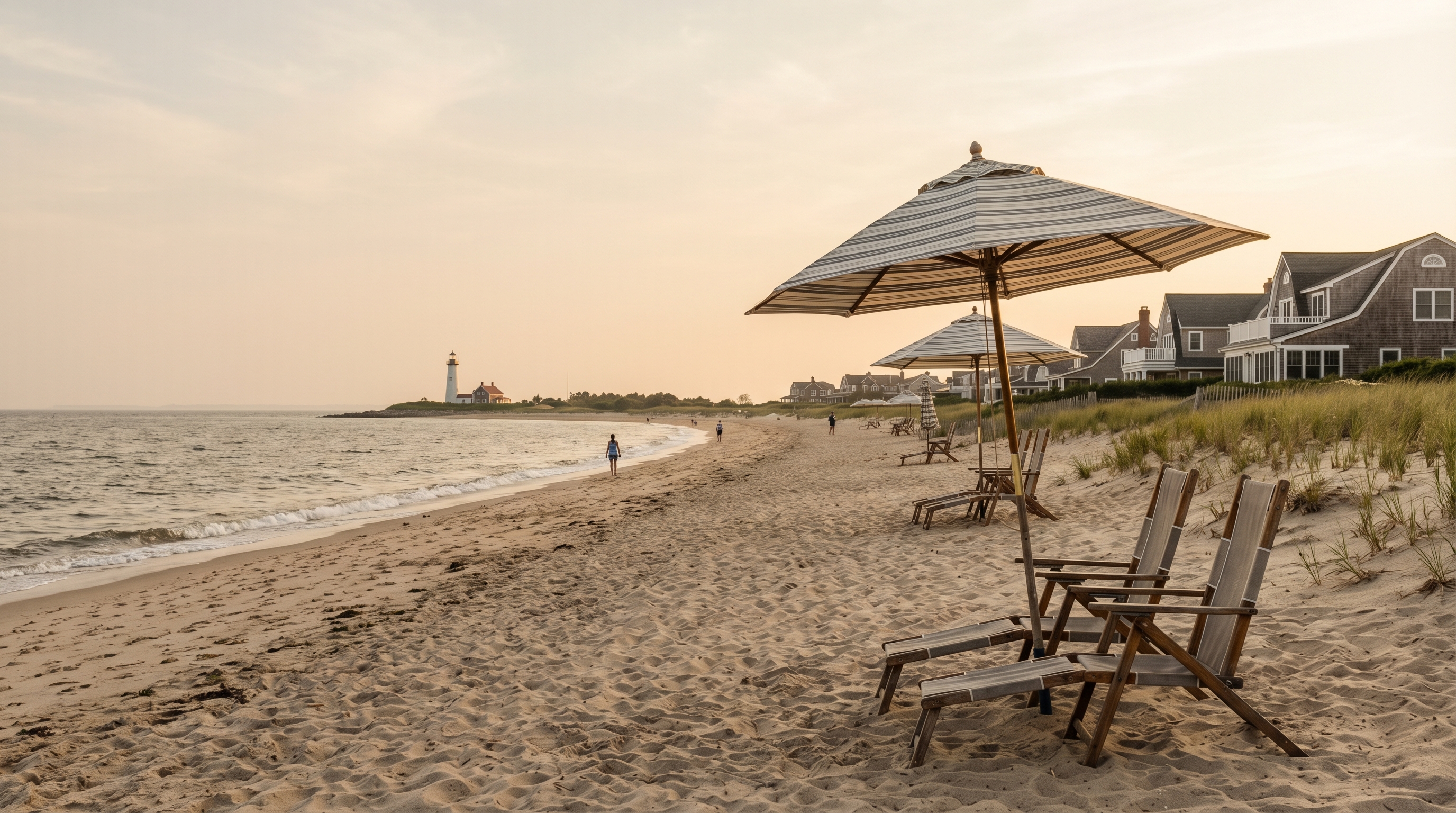
The Atlantic Ocean beachfront inside Sea Gate’s perimeter is private property of the Sea Gate Association, maintained with lifeguard coverage funded by resident dues from Memorial Day through Labor Day. In a city where the public beaches at Coney Island, Brighton Beach, and Rockaway attract hundreds of thousands of visitors on summer weekends, Sea Gate’s beach is a place where a few thousand people spread out on the same stretch of sand.
The beach is the neighborhood’s primary recreational draw and its most tangible reward for paying community dues on top of city taxes. On summer afternoons, the private Atlantic shore is where Sea Gate’s diverse mix of Jewish, Caribbean, Russian, Italian, and African-American families converge, separated from the crowd by a fence and a guard booth a short walk to the east. It is, by any reasonable measure, an extraordinary thing to have as your backyard in the middle of Brooklyn.
During beach season, homes get heavier use and more foot traffic. Sand tracks through entry points and collects on bathroom floors after beach visits. Outdoor furniture comes inside. Towels accumulate. Scheduling a recurring weekly or biweekly apartment cleaning through the summer keeps the home manageable through the high-traffic months. We serve the full Coney Island peninsula, including our neighbors at Coney Island and Brighton Beach.
What booking looks like for a gated community
Booking a cleaning in Sea Gate takes one extra step that other Brooklyn neighborhoods do not require. When you book, you tell us your address inside the community. Before the first appointment, we send you driver names and vehicle information, along with a certificate of insurance, to add to your approved vendor list with the Sea Gate Association’s public safety department. On the day of the cleaning, our team checks in at the gate and is waved through. It takes about two minutes on your end the first time and nothing after that.
You can book your first cleaning online and see your flat-rate price before you commit. Prices are based on bedrooms, bathrooms, and square footage. A three-story Victorian house is priced accordingly. A converted beach bungalow is priced differently. There are no upcharges at the door for extra floors, coastal location, or the guard gate. The price you see when you book is the price you pay.
We also serve Gravesend, Bensonhurst, and the rest of southern Brooklyn.