
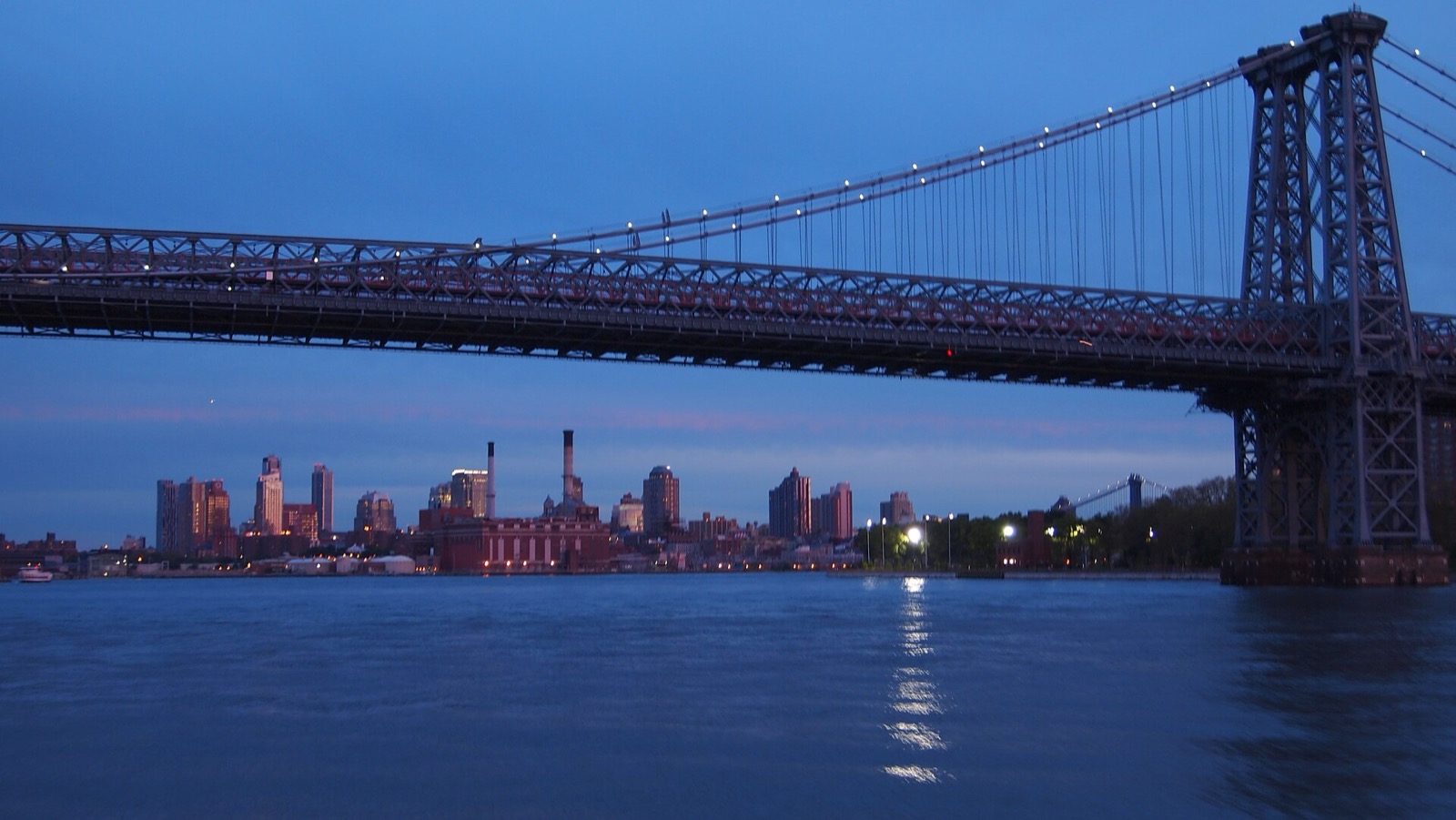
The Williamsburg Bridge opened on December 19, 1903, and became the longest suspension bridge in the world by exactly 4.5 feet over the Brooklyn Bridge. It was also the first major suspension bridge built entirely of steel. But the bridge’s real significance was not engineering. It was human traffic. Within years of opening, newspapers called it the “Jews’ Highway” because tens of thousands of Jewish immigrants fleeing the overcrowded tenements of Manhattan’s Lower East Side poured across it into Brooklyn, transforming a predominantly German and Irish neighborhood into one of the most densely Jewish communities on earth.
That crossing set the pattern for everything Williamsburg would become. Every wave that shaped this neighborhood arrived through some version of a bridge: the horse ferry of 1802, the suspension bridge of 1903, the L train that delivered artists in the 1990s, the luxury SUVs of the 2010s. Williamsburg has always been a neighborhood people arrive at. It has never been static long enough to be anything else.
The bridge still functions as a connective artery between Williamsburg and Manhattan’s Lower East Side. Walk or bike across its pedestrian path and you land on Delancey Street, deep in what was once the most crowded neighborhood in the Western Hemisphere. The two communities on either end of that span shared a population for decades. Families moved back and forth across the river depending on rent, factory work, and which side had room. Today the bridge carries over 30,000 vehicles a day plus thousands of cyclists using its dedicated bike lane, one of the most heavily trafficked cycling corridors in the five boroughs. The rumble of bridge traffic and the particulate it generates is a daily reality for residents within a few blocks of the approach ramps on Broadway.
How a thirteen-acre land purchase in 1802 created a neighborhood that would become its own city
The land that would become Williamsburg was farmland for most of its colonial history. The Lenape people inhabited it before Dutch settlers arrived under Governor Peter Stuyvesant in 1660. For over a century it was flat, fertile ground between the Bushwick and Wallabout marshes, supplying Manhattan with produce across the river.
In 1802, real estate speculator Richard M. Woodhull bought thirteen acres near what is now Metropolitan Avenue and hired Colonel Jonathan Williams to survey the land. Williams was West Point’s first superintendent and Benjamin Franklin’s grandnephew. Woodhull named his planned settlement “Williamsburgh” in Williams’s honor, established a horse ferry to Manhattan, and opened a tavern. The ferry was the decisive act. It turned farmland into a transit hub overnight.
Growth came fast. Williamsburgh was incorporated as a village in 1827. By 1851 it had become an independent city with roughly 30,000 residents, the third largest in New York State. That independence lasted only four years. On January 1, 1855, Williamsburg was annexed by the City of Brooklyn, the terminal “h” was officially dropped, and local newspapers bitterly called it a forced surrender.
The neighborhood’s industrial identity took hold in the latter half of the 1800s. German immigrant Charles Pfizer founded his pharmaceutical company at Harrison Avenue and Bartlett Street in 1849, starting with tartaric acid and cream of tartar. By the Civil War, Pfizer was the largest supplier of citric acid and iodine to the Union Army. The company kept Brooklyn operations running for over 150 years until the plant finally closed in 2007.
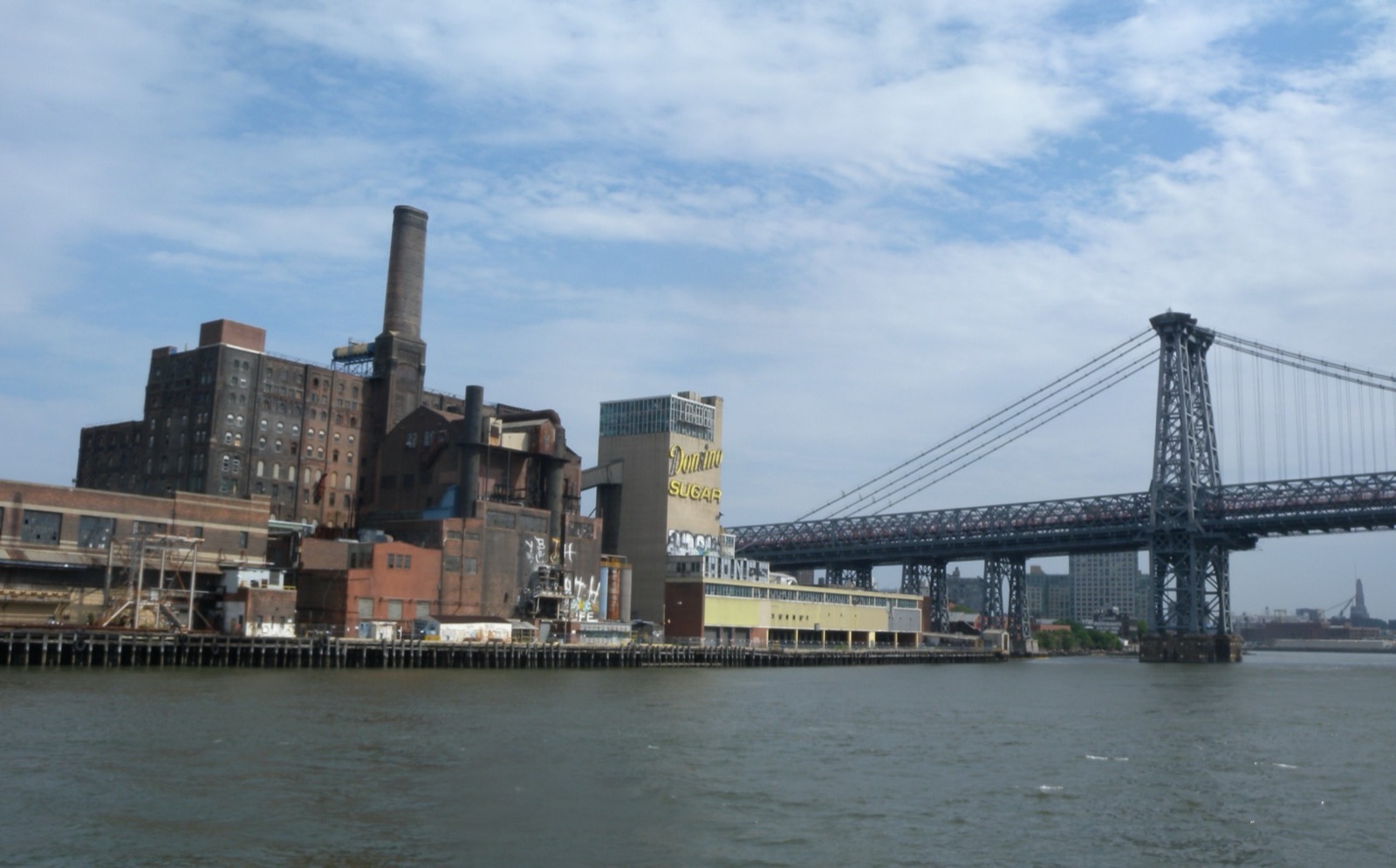
The Havemeyer family built their first sugar refinery on the waterfront in 1856. After a fire destroyed the original structures, the complex was rebuilt in 1882 as what became the Domino Sugar Refinery. At its peak in the 1920s, the plant processed 4 million pounds of sugar daily and employed 4,500 workers. It produced up to 98 percent of the sugar consumed in the United States. Workers endured twelve-hour shifts in temperatures above one hundred degrees with near-total humidity. The refinery operated until 2004, and the iconic yellow “Domino Sugars” sign on its roofline was visible from Manhattan for more than a century.
The architecture here tells a story that spans from pre-Civil War tenements to 22-story glass towers
The built environment of Williamsburg never settled into a single style. It accumulated in layers, each one visible on the street if you know where to look.
The oldest surviving residential fabric is pre-Civil War rowhouses and tenements on the North Side, built in brick and brownstone for waves of immigrants from the 1850s onward. The Fillmore Place Historic District preserves twenty-nine houses from between 1860 and 1895 in the Italianate style. It is Williamsburg’s only locally designated historic district, and it represents a fragment of what the neighborhood once was.
The industrial era left massive brick factory and warehouse buildings lining streets like Wythe Avenue and North 11th Street. Five to seven stories of red brick, built to house manufacturing operations that needed high ceilings, heavy floor loads, and natural light from oversized windows. These buildings became artist lofts in the 1990s, then restaurants and bars, then boutique hotels like the Wythe Hotel, which occupies a converted cooperage built in 1901.
That conversion pattern is the architectural story of Williamsburg in miniature. And it is also what makes cleaning here so specific to each building. The polished concrete floors in a converted factory scratch permanently with the wrong pad. The exposed brick absorbs water and stains if you wipe it with a wet cloth. The original steel beams and ductwork at 12 to 14 feet overhead collect dust that most cleaning services never touch because they do not carry the right tools or budget the time. Our teams use extendable microfiber systems on every visit to reach what accumulates above eye level in these former industrial spaces.
New construction since the 2005 waterfront rezoning changed the skyline entirely. One Williamsburg Wharf and the other luxury towers along Kent Avenue rise 15 to 22 stories with floor-to-ceiling glass, engineered stone countertops, and matte-finish cabinetry. These buildings require vendor documentation, service elevator reservations, and Certificates of Insurance before a cleaning team can even enter the lobby. Tell us your building when you book and we coordinate all of that before the first appointment.
Mel Brooks grew up in a sixteen-dollar-a-month tenement three blocks from the bridge
Melvin Kaminsky was born in 1926 in a Williamsburg tenement at 365 South Third Street. He shared the apartment with his mother and three brothers. The family eventually saved up an extra two dollars a month to move to the front unit so his mother could see the world from her windows. That same apartment reportedly rents for over four thousand dollars today.
Brooks was not the only famous name to come out of these blocks. Barry Manilow was born here in 1943 and grew up to sell over 85 million records. Man Ray, born Emmanuel Radnitzky in 1890 in a South Williamsburg tenement, became one of the central figures of the Dadaist and Surrealist movements in Paris. Bugsy Siegel was born on Williamsburg’s streets in 1906 and developed his criminal career with Meyer Lansky in the neighborhood before going on to help conceive the modern Las Vegas Strip. Buddy Rich was born here in 1917 to a vaudeville family and became one of the greatest jazz drummers in history.
Will Eisner, the comic book artist who pioneered the graphic novel form and for whom the Eisner Award is named, was raised in the Williamsburg-Bushwick area and drew heavily on immigrant Brooklyn life for his most famous work, A Contract with God. Joy Behar grew up here. Gene Simmons of KISS emigrated as a child and grew up in the area.
The neighborhood that produced this list is unrecognizable today. The tenements are still standing, but their interiors have been renovated, their rents multiplied by hundreds, and the community that shaped those lives replaced by successive waves of newcomers. What has not changed is the density. These are still buildings where people live close together, where dust migrates between units through shared walls and aging building systems, and where a cleaning approach needs to account for the specific construction of each era.
South Williamsburg operates on an entirely different frequency from the North Side
Walk south past Grand Street and the neighborhood transforms. The boutiques and coffee bars disappear. The language on storefronts switches to Yiddish. Men in shtreimels and long black coats walk to synagogue. Storefronts sell religious books and kosher provisions. This is the home of the Satmar Hasidic community, the largest Hasidic sect in the world, with over 57,000 adherents in South Williamsburg alone.
The Satmar arrived beginning in the late 1940s as Holocaust survivors from Hungary and Romania. They built institutions that predate the gentrification economy of the North Side by decades and in many ways resist it. Congregation Yetev Lev D’Satmar on Rodney Street is one of the largest synagogues in the world by regular attendance, with a main sanctuary that seats over 3,000 men on the ground floor and women in the upper gallery. Grand Rabbi Joel Teitelbaum founded the community in 1947 after surviving the Bergen-Belsen concentration camp. He arrived in Williamsburg with a small group of followers and within two decades had built an insular, self-sustaining enclave with its own schools, courts, ambulance service, and bus system. The community expanded steadily through organized real estate acquisition and bloc voting that delivered major civic wins for generations. Today the Satmar operate over 100 private religious schools in South Williamsburg alone.
The housing stock reflects this continuity. Rowhouses and small apartment buildings, many family-occupied for decades, with kitchens that maintain separate areas for meat and dairy preparation. Our teams clean these homes with dedicated supplies for each kitchen section. We do not cross-contaminate surfaces or equipment between the two areas. We do not schedule Friday evening or Saturday service for households that observe Shabbat. This is standard practice for our teams working south of Grand Street, not a special accommodation.
Between Division Avenue and Broadway sits “Los Sures,” the neighborhood where Puerto Rican and Dominican families built one of the most tenacious community organizations in Brooklyn history. Founded in 1972, the organization called Los Sures (Spanish for “The Southsiders”) fought landlord abandonment and secured housing rights during the darkest years of the 1970s. In 1975 it became Brooklyn’s first community-based organization to manage city-owned properties. The families who organized that fight are still here, and the buildings they saved are older, with unconventional layouts and kitchens that see heavy daily cooking. Range hoods, backsplashes, and cabinet faces build up grease films that routine cleaning does not reach. Our deep cleaning service handles the degreasing work that keeps these kitchens functional.
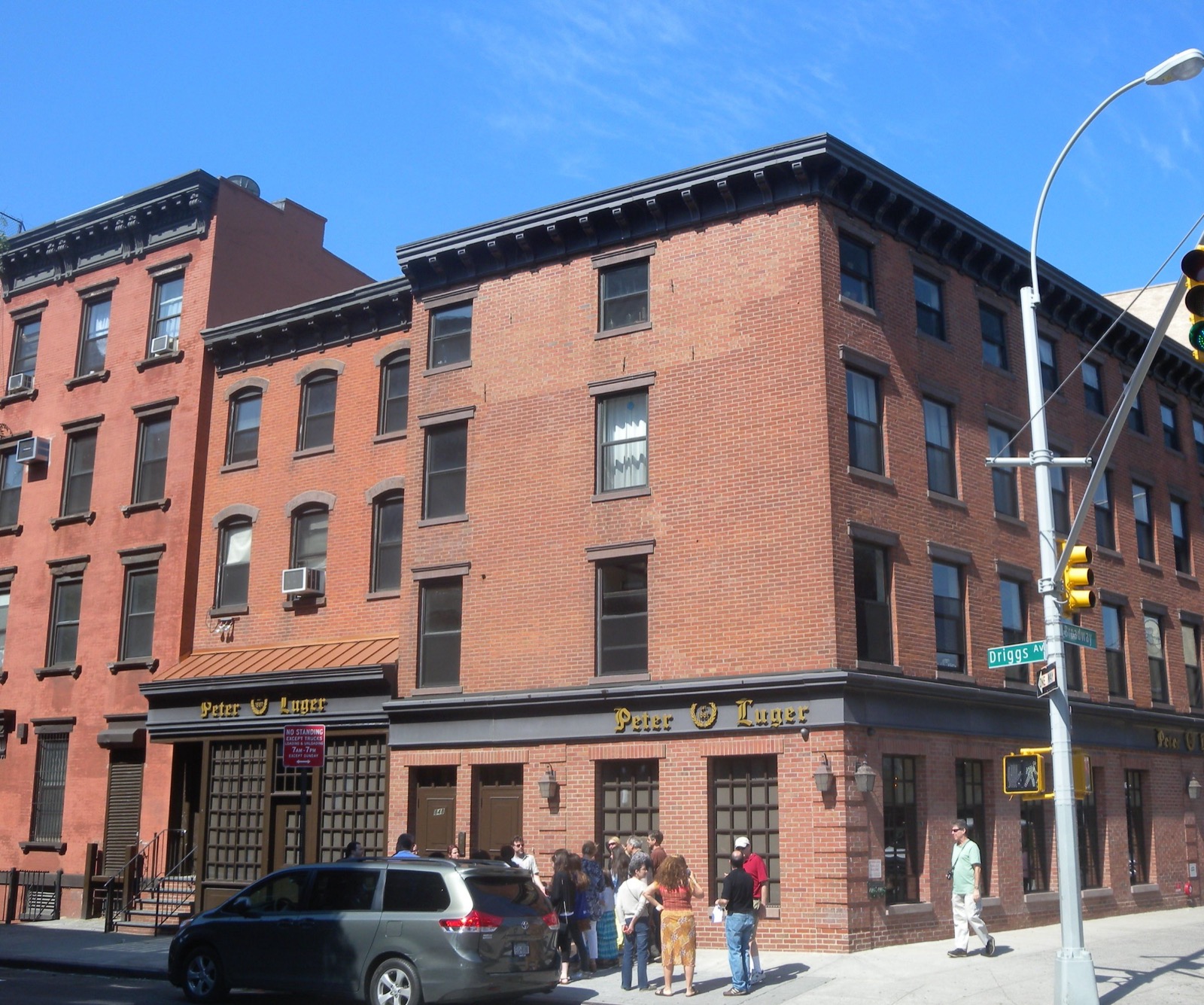
Peter Luger has been serving porterhouse at 178 Broadway since 1887
Before Williamsburg was famous for natural wine bars and tasting menus, it was famous for one restaurant. Carl Luger opened his Cafe, Billiards and Bowling Alley at 178 Broadway in 1887, in what was then a German neighborhood. When the founding family died out and the restaurant went to auction in 1950, Sol Forman, who owned a metal giftware factory across the street and had been eating lunch there for 25 years, bought it for 35,000 dollars. His wife Marsha took over the critical job of inspecting and purchasing meat.
The restaurant has operated under the Forman family ever since. It is cash only, famously brusque in service, and consistently ranked among the best steakhouses in the world. The porterhouse for two is the reason people make the trip. Peter Luger has a Michelin star and a reputation that has survived 138 years of neighborhood transformation around it.
The broader food scene caught up in the 2010s and has not slowed down. Lilia, chef Missy Robbins’s Italian restaurant on Union Avenue, was one of the hardest reservations in New York for years. Aska at 47 South 5th Street holds two Michelin stars for a Nordic tasting menu at 325 dollars per person. The Four Horsemen on Grand Street, co-owned by LCD Soundsystem’s James Murphy, carries a Michelin star and has an extraordinary natural wine list. L’Industrie on South 2nd Street produces a Roman-style thin crust pizza that multiple critics have called the city’s best.
Your Saturday belongs at one of these tables, not wiping down kitchen counters. That is the simple math of living in one of the most competitive dining neighborhoods in the country. A biweekly apartment cleaning handles the routine so your time goes where the neighborhood rewards it most.
The waterfront rezoning of 2005 turned 350 acres of industrial zoning into the most documented gentrification story in Brooklyn
On May 11, 2005, the New York City Council passed the large-scale rezoning of the North Side and Greenpoint waterfront. Three hundred fifty acres of industrial zoning became mixed-use residential, with requirements for public waterfront park space. In the four years immediately following, residential property values increased 175.8 percent, the largest percentage gain of any New York City neighborhood over that period.
Domino Park opened in 2018 on the five-acre site where refinery warehouses once stood. Designed by James Corner Field Operations, the park incorporates original sugar-processing equipment as public art installations, offers terraced lawns and an elevated walkway along the East River, and has become the neighborhood’s defining public space. The Refinery at Domino, the converted filter and finishing house designed by architect Morris Adjmi, opened in 2023 as a creative office complex that preserved the original vacuum pans, centrifugals, and filter presses as interior design elements.
The full Domino redevelopment is one of the largest adaptive reuse projects in New York City history. Two Trees Management bought the 11-acre site in 2012 for 185 million dollars and planned four residential towers alongside the office conversion and the park. The project eventually added over 2,800 apartments, 700 of them designated affordable. The landmark refinery building itself, with its Romanesque Revival brick arches and massive timber roof trusses, was too structurally compromised to convert to residential use, so the developers preserved the shell and built new interiors inside it. Walking through the lobby of the Refinery today you pass original cast iron columns and century-old brick walls that still smell faintly of molasses when the air is warm.
The luxury towers that rose along Kent Avenue after the rezoning present specific cleaning challenges that have nothing to do with history. Engineered stone countertops show every water ring. Floor-to-ceiling glass displays streaks visible from the street below. Matte-finish cabinetry fingerprints immediately. These buildings also require paperwork. COIs, service elevator reservations, advance-notice periods. Our dispatch team works with Williamsburg waterfront management offices regularly and handles all of it before the first visit.
The music scene that made this neighborhood famous is closing at the end of 2026
Artists arrived in the late 1980s, drawn by dirt-cheap rents in industrial lofts. A generation of interdisciplinary artists known as the Brooklyn Immersionists used warehouses, rooftops, and streets as canvases. By the mid-1990s, Williamsburg was the center of New York’s indie rock scene. Northsix opened on North 6th Street in 2001 as a 550-capacity venue and helped define the Brooklyn sound. It was renamed the Music Hall of Williamsburg in 2007 and operated by the Bowery Presents, hosting acts that grew into international touring artists.
The Music Hall’s lease expires at the end of 2026. It is one of the most prominent cultural institutions Williamsburg is about to lose, displaced by the same market forces its cultural identity helped create. Brooklyn Steel, which opened in 2017 at 319 Frost Street in a converted steel supply warehouse, partially fills the gap with a 1,800-capacity standing room that books mid-tier touring acts who have outgrown the 550-cap rooms but have not graduated to arenas. The venue’s industrial bones are still visible in the exposed steel beams and concrete floors that rumble underfoot during a packed show. It is owned by the same Bowery Presents group that runs the Music Hall, and when the Hall closes, Brooklyn Steel will be the last major live music room in the neighborhood.
National Sawdust, which opened in 2015 in a converted sawdust factory on North 6th Street, represents a different lineage entirely. Designed by Arup for acoustic precision, it commissions and presents new work across classical, jazz, electronic, and experimental genres.
Street art is woven through the fabric of the North Side. Bedford Avenue, Kent Avenue, North 6th Street between Kent and Bedford, and Wythe Avenue all carry a rotating gallery of murals, paste-ups, and spray work that survives the boutique turnover happening at street level. McCarren Park, 35 acres shared with Greenpoint to the north, anchors the neighborhood’s communal life. The WPA-era pool, originally built in 1936 and restored for 50 million dollars in 2012, is a summer institution. The Saturday farmers market is one of the best in North Brooklyn.
The L train is seven minutes to Union Square and it changed everything about who lives here
Bedford Avenue station on the L train is the first stop in Brooklyn from Manhattan. Seven minutes from Union Square. That single fact drove the entire transformation of North Williamsburg from industrial backwater to one of the most expensive rental markets in Brooklyn. The station itself has become a cultural landmark, the kind of place where you can measure the neighborhood’s temperature just by standing on the platform. Buskers play to a captive audience during rush hour. The stairwell exit at Bedford and North 7th dumps you directly into the commercial spine of the North Side, where the foot traffic is dense enough to support a retail corridor that stretches for blocks in every direction. On weekends the station handles over 20,000 riders, making it one of the busiest local stops in the outer boroughs. The L train was subject to a planned emergency shutdown in 2019 that was averted at the last minute, and partial weekend service suspensions in 2024 and 2025 for tunnel repair work temporarily complicated commutes.
Beyond the L, Williamsburg has the J, M, and Z trains at Marcy Avenue, Hewes Street, and Lorimer Street serving the southern and eastern sections. The G train reaches Lorimer Street and Metropolitan Avenue, connecting to Greenpoint and Long Island City without a Manhattan transfer. The NYC Ferry East River Route stops at both North and South Williamsburg. The Kent Avenue protected bike lane and Brooklyn Waterfront Greenway connect to Greenpoint to the north and DUMBO to the south. Walk scores in the core of the neighborhood run in the high 90s.
Our teams reach Williamsburg from across Brooklyn using these same transit lines. The constraint is not access. It is availability during peak moving season in the summer, when studios averaging 3,640 dollars a month and one-bedrooms pushing past 5,100 dollars turn over constantly. If you need a move-in or move-out cleaning, booking a few days ahead helps during June through September.
What booking looks like for Williamsburg residents
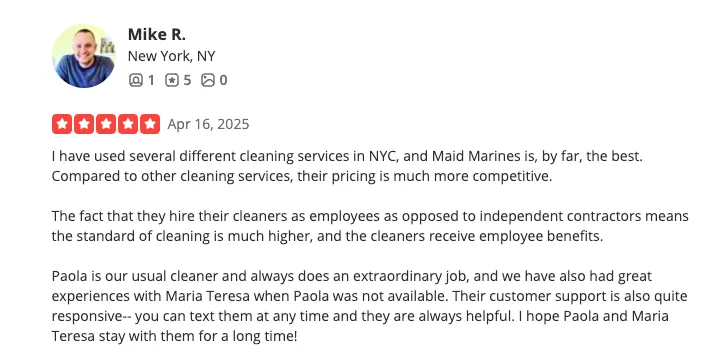
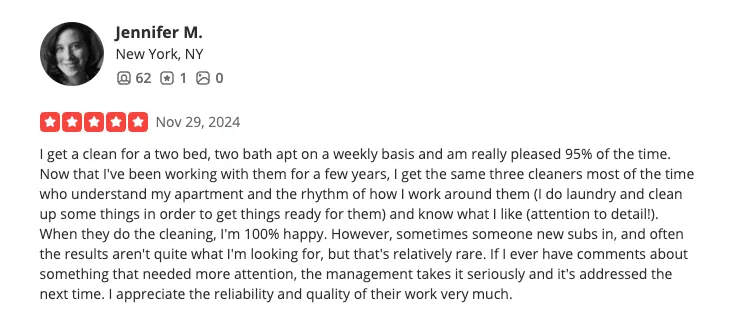
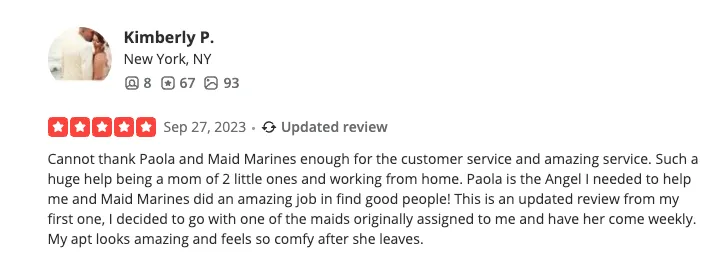
You pick your date and time on our booking page. You see your flat-rate price before you commit. If your building has COI requirements or service elevator rules, you tell us once and we handle it from there. Our cleaners are W-2 employees, not gig workers from a platform. They are vetted, insured, and they show up with everything they need.
If you are in a loft and want us to clean the overhead ductwork, we do that. If you are in a walkup and need someone willing to haul supplies up four flights, that is every visit for us. If you are in a waterfront tower and need a team that will not trigger a call from the front desk, we have done this enough times to know the protocol. If you are in South Williamsburg and need separate supplies for a kosher kitchen, we handle that without being asked twice.
Williamsburg residents also use us for recurring house cleaning and apartment cleaning on a schedule that works around their week. We serve nearby Greenpoint, Bushwick, DUMBO, and the rest of Brooklyn.