
The Upper West Side is the neighborhood New York City built when it decided that an entire residential district could be organized around the idea that life should contain books, good food, serious music, and a park on both sides. From West 59th Street to West 110th Street, between Central Park and the Hudson River, this 50-block stretch has spent 140 years refining what it means to live well in a city. The brownstone blocks look like movie sets because they are movie sets. The food institutions provoke arguments that last decades. The apartment buildings on Central Park West form what might be the most famous residential skyline on earth. And the residents, who have been arguing about all of it since before most of them were born, would not trade a single block for anywhere else in Manhattan.
This is the neighborhood of Zabar’s and the Dakota, of Leonard Bernstein and Nora Ephron, of the Museum of Natural History and Riverside Park. It is also, for our purposes, a neighborhood where the housing stock ranges from 1880s Queen Anne brownstones with irreplaceable hand-rubbed woodwork to 2020s glass-and-steel towers with engineered stone countertops, and every building requires a different cleaning approach. But before we get to mop buckets and pH-neutral solutions, the Upper West Side deserves the full story.
The neighborhood that started with a building so far north they named it after the frontier
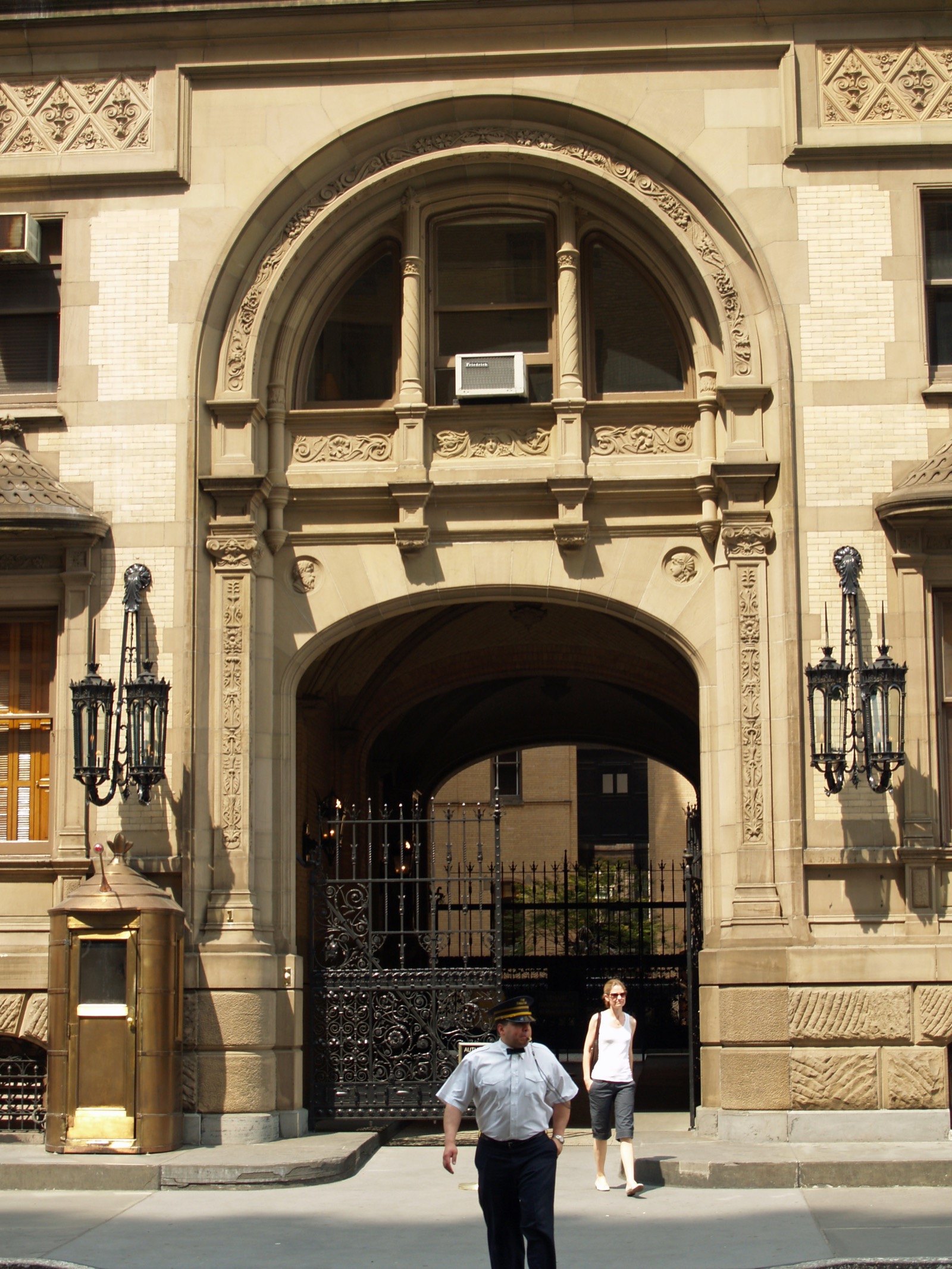
The Upper West Side’s transformation from farmland to one of the most desirable addresses in the Western world began with a single building. In 1884, developer Edward Clark opened the Dakota at 1 West 72nd Street, a massive German Renaissance Revival apartment house designed by Henry Hardenbergh. The building was so far north of settled Manhattan that wags said it might as well be in the Dakota Territory. Clark had made his fortune as president of the Singer Sewing Machine Company, and he spent it proving that New Yorkers would pay for the luxury of apartment living if the apartments were grand enough. Yellow brick with gabled dormers, terra-cotta ornament, a central courtyard, and rooms large enough to accommodate the furniture of people who had previously lived in townhouses. The gamble worked. The Dakota became the most famous apartment building in Manhattan and opened a real estate gold rush that has not stopped since.
Before Clark and Hardenbergh, the area was open country. The Lenape had occupied this land for centuries before Dutch colonists established farms along what they called Bloomingdale Road, the path that eventually became Broadway. The Bloomingdale Insane Asylum occupied a large campus west of the future Central Park from 1821 to 1892. The rolling terrain was described in contemporary accounts as a pleasant country drive north of the city. When Central Park opened incrementally between 1858 and 1876, it transformed the neighborhood’s eastern edge into some of the most valuable real estate frontage in the world. Developers recognized an opportunity that required only one thing: proof that people would actually live up here.
The Dakota was that proof.
Five decades of architects competing to build the grandest apartment house in New York
What followed the Dakota was one of the most concentrated building campaigns in American residential history. The Elevated rail along Broadway and the 1904 opening of the IRT subway’s West Side line made the neighborhood accessible to working professionals. The side streets filled with brownstone rows in Queen Anne, Romanesque Revival, and Neo-Grec styles. The avenues and Central Park West attracted larger and more elaborate apartment buildings, each one attempting to outdo the last.
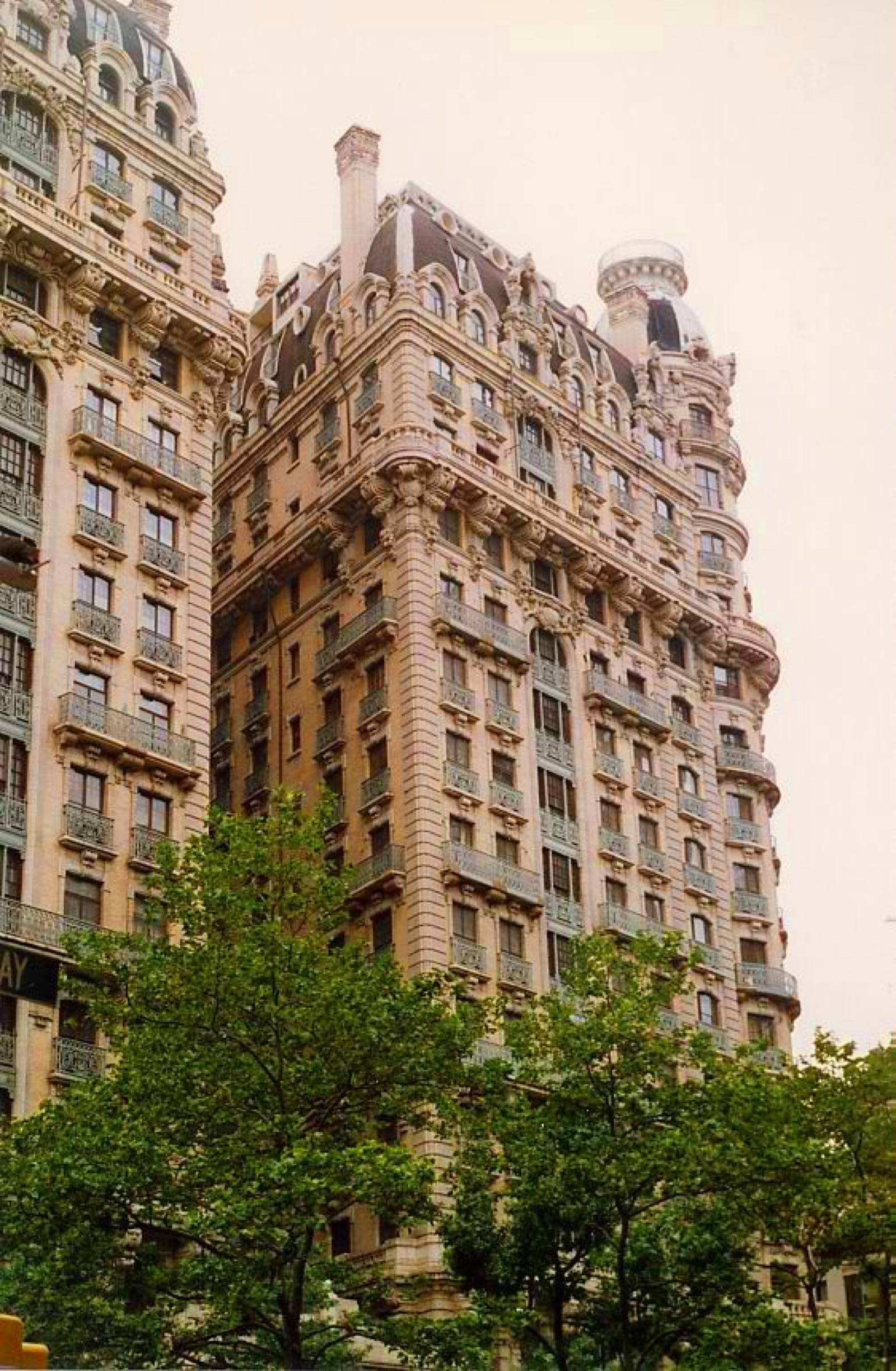
The Ansonia at 2109 Broadway arrived in 1904, designed by Paul Duboy as a Beaux-Arts residential hotel of almost absurd ambition. Developer W.E.D. Stokes envisioned a self-sufficient utopian residence. The building had a rooftop farm with 500 chickens that delivered fresh eggs to tenants. A seal lived in the lobby fountain until neighbors complained and it was donated to the Central Park Zoo. The walls were built so thick that the building became legendary for its soundproofing, which made it the preferred residence of musicians. Enrico Caruso practiced opera there. Igor Stravinsky composed there. Babe Ruth moved in when the Yankees bought him from the Red Sox in January 1920 and lived through much of the decade on the upper floors. In a darker footnote, the meeting where first baseman Chick Gandil arranged with gamblers to fix the 1919 World Series reportedly took place inside the Ansonia, setting in motion the Black Sox scandal that nearly destroyed professional baseball.
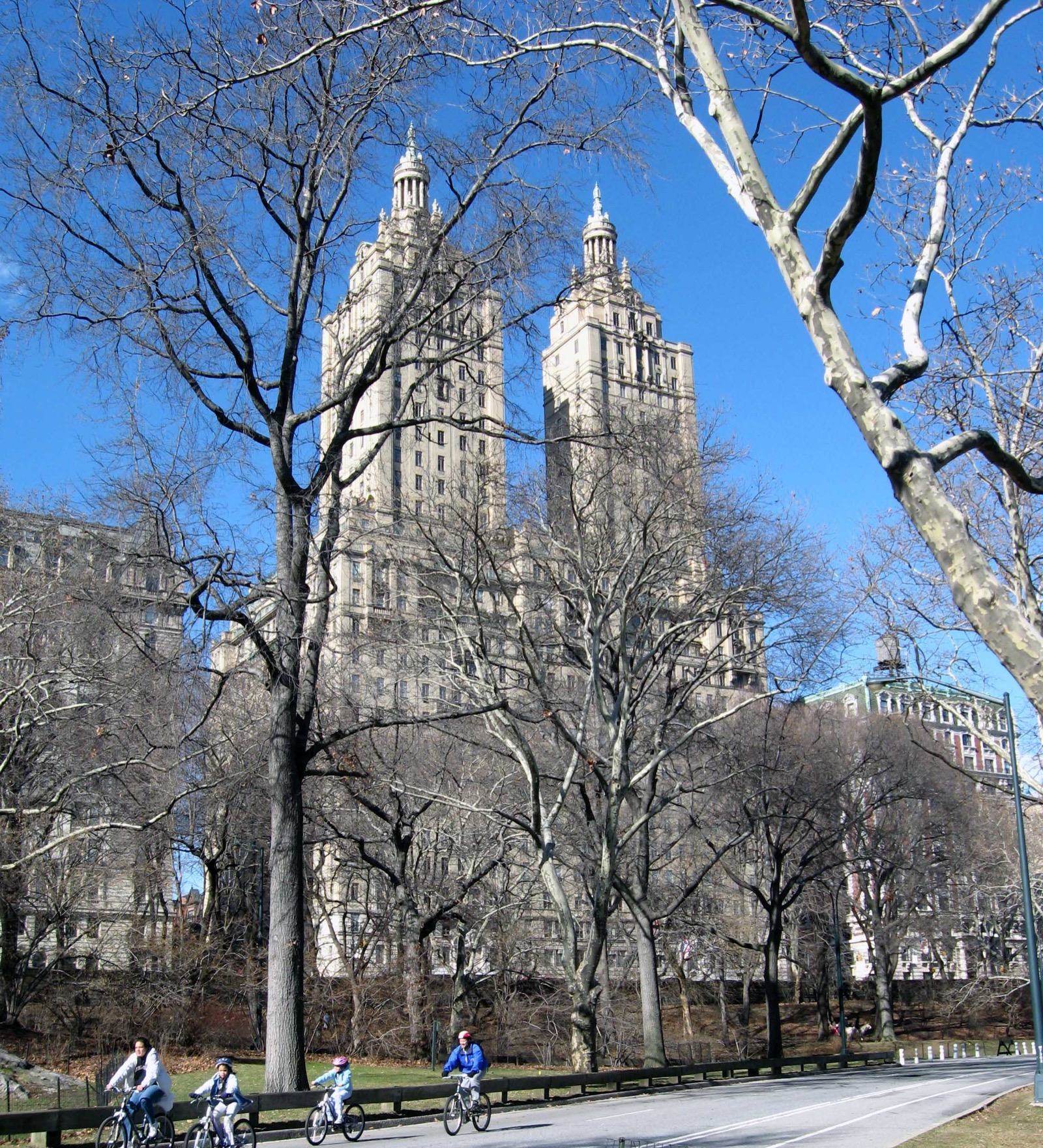
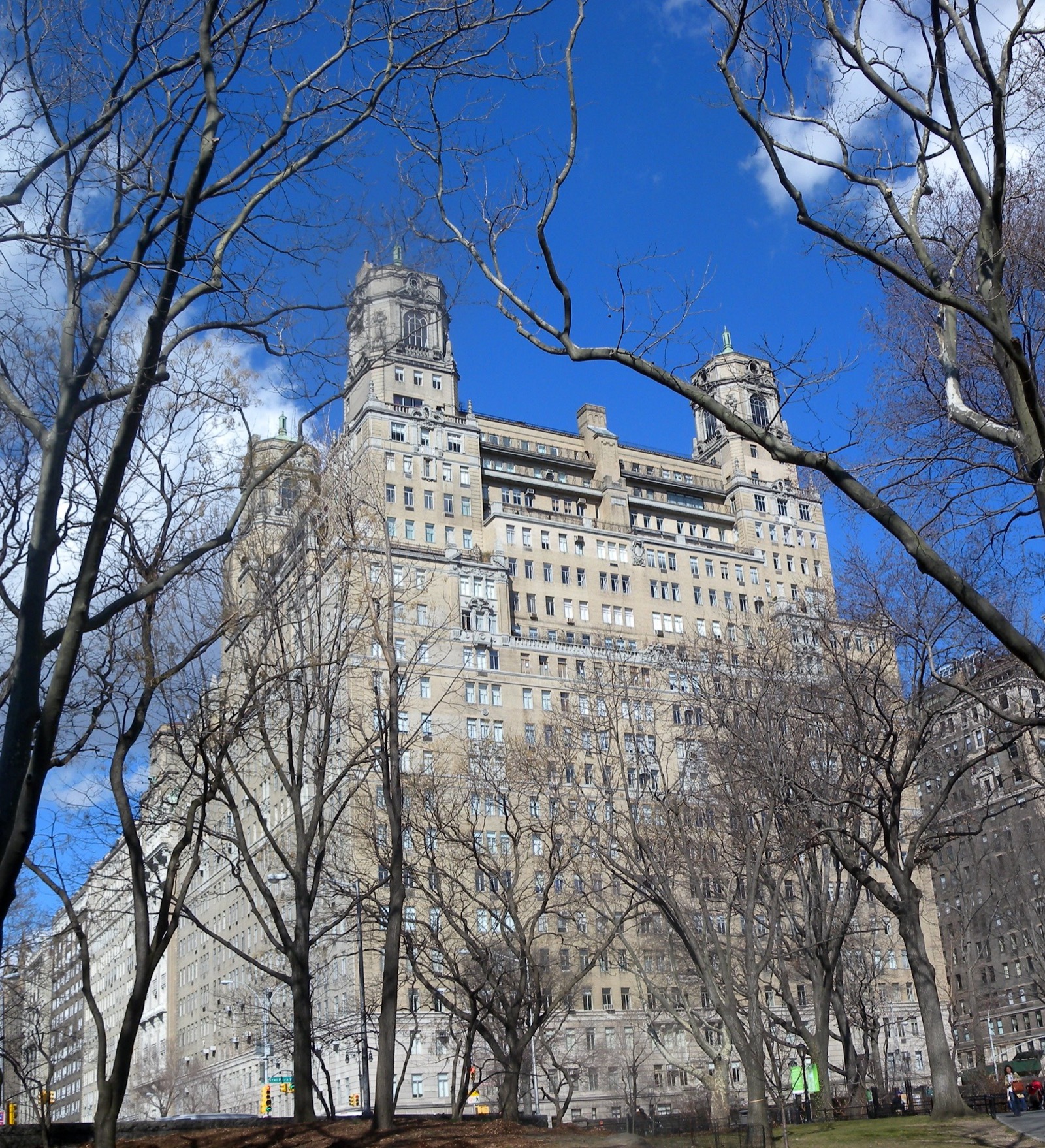
Emery Roth, the architect who would define Central Park West’s skyline more than any other individual, completed the Beresford at 211 Central Park West in 1929 and the San Remo at 145-146 Central Park West in 1930. The Beresford has three towers. The San Remo has twin towers that became the most recognizable residential silhouette in New York. Both are Renaissance Revival cooperatives that have housed some of the most famous people in the city. Jerry Seinfeld lives at the Beresford. Steve Martin and Dustin Hoffman have lived at the San Remo. Diane Keaton, Demi Moore, Bono, and Tiger Woods have all held apartments there.
The Apthorp at 2211 Broadway, designed by Clinton and Russell in 1908 for William Waldorf Astor, occupies a full city block between West 78th and 79th Streets and was modeled on the Palazzo Pitti in Florence. Nora Ephron lived there. So did Al Pacino, Rosie O’Donnell, and Conan O’Brien. The Belnord at 225 West 86th Street, designed by Hiss and Weekes in 1909, is another full-block palazzo and one of the largest apartment buildings ever built in New York. The Dorilton at 171 West 71st Street, completed in 1902, was described by the New York Times as “the strangest and most magnificent apartment house in the world,” and its French Baroque entrance remains one of the most photographed doorways on the West Side.
And then there is Pomander Walk, hidden between 94th and 95th Streets off Broadway. Developer Thomas Healy built a cluster of Tudor-style cottages in 1921 as a temporary investment while he tried to raise money for a hotel on the site. He died in 1927 before financing the hotel. The “temporary” cottages have stood for over a century, are now a designated New York City Landmark, and remain one of the most improbable residential addresses in Manhattan. Rosalind Russell, Paulette Goddard, and Nancy Carroll all lived in this gated lane that most New Yorkers do not know exists.
The writers and musicians who gave the Upper West Side its personality
A neighborhood’s character comes from its buildings, but its personality comes from the people who choose to live there. The Upper West Side has attracted, since the 1950s, a specific type of New Yorker: educated, politically engaged, culturally serious, and opinionated about everything from bagels to foreign policy. The concentration of intellectuals, artists, and writers who settled between Central Park and the Hudson River over the past seven decades created a neighborhood identity that persists through every market cycle.
Leonard Bernstein, conductor of the New York Philharmonic and composer of West Side Story, was the quintessential Upper West Sider. He lived in the neighborhood for decades and was instrumental in the founding of Lincoln Center, the performing arts complex that anchors the southern end of the UWS. West Side Story itself drew its setting from San Juan Hill, the neighborhood that was demolished to build Lincoln Center in the late 1950s and early 1960s. That community, a nexus of African American and Caribbean culture that had nurtured jazz musicians like Benny Carter and pianist Herbie Nichols, was razed under Robert Moses’ urban renewal programs. The neighborhood that was called the birthplace of the Charleston and Bebop was replaced by the Metropolitan Opera, the New York Philharmonic, and the New York City Ballet. It is one of the Upper West Side’s most complicated legacies.
Isaac Bashevis Singer, the Nobel Prize-winning Yiddish author, lived on West 86th Street and specifically mentioned the Upper West Side in his 1978 Nobel acceptance speech, describing it as one of the places where Yiddish literature survived the Holocaust and found new life. Philip Roth was a longtime West Side resident. Susan Sontag lived here. Hannah Arendt, the political philosopher, lived and died on Riverside Drive. Nora Ephron, whose films When Harry Met Sally and You’ve Got Mail are practically Upper West Side tourism advertisements, lived at the Apthorp. Edgar Allan Poe resided with his family at the Brennan Farmhouse on West 84th Street, where in 1844 he finished “The Raven,” having fled the inflated rents of the Washington Square area. Even in the 1840s, the Upper West Side was where you moved when downtown got too expensive.
John Lennon moved into the Dakota in 1973 with Yoko Ono and lived there until the evening of December 8, 1980, when he was shot by Mark David Chapman just 50 feet from the building’s entrance archway. He had signed an autograph for Chapman hours earlier. The vigil outside the Dakota began that night and has never completely ended. Yoko Ono still lives in the building. Across Central Park West, the 2.5-acre Strawberry Fields memorial contains the “Imagine” mosaic that draws visitors from around the world. Lauren Bacall and Judy Garland also lived at the Dakota. The building itself was nearly demolished in 1961, before New York’s Landmarks Preservation Commission existed. The campaign to save it helped build the public support that led to the landmarks law passed in 1965, four years before the Dakota received its official designation.
Brownstone blocks that nearly vanished and the preservationists who saved them
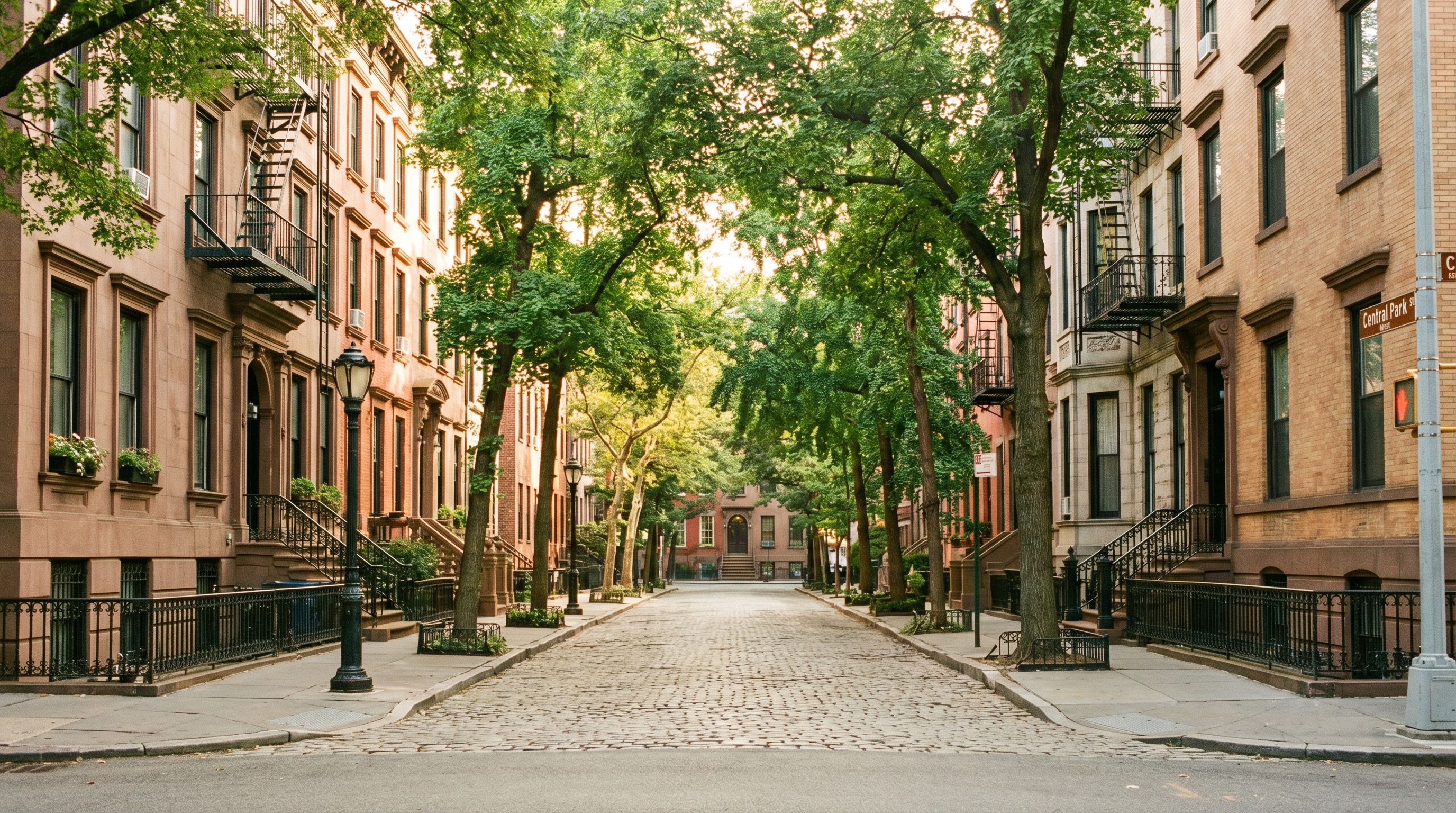
The brownstone-lined side streets of the Upper West Side, particularly along West 76th, 78th, and 80th Streets between Columbus and West End Avenues, contain some of the finest intact Victorian residential architecture in the United States. Queen Anne, Romanesque Revival, and Neo-Grec rowhouses from the 1880s and 1890s, four stories tall with original stoops, ironwork, and interior woodwork. These blocks are what most people picture when they think of residential New York.
They almost did not survive. Urban renewal plans in the 1950s and early 1960s called for demolishing large sections of the brownstone stock to build modern apartment towers. Community organizing, combined with the eventual passage of the Landmarks Preservation Law in 1965, saved the streetscapes. The Upper West Side Historic District now protects many of these blocks, ensuring that the carved sandstone facades, turned balusters, and hand-rubbed oak floors will remain for future generations.
Protecting these surfaces is a daily practice, not just a legal designation. The original shellac finishes on herringbone parquet floors will cloud if exposed to water-based cleaners. Hand-carved plaster crown molding at ten-foot ceilings requires careful dusting, not aggressive scrubbing. The hex mosaic bathroom tile in buildings from the 1890s has century-old grout that stains permanently with bleach. And every floor of a four-story brownstone typically has different materials: wide-plank oak on the parlor level, flagstone or brick in the garden kitchen, refinished pine in the upper bedrooms, and a staircase with turned balusters and a handrail that shows every fingerprint.
This is where preservation meets house cleaning. Our teams work these brownstone blocks regularly, switching products as they move between levels, treating each floor according to what is actually underfoot. A mistake on irreplaceable 1880s woodwork is not something a second pass can fix. We carry pH-neutral floor solutions, microfiber-only tools for delicate surfaces, and the awareness that a brownstone on West 76th is not the same job as a condo at 200 Amsterdam.
Central Park West co-ops and the buildings that define a skyline
The stretch of Central Park West from Columbus Circle to 110th Street is lined with what many architectural critics consider the most magnificent residential frontage in the world. The Dakota, the San Remo, the Beresford, the Eldorado at 300 Central Park West, the twin Art Deco towers reaching 27 stories. These are Emery Roth and Henry Hardenbergh buildings from the 1880s through the 1930s, built with materials and craftsmanship that modern construction does not replicate.
The apartments inside are equally particular. Herringbone parquet or wide-plank oak floors, sometimes with original shellac finishes. Crown molding that is hand-carved plaster, not polyurethane. Kitchens renovated anywhere from zero to four times across a century, which means you might encounter marble, butcher block, soapstone, and laminate in the same building. Cast-iron radiators connected to steam heat systems that trap a summer’s worth of dust between the fins and burn it off in October, filling the apartment with a scorched smell that persists until someone cleans them properly.
Most Central Park West co-ops require 48 hours advance notice for any service provider. Some require a Certificate of Insurance naming the building as additional insured. A few of the older prestige buildings require both, plus a signed vendor agreement and a management-office walk-through on the first visit. When you book your cleaning, tell us your building name and address. Our dispatch team coordinates with the management office directly. COI, service elevator scheduling, advance notice windows. We work with UWS buildings regularly and know what most of them require before we call.
A food culture worth protecting your Saturday mornings for
The Upper West Side’s food institutions are not restaurants that opened last year. They are generational anchors that have shaped how this neighborhood eats, shops, and argues about what constitutes a proper bagel.
Zabar’s at 2245 Broadway and 80th Street has been the platonic ideal of a New York food emporium since 1934. Smoked salmon, sturgeon, sable, whitefish, every cheese, prepared foods, and the kitchen equipment floor where, in the late 1960s, founder Louis Zabar became the first retailer in America to import European drip coffee makers. That single purchasing decision helped launch the specialty coffee movement in the United States. Barney Greengrass at 541 Amsterdam, the self-proclaimed Sturgeon King since 1908, is a diner-style counter where the neighborhood gathers on Saturday mornings for lox and eggs and conversation that has not changed in character for a century.
Per Se at 10 Columbus Circle is Thomas Keller’s three-Michelin-star restaurant overlooking Central Park, among the most celebrated in the United States. Jean-Georges Vongerichten’s flagship French-Asian restaurant occupies the ground floor of 1 Central Park West. Levain Bakery at 167 West 74th Street sells a 6-ounce chocolate chip walnut cookie that has achieved the kind of cult following usually reserved for musicians.
The Beacon Theatre at 2124 Broadway, designed by Walter Ahlschlager and opened by Roxy Rothafel in 1929, brings live music and comedy to the neighborhood from a Rococo and Greek Revival interior listed on the National Register of Historic Places. Symphony Space at 96th and Broadway puts on Off-Broadway plays, comedy, and dance performances. The New-York Historical Society at 170 Central Park West, founded in 1804, is the oldest museum in New York City and sits right next door to the American Museum of Natural History, which houses 32 million specimens in a building complex that covers four city blocks. Only about 2 to 3 percent of that collection is on display at any given time.
Your Saturday belongs at Zabar’s counter or inside the Rose Center planetarium or walking Riverside Park along the Hudson, not scrubbing radiator fins or mopping four flights of brownstone stairs. That is what we are here for. Our teams handle the apartment cleaning and the deep cleaning so that your weekends belong to the neighborhood you chose to live in.
Riverside Park and the monuments along the Hudson
Riverside Park, designed by Frederick Law Olmsted beginning in 1875, runs four miles along the Hudson River from 59th Street to 158th Street. For Upper West Siders, it functions as the neighborhood’s second park, quieter and less crowded than Central Park, with the river always in view.
The Soldiers and Sailors Monument at West 89th Street, a white marble Civil War memorial inspired by the Choragic Monument of Lysicrates in Athens, was unveiled on Decoration Day in 1902. Twelve Corinthian columns ring a rusticated cylinder, and the plinths at the entrance are inscribed with the names of New York volunteer regiments and the battles they fought. At West 93rd Street, the Joan of Arc equestrian statue by sculptor Anna Hyatt Huntington was dedicated in 1915, making it the first public monument in New York City honoring a historical woman. Limestone blocks from the actual tower where Joan was imprisoned in Rouen are embedded in the granite base.
The 79th Street Boat Basin, completed in 1937 as part of Robert Moses’ West Side Improvement Project, provides one of the few places in Manhattan where people can live year-round on the water. Houseboats line the marina, and the rotunda structure above, designed by Gilmore David Clarke, offers one of the most underrated views in the city.
What makes Upper West Side cleaning different from anywhere else in Manhattan
The Upper West Side has the most architecturally varied residential stock in Manhattan, and every variation creates a different cleaning challenge. A pre-war co-op on Central Park West has plaster crown molding at ten-foot ceilings, herringbone parquet floors, and radiators that require specialized brushes. A brownstone three blocks west has four stories of different surfaces, no elevator, and original woodwork that will not forgive the wrong product. A new condo at 200 Amsterdam has engineered stone countertops and floor-to-ceiling glass overlooking the park.
These are not the same cleaning job. They require different products, different tools, and different awareness of what can go wrong.
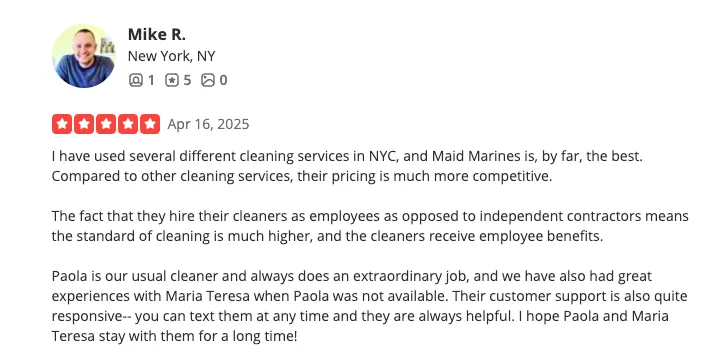
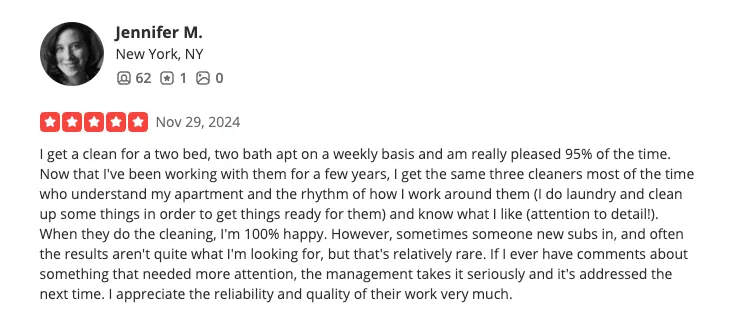
Our cleaners are W-2 employees, not contractors from a gig platform. They are vetted, insured, and they bring everything they need. If you are in a pre-war co-op and want the radiator covers and vent grilles dusted properly every visit, that is standard for us. If you are in a brownstone and need each level treated as its own job, we already do that. If you are in a newer condo where the main concern is streak-free glass and engineered stone care, we have the right products for those surfaces.
Upper West Side residents also use us for move-in and move-out cleaning during the neighborhood’s active co-op and rental turnover season and recurring cleaning on whatever schedule fits your household.
The neighborhood where getting it right matters more than getting it done
The Upper West Side is a neighborhood of people who have strong opinions about everything and the education to back those opinions up. It has the highest rate of graduate and professional degree holders of almost any residential neighborhood in the United States. The residents subscribe to three magazines and read them all. They know what pH-neutral means. They know the difference between shellac and polyurethane. They will notice if you use the wrong product on their 1890s parquet floors.
That level of attention is what we bring to every appointment. You pick your date and time on our booking page. You see your flat-rate price before you commit to anything. If your building has specific access requirements, you tell us once and we handle it every time after that.
The Upper West Side has been refining what good residential life looks like for 140 years. We think the cleaning should match.
We also serve the Upper East Side, Hell’s Kitchen, and the rest of Manhattan.