
More than half the residential buildings in Bensonhurst were standing before the United States entered World War II. That statistic places this neighborhood in the top four percent of all American neighborhoods for concentration of historic housing stock, and it shapes everything about what happens inside these homes today. The brick rowhouses that line the blocks between 18th Avenue and Bay Parkway have survived four generations of families, two complete demographic transformations, and the kind of daily cooking that turns kitchens into grease-management challenges no apartment cleaning service in Manhattan has ever encountered. This is a neighborhood where the surfaces tell the story, and where the cleaning has to match.
The Dutch began farming this land in 1652 and left behind a church that still holds services
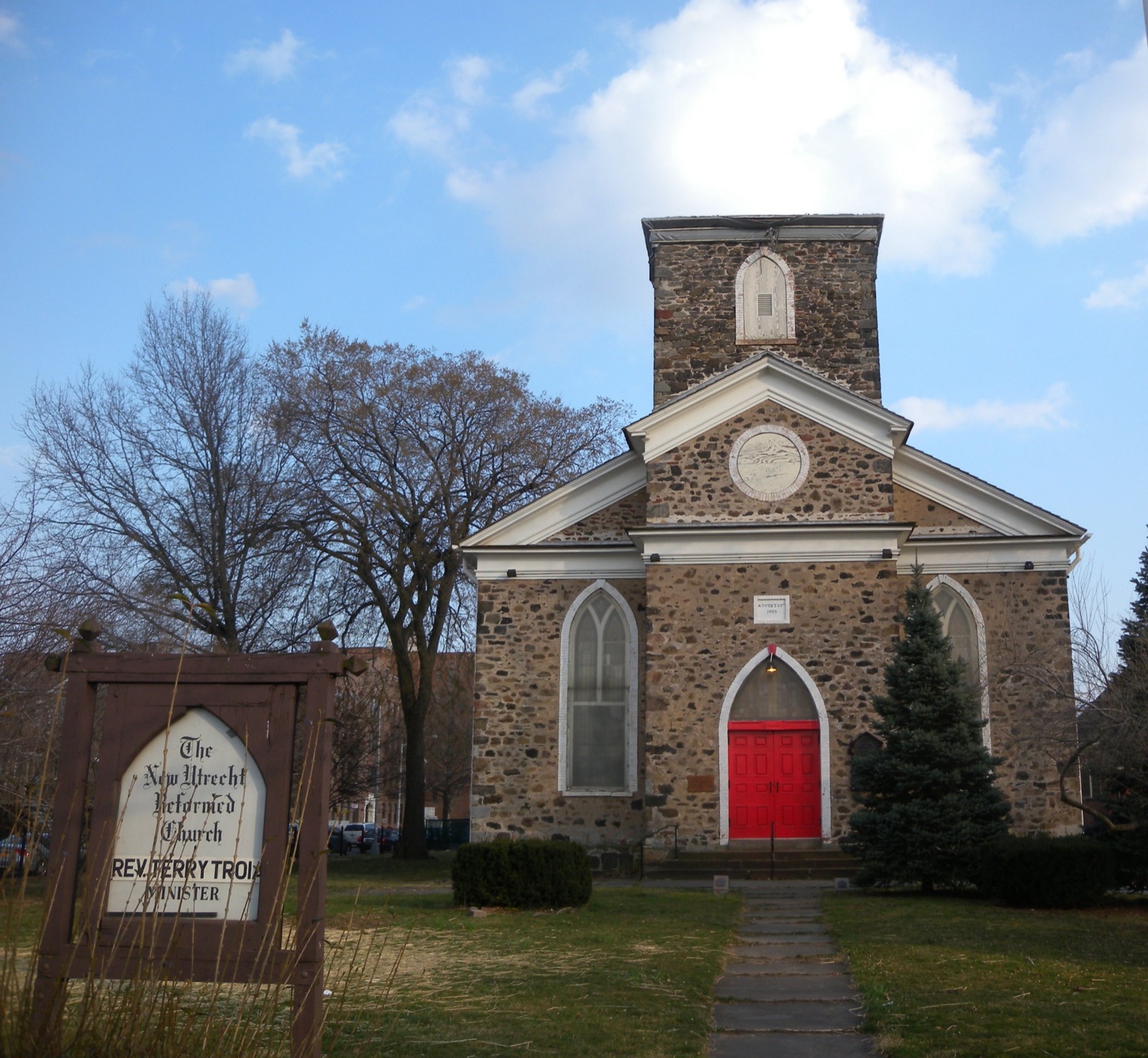
Before Bensonhurst was Bensonhurst, it was the Town of New Utrecht, one of the six original towns of Kings County established by Dutch colonists who saw flat fertile land near the harbor and decided to stay. They built farms. They buried their dead in a cemetery organized around 1653, which makes it one of the oldest continuously maintained burial grounds anywhere in New York City. They established the New Utrecht Reformed Church in 1677, and the fourth building on that site, constructed in 1828 using stones from its predecessors and ballast stones carried from Holland in the hulls of sailing ships, still stands at 84th Street and 18th Avenue.
The New York City Landmarks Preservation Commission designated this church as one of its very first official landmarks in 1966. The cemetery predates the Declaration of Independence by 123 years. And both still function. The church still holds services. The cemetery still stands. The Liberty Pole on the grounds commemorates the neighborhood’s role in the American Revolution.
This is the deep foundation underneath the neighborhood’s working-class present. Most residents walking past the church on their way to the N train probably do not think about Dutch colonial history, but the stones are right there on the corner, the same stones that crossed the Atlantic when New York was still New Amsterdam.
The Italians arrived from the Mezzogiorno and made 18th Avenue their main street
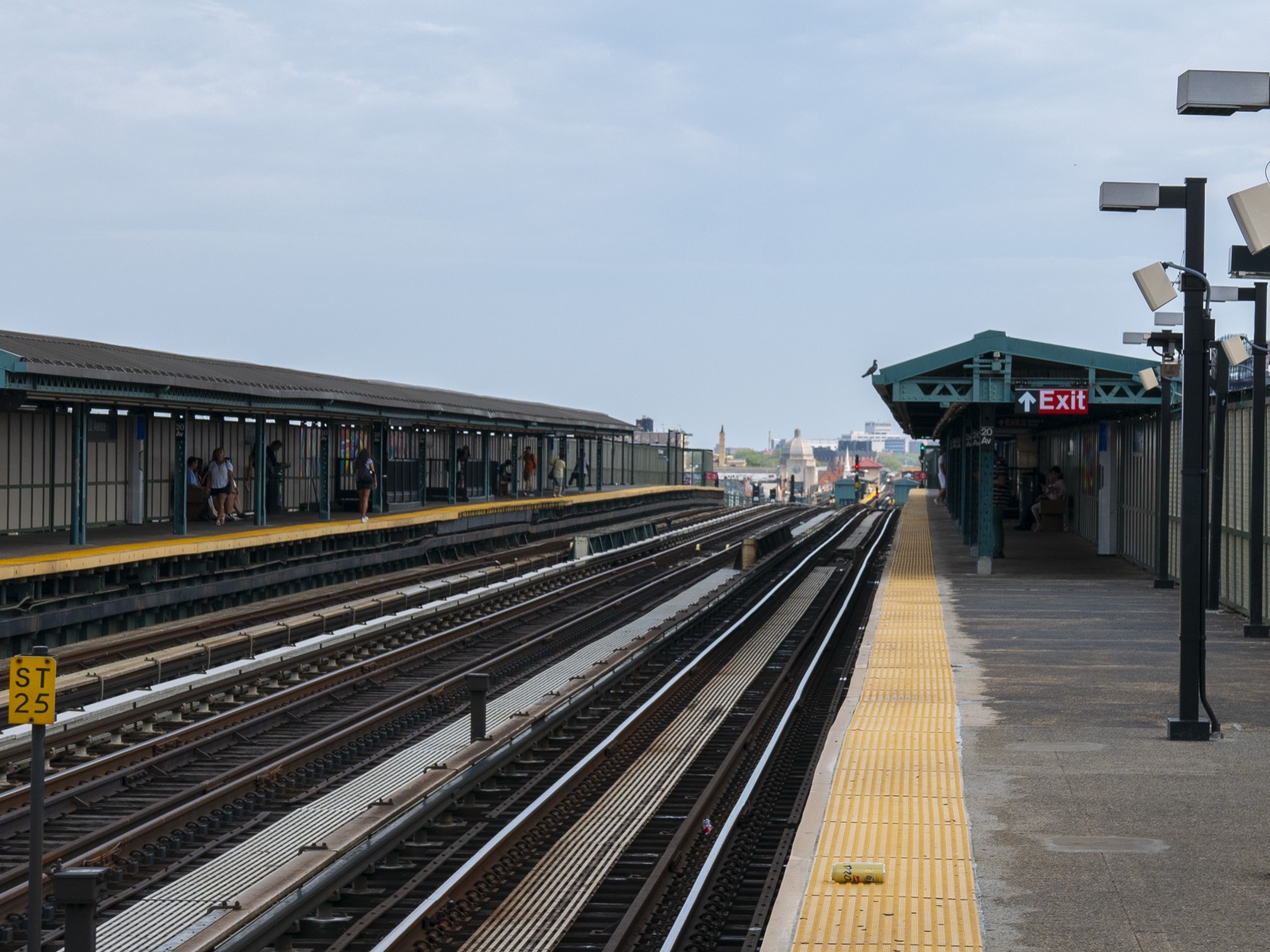
The railroad suburb phase came first. The Brooklyn, Bath and Coney Island Railroad arrived in 1862, eventually becoming the elevated BMT West End Line that still runs above 86th Street today as the D train. The connection to downtown Brooklyn and Coney Island turned farmland into row after row of attached brick homes, filling with Irish and German immigrants first, then the wave that would define the neighborhood for the next century.
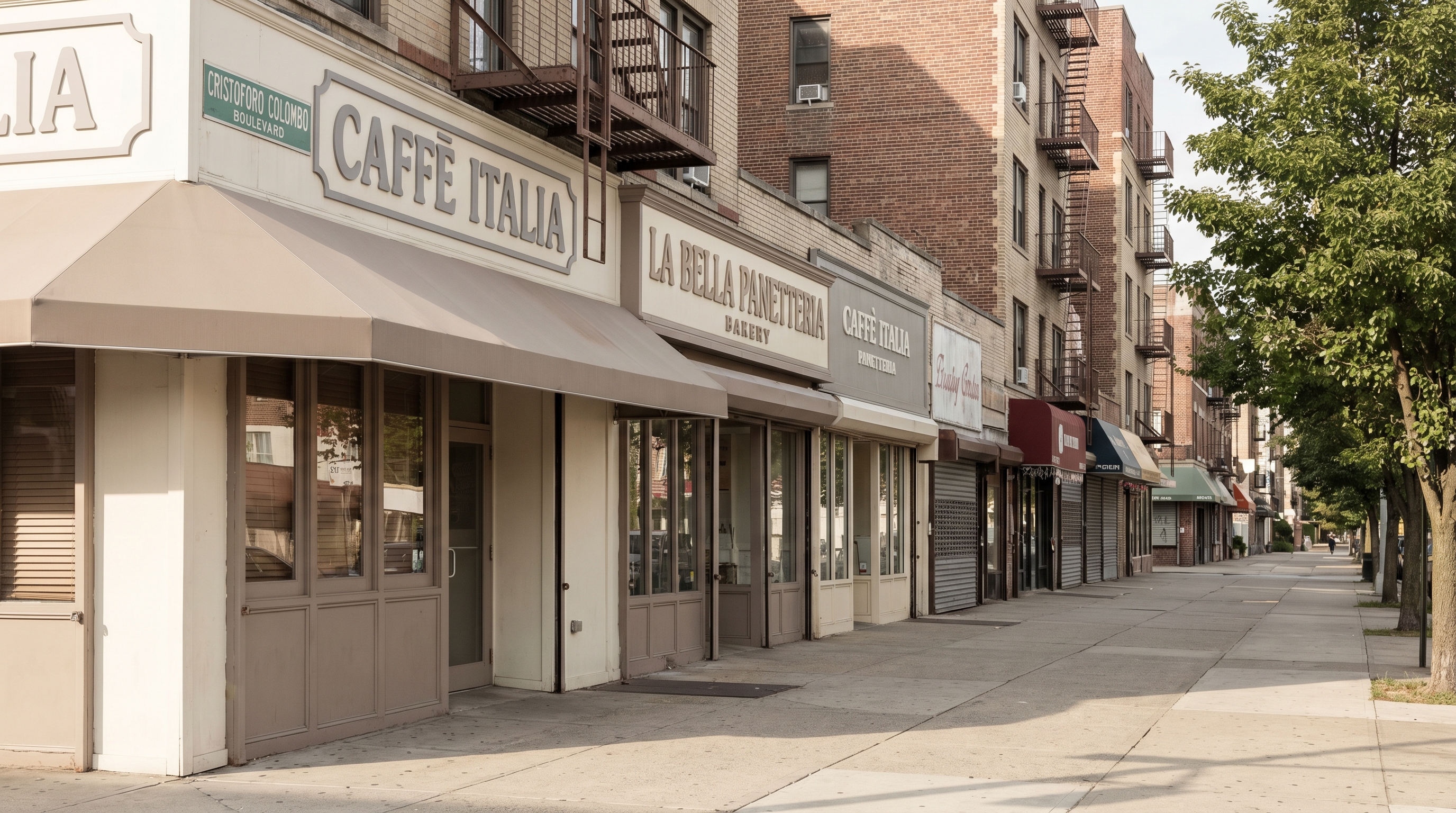
Southern Italians and Sicilians began arriving in the 1900s and 1910s, families from Naples, Calabria, and Palermo who had first landed on the Lower East Side or in East Harlem and were spreading outward to the boroughs in search of space and air. They found both in Bensonhurst. By the 1920s, the neighborhood was one of the largest Italian-American communities in the United States, rivaling East Harlem itself in population density. Italian was the dominant language on every sidewalk. Parish churches anchored each cluster of blocks. And 18th Avenue, which the city would eventually co-name Cristoforo Colombo Boulevard, became the commercial and social heart of everything.
The institutions built during this era still operate. Villabate Alba, the Sicilian pastry shop on 18th Avenue, still makes cassata and sfogliatelle by hand. The pork stores and delis that supplied Sunday dinner for three generations of families are still there. The Feast of Santa Rosalia, honoring the patron saint who saved Palermo from plague in 1624, has run on 18th Avenue for over fifty consecutive years, eleven nights of sausage-and-pepper stands, carnival rides, live bands, and religious procession.
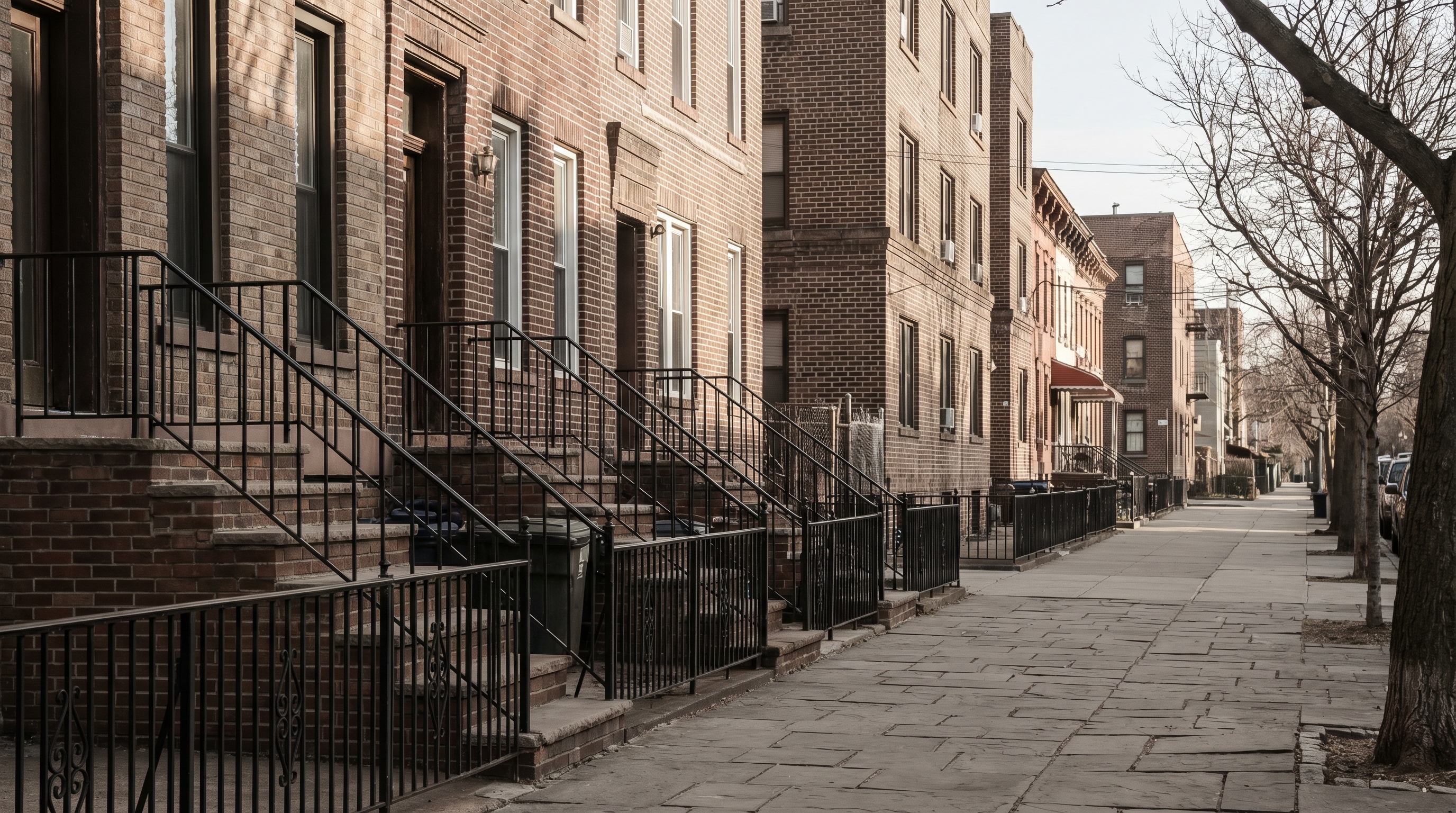
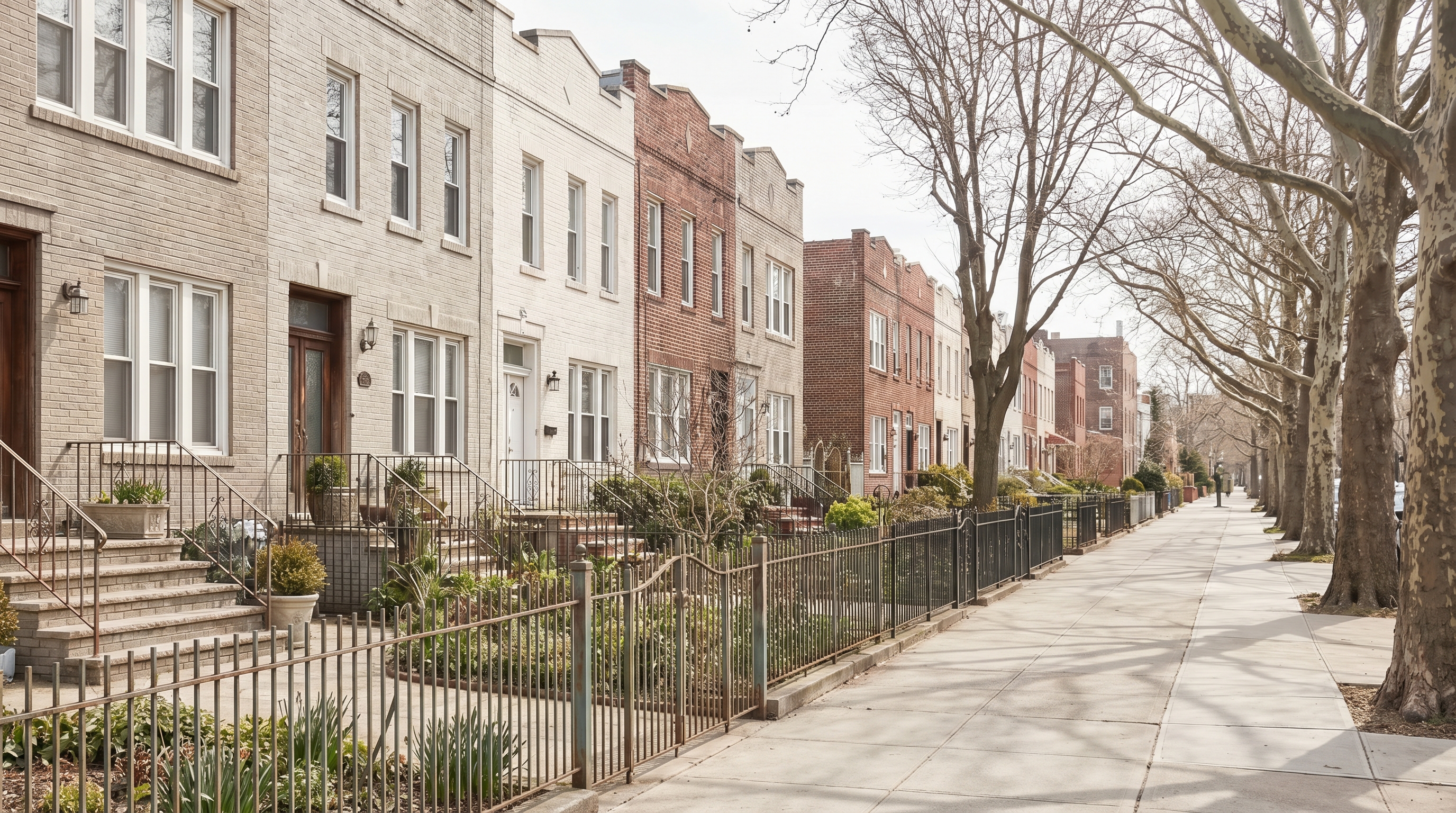
The homes these families built and maintained are the homes that still stand on every block. Two- and three-story attached brick rowhouses, narrow lots, small front yards, stoops, basement apartments. Brick facades with Italianate bracketed cornices. Stucco-covered exteriors with decorative tile work. The street rhythm is continuous and unbroken for miles. The original hardwood floors inside these homes, laid in the 1920s and 1930s, have been walked on by four generations. They have been refinished once or twice. They need a pH-neutral cleaner and a flat microfiber mop, not a bucket of soapy water. Our house cleaning teams know this because they clean Bensonhurst rowhouses every week, and they switch products as they move between the parlor floor hardwood, the kitchen ceramic tile, and the vinyl or concrete in the finished basement below.
Saturday Night Fever opened with Tony Manero walking down 86th Street buying pizza
The 1977 film that turned John Travolta into a global star was shot entirely on location in southern Brooklyn, and its opening scene takes place on 86th Street in Bensonhurst. Tony Manero struts beneath the elevated train tracks, buys a double-decker pizza slice at Lenny’s Pizza at 1969 86th Street near 20th Avenue, and carries it down the sidewalk. The rehearsal scenes were filmed at Phillips School of Dancing at Bay Parkway. The film captured something real about working-class Italian Brooklyn in the late 1970s, the restlessness and style and energy of young people in a neighborhood that felt simultaneously like home and like a cage.
The film came out during the neighborhood’s peak Italian period, when the population was overwhelmingly southern Italian and Sicilian, when the social clubs on every block were still packed on Friday nights, when the neighborhood’s reputation for insularity was both deserved and self-reinforcing.
Carl Sagan asked for a book about stars at the New Utrecht Library and became the voice of the cosmos
Carl Sagan was born on November 9, 1934, on Bay 37th Street and grew up along Bay Parkway. When he was five years old, his mother gave him his first library card. He walked alone to the New Utrecht branch of the public library, the same building that still stands on 86th Street, and asked the librarian for a book about stars. What he learned that afternoon, that the Sun was a star and the stars were suns, just impossibly far away, changed the trajectory of his life and eventually the trajectory of American science education.
Sagan credits Bensonhurst with something essential. He grew up in a working-class family, his father a garment worker from what is now Ukraine, his mother from New York. The neighborhood gave him a public library, public schools, and the freedom to walk around and wonder. He went on to write Cosmos, host the television series that introduced millions of Americans to astrophysics, and become the most famous science communicator of his generation.
Anthony Fauci was born on Christmas Eve 1940 in the same neighborhood and became the most recognized public health official in American history during the COVID-19 pandemic. Larry King grew up in a Bensonhurst walkup after his father died, attended Lafayette High School at 2630 Benson Avenue, and became a broadcasting legend. Sandy Koufax, widely considered the greatest left-handed pitcher in baseball history, grew up here and also attended Lafayette. The Three Stooges, Moe, Shemp, and Curly Howard, were raised in Bensonhurst.
Something about this neighborhood, working-class and dense and full of immigrant energy, produced an extraordinary density of people who went on to shape American culture. The library is still there. The school is still there. The rowhouses are still standing.
The Chinese community arrived after 1965 and built Brooklyn’s largest Chinatown on 86th Street
The Immigration and Nationality Act of 1965 abolished the national-origins quotas that had restricted Asian immigration for decades. Over the following years, Chinese immigrants began arriving in Bensonhurst, many from Fujian Province in mainland China, others from Guangdong and Hong Kong. They settled between 18th Avenue and 25th Avenue along the 86th Street corridor, beneath the shadow of the elevated D train, and they built something remarkable.
By the 2000s, Bensonhurst had become the single largest concentration of Chinese-born residents in all of New York City. Not Manhattan’s Chinatown. Not Flushing, Queens. Bensonhurst. The neighborhood that had been synonymous with Italian Brooklyn for eighty years became, by raw population numbers, the most Chinese neighborhood in the five boroughs.
The transformation happened block by block, storefront by storefront. Hand-pulled noodle shops opened next to Italian bakeries. Chinese supermarkets took over spaces that had been Italian groceries. Fujianese seafood restaurants, Cantonese BBQ counters, dim sum halls, and Asian bakeries filled the commercial stretches of 86th Street until the signs alternating between Chinese characters and Italian names became the physical record of the neighborhood’s layered history.
Today, approximately 39.5 percent of Bensonhurst residents are Asian, making it one of the most genuinely multicultural neighborhoods in Brooklyn. Russian Jewish families concentrated in the northern blocks, Arab families from Egypt and Yemen along certain stretches of 86th Street, and Latino communities all coexist within the same grid. Walk one block of 86th Street on a Saturday afternoon and you will hear Mandarin, Cantonese, Italian, Russian, Arabic, and Spanish.
The cooking traditions these communities brought with them generate a specific cleaning challenge. Daily wok cooking at high heat produces an oil film on range hoods, upper cabinets, and ceiling areas that standard light-touch apartment cleaning does not address. Our recurring cleaning includes stovetop and backsplash degreasing every visit, and for kitchens with heavy daily use we recommend starting with a deep clean to establish a baseline on the hood interior, cabinet faces, and the ceiling directly above the burners.
The architecture tells you everything about how to clean these homes
Bensonhurst’s built environment is quintessentially outer-borough Brooklyn. Dense, low-rise, brick-heavy, and relentlessly residential. The dominant form is the attached two-family rowhouse, built in great quantities from the 1900s through the 1930s on narrow lots. Two and three stories over a finished basement. Small front yards. Stoops. The architectural vocabulary varies from block to block, brick facades with Italianate bracketed cornices on one street, stucco-covered exteriors with decorative tile on the next, aluminum-sided renovations from the 1970s obscuring older brick on a third.
The semi-detached homes in the western blocks toward Dyker Heights sit on slightly wider lots, mostly 1920s and 1930s construction in Colonial Revival and Tudor Revival styles with driveways and larger kitchens.
Pre-war apartment buildings, five-story walkups and early elevator buildings from the 1920s and 1930s, cluster along New Utrecht Avenue, Bay Parkway, and 86th Street. Post-2000s rezoning added three-story multi-family buildings and condominiums with modern finishes.
Each of these building types presents different surfaces and different problems. The 1920s rowhouse has original hardwood that has been sealed and resealed, ceramic tile in the kitchen that collects grease in the grout lines, and a finished basement with vinyl plank over concrete that traps moisture. The newer condo has engineered hardwood and quartz countertops that need different products entirely. The walkup apartment has cast-iron radiators that collect dust between the fins all summer and burn it off when the steam kicks on in October.
Our teams carry separate mop heads and product sets for each surface type and switch as they move through the building. You do not clean a Bensonhurst rowhouse with one bucket and one mop.
The Statue House on 85th Street is one of the strangest residences in all of New York
Between 20th and 21st Avenues on 85th Street, an otherwise unremarkable residential block of attached brick homes, there is a house that stops every person who walks past it. Steve Campanella, a retired Marine, spent decades populating his rowhouse exterior with nearly 40 life-size sculptures of pop culture icons. Superman appears to burst from the second-floor balcony. Marilyn Monroe and Elvis flirt near the front door. James Dean stares down Humphrey Bogart. The Blues Brothers sit on a bench by the garage. Dracula peers from above the garage door. The Statue of Liberty stands guard.
Campanella bought the house twenty years ago because it had a twelve-car garage for his collection of cars. The sculptures came later, each one costing hundreds of dollars, most of them connected to Brooklyn or to growing up in Brooklyn. The house has been featured in Atlas Obscura, in multiple Brooklyn history publications, and in every walking tour that passes through southern Brooklyn. It has been called the most surprising block in the borough.
This is the kind of thing that exists in Bensonhurst precisely because the neighborhood has not been gentrified, not been smoothed into aesthetic uniformity. There is no homeowners association telling Campanella to take down Superman. There are no design guidelines preventing a retired Marine from turning his home into a pop-culture museum. The neighborhood tolerates eccentricity because it operates on an older set of rules, where what you do with your own property is your own business.
Multi-generational homes need a cleaning plan that respects how families actually live
Bensonhurst has one of the highest concentrations of multi-generational households in Brooklyn. The typical arrangement is an owner on the top floor, parents or grandparents on the ground floor, and a tenant or another family member in between. Each floor functions as its own household with its own kitchen, its own bathroom, and its own cleaning needs.
Some families want all floors cleaned on the same day. Others want different schedules for different floors, weekly for the grandparents who cook every day and biweekly for the upstairs couple who works long hours. Some landlords only need us when turning over a rental floor between tenants.
We handle all of these arrangements. When you book your cleaning, you can specify which floors need service and how often. Each floor gets its own line so pricing stays transparent. If you are a landlord turning over a rental unit, our move-in and move-out cleaning gets it ready for the next tenant without disrupting the occupied floors above or below.
Your Saturday belongs at L&B Spumoni Gardens or Hand Pull Noodle, not scrubbing grout lines
The food in this neighborhood is extraordinary and almost entirely unknown outside of southern Brooklyn. L&B Spumoni Gardens has been making square Sicilian slices and spumoni ice cream since 1939, now in its fourth generation of the Barbati family. The outdoor garden in warm weather is one of the best places to eat in all of Brooklyn. Hand Pull Noodle and Dumpling House on 86th Street serves Fujianese hand-pulled noodles made in an open kitchen, and the lunch rush is fast and loud and genuine in a way that precious restaurant experiences elsewhere in the borough never manage.
Duck Wong hangs whole roast ducks in the window. Ten Seconds Yunnan Rice Noodle serves crossing-the-bridge noodle soups that are a full sensory experience. Russian bakeries along 20th Avenue sell black bread and Eastern European pastries to the Russian Jewish community that settled the northern blocks.
This is a neighborhood where your Saturday should be spent eating, walking, and existing in the layered culture that makes Bensonhurst unlike anything else in the city. Your Saturday should not be spent scrubbing the grout lines in your kitchen tile or degreasing the range hood or cleaning between the radiator fins.
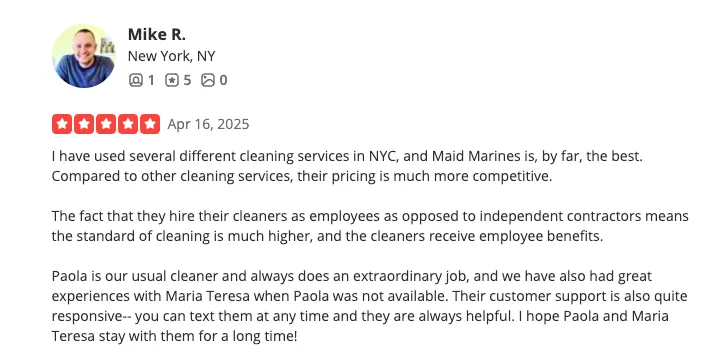
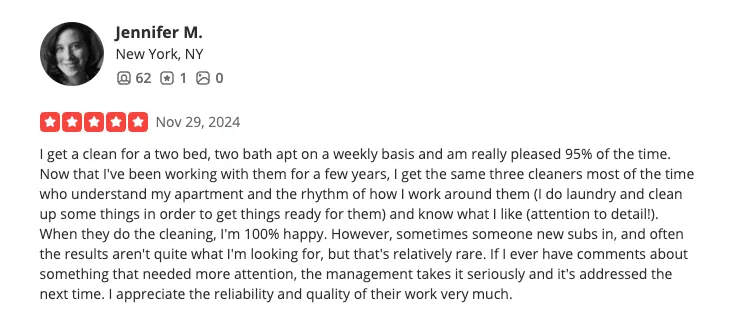
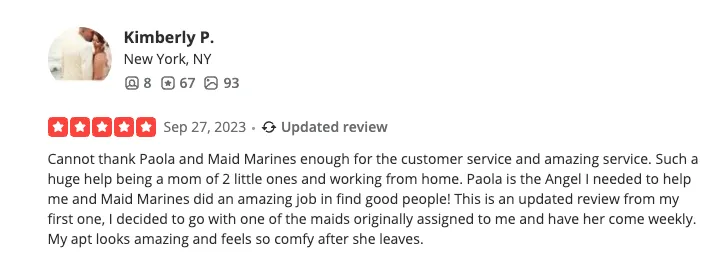
That is what we do. Our cleaners are W-2 employees, vetted and insured. They bring everything they need. They know the difference between a 1920s semi-detached near Dyker Heights and a newer condo on Bay Parkway. The first visit takes a little longer because they are learning your home, and after that they know what every floor needs without asking again.
The 1989 murder of Yusef Hawkins forced the neighborhood to confront its own boundaries
On August 23, 1989, Yusef Hawkins, a sixteen-year-old Black teenager from East New York, came to Bensonhurst with three friends to look at a used car. A mob of white youths attacked them with baseball bats. One shot Hawkins twice in the chest, killing him. The murder led to massive protests through the neighborhood, led by Reverend Al Sharpton, and became one of the defining moments in New York’s ongoing reckoning with racial segregation and violence.
The incident does not exist in isolation. It emerged from a neighborhood culture of insularity that had existed for decades, a culture that treated outsiders as threats. The aftermath changed Bensonhurst. Not immediately, and not completely. But the neighborhood that exists today, with its Chinese, Italian, Russian, Arab, and Latino communities sharing the same grid, is a fundamentally different place than the neighborhood of 1989.
This history matters because neighborhoods are not just collections of buildings. They are the accumulated weight of everything that has happened on their streets. Bensonhurst carries this weight honestly, without erasure, and has moved forward.
The D train has connected this neighborhood to Manhattan since the elevated line was built in 1916
The BMT West End Line, running elevated above 86th Street, opened for service in 1916 under the Dual Contracts that expanded the subway system into the outer boroughs. Today it carries the D train from Coney Island to Midtown Manhattan via the Manhattan Bridge. The ride from 86th Street to Atlantic Terminal takes roughly twenty minutes. To 42nd Street, about forty-five.
The N and W trains run underground along the Sea Beach Line with stops at 18th Avenue, 20th Avenue, and Bay Parkway. The F train runs along McDonald Avenue on the eastern border. This density of subway access makes Bensonhurst one of the better-connected neighborhoods in outer Brooklyn, and it means our cleaning teams can reach any block in the neighborhood efficiently by transit.
We serve homes throughout Bensonhurst’s two zip codes, 11204 and 11214, and across the full grid from 14th Avenue on the northwest to McDonald Avenue on the east, from 60th Street down to Bay Parkway. We also clean in nearby Dyker Heights, Gravesend, and Borough Park, and throughout the rest of Brooklyn.
What booking looks like for Bensonhurst homes
You pick your date and time online. You see your flat-rate price before you commit. Tell us how many floors need cleaning, what the main surfaces are, and whether any floor has specific needs like heavy kitchen degreasing or basement moisture. If your family prefers shoes off at the door, our team carries shoe covers. If your building is one of the prewar walkups along Bay Parkway without an elevator, we bring everything up the stairs.
Bensonhurst residents also use us for recurring apartment cleaning in the walkups along New Utrecht Avenue and for the newer condos that went up after the 2000s rezoning. Whatever the building type, we already know the layout. We have been cleaning this neighborhood long enough that very little surprises us.