
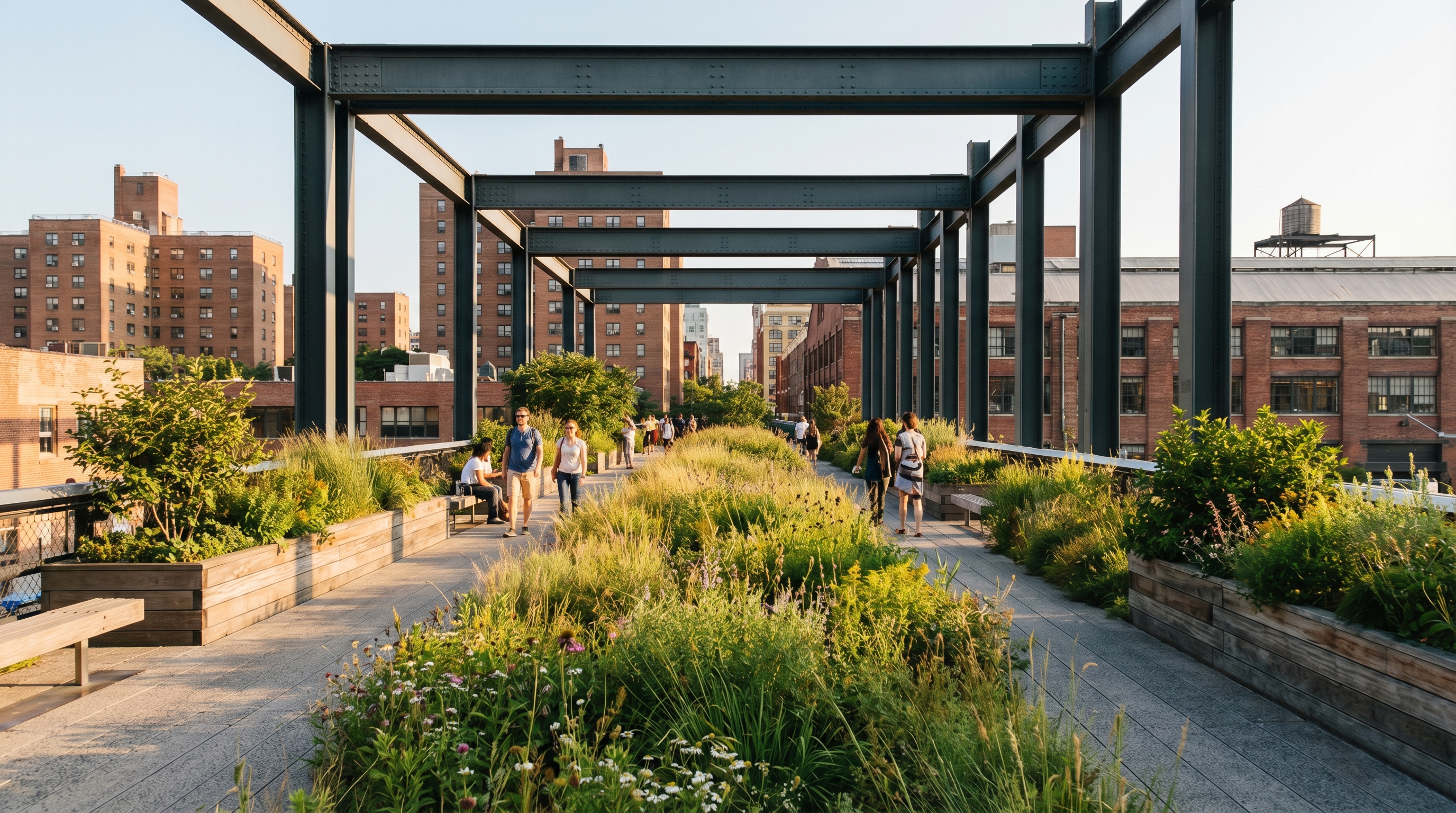
Chelsea is a neighborhood that refuses to be only one thing. It is the place where the Oreo cookie was invented, where Leonard Cohen wrote songs about Janis Joplin in a hotel hallway, where men on horseback rode ahead of freight trains to keep pedestrians alive, and where a rusting elevated railway became one of the most visited public parks on the planet. Walk ten blocks in any direction and you will cross paths with two centuries of reinvention. The Greek Revival rowhouses that Clement Clarke Moore planned in the 1830s sit a few hundred yards from glass condominium towers designed by Jean Nouvel. A 200-year-old theological seminary shares the neighborhood with over 200 contemporary art galleries. The former factory floor where Nabisco engineers developed the Oreo in 1912 now houses a food hall owned by Google. None of this feels contradictory when you are standing in it. It just feels like Chelsea.
A farm named after a soldiers’ hospital became the neighborhood that shaped Manhattan
The name Chelsea traveled across the Atlantic on a military man’s memory. In 1750, Captain Thomas Clarke purchased a 94-acre farm stretching from what is now 19th Street to 24th Street, between Eighth and Tenth Avenues. Clarke had served in the British army, and he named his waterfront property after the Royal Hospital Chelsea in London, a retirement home for veteran soldiers established in 1682. The English name itself goes deeper. Chelsea derives from Old English “Cealchythe,” meaning “chalk landing place,” a reference to the barges that unloaded chalk and limestone along the Thames. The name moved from one riverbank to another and has stayed put for over 270 years.
Clarke died, and the estate passed to his grandson, a man who would do more to shape Chelsea than any developer, politician, or architect who followed. Clement Clarke Moore, born on the farm on July 15, 1779, is remembered by most people as the probable author of “A Visit from St. Nicholas,” the poem that begins “Twas the Night Before Christmas.” What matters more for Chelsea is what Moore did with his land. Rather than selling the 94 acres wholesale to speculators, he subdivided the property carefully and attached deed restrictions to every lot he sold. Buyers had to build respectable homes. They had to maintain setbacks from the street. They had to hold to consistent building heights. These restrictions gave Chelsea its first generation of Greek Revival rowhouses between the 1820s and 1840s, and because the restrictions held, many of those houses survive today in the Chelsea Historic District.
Moore also gave a full city block to the General Theological Seminary in 1818. The seminary, occupying the land between 20th and 21st Streets from Ninth to Tenth Avenue, built a Gothic Revival campus that remains the oldest building complex in the neighborhood. The Close, the central garden courtyard, is open to the public. It is one of the most unexpectedly quiet places in Manhattan.
The Chelsea Hotel collected a century of bohemian legends under one roof
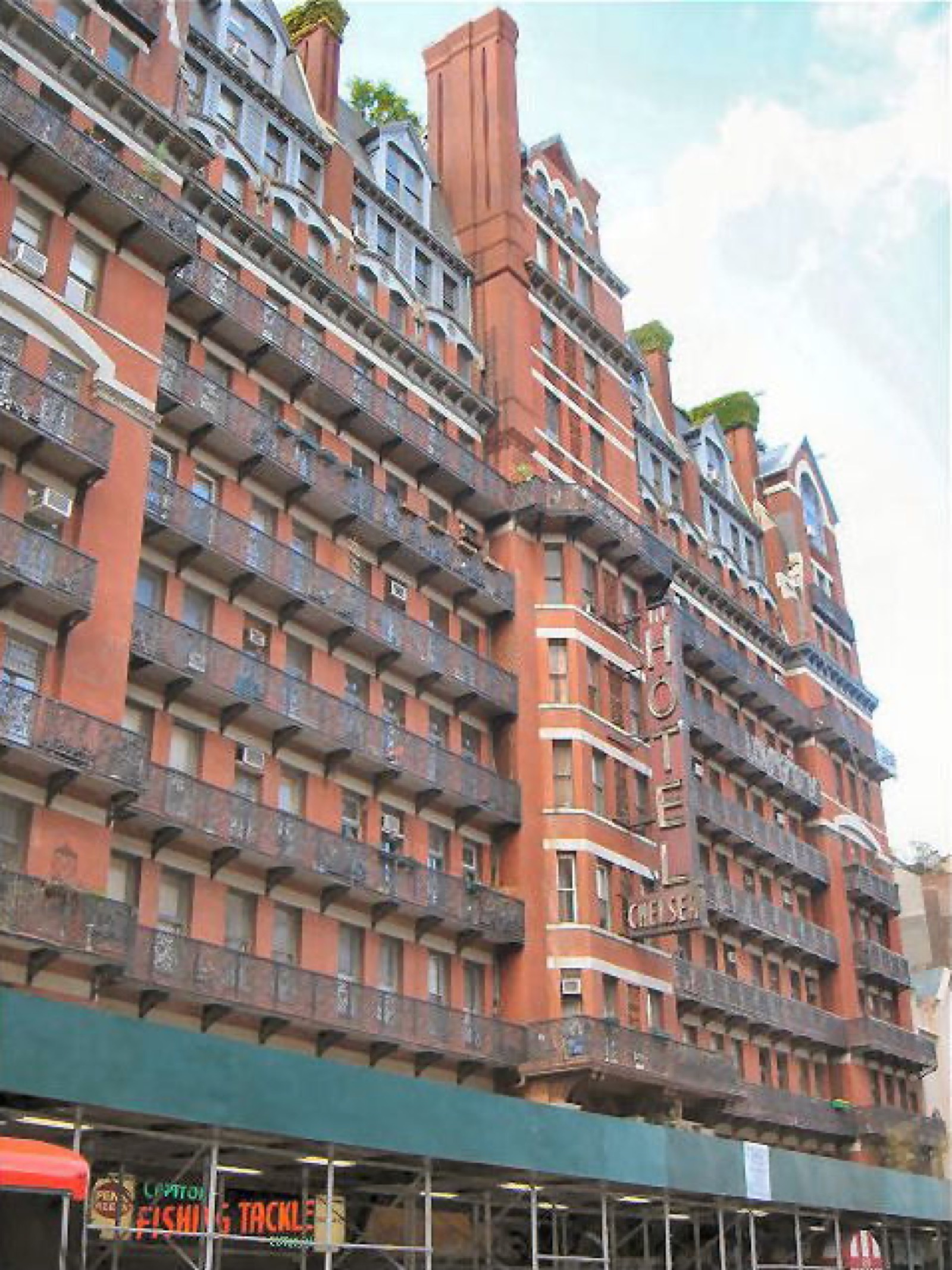
There is no building in New York with a guest register like 222 West 23rd Street. The Chelsea Hotel opened in 1884 as one of the city’s first cooperative apartment buildings, designed by architect Philip Hubert in Queen Anne and Renaissance Revival style. Twelve stories of red brick, ornate wrought-iron balconies, and a mansard roof with dormers. At the time of construction, it was one of the tallest buildings in the city.
The building became something else entirely over the next 140 years. Mark Twain lived there. So did O. Henry. Dylan Thomas stayed at the Chelsea while on a lecture tour in 1953 and, according to the story that has followed the building ever since, declared “I have had 18 straight whiskies. I think that is the record” before collapsing. He died four days later at St. Vincent’s Hospital. Thomas Wolfe wrote “You Can’t Go Home Again” at the Chelsea during the Depression years. Tennessee Williams kept a room. Virgil Thomson, the American composer, lived there for decades.
The musicians came next, or rather came at the same time. Bob Dylan lived at the Chelsea and wrote “Sad Eyed Lady of the Lowlands” there. Leonard Cohen and Janis Joplin reportedly had their relationship under the same roof, and Cohen later wrote “Chelsea Hotel No. 2” about it. Jimi Hendrix stayed. Patti Smith stayed. The members of Pink Floyd stayed. Andy Warhol shot the film “Chelsea Girls” in the hotel in 1966, using the building itself as the set.
And then there is Room 100. On October 12, 1978, Nancy Spungen was found stabbed to death in the room she shared with Sid Vicious, the Sex Pistols bassist. Vicious was charged with her murder but died of a heroin overdose in February 1979 before trial. The case remains one of rock and roll’s most infamous tragedies.
The hotel reopened in 2022 after a long and contentious renovation. Bronze plaques on the facade commemorate the names that passed through. It is a New York City Landmark and sits on the National Register of Historic Places, which means the wrought-iron balconies that have defined the 23rd Street skyline since the 1880s are protected. The materials that make up that facade need careful, knowledgeable maintenance, the same attention that every historic surface in Chelsea deserves.
Cowboys on horseback once rode through the streets to stop people from dying
Chelsea’s western edge along the Hudson River has always been industrial. By the 1840s and 1850s, the waterfront was occupied by rail yards, warehouses, and the slaughterhouses that gave the Meatpacking District its name. The New York Central Railroad ran freight trains at street level along Tenth and Eleventh Avenues, and the trains killed people. They killed a lot of people. The stretch earned the nickname “Death Avenue,” and by 1910, one estimate placed the toll at 548 dead and 1,574 injured.
The railroad’s solution was unusual. They hired men on horseback, called the West Side Cowboys, to ride ahead of the trains waving red flags and lanterns, warning pedestrians to get out of the way. The last cowboy ride happened on March 24, 1941, when 21-year-old George Hayde and his horse Cyclone escorted fourteen rail cars loaded with oranges up Tenth Avenue.
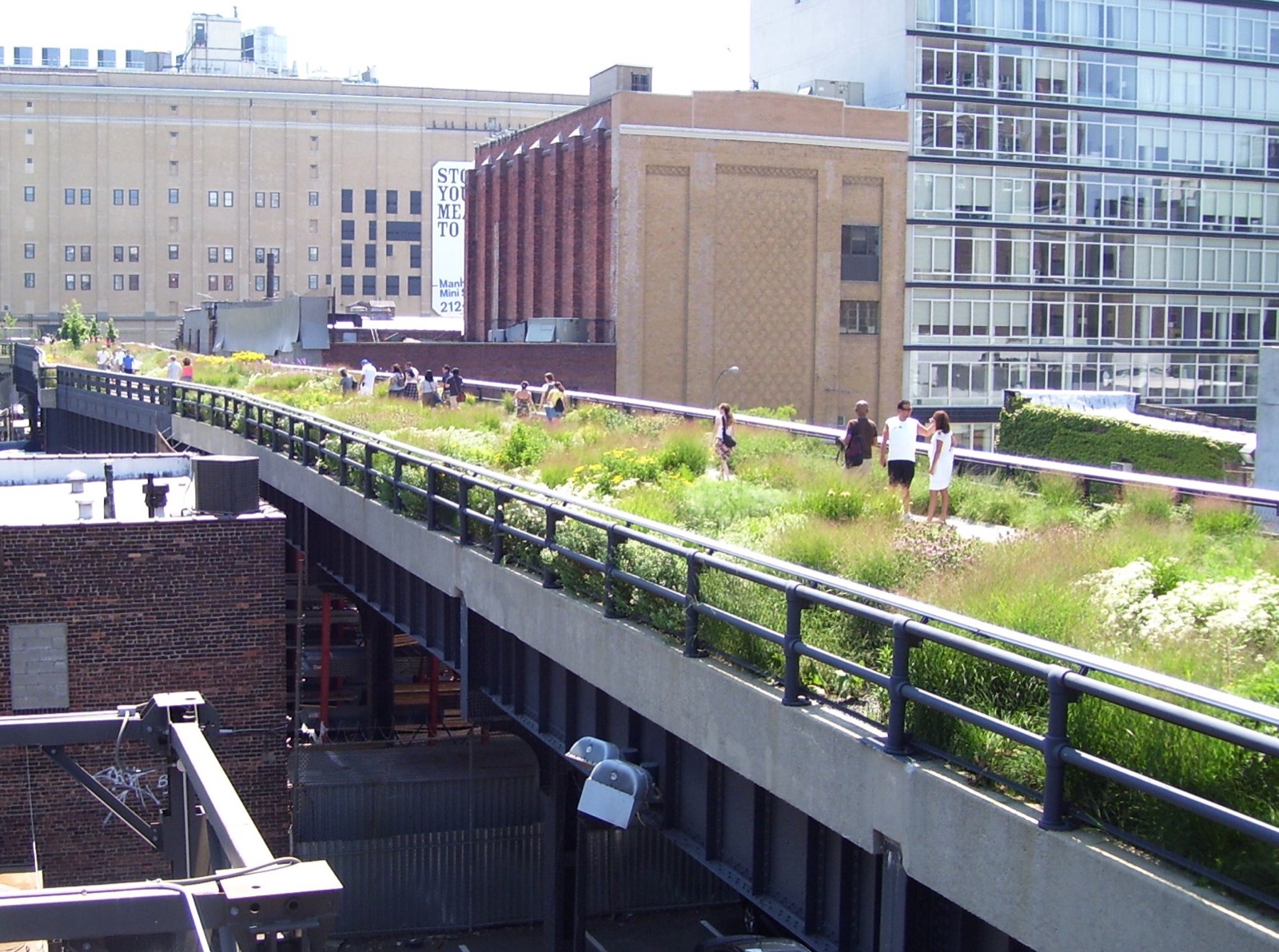
The permanent solution came in the 1930s. Robert Moses and the New York Central Railroad agreed on the West Side Improvement Project, which replaced the street-level tracks with an elevated freight line. The High Line, as it came to be known, was built in 1934 and designed to pass directly through the second and third floors of industrial buildings along the route, with loading doors that opened directly onto the train. Some of those buildings still stand. You can see the old loading bay openings from the park today.
The freight line ran until 1980, then sat rusting and unused for two decades. Wildflowers and grasses self-seeded along the abandoned tracks. The city government wanted to tear it down. Two regular people, Joshua David and Robert Hammond, who met at a community board meeting in 1999, decided they did not want that to happen. They founded the Friends of the High Line and spent ten years fighting to save it. Neither had a background in urban planning. The park opened in 2009. It now draws roughly 7 to 8 million visitors per year, more than the Statue of Liberty.
The Titanic was supposed to dock in Chelsea
The Chelsea Piers, stretching along the Hudson River from roughly 17th to 23rd Street, were New York’s primary luxury ocean liner terminal from 1910 to 1935. The piers were designed by the architectural firm Warren and Wetmore, the same firm that designed Grand Central Terminal. Cunard and White Star, the rival transatlantic lines, both docked here.
On April 15, 1912, the RMS Titanic was scheduled to complete its maiden voyage at Pier 59. It never arrived. Three days later, on April 18, the Cunard liner Carpathia brought 675 survivors to Pier 54, where a crowd of more than 30,000 people waited on the docks. The wooden posts that were once part of Pier 54 still jutted from the water until recently. The site has since been reimagined as Little Island, a public park built on concrete tulip-shaped pillars in the river.
During both World Wars, the Chelsea Piers served as points of departure for soldiers heading to Europe. The piers declined after 1935 as ships grew too large for the berths. Today the complex houses Chelsea Piers Sports and Entertainment, a massive recreational facility with a gym, swimming, rock climbing, bowling, and a golf driving range suspended over the river.
Over 200 galleries made Chelsea the center of the global art market
In the early 1990s, the contemporary art world needed more space. SoHo’s galleries were being priced out by boutiques and restaurants. Chelsea’s western edge, lined with former warehouses and industrial lofts along Tenth and Eleventh Avenues, had exactly what dealers needed: large, cheap floor space with high ceilings, freight elevators, and ground-floor access for installing oversized work. The migration happened fast. By the mid-1990s, Chelsea had displaced SoHo as the center of the New York art market, and eventually the global one.
At its peak in the 2000s, the ten-block strip between 18th and 27th Streets along Tenth Avenue held more than 200 galleries. The blue-chip dealers arrived first. Gagosian. Hauser and Wirth. David Zwirner. Pace. They were followed by mid-career and emerging spaces. The result was a concentration of contemporary art dealing with no equivalent anywhere on earth. On Thursday evenings during gallery season, dozens of openings happen simultaneously. You can walk from show to show for free, seeing work that will sell for hundreds of thousands of dollars, in spaces that share blocks with hardware stores and nail salons. No ticket, no membership, no reservation.
Rising rents along Tenth Avenue have begun to pressure even the major dealers. Some have shifted parts of their programming to the Lower East Side, Tribeca, or satellite locations. But the gallery district remains dominant. And the converted warehouse spaces those galleries occupy represent one of the most interesting cleaning challenges in the neighborhood. Polished concrete floors that scratch permanently with the wrong pad. Exposed brick walls that absorb water and stain if you wipe them wet. Oversized factory windows with sills that collect grit from the street. These spaces need a cleaning approach built specifically for what they are, not a one-size-fits-all apartment routine.
The Oreo cookie, London bobbies, and the Santa Claus poem all have Chelsea addresses
Chelsea collects stories the way other neighborhoods collect coffee shops. The National Biscuit Company opened its factory complex along Ninth Avenue and 15th Street in 1898. In 1912, inside that factory, Nabisco engineers developed and first produced the Oreo cookie. The building is now Chelsea Market, a food hall and commercial space. Google purchased the entire block in 2018 for $2.4 billion. The factory where America’s best-selling cookie was invented is now owned by one of the world’s largest technology companies.
A few blocks north, London Terrace consumed an entire city block between 23rd and 24th Streets when it opened in 1930. It was the largest apartment building in the world at the time, with 1,665 units. The building had a swimming pool, a gymnasium, a solarium, and a concierge message center that hand-delivered notes around the city. In a flourish that captures something essential about Chelsea’s character, the doormen were dressed as London bobbies, a play on the building’s name.
And then there is the poem. Clement Clarke Moore, the man who subdivided Chelsea and shaped its physical character through deed restrictions, is traditionally credited with writing “A Visit from St. Nicholas” in 1823. The attribution is disputed by some scholars, but the connection is deeply embedded in the neighborhood’s identity. The man who planned Chelsea’s streets may also have invented the modern image of Santa Claus.
Chelsea was also home to Little Spain in the late 19th and early 20th centuries. The stretch around 14th Street had one of the largest concentrations of Spanish immigrants in New York, with restaurants, flamenco clubs, and mutual aid societies. Further north, on West 30th Street, the Lithuanian Alliance of America established its national headquarters in a neo-Grec building constructed in 1876, serving as a support center for Lithuanian immigrants and their descendants for over a century.
Greek Revival marble and polished concrete floors need people who understand what they are cleaning
Walk from Cushman Row on West 20th Street to a High Line condo on Tenth Avenue, and you will cross through four different centuries of construction, each with surfaces that react badly to the wrong product or tool.
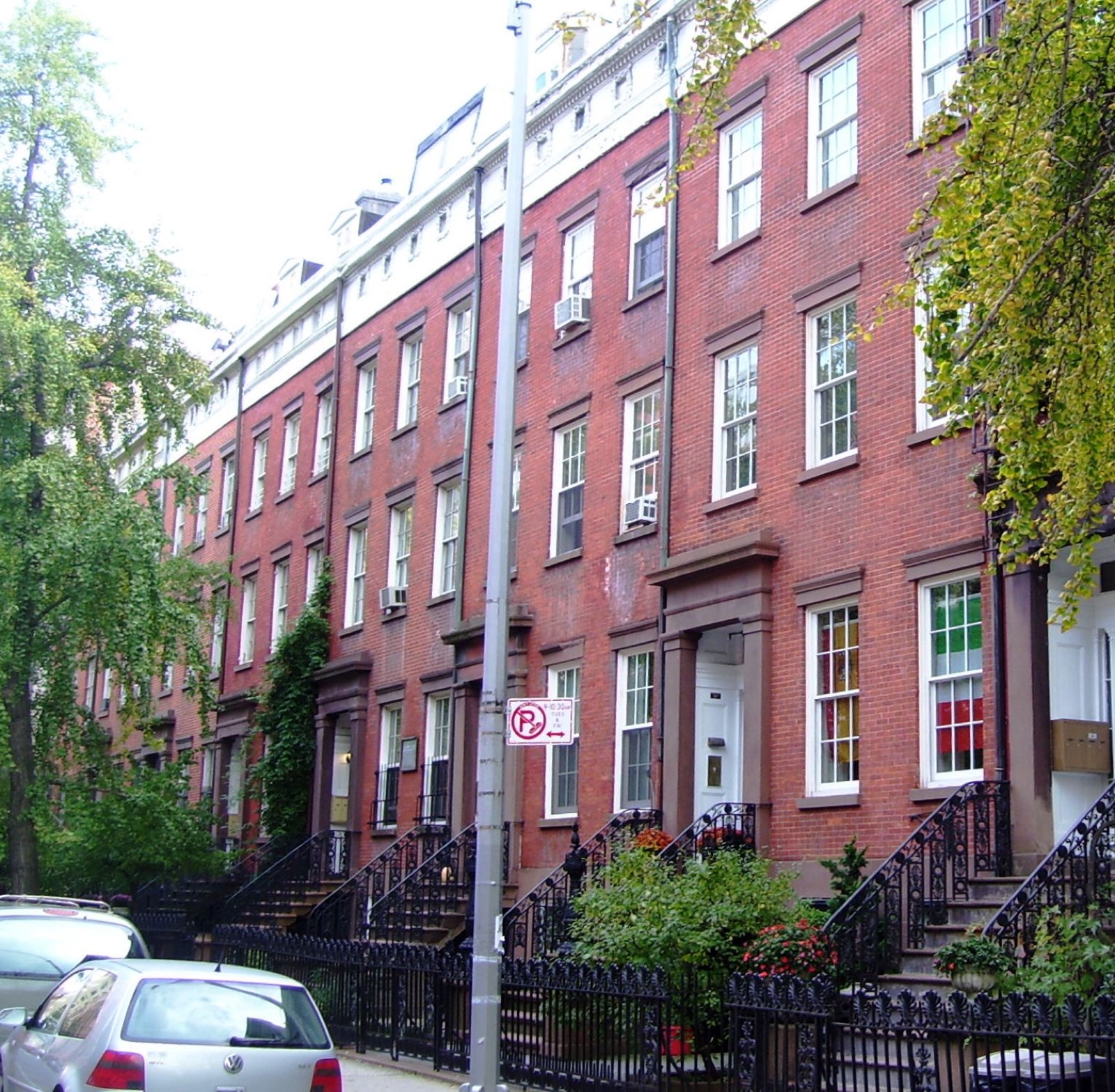
Cushman Row is a set of seven red-brick Greek Revival houses at 406 to 418 West 20th Street, built in 1839 and 1840 by dry goods merchant Don Alonzo Cushman. They sit ten feet back from the property line behind iron fences and gates with elaborate candelabrum newels. The brownstone stoops, the temple-like entry surrounds, the running bond brickwork. These are among the finest Greek Revival residences surviving in New York City, alongside the houses on Washington Square North. The marble, the original woodwork, the grout in century-old hex tile bathroom floors. These materials etch, scratch, and stain in response to products that work perfectly well on modern surfaces.
Three blocks west, in the gallery district, the housing stock flips entirely. Former industrial buildings converted to residential lofts have open floor plans with 12 to 14 foot ceilings, exposed brick walls, and polished concrete underfoot. Dust moves freely in these spaces because there are no hallways or doors to contain it. Concrete floors get a flat microfiber mop with a pH-neutral solution. Nothing abrasive. Nothing acidic. The exposed brick gets a soft brush, never a wet cloth, because water pushes dirt deeper into the mortar and leaves stains.
Then there are the new glass towers along the High Line. Jean Nouvel’s 100 Eleventh Avenue, completed in 2010, is a pixelated glass residential tower where every panel catches light at a different angle. The finishes inside are new and expensive. Engineered stone countertops that show every water ring. Floor-to-ceiling glass where streaks are visible from the elevated park below. These buildings also have strict vendor rules. Service elevator reservations, advance notice, COI paperwork.
The pre-war co-ops along Seventh and Eighth Avenues add another layer. Plaster walls, crown molding at nine or ten feet, cast-iron radiators. The plaster is the thing most cleaning services get wrong. A wet cloth on a hairline crack turns it into a stain that never comes out, so ours stay dry on those walls and use extension dusters for the molding rather than a ladder. The radiator covers, the AC units, and the vent grilles get dusted every visit. The cast iron underneath traps dust all summer, and when the steam heat kicks on in October it burns off and fills the apartment with a smell you cannot ignore. That part is a specialty job, and we will say so instead of pretending a microfiber cloth solves it.
This is why Chelsea requires teams that know the difference between a building where everything needs pH-neutral products and one where the real challenge is getting past the management office. Our cleaners work in Chelsea regularly. They switch products floor by floor in a townhouse and adjust their approach block by block across the neighborhood.
Your Saturday belongs at Chelsea Market or the High Line, not scrubbing grout
Chelsea Market alone contains dozens of food vendors in the old Nabisco factory corridor. The Lobster Place runs one of the best raw bars in the city. Los Tacos No. 1 draws lines that wrap around the industrial interior. Fat Witch Bakery has been selling brownies from the same location for over two decades. You can spend two hours walking the building without repeating a vendor.
Outside the market, Ninth Avenue and the side streets offer their own depth. Cookshop at 156 Tenth Avenue has been a Chelsea institution for over 15 years, serving seasonal American food with a brunch that does not rush you out. Tia Pol at 205 Tenth Avenue runs an intimate Spanish tapas bar with some of the best small plates and wines in the neighborhood. Bottino at 246 Tenth Avenue has been the de facto canteen of the gallery district for years, serving Italian comfort food to dealers and collectors between openings. The Empire Diner at 210 Tenth Avenue occupies a 1940s railroad car and remains a brunch and late-night staple.
The LGBTQ+ community has defined the Eighth Avenue corridor since the 1980s, when gay men moved in significant numbers from Greenwich Village as rents climbed. The blocks from 14th to 23rd Street became the heart of gay New York, packed with bars, restaurants, boutiques, and cafes. Pride events, fundraisers, and community organizations are deeply embedded in neighborhood life. The neighborhood experienced devastating losses during the AIDS crisis, memorialized at the AIDS Memorial in nearby Hudson River Park, where 390 white granite stones arranged in a triangle bear the names of the dead.
The Joyce Theater at 175 Eighth Avenue, a former Art Deco movie house converted to a 470-seat dance theater in 1982, is one of the most important mid-scale dance venues in the city. The Rubin Museum of Art at 150 West 17th Street, dedicated to the art and cultures of the Himalayas, is a genuine surprise in the Chelsea streetscape.
All of which is to say that Chelsea has more to offer on a Saturday than almost anywhere in the city. The neighborhood gives you the High Line in spring when the native wildflower plantings peak. It gives you gallery openings on Thursday evenings in September and January. It gives you Chelsea Piers for rock climbing, swimming, or hitting golf balls over the Hudson. Your weekend is better spent doing any of those things than scrubbing tile grout or dusting radiator fins. That is what a recurring cleaning handles.
What Chelsea cleaning actually looks like when you book
You pick your date and time on our booking page. You see your flat-rate price before you commit. If your building has specific access requirements, you tell us once and we handle it from there. Most co-ops west of Sixth Avenue require 48 hours advance notice for any vendor. Some require a Certificate of Insurance naming the building as an additional insured. A few require both plus a signed vendor agreement. Our dispatch team deals with Chelsea building offices regularly and knows what most of them need before we even ask.
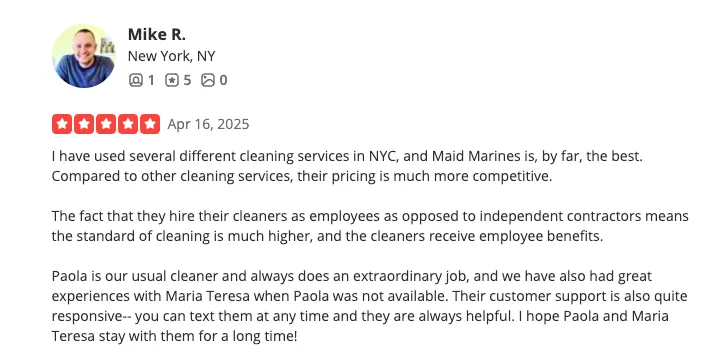
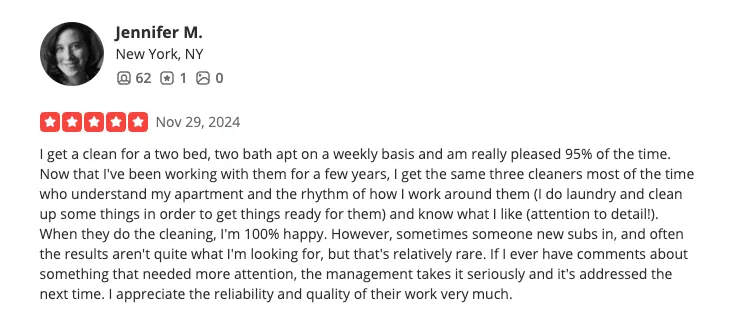
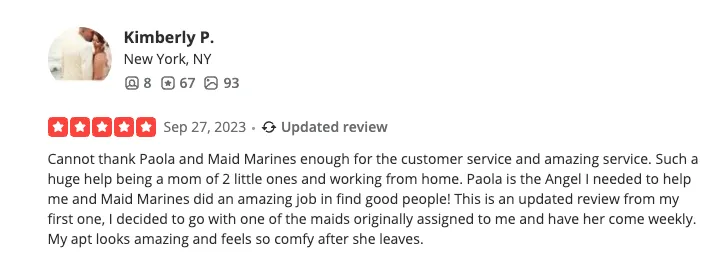
Our cleaners are W-2 employees, not gig workers. They are vetted, insured, and they show up with everything they need. If you are in a loft and want us to stay away from the art on your walls, we will. If you are in a townhouse and want each floor treated differently, we do that already. If you are in a co-op and need someone who will not set off your building manager, we have been doing this long enough to know the drill.
Chelsea residents also use us for deep cleaning before or after renovation work, move-in and move-out cleaning for the neighborhood’s active rental market, and recurring apartment cleaning on a schedule that works around your life. We also serve nearby Hell’s Kitchen and Tribeca.