

The name Middle Village came from geography and nothing else. In the 1850s, the settlement growing up around the crossroads of Metropolitan Avenue and what is now 69th Street sat at the literal center of western Queens — between the Brooklyn border to the west, the Town of Jamaica to the east, and the Town of Newtown to the north. Residents started calling it the middle village, and the name held. No real estate developer invented it. No marketing campaign polished it. It just described where the place was.
That willingness to be straightforward about itself has remained the neighborhood’s defining characteristic for the 170 years since.

The housing stock here was built to last and the owners have kept that promise
The two-family brick row house is the fundamental unit of Middle Village. The neighborhood was built almost entirely between 1910 and 1940 on the grid of residential blocks laid out as the BMT Myrtle Avenue elevated line pushed west and made the commute to Brooklyn practical. Developers went block by block erecting attached and semi-detached brick homes, two to three stories, full basements, small front gardens with wrought-iron fences or clipped hedges, and shared driveways between pairs of buildings. Most were built as owner-occupied with a rental floor below, which is still the dominant arrangement today.
What sets Middle Village apart from other Queens neighborhoods with similar housing stock is the maintenance level. The hedges are clipped. The stoops are swept. The brick is pointed and the window frames are painted. The front gardens have flower beds that actually get planted each spring. This is not coincidental and it is not recent. The Italian-American families who became the dominant community here in the postwar decades brought with them a specific set of values about property: that a house is not merely an investment but a physical expression of the household’s standards, maintained continuously as a matter of character. That tradition is still visible on virtually every residential block.
The consequence for anyone cleaning one of these homes is that the standard already set by the owners is high. Baseboards are noticed. Grout gets attention. The hardwood floors in many of these row houses are original to the 1920s and 1930s, old-growth wood with a wax finish that requires different handling than polyurethaned modern floors. Our house cleaning teams carry separate products for hardwood and tile, use a damp rather than wet approach on old-growth floors, and clean top-down so dust settled by vacuuming does not land on surfaces already wiped below. We have cleaned enough Middle Village two-families to know what the standard here looks like.
Metropolitan Avenue on a Saturday morning is the neighborhood doing what it does best
Metropolitan Avenue is not a destination neighborhood commercial strip in the way that certain Brooklyn main streets have become. There is no particular reason to come here from other boroughs, and the neighborhood does not seem to want one. The businesses on the avenue serve the people who live here, and those people have been eating at the same restaurants and buying from the same shops for twenty years. The result is a main street that functions: it is busy on weekends, the food is good, the prices are honest, and the atmosphere is genuine rather than performed.
La Vigna on Metropolitan Avenue is the refined end of the dining spectrum — an Italian wine bar with house-made pasta and a serious list of Italian wines that draws regulars from Forest Hills and Glendale and well beyond. Taci’s Beyti, the Turkish restaurant that has earned notice from food critics for its lamb dishes and meze spreads, represents the kind of genuine cooking that thrives in neighborhoods where the regulars return every week and hold the kitchen to account. Zum Stammtisch, technically on Myrtle Avenue in adjacent Glendale, has been serving German food — pork knuckle, schnitzel, sauerbraten — since 1972 and remains a community institution for the larger Middle Village neighborhood.
These are not new restaurants optimizing for social media. They are places where the same families have been eating for decades, and that continuity produces a kind of quality that is difficult to manufacture.
Your Saturday morning belongs at one of these places, not inside scrubbing the bathroom tile in your row house. That is what we are here for.
Forest Park sits at the end of the block and most of the country does not know it exists
The 538 acres of Forest Park that border Middle Village to the south are among the finest natural environments in New York City, and they receive only a fraction of the attention that Central Park and Prospect Park command. This is partly because they require a trip to Queens, and partly because the park does not market itself aggressively. The oak and hickory forest sits on a glacial ridge deposited roughly 20,000 years ago during the Wisconsin glaciation — the rolling hills are terminal moraine, the rubble pushed to the front edge of the last Ice Age glacier, which gives the park a topography unlike anything else in the five boroughs.

The Forest Park Carousel has been operating in continuous service since 1903 and is listed on the National Register of Historic Places. The hand-carved wooden horses were individually shaped and painted by craftsmen working in a tradition that no longer exists. The Bandshell hosts outdoor concerts through the summer. The mountain bike trail network draws serious riders from across the borough. The golf course is an 18-hole public facility inside the forest. All of this is a five-minute walk from most Middle Village residential blocks.
The practical consequence for the cleaning schedule is that residents here use the park the way other neighborhoods use their own backyards. Dogs come home from the trails with mud. Children come in with leaf litter. Boots track pine needles and oak mast from October through December. Homes near the Forest Park border — particularly those on the southern blocks near Park Lane South — have specific entryway and floor challenges that we build into every recurring visit. The front entry gets priority on arrival. Pet hair removal precedes mopping rather than following it. The baseboards along the main traffic corridors get attention on every clean, not just the deep cleans.
The cemeteries that define the neighborhood’s landscape have been here longer than anything else
Middle Village occupies an unusual position in New York City geography: it sits at the center of what urban planners call the Cemetery Belt, the extraordinary concentration of Victorian rural cemeteries that covers much of the Queens-Brooklyn border. St. John’s Cemetery on Metropolitan Avenue was established by the Roman Catholic Diocese of Brooklyn in 1879 and covers 55 acres of rolling wooded grounds with Victorian marble monuments and elaborate family mausoleums. Lutheran All Faiths Cemetery, founded in 1852, sits adjacent to St. John’s along the same avenue.
The organized crime association of St. John’s Cemetery is historically documented. Vito Genovese, Carlo Gambino, Joe Profaci, and dozens of other organized crime figures are buried on Metropolitan Avenue. True crime enthusiasts have been making pilgrimages here for decades. This is a real part of the neighborhood’s history, and Middle Village does not pretend otherwise.
What the neighborhood might gently correct is the implication that this is the defining fact of the place. The overwhelming majority of people buried at St. John’s are ordinary Queens Catholics from generations of Italian-American, Irish, and German families who lived in these row houses, attended these churches, and walked these streets. The cemetery landscape is genuinely peaceful, shaded by mature trees, and a reminder that this neighborhood has been absorbing the weight of the city’s dead for more than 150 years.
The green mass of the cemeteries — tens of acres of wooded grounds running along Metropolitan Avenue — also functions as a physical buffer that has limited real estate development pressure from the west. Together with the LIE to the north, the Jackie Robinson Parkway to the south, and Woodhaven Boulevard to the east, the cemeteries complete an almost total encirclement of Middle Village by infrastructure and green space. The neighborhood’s relative isolation from through-traffic and from the development pressures that reshape more accessible communities is not accidental. It is structural.
The two-family row house demands a specific kind of cleaning attention
The defining challenge of cleaning a Middle Village row house is the layering of surfaces across multiple floors and the full basement. A typical two-family here has original hardwood floors on the upper residential floor, ceramic tile in the bathrooms, a kitchen that has been updated multiple times over the decades, and a basement that may be partially finished as a laundry and storage area or fully finished as living space. The stairs between floors are often hardwood with painted risers and a wooden banister that runs the full height of the building.
Each surface type needs its own approach. The hardwood in these homes is typically old-growth, cut from trees that were already mature when the houses were built in the 1920s and 1930s. The grain is tight and the wood is dense, but old wax finishes do not tolerate saturating moisture or alkaline cleaners. We use a pH-neutral hardwood solution applied on a barely damp flat microfiber pad and dried immediately. No steam mops, no bucket-and-wring, no wet toweling on the surface. The kitchen tile and bathroom tile take a different set of products entirely — an appropriate acid cleaner for grout lines and a non-abrasive surface cleaner for the tile faces.
The banister is a detail many services skip. It runs through the center of the home, gets touched by everyone multiple times each day, and collects handprints and grime in the turned spindles between landings. We wipe the full banister on every visit. The basement, if finished, gets the same attention as the floors above. If unfinished, we sweep and address visible dust but do not clean behind utility equipment or in areas that are purely mechanical storage.
Our deep cleaning service covers everything that gets deferred in weekly or biweekly visits: the oven interior, the floor beneath the refrigerator and stove cleaned as far as reach allows, window sills with accumulated grit, baseboard edges on all floors, and grout lines throughout the bathrooms. The insides of cabinets and drawers are a separate line item you check off at booking. In a Middle Village two-family, a full deep clean typically takes a team of two people three to four hours. We have over 100,000 homes cleaned across New York City. These homes are well maintained to begin with, and our job is to keep them that way.
What booking looks like for Middle Village residents
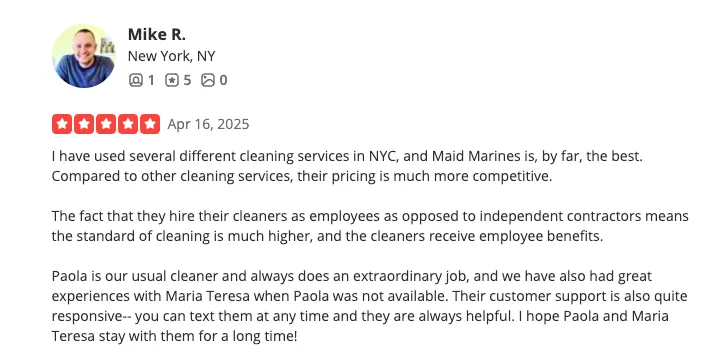
You pick your date and time on our booking page. You see your flat-rate price before you commit — based on bedrooms, bathrooms, and square footage. A two-family row house is priced honestly to reflect the actual work involved. Our cleaners are W-2 employees, not gig workers. They are vetted, insured, and they arrive with the right products for the surfaces in your home.
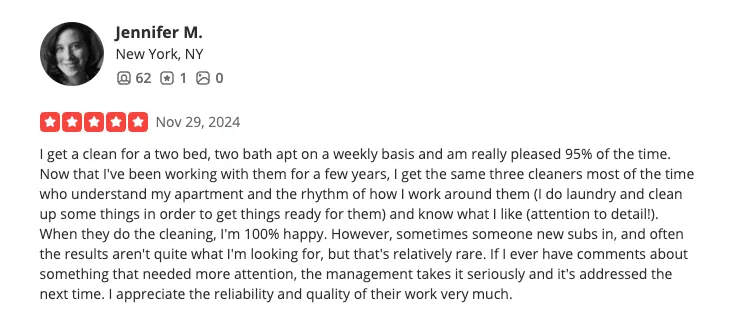
For recurring apartment cleaning or regular house cleaning, we assign the same team to your home on every visit. They learn the floors, the finishes, the entry where the dog comes in, the bathroom tile that needs attention. That consistency is what the difference between a cleaning service and a reliable part of how your household runs.
For rental unit turnover, move-in and move-out cleaning between tenants is one of our most common requests in this neighborhood. We restore the unit to the standard the owner maintains, which in Middle Village is a notably high standard.
We also serve nearby Forest Hills, Richmond Hill, and the rest of Queens.