
Forest Hills did not happen by accident. In 1906, Margaret Olivia Slocum Sage, widow of the railroad financier Russell Sage, took 142 acres of wooded glacial hills in central Queens and handed them to her charitable foundation with a single instruction: build a model community that proves good design is not a luxury. The foundation hired Frederick Law Olmsted Jr., son of the man who created Central Park, to draw the streets. They hired Grosvenor Atterbury to design the buildings. The result was Forest Hills Gardens, a planned English garden village that opened in 1911 and has not stopped being one of the most beautiful neighborhoods in the United States since.
The irony is that the community was supposed to be affordable housing. The Russell Sage Foundation designed it as a working-class neighborhood where families of modest income could live in well-built homes on thoughtfully landscaped streets. Within a decade the economics proved impossible. The construction was too good, the design too attractive, and the location too convenient. Forest Hills Gardens became an upper-middle-class enclave instead. The social mission failed, but the architecture endured, and the neighborhood that grew around it became one of the most desirable addresses in all of Queens.
The streets that follow the hills tell you everything about how this neighborhood thinks
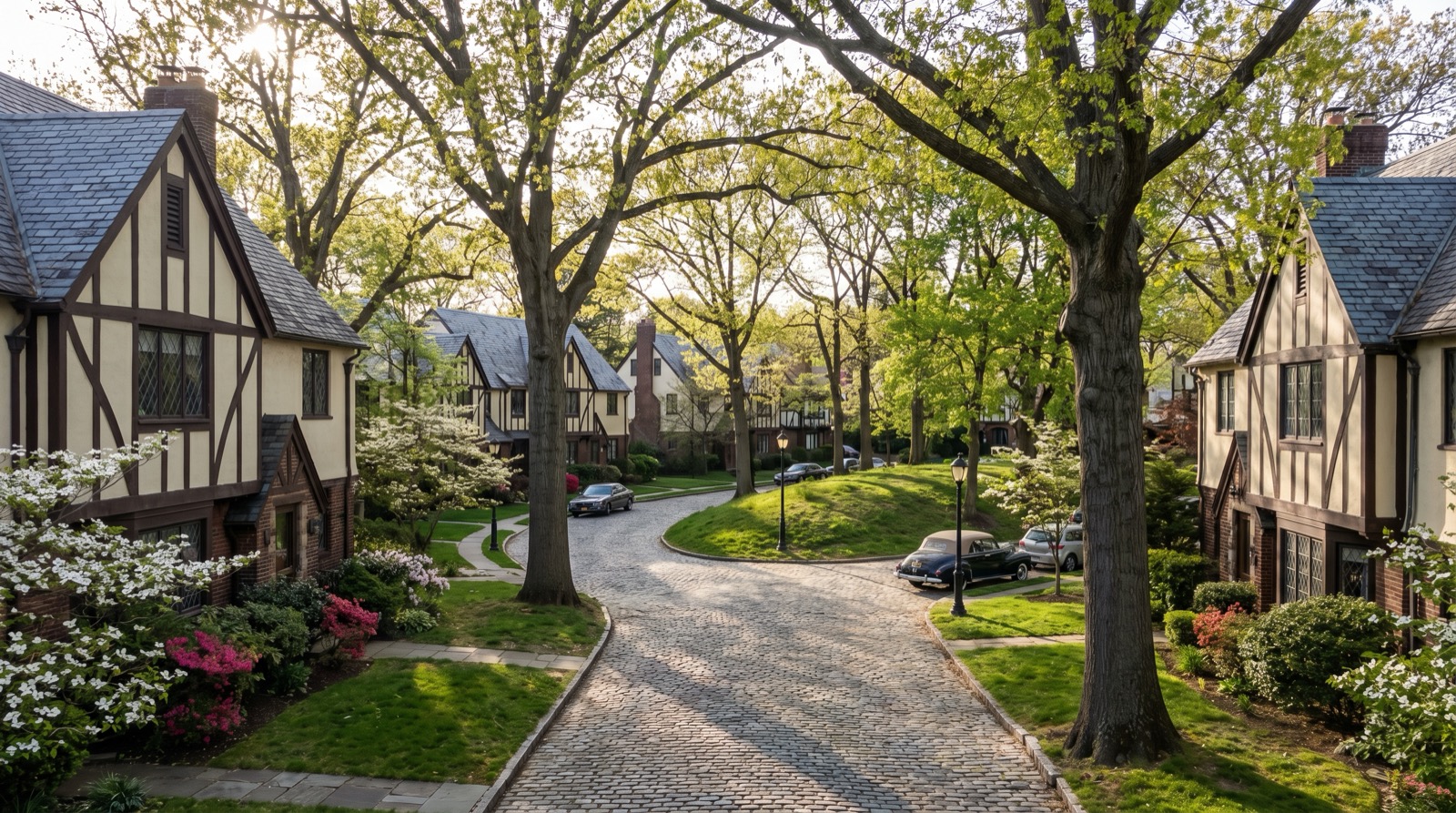
Most of Queens was platted on a rigid grid. Surveyors came through, flattened what they could, and laid perpendicular streets that ignored the terrain. Olmsted did the opposite. He traced his streets along the natural contours of the glacial hills, letting them curve where the land curved and rise where the land rose. The result is a residential layout that feels nothing like the rest of the borough. You walk down Ascan Avenue, one of the most photographed residential streets in Queens, and the road bends gently ahead of you beneath a full canopy of mature trees. Tudor homes with half-timbered facades and steep slate roofs sit on either side. Stone walls separate the small front gardens from the sidewalk. There are no right angles. The whole composition follows the earth.
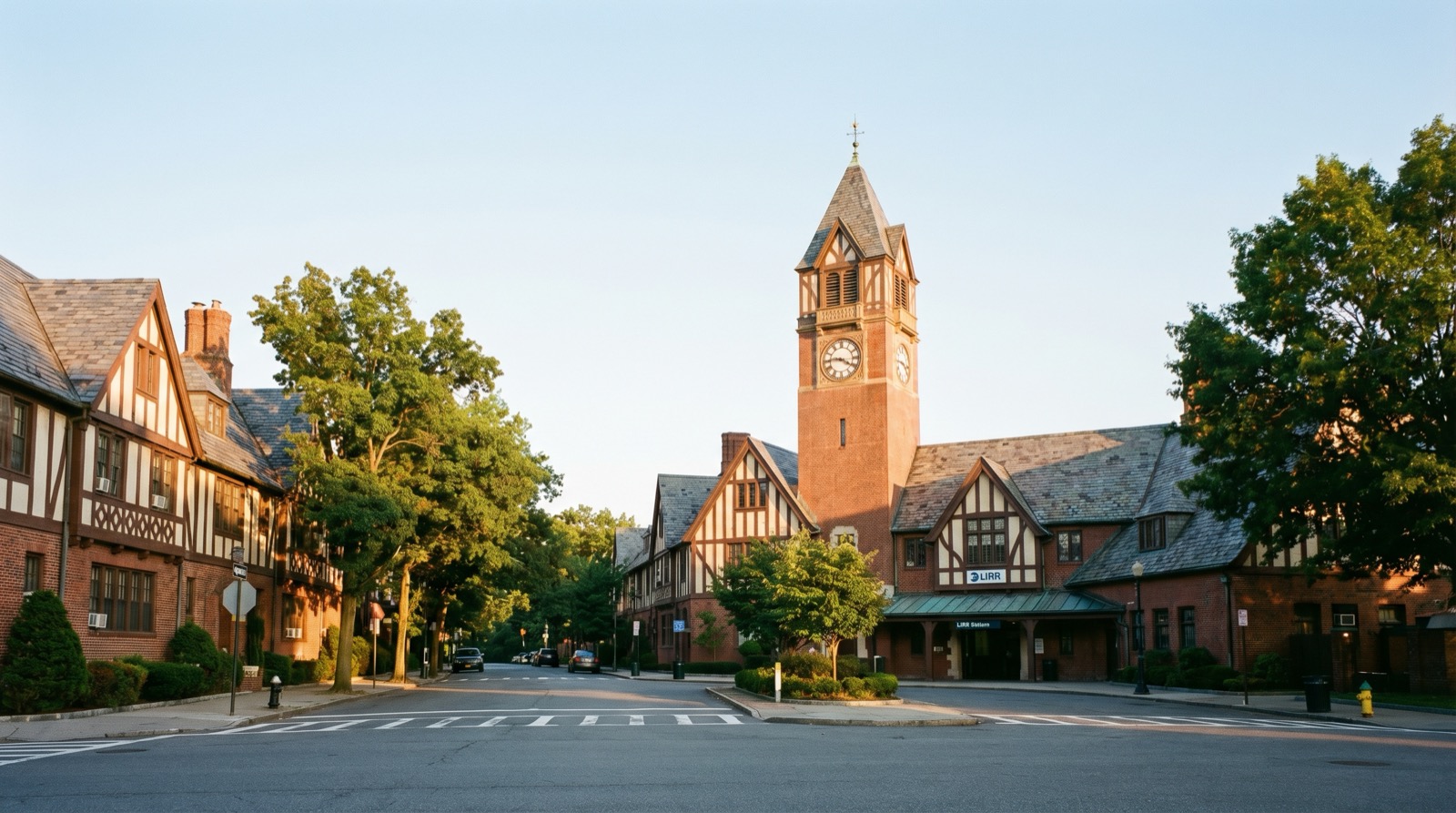
At the center of the community sits Station Square, the plaza Atterbury designed around the Long Island Rail Road station. It is a composition of Tudor and half-timbered buildings arranged around a clock tower, with red brick paving in which Olmsted embedded the pattern of intersecting crosses from the Union Jack. The homage to English garden-city planning is deliberate and carried through every detail. The Forest Hills Inn, the original residential inn at 1 Station Square, still stands. The streetlamps and signposts are Atterbury originals. The whole ensemble was designated a New York City landmark, and the Forest Hills Gardens Corporation, a homeowners association that has governed the community since 1913, enforces architectural standards on every home.
This is not a museum. People live here, raise families here, commute from here. But the commitment to preserving what Olmsted and Atterbury built has created a neighborhood where the cleaning job itself becomes an act of preservation. The leaded glass windows that Atterbury specified are over a century old. The cames, the soft metal strips that hold the glass panels together, corrode if you spray them with ammonia. The oak wainscoting in the older homes scratches if you wipe it with anything abrasive. The plaster walls take moisture marks if you are careless. We send teams into the Gardens who understand that cleaning a 1911 Tudor is not the same as cleaning a modern apartment. It requires knowing what not to do.
Forest Hills High School produced the most improbable concentration of musical talent in American history
It is genuinely difficult to overstate what came out of this one public school on 67th Avenue. Paul Simon and Art Garfunkel met here as students in the 1950s, performing together in a sixth-grade production of Alice in Wonderland before forming a duo they initially called Tom and Jerry, choosing the pseudonyms because they worried their real names sounded too Jewish. They graduated from Forest Hills High School in 1958, went off to college, reunited as Simon and Garfunkel, and produced “The Sound of Silence,” “Mrs. Robinson,” “Bridge Over Troubled Water,” and one of the most beloved catalogs in the history of American popular music. Simon grew up in the neighborhood, three blocks from Garfunkel. They listened to the radio together as teenagers, taken with the Everly Brothers and the new sound of rock and roll coming through AM stations.
Then, from the same school, a generation later: Joey Ramone, Johnny Ramone, Dee Dee Ramone, and Tommy Ramone. All four founding members of the Ramones grew up in Forest Hills and attended Forest Hills High School. They met hanging out on a ramp at the top of a parking garage at the Thorneycroft Apartments on Queens Boulevard, bonding over the Stooges and the New York Dolls. They put on matching leather jackets, adopted the surname Ramone, and invented punk rock. The intersection of 67th Avenue and 110th Street in front of the school was officially renamed The Ramones Way in 2016. A mural of the band now covers the wall at the parking ramp where they used to gather.
The same high school. Simon and Garfunkel and the Ramones. “Bridge Over Troubled Water” and “Blitzkrieg Bop.” Two groups that represent polar opposite ends of the musical spectrum, both from the same building in the same Queens neighborhood. No other school in America has produced anything like it.
Add to that list Ray Romano, who grew up in Forest Hills and later starred in “Everybody Loves Raymond.” Paul Reiser, who grew up here and starred in “Mad About You.” Burt Bacharach spent part of his childhood here. And the comedian Alan King, one of the defining Jewish-American comedians of the mid-twentieth century, was raised in the neighborhood.
The West Side Tennis Club hosted the US Open for sixty-three years before the world moved to Flushing
The West Side Tennis Club was founded in 1892 when thirteen members rented land on Central Park West for three clay courts and a small clubhouse. The club outgrew Manhattan, purchased land in Forest Hills in 1912, and built a Tudor-style clubhouse the following year. The US National Championships, the tournament that became the US Open, moved here in 1915.
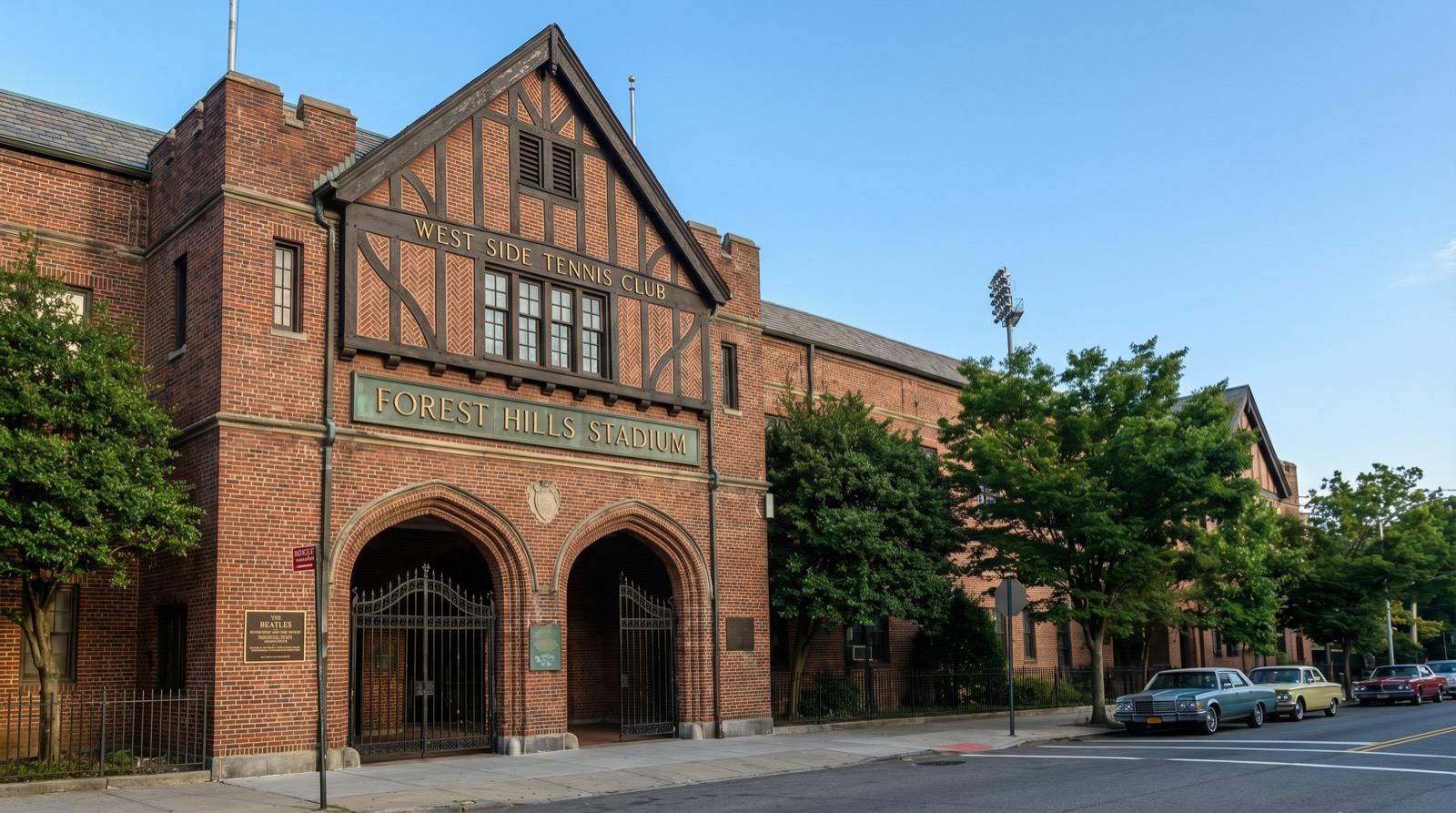
By 1923, the crowds had outgrown the existing facilities, and the club built the horseshoe-shaped Forest Hills Stadium, a 14,000-seat open-air venue with Tudor Revival detailing that matched the surrounding Gardens architecture. For the next fifty-plus years, this was the center of American tennis. Bill Tilden, Don Budge, Rod Laver, Billie Jean King, Arthur Ashe, Althea Gibson, Jimmy Connors, Chris Evert, Bjorn Borg, and Martina Navratilova all played here. John McEnroe, who grew up in Queens and learned the game at the West Side Tennis Club, won three US Open singles titles.
The tournament moved to the new USTA National Tennis Center in Flushing Meadows in 1978, and Forest Hills lost its place at the center of the tennis world. But the stadium survived. After years of decline, it was restored as a concert and events venue. The Beatles had played two consecutive sold-out shows here on August 28 and 29, 1964, weeks after their Ed Sullivan Show appearances, among the first major Beatles concerts in the United States. Frank Sinatra, the Rolling Stones, Barbra Streisand, Bob Dylan, and Jimi Hendrix all performed on the same stage. Today the stadium hosts a summer concert series that runs from June through September, and the brick Tudor facade on Dartmouth Street looks much the same as it did a century ago.
Prewar co-ops along Queens Boulevard deserve the same careful attention as the Gardens
The apartment buildings that went up in the 1920s and 1930s outside the Gardens are some of the finest prewar housing stock in Queens. Six to twelve stories, brick and limestone facades, generous lobbies with terrazzo floors, and apartments with real dining rooms, nine-foot ceilings, crown molding, and original parquet. Many converted to co-op ownership in the 1970s and 1980s, and the boards run them with the seriousness you would expect from owners who bought in a neighborhood designed by Olmsted.
The parquet is the thing to get right. These floors are individual wood blocks, not planks, laid with glue that does not tolerate water. A wet mop left sitting on 1930s parquet will swell the blocks and pop them loose from the substrate. We use a flat microfiber pad with a pH-neutral hardwood solution, damp-mop only, and dry immediately. No steam mops, no bucket-and-wring approach. These floors have lasted a hundred years, and the goal of every cleaning visit is to keep them going another hundred.
The radiators are the other detail most services skip. They walk past them entirely. The dust that works its way down inside from April through September burns off when the steam heat turns on in October, and it fills the apartment with a scorched smell that lingers for days. We dust the top panel, the radiator covers, and the vent grilles on every visit, so the loose layer never gets the chance to work its way down in the first place.
The co-op boards along Queens Boulevard and Continental Avenue require advance notice for vendors, and several require a Certificate of Insurance on file before a cleaner enters the building. Tell us your building name when you book and we handle the paperwork before the first visit.
The Bukharan Jewish community transformed Forest Hills in ways no urban planner could have predicted
After the Soviet Union collapsed in 1991, a wave of Jewish families from Uzbekistan, Tajikistan, and other Central Asian republics began arriving in Queens. They settled in Forest Hills and neighboring Rego Park in extraordinary numbers. Today the Bukharan Jewish community here is one of the largest outside of Israel, with over 100,000 Bukharan Jews in the greater Queens area.
These are Jewish families whose culture blends Central Asian, Persian, and Jewish traditions in ways that have no real parallel elsewhere in New York City. The Bukharan restaurants along Queens Boulevard and 108th Street serve plov, the Central Asian lamb and rice pilaf that is the community’s signature dish. They serve samsa, baked lamb-filled pastries. Lagman, hand-pulled noodles in a savory broth. Kebabs grilled over charcoal. The bakeries produce non, the round flatbread you tear and share at the table. These restaurants double as community gathering places. Walk into a Bukharan restaurant on a Friday evening before Shabbat and you will see three generations at the table, speaking a mix of Russian, Bukharan Judeo-Tajik, and English.
The community has also built synagogues, catering halls, and cultural institutions throughout the neighborhood. The ornate catering halls, some of them large enough to seat several hundred guests, host weddings and celebrations with a grandeur that reflects the community’s deep investment in family occasions. All of this happened within a single generation, overlaid onto a neighborhood that was already home to a large Ashkenazi Jewish population dating back to the 1940s and 1950s.
The diversity of cooking traditions in Forest Hills kitchens is directly relevant to how we clean. Many households maintain kosher kitchens with separate zones for meat and dairy preparation. Others cook Central Asian dishes that involve heavy use of oil for frying and stewing, building up grease film on range hoods, backsplashes, and upper cabinet faces that standard all-purpose cleaners do not touch. We use designated cleaning supplies for kosher kitchens when requested, and we bring commercial-grade degreasers for kitchens where the cooking is ambitious. You tell us what your kitchen looks like and we adjust.
Austin Street on a Saturday morning is the reason you should not be cleaning your own apartment
This is the commercial heart of Forest Hills, and on any given Saturday it looks like the neighborhood’s living room. Parents push strollers into coffee shops. Older couples sit at the diner. Russian-speaking families walk toward the Bukharan groceries on Queens Boulevard. Teenagers stand outside the movie theater. The wine bars are starting to fill up by noon. Austin Street has undergone the typical upscaling of the past decade, with longtime dry cleaners and shoe repair shops making way for farm-to-table restaurants, boutiques, and cafes targeting higher-income professionals. But the fundamentals remain: this is a walking street, a browsing street, a street where people come to spend unhurried time.
Your Saturday belongs here, not scrubbing the bathtub in your co-op. That is not a sales pitch. It is an observation about what this neighborhood offers and what a cleaning service is actually for. The three hours you spend cleaning are three hours you could spend walking Austin Street, sitting in a cafe with the newspaper, stopping at Eddie’s Sweet Shop on Metropolitan Avenue for an egg cream from a soda fountain that has not changed since the 1920s. Eddie’s has pressed tin ceilings, marble counters, cast-iron swivel stools, and roughly twenty flavors of handmade ice cream at any given time. It is cash only and does not hurry you.
Or walk into the Gardens. Ascan Avenue alone is worth thirty minutes of slow walking, just looking at the homes and the trees and the way the street curves. Station Square with its clock tower is a five-minute walk from Austin Street. Keep going south and you reach the West Side Tennis Club and Forest Hills Stadium, where you can check the concert schedule for summer shows. Head in the other direction and you are at the Forest Hills-71st Avenue subway station, with E, F, M, and R trains that put you in Midtown Manhattan in twenty minutes. Or take the LIRR from the station right inside the Gardens to Penn Station in the same time. Forest Hills is one of the only neighborhoods in New York City with two separate rail lines to Midtown.
The 1972 housing controversy is part of understanding why this neighborhood protects itself so fiercely
In one of the defining urban controversies of 1970s New York, plans to build three 24-story public housing towers in Forest Hills triggered massive community protests. Opponents, primarily middle-class Jewish families, argued the development would threaten the neighborhood’s character, school quality, and safety. Supporters argued the opposition was exclusionary and racially motivated. The controversy drew national attention and became a case study in the tensions between integration, community self-determination, and racial equity.
A young attorney named Mario Cuomo, later governor of New York, brokered the compromise that reduced the scale of the development. The resulting Forest Hills Houses, completed in 1975, are smaller than originally planned. The episode left a mark on the neighborhood’s civic culture. Forest Hills learned that its character could be changed by outside decisions, and it built the institutional tools to resist. Community boards are engaged. The Gardens Corporation enforces architectural standards. Landmark protections are pursued aggressively. Zoning changes are fought.
This instinct for preservation extends down to the individual home. Forest Hills residents take their properties seriously. The Gardens homeowners maintain Tudor facades that are over a century old. The co-op boards enforce standards that keep prewar buildings in the condition they deserve. When we send a cleaning team into a Forest Hills home, we are entering a place where the owner has strong opinions about how things should be maintained. We respect that. We send the same team to the same home on every visit so they learn the house and know what matters to the family. That consistency is what turns a cleaning service into a trusted part of how a household runs.
The Gardens Corporation keeps a century-old village intact through rules no other HOA in the city can match
The Forest Hills Gardens Corporation has governed the community continuously since 1913, making it one of the oldest homeowners associations in the United States. Its architectural review process is not advisory. It is binding. Homeowners cannot alter their facades, replace windows, change roof materials, or even repaint in an unapproved color without written approval. The result is that Atterbury’s Tudor Revival vocabulary, the half-timbered stucco, the steep slate roofs, the arched doorways, the copper gutters that have aged to green patina, has survived largely intact for over a century.
The Corporation also maintains the private roads within the Gardens. These are not city streets. They are private thoroughfares owned and maintained by the Corporation, which is why the paving, curbing, and street trees look different from anything outside the gates. The lampposts are Atterbury originals, cast iron with a distinctive curved arm. The street signs are custom. The fire hydrants are painted to match the community palette. This level of coordinated maintenance creates an environment where every element of the streetscape reinforces the original design intent.
For cleaning crews, the Corporation’s standards mean that homeowners expect a corresponding level of care inside. A family that submits paint color samples for exterior review before touching their front door is not going to accept careless work on their interior plaster walls or original oak staircase banisters. The slate entryway tiles in many Gardens homes are original to the 1911 construction and scratch permanently with grit tracked in from the garden paths. We address those entry areas first on every visit, clearing debris before it migrates deeper into the house. The copper and brass hardware on interior doors and cabinets in several of the older homes requires polish-specific cleaning, not all-purpose spray, which is one of the details our teams learn on the first visit and remember on every subsequent one.
What makes Forest Hills different from every other neighborhood we serve
The cleaning job in Forest Hills changes depending on which block you are standing on. A 1911 Tudor in the Gardens has leaded glass, oak paneling, slate roofs, and a yard that tracks grass clippings into the foyer. A 1930s co-op on Queens Boulevard has original parquet, cast-iron radiators, and a lobby where the doorman needs your cleaner’s name 48 hours before the appointment. A postwar brick building on Yellowstone Boulevard has tile floors and aluminum-frame windows that collect grit. The attached rowhouses on the eastern blocks have finished basements, small yards, and the daily wear of multigenerational households where shoes come off at the front door and the floors need to be genuinely clean, not just visually acceptable.
We clean all of them. We have teams that understand the difference between a house cleaning in the Gardens, where you are preserving hundred-year-old surfaces, and an apartment cleaning in a postwar building, where the challenge is efficiency and thoroughness in a compact layout. We know which co-op boards need a COI, which buildings have service elevator schedules, and which Gardens homes require two people for three to four hours because there are three floors, a basement, and an attic.
You pick your date and time on our booking page. You see your flat-rate price before you commit. If your building has specific access requirements or your home has surfaces that need special handling, tell us once and we handle it from there. Our cleaners are W-2 employees, not gig workers. They are vetted, insured, and they show up with everything they need.
Forest Hills residents also use us for deep cleaning before Passover or after the long winter, move-in and move-out cleaning for the co-op resale market, and recurring cleaning on a schedule that works around your life. We also serve nearby Sunnyside, Astoria, Long Island City, and the rest of Queens.
Your cleaning takes about three hours so here is how to spend them in a neighborhood that earned every one of its laurels
Forest Hills is twenty minutes from Midtown by express subway, designed by the son of the man who created Central Park, and home to a high school that produced both Simon and Garfunkel and the Ramones. It hosted the US Open for sixty-three years. The Beatles played here in 1964. The Bukharan Jewish community has built one of the most distinctive food cultures in all of New York City within its borders. Eddie’s Sweet Shop has been making ice cream by hand for a century. The streets curve because an Olmsted traced them along the glacial hills.
This is a neighborhood that has been desirable since 1911 and has never stopped being desirable since. That kind of stability is its own extraordinary achievement, and it is built on a foundation of people who care about where they live. Let us handle the cleaning so you can go enjoy the place.