
Greenwood Heights is one of those Brooklyn neighborhoods that earns its reputation quietly, without putting in much effort to be discovered. It sits on a glacially carved hillside between Park Slope and Sunset Park, bordered on one side by 478 acres of one of the great designed landscapes in American history and on the other by a thundering elevated expressway. The contrast is not accidental. It is the neighborhood.
The streets here slope steeply on the east-west cross blocks, giving you harbor views from the higher ground and a mild cardiovascular workout on the way to the subway. The subway runs under Fourth Avenue, which has three stops in the neighborhood: Prospect Avenue, 25th Street, and 36th Street, all serving the D, N, R, and W. You are in Downtown Brooklyn in twelve minutes, Midtown in thirty. Most of the people who live here now moved from somewhere more expensive and found something that felt almost as good for considerably less money.
A hillside that held one of the Revolution’s bloodiest rearguard fights
The ridge that runs through Greenwood Heights is the same terminal moraine left by the last glacier roughly 20,000 years ago. It created Battle Hill, Battle Hill created a defensible high point, and on August 27, 1776, that high point became one of the bloodiest chokepoints of the Battle of Long Island, the largest single battle of the American Revolution. British and Hessian forces under General William Howe pressed across these slopes against the American Continental Army in the first major engagement after the Declaration of Independence. American troops under Lord Stirling held the glacial ridge as a rear-guard action while Washington’s main army retreated toward Gowanus Creek and eventually across the East River to Manhattan in a daring overnight withdrawal.
Battle Hill is now the highest natural point in Brooklyn, at 216 feet above sea level, and you can climb it today on a walk through the Green-Wood Cemetery. There is a bronze eagle atop a granite pedestal at the summit. On clear days you can see the harbor below and, if the light is right, the distant outline of the Verrazano-Narrows Bridge.
The land sat as Dutch and then English farmland for over a century after that battle, part of the colonial township of New Utrecht. The ridge and its slopes were worked as orchards and fields. It was not until 1838 that the neighborhood’s defining institution arrived.
The cemetery that drew more tourists than Niagara Falls
Henry Evelyn Pierrepont had a vision for the rolling, glacially sculpted terrain south of the growing city: a rural cemetery on the model of the great European burial landscapes, designed as a pastoral retreat for the living as much as a resting place for the dead. In 1838 the Green-Wood Cemetery was established on 478 acres of the very hills where American soldiers had fought sixty-two years earlier. Landscape architects designed winding carriage roads, planted thousands of trees, dug ponds to complement the natural glacial kettles, and shaped the grounds into something between a park and a monument.
Richard Upjohn, the leading Gothic Revivalist in America, designed the main entrance gate at Fifth Avenue and 25th Street. Completed in 1861, the twin brownstone spires and pointed arch gateway became one of the most photographed structures in Brooklyn. Historians of architecture note that it influenced the design of St. Patrick’s Cathedral in Manhattan. Upjohn set the template and James Renwick Jr. built on it. By the 1860s, Green-Wood was drawing 500,000 visitors a year, the second most popular tourist destination in the United States after Niagara Falls. Before Central Park existed, this was where New Yorkers came to walk, picnic, and ride carriages through green hills.
The cemetery’s permanent residents are an extraordinary concentration of American history. Leonard Bernstein is buried here with a worn copy of Mahler’s Fifth Symphony on his chest. Visitors leave conductor’s batons on the stone. Jean-Michel Basquiat’s grave is a simple gray slab reading “1960-1988 / JEAN-MICHEL BASQUIAT / ARTIST” and is regularly covered with flowers, drawings, and handwritten notes from admirers. Louis Comfort Tiffany is here, the man whose studio defined American Art Nouveau. So is Charles Ebbets, who built Ebbets Field. Boss Tweed, Horace Greeley, Henry Ward Beecher, DeWitt Clinton who built the Erie Canal. Over 570,000 people in total, including sixteen Union generals and two Confederate generals from the Civil War.
The catacombs under the grounds, built in the 1850s, now host concerts, theater, and art installations in the tunnels beneath the hills. The cemetery is free to enter and Greenwood Heights residents use it the way other neighborhoods use parks: morning runs, long afternoon walks, weekend reading on the hillsides. Five minutes from any block in the neighborhood and you are in one of the quietest places in the outer boroughs.
Working-class rowhouses on a slope that Park Slope couldn’t afford
The slopes north and west of Green-Wood began to fill with working-class housing in the 1870s and 1880s. Irish, Italian, Polish, and Norwegian immigrants, dockworkers and factory hands and tradespeople employed at the Erie Basin and the Brooklyn waterfront, built and rented modest brick rowhouses and wood-frame two- and three-family homes on the steeply graded streets. By the 1890s, the neighborhood was largely built out. It had no distinct identity then, functioning as a southern extension of South Brooklyn without a name of its own.
The name “Greenwood Heights” came into common use in the late 1980s, coined by real estate agents who wanted to distinguish these blocks from the lower-priced Sunset Park to the south. The name combined the cemetery’s greenery with the neighborhood’s topographic reality. Before that, no map and no New Yorker called it anything other than the northern edge of Sunset Park.
What the rebranding captured, at least, was the housing stock. The defining building type is the two- and three-family attached rowhouse in red and brown brick, three stories tall, built between 1880 and 1920. Stoops at street level, modest ornamental brickwork, Italianate and Romanesque Revival cornices. On the steeply graded cross streets, rows of near-identical houses step up or down the hill, each slightly offset from its neighbor. The steep grades create dramatic visual lines that flat Brooklyn cannot replicate. Interspersed among the brick rowhouses are wood-frame two- and three-family homes from the 1870s and 1880s, some clad in aluminum or vinyl siding added mid-century, which give blocks on Sixth and Seventh Avenues a more modest and slightly rural feel.
Five- and six-story brick walk-up apartment buildings from 1900 to 1930 fill in the corners and mid-block lots. New glass-and-brick condominiums have been going up along Fourth Avenue since 2010, four to seven stories, targeting buyers in the $700,000 to $1.2 million range.

What a century-old rowhouse actually needs from a cleaning service
A Greenwood Heights rowhouse from 1895 is not the same cleaning job as a new Fourth Avenue condo, and the difference is not just aesthetic. The older buildings have specific surfaces that react badly to the wrong product or the wrong tool, and a cleaning service that treats every apartment the same will damage them.
The original wood floors in pre-1920s rowhouses are often softer old-growth wood, sometimes pine or Douglas fir, with finishes that have been refreshed and worn down multiple times over a century. Wet mops will penetrate the grain. Vinegar-based cleaners strip the finish over time. Steam mops generate enough heat to lift old adhesive and bubble the planks. We use a flat microfiber mop with a pH-neutral hardwood cleaner on these floors, wrung nearly dry, and nothing else.
The basement apartments common in Greenwood Heights rowhouses have their own conditions. Lower ceilings, less airflow, older tile or linoleum floors, bathrooms that were added into spaces not originally designed for them. Moisture collects in corners that the upstairs floors never see. The grout in a basement bathroom from 1940 is porous and needs a soft brush and an oxygen-based cleaner, not bleach, which etches old grout and turns it chalky.
The brick exterior of these buildings and the interior brick walls that sometimes show through in older renovated units: the instinct is to wipe them with a wet cloth when they look grimy. That pushes dirt deeper into the mortar and can leave white efflorescence stains that are extremely difficult to remove. Exposed brick gets a soft dry brush only.
The walk-up apartment buildings from the 1920s have their own issues: plaster walls, crown molding at nine or ten feet, cast-iron radiators. The Gowanus Expressway runs elevated above Third Avenue a few blocks to the west, and the soot from that constant traffic settles into every horizontal surface, window sill, and AC unit exterior on the blocks nearest the highway. Third Avenue apartments and the blocks immediately east of it accumulate a specific type of fine particulate grime that requires regular attention.
The blocks between two Brooklyn extremes
Greenwood Heights exists in a genuine identity negotiation between its working-class past and its gentrified present, and the result is a neighborhood that feels interesting precisely because it hasn’t resolved the tension. To the north is Park Slope, one of the most expensive and thoroughly gentrified neighborhoods in Brooklyn. To the south and east is Sunset Park, one of the largest and most culturally intact working-class immigrant neighborhoods in the borough. Greenwood Heights sits in the hinge between them.
Walk down Fifth Avenue on a Saturday and you cross a Colombian bakery, then a wine bar with natural wines on a chalkboard, then a Polish deli with kielbasa in the window, then a brunch spot with a forty-five-minute wait. The block changes character every hundred feet. This is not a curated neighborhood. It is an organic one, where the old and the new share block frontage without anyone having designed the result.
The new residents who have arrived since 2000 are largely young professionals and creative workers who came because Park Slope no longer had what they wanted: the feeling of a neighborhood that hasn’t been entirely finished. The restaurants are good but not precious. The coffee shops are comfortable but don’t all have fifteen-dollar pour-overs. There are bodegas between the wine bars.
The proximity of Industry City reinforces that quality. Irving T. Bush opened his waterfront terminal complex in 1895 on the blocks between 32nd and 37th Streets, and skeptics called it “Bush’s Folly” for competing with Manhattan’s ports. The 35-building, six-million-square-foot complex eventually employed thousands and defined the Brooklyn waterfront for decades. Renovated through the 2010s into a creative and culinary hub, Industry City now houses food halls, maker studios, tech offices, coffee roasters, and Japanese chocolatiers. The food hall is worth a trip from anywhere in Brooklyn.
Cleaning that fits how people actually live here
The residents of Greenwood Heights are a mix that the demographic numbers barely capture. There is the Polish family that has been in the same rowhouse since 1967, the Mexican family that bought their two-family building in 2001, the tech worker who rented an apartment in 2019 and loves that it’s still near Industry City. The street life reflects all of them.
What they share is that most people here are in two- or three-family rowhouses, basement units, or walk-up apartments without elevator service. There are no doormen, no building offices to coordinate with, no COI filings. Getting to your apartment usually means a stoop and a few flights of stairs. Our teams carry everything they need. Fourth-floor walk-ups are a regular part of the work, not an exception.
The apartment cleaning we do in Greenwood Heights covers the full range: the basement units in older rowhouses with moisture issues in the corners, the parlor-floor two-bedrooms with original woodwork and lead paint considerations, the new Fourth Avenue condos where the finishes are fresh and the main challenge is keeping engineered stone countertops streak-free. We know the difference between a building where everything needs pH-neutral products and one where the challenge is just getting good natural light for inspection.
A lot of people here move frequently as rents shift with the neighborhood’s trajectory. We do substantial move-in and move-out cleaning in Greenwood Heights for exactly that reason. A move-out clean in a 1910 rowhouse apartment where the previous tenant stayed for eight years takes real time: inside every cabinet, inside the oven, the grout in the tile bathroom, the baseboards, the window tracks that have accumulated the expressway’s soot. We price move-in and move-out separately from regular cleaning for a reason.
For people who want the apartment maintained on a regular schedule, a recurring house cleaning every two or four weeks handles the ongoing grime without letting it build to the point where it requires a deeper intervention. The Gowanus Expressway traffic means dust and soot reset faster here than in more sheltered neighborhoods. Regular cleaning is genuinely more effective than sporadic deep cleaning at keeping it managed.

Green-Wood on a Tuesday afternoon beats any weekend errand
The best thing about living in Greenwood Heights is that you have 478 acres of cemetery and hillside you can walk into on any day of the week. Most visitors come on weekends for the guided tours and the famous graves. Residents know that a Tuesday afternoon inside Green-Wood, with the carriage roads mostly to yourself, the ancient oaks over the ponds, and the harbor visible from Battle Hill, is one of the better things New York has to offer.
The cemetery runs programming throughout the year through the Green-Wood Historic Fund. The catacombs host concerts in the spring and fall. A Memorial Day concert on the grounds draws an outdoor crowd each year. The October Halloween tours through the grounds at dusk are atmospheric and genuinely informative. You do not need to be interested in history or horticulture to find the place extraordinary. It is simply one of the finest designed landscapes in America and it is at the end of your block.
Greenwood Park on Seventh Avenue is the neighborhood’s other gathering place. Seven thousand square feet of outdoor space on a former auto lot, thirty beers on draft, bocce courts, ping-pong tables, and fire pits for when the temperature drops. The kind of place that feels exactly like what a neighborhood needs and doesn’t always get.
Fonda on Seventh Avenue near 14th Street is the restaurant recommendation that should go at the top of any list. Chef Roberto Santibañez’s modern Mexican cooking is the real thing. The mole negro and tacos de canasta are exemplary. It draws people from Park Slope and beyond, but it remains a neighborhood restaurant in the way it operates.
Fifth Avenue’s commercial strip between 15th and 36th Street is the daily life of the neighborhood laid out block by block: the Colombian bakeries with pan de bono and obleas, the Dominican lunch counters, the taquerias with al pastor, and now the coffee bars and wine spots that have moved in alongside them. The Avenue has not been fully remade, which is exactly what its regulars prefer.
That is what your Saturday in Greenwood Heights looks like if you are not spending it scrubbing bathroom tile or hauling trash bags of debris from a move. When you have a deep cleaning or a regular recurring clean scheduled, you can be in the cemetery at nine in the morning while we handle the apartment. You can take the D train to Midtown. You can sit at the beer garden until the evening. You book your clean and you get your day back.
Booking a clean in Greenwood Heights
You pick your date and time on our booking page, see your flat-rate price before you commit, and tell us anything specific about your apartment in the notes field. Walk-up building on the fourth floor with an awkward stoop access: mention it. Basement unit with a moisture issue in the back corner: mention it. Apartment that faces Third Avenue and collects expressway soot: we already know what that means, but you can flag it anyway.
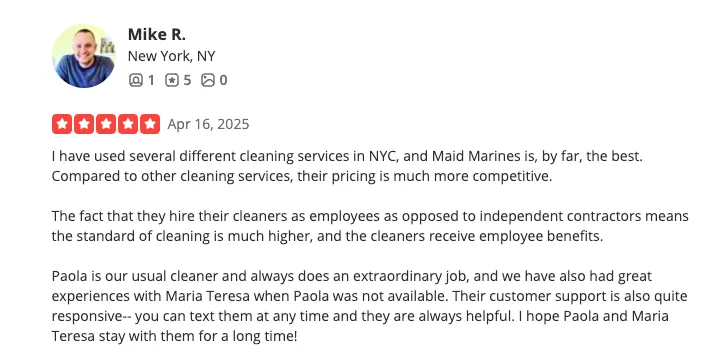
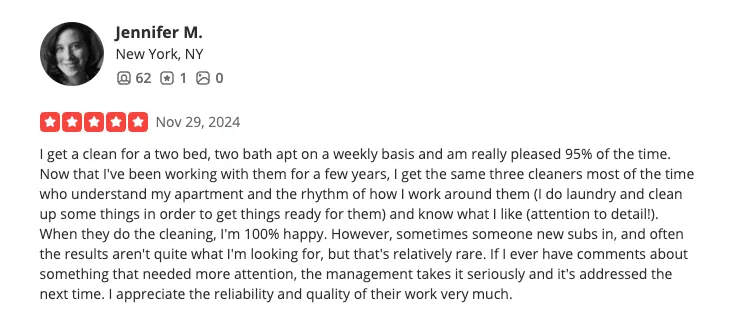
Our cleaners are W-2 employees, vetted and insured. They bring everything they need. There are no gig workers being dispatched from an app to a building they have never seen. We work in this neighborhood. We know what a 1905 Greenwood Heights rowhouse requires compared to a Fourth Avenue condo from 2018.
We also serve nearby Park Slope, Sunset Park, and Gowanus for apartment cleaning and maid service across central Brooklyn.