

Kensington is the Brooklyn neighborhood that developers named after a London royal borough to attract middle-class buyers, got something entirely different, and ended up with something better. The Victorian Foursquares and semidetached Edwardian houses that line the internal blocks of Kensington are genuinely beautiful. The world’s first dedicated bicycle path runs along its western edge. Prospect Park is directly to the north. And the neighborhood has assembled a population drawn from Bangladesh, Pakistan, Mexico, Russia, Jamaica, and a dozen other places that somehow manages to share streets, subway cars, and corner bodegas with remarkable ease. Real estate writers have been calling it the next neighborhood to tip for twenty years. It hasn’t tipped. It is still, quietly, one of the best places in Brooklyn to actually live.
Kensington’s Victorian houses have floors and surfaces that need people who understand what they are cleaning
The characteristic housing type in Kensington is the American Foursquare, built between roughly 1895 and 1920. These are the boxy two-and-a-half-story houses with wide front porches, hipped roofs, and full-width dormers that define the residential interior blocks between Ocean Parkway and Coney Island Avenue. They have original hardwood floors in many cases, narrow closets, and the kind of accumulated layers in baseboards and window sills that comes from a century of inhabitation. Some are owner-occupied by families that have been there for two or three generations. Others have been split into two- or three-family use. A few have been renovated. Most have not, which means the original millwork, the original radiators, and the original floors are still there under however many coats of paint and years of daily life.
The Queen Anne and Romanesque Revival variants that appear on Albemarle Road and the southern blocks add turrets, decorative bracketing, and ornate porch columns. These are the kinds of surfaces that disintegrate under harsh cleaners or abrasive pads. The wood trim on a 120-year-old Kensington house is not the same as the trim in a 2015 condo. It has absorbed a century of seasonal expansion and contraction. It needs pH-neutral products, real microfiber, and a team that will not sand through the finish on the porch railings because they used the wrong scrubbing pad.
Along Ocean Parkway and on the Coney Island Avenue frontage, the housing stock shifts to the pre-war elevator buildings that went up in the 1920s and 1930s. These are solid five- and six-story brick buildings with Art Deco or Classical detailing on the facades, and they have been housing Jewish families and more recently immigrant families for nearly a hundred years. The interiors tend toward plaster walls, parquet floors in the main rooms, and the cast-iron radiators that everyone who lives in a pre-war New York apartment has a complicated relationship with. Dust settles on them all summer and burns off in October when the heat comes on. The radiators get dusted on every visit, along with the AC units and the vent covers above them. Most services work around all three. We do not.
The rowhouses on the interior blocks are a different situation again. Brick construction from roughly 1910 to 1940, typically two or three stories, often run as owner-occupied two-families. The challenge in these houses is usually the kitchen and the bathroom, which have been updated incrementally over decades rather than renovated comprehensively. Grout that dates to multiple eras. Tile combinations that don’t quite match. Cabinets from different decades on different walls. Our approach to rowhouse kitchens in Kensington is to deep clean systematically rather than surface-wipe, which is the only way to make those rooms actually clean rather than just look clean from a distance.

Frederick Law Olmsted drew the line that made Kensington worth living in
The name came from a London real estate promotion. The neighborhood was named around 1900 by Brooklyn developers who were subdividing the old Flatbush farmland and needed something that sounded respectable. They picked Kensington after the Royal Borough of Kensington in West London, home to Kensington Palace, Hyde Park, and the Victoria and Albert Museum. The aspiration was to attract Anglo-Protestant middle-class buyers who would read the name and feel an implied prestige. It mostly worked as a naming strategy. It did not work as a demographic prediction.
What actually made Kensington viable as a residential neighborhood was something that happened twenty-six years before the developers arrived with their English place names. In 1874, the city of Brooklyn commissioned Frederick Law Olmsted and Calvert Vaux to design a grand parkway connecting Prospect Park to the beaches at Coney Island. Olmsted and Vaux had already designed Prospect Park and Central Park. They knew what a parkway could do to surrounding land values. Ocean Parkway opened in 1876 as a five-and-a-half-mile tree-lined boulevard with landscaped median malls, carriage paths, and walking promenades. It ran directly along what would become Kensington’s western edge, and it immediately transformed adjacent farmland into desirable residential real estate. Developers arrived within the decade.
The bicycle path followed eighteen years later. In 1894, the City of Brooklyn installed a dedicated cycling lane along Ocean Parkway’s western mall, protected from carriages and pedestrians and shaded by mature elm trees. It was the first such infrastructure in North America. It is still there. It still runs the full length of Ocean Parkway from Prospect Park to Coney Island. Every morning and weekend it fills with cyclists, many of them Kensington residents, taking the same path that was built when Grover Cleveland was president. You would not know this from any tourist guide or Brooklyn lifestyle publication. Kensington does not promote itself. It just keeps existing, quietly doing things right.
The land before the developers was Dutch colonial farmland. The Canarsee, a band of the Lenape people, had inhabited this flat coastal plain for thousands of years before Dutch settlers from New Netherland established the town of Flatbush (Vlacke Bos, meaning flat forest) in 1651. The Dutch colonial families, the Cortelyous and the Leffertses and the Lotts, held large farm tracts through the 17th and 18th centuries. The British took over in 1664. During the Revolution, British forces occupied the area after the Battle of Brooklyn in 1776 and used the Kings County roads and farms as they advanced. For most of the 19th century the land remained agricultural, used for dairy and market gardens, semi-rural countryside within easy reach of the growing city. Then Olmsted drew his line, and the farmland became a neighborhood.
The F train and a century of immigration built the neighborhood that exists today
The early 20th century brought the first residential development and the first immigrant communities. Jewish families from the Lower East Side and Brownsville moved in during the 1910s and 1920s, followed by Italian and Irish Catholic families. The housing stock that went up in those decades reflects what those buyers wanted and could afford. Solid semidetached Victorian houses. Two-family rowhouses. Pre-war elevator buildings on the parkway. The synagogues that followed on Ocean Parkway anchored a Jewish community that would persist there for generations. Some are still active. Some have been converted to other religious uses as the demographics of the parkway corridor shifted. The architectural bones remain.
The most significant recent chapter in Kensington’s history began in 1982 when the Makki Masjid opened at 1012 Coney Island Avenue. The mosque drew Pakistani Muslim families to the surrounding blocks and established the nucleus of what would become Brooklyn’s Little Pakistan. By the 1990s, the stretch of Coney Island Avenue between Beverley Road and Foster Avenue had developed into a dense South Asian commercial corridor with Pakistani restaurants, halal butchers, spice markets, wedding halls, and community organizations. In December 2021, the New York City Council officially renamed that section of the avenue Muhammad Ali Jinnah Way, honoring Pakistan’s founding leader and recognizing the community’s four decades of roots in the neighborhood. It was the first such renaming for the Pakistani community in New York.
Bangladeshi immigrants arrived in significant numbers somewhat later, establishing a commercial foothold along Church Avenue near the F train station at McDonald Avenue. The stretch near the subway entrance is now recognized as Little Bangladesh, with Bengali rice shops, sweet shops selling mishti doi and rasgolla, fuchka stands, and community organizations that have deepened the Bangladeshi presence in the neighborhood over the past thirty years. Shahana Hanif, who grew up in Kensington and became the first Bangladeshi-American woman elected to the New York City Council in 2021, represents the district. She has championed official recognition of both Little Bangladesh and the community’s role in shaping the neighborhood.
The demographic picture today is one of genuine sustained diversity rather than the transitional diversity of a neighborhood in flux. Approximately 30 to 35 percent of residents are white, including remaining Jewish families on the Ocean Parkway corridor, Eastern European and Russian immigrants, and newer arrivals from across Europe. South Asian residents, primarily Pakistani and Bangladeshi, account for roughly 20 to 25 percent. Latino residents, representing Mexican, Dominican, and other Latin American communities, make up another 20 to 25 percent. West Indian and Caribbean families are well established on the interior blocks. About 40,000 people live in a neighborhood bounded by Caton Avenue, Ocean Parkway, Foster Avenue, and Coney Island Avenue. No single group dominates.
Cleaning in this neighborhood means working in homes from across that full range. Houses where shoes come off at the door as a matter of cultural habit. Kitchens that see daily high-heat cooking with spices and oils that build up differently than the residue from a microwave dinner. Extended family arrangements in Victorian houses where multiple generations share the same space. We have cleaned enough homes in South Brooklyn and across the borough to understand what these variations mean practically, and our approach adjusts to the home rather than applying the same routine to every appointment.

Moving to or from a Kensington house takes more coordination than a typical apartment turnover
Kensington has an unusually high rate of owner-occupied homes compared to most Brooklyn neighborhoods. Many of the detached and semidetached Victorian houses have been in families for one or more generations. When those houses do change hands, or when tenants move in and out of the two- and three-family rentals, the cleaning situation is more involved than a single apartment turnover.
A three-story Victorian Foursquare has multiple flooring types across its floors. Original hardwood in the main rooms. Tile in the bathrooms, often from different eras if the house has been incrementally updated. Linoleum or vinyl in the kitchen that may date to the 1970s or 1980s. The interior of a built-in from 1920 has accumulated a different kind of dust and grease than a modern kitchen cabinet. The radiators in these houses have not always been serviced. The window tracks fill with decades of grit. Getting one of these houses genuinely clean for a new occupant requires a different approach than cleaning a one-bedroom apartment in a new construction building.
Our move-in and move-out cleaning for Kensington houses starts with an assessment of what we are actually dealing with. Older houses need the interior of every cabinet, the tops of all the door frames, the radiator fins, the window tracks, and the spaces behind appliances treated as first-class priorities, not afterthoughts. We do not quote a Kensington Victorian the same way we quote a FiDi studio. The price reflects the real scope of the job.
For apartment turnovers in the Ocean Parkway co-ops or the smaller buildings on the interior blocks, the apartment cleaning process is more standard but the buildings themselves add logistics. Some co-ops require coordination with the building management office before any outside vendor enters. We deal with that regularly and know how to handle it without making the resident feel like they are managing us.
What to do with your Saturday while we work through the house
A cleaning appointment in one of Kensington’s larger Victorian houses takes three to four hours. That is a meaningful window, and the neighborhood is surrounded by options worth using it on.
The most obvious one is Prospect Park, directly to the north. The Parade Ground entrance off Caton Avenue drops you into the open field that runs along the park’s southern edge, where weekend mornings reliably bring cricket matches, soccer games, and Caribbean families spreading out for the day. The main park body is minutes further in. Walk the full perimeter loop and you have covered three miles of one of the greatest urban parks on earth.
Ocean Parkway is the better choice if you want something more relaxed. The landscaped median malls have benches, mature trees, and a pace of life that is distinctly different from the park. Russian and Jewish seniors play cards. Bangladeshi mothers push strollers. Cyclists move south toward Coney Island on the dedicated path. You can sit here for two hours and not feel like you need to be anywhere.
For food, Coney Island Avenue is the obvious destination. The Pakistani corridor between Beverley Road and Foster Avenue, now officially Muhammad Ali Jinnah Way, runs restaurant after restaurant with biryani, nihari, karahi, seekh kababs, and mithai shops. These are some of the most serious and affordable South Asian restaurants in New York. Church Avenue provides the Bangladeshi counterpart: Bengali rice plates, fish curry, fuchka, and sweet shops that make a strong case for spending thirty minutes eating and thirty minutes walking it off on the parkway.
For a good burger or something closer to the Windsor Terrace border, Korzo has been drawing a loyal neighborhood following for years with its inventive approach and Slovak-American roots. It is the kind of restaurant that a neighborhood has because its residents live there, not because food writers put it on a list.
If you want to look at the neighborhood itself rather than leave it, Albemarle Road is worth a slow walk. The concentration of Victorian and Edwardian single-family homes along that block is the best single-street survey of what Kensington’s residential character actually looked like when it was built. Queen Anne turrets, wide wraparound porches, Colonial Revival gambrel roofs. The kind of residential architecture that Manhattan lost to development decades ago and Brooklyn held onto because nobody was paying attention.
Kensington recurring cleaning makes sense for exactly the reason the neighborhood is hard to leave
The people who move to Kensington tend to stay. It is affordable relative to Park Slope and Windsor Terrace. It has direct F train access to Midtown in 40 to 50 minutes. Prospect Park is around the corner. The Victorian houses are the real thing, not a facsimile. And the neighborhood has the settled, unassuming quality of a place populated by people who came here to live rather than to be seen living somewhere.
The houses that have been occupied for decades have the accumulated dust and grime of that tenure. Original woodwork with paint layers that have built up in corners. Radiator fins that have never been properly cleaned. Bathroom grout from the 1960s that needs a real effort to get white again. Kitchen exhaust fans coated in the residue of a lot of cooking over a lot of years. A one-time deep clean addresses all of that as a reset. A regular cleaning schedule holds the baseline from there, which is how most of our Kensington clients use the service: start with the deep clean, then book recurring house cleaning every two or four weeks to stay ahead of what these older houses accumulate.
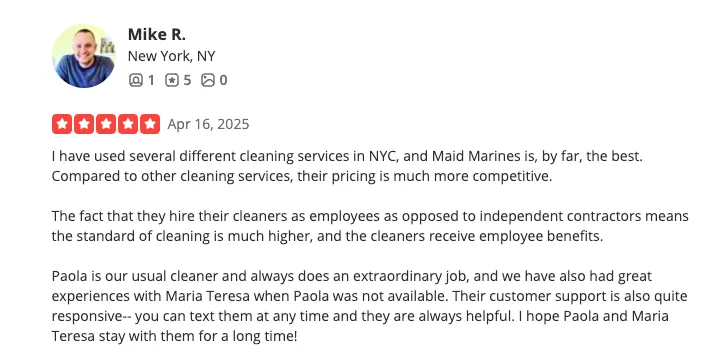
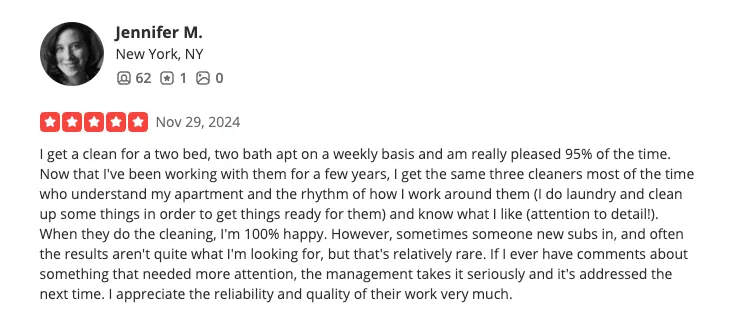
You book on our booking page, see your flat-rate price before committing, and tell us anything specific about your building or your home. Our cleaners are W-2 employees, not gig contractors. They are vetted and insured and they bring everything they need. If you are in a Victorian with original floors and you want us to stay off them with anything wet, we do that. If you are in a rowhouse with a two-family setup and you need both units done in the same visit, that is a standard request. If you are in an Ocean Parkway co-op that wants advance notice and a certificate of insurance before any vendor enters the building, we handle the paperwork.
We also cover cleaning across Brooklyn in neighborhoods near Kensington, including the adjacent streets that border Windsor Terrace, Ditmas Park, and Flatbush, so if you have family or friends in the surrounding blocks we are already in the area.