

Manhattan Beach does not behave like the rest of Brooklyn. The streets are named for English places. The houses sit on their own lots with front lawns and driveways. The Atlantic Ocean is two blocks from nearly everywhere you stand. The nearest subway is a bus ride away, and the neighborhood has never seemed particularly bothered by that fact. This is a place that decided a long time ago what it wanted to be, built itself accordingly, and has stayed that way for over a century.
The peninsula at the southern tip of Brooklyn is small enough to walk end to end in twenty minutes but dense enough in history that you could spend weeks untangling it. The streets going east from the western edge run Amherst, Beaumont, Coleridge, Dover, Exeter, Falmouth, Girard, Hastings, Irwin, Jaffray, Kensington, Langham, Mackenzie, Norfolk, Oxford, Pembroke. Sixteen streets in alphabetical order, all English names, running from the bay to the ocean on a triangular peninsula at the far edge of the city. It is the kind of street grid that makes you wonder who planned it and why, and the answer to both questions is the same man.
Austin Corbin built the resort and then his resort became the neighborhood
In 1877, a Connecticut railroad financier named Austin Corbin opened the Manhattan Beach Hotel on what had been undeveloped Atlantic shoreline. He had come to the area for his son’s health and stayed because he recognized what the land could become. The hotel was a sprawling wooden palace designed for the elite of New York society. Corbin controlled the railway that brought guests from Brooklyn, which meant he controlled the whole equation. The location was remote, the amenities were lavish, and the train could get you there in under an hour.
Three years later he built the Oriental Hotel at the eastern end of the peninsula. It ran nearly 700 feet long, housed 500 bedrooms, employed 600 staff members, and ran electric lights from basement generators at a time when electric light was still a novelty. The kitchens had an ice-making machine. The dining rooms could serve 2,000 people simultaneously. By the standards of the era, this was extraordinary.
The Manhattan Beach resort became a place where extraordinary things happened as a matter of routine. John Philip Sousa conducted his band here for multiple summer seasons in front of crowds that numbered in the tens of thousands. He was so taken with the place that he composed “The Manhattan Beach March” in 1893, one of the most celebrated march compositions in American musical history. In 1896, Thomas Edison sat in the Oriental Hotel at a dinner of the Association of Edison Illuminating Companies and met a young engineer from Detroit named Henry Ford. Edison encouraged Ford’s work on the internal combustion engine during that conversation. Ford described it decades later as a turning point that gave him confidence to continue his work. The hotel that witnessed this meeting was demolished in 1916. Its site is now the campus of Kingsborough Community College.
Corbin’s resort was also defined by a dark and well-documented distinction. He maintained explicit anti-Semitic exclusion policies, barring Jewish guests from his hotels and attaching restrictive covenants to real estate sales in the area. The policies were notorious in their day. The complete historical irony arrived within two generations: the neighborhood that Corbin specifically designed to exclude Jewish families became one of the most heavily Jewish residential enclaves in Brooklyn. Today the neighborhood’s Orthodox and non-Orthodox Jewish communities, the Sephardic Syrian Jewish families who arrived through the mid-20th century, and the Russian Jewish immigrant community that has been growing since the 1970s define much of the neighborhood’s institutional and cultural life.
The alphabetical streets and the brick houses that replaced the hotels
The resort era ended after World War I. The Manhattan Beach Hotel was demolished in 1911. The Oriental followed in 1916. The City of New York acquired much of the land and converted it into Manhattan Beach Park, which opened formally to the public in 1955 to relieve overcrowding at Coney Island and Brighton Beach. During the 1920s and 1930s, developers moved through the remaining lots and built the residential neighborhood that exists today.
The streets Corbin’s developers had laid out decades earlier were still there, still running in alphabetical order from Amherst to Pembroke, all named for English towns and figures. The new houses that went up on those lots took their character from the era of construction: brick colonials with symmetrical window arrangements and shuttered facades, Tudor revival houses with half-timbered gable ends and steeply pitched roofs, Mediterranean revival stucco homes with red tile roofs and arched windows that acknowledged the coastal setting. Cape Cod bungalows on the smaller lots, larger two-story brick houses with broad lawns on the blocks closest to Shore Boulevard.
The result is a housing stock that is coherent without being uniform. Walk Kensington Street from Oriental Boulevard down to Shore Boulevard and you will cross through houses that are recognizably from the same era and the same set of intentions, but different enough from each other that the block has texture. The brick is real brick, not veneer. The construction is from decades when materials were used at full depth. The bones of these houses are solid.

Jack Kirby, Marv Albert, and the quiet peninsula that shaped them
The people who grew up in Manhattan Beach and the surrounding neighborhoods of southern Brooklyn include a set of figures whose careers have almost nothing in common except the geography.
Jack Kirby co-created Captain America in 1940, nine months before the United States entered World War II. The first issue, published in March 1941, showed Captain America punching Adolf Hitler on the cover. Kirby, who grew up in southern Brooklyn, received death threats from American Nazi sympathizers. He also co-created the Fantastic Four, the X-Men, Black Panther, the New Gods, and dozens of other characters and concepts that defined the visual vocabulary of American superhero comics for fifty years. He invented what became known as the Kirby Krackle, the clusters of black dots he used to suggest cosmic energy, which is now one of the most referenced stylistic elements in comics illustration.
Marv Albert grew up in Manhattan Beach and learned basketball as a ball boy for the New York Knicks, connections made through the pick-up game culture at Manhattan Beach Park in the 1950s. His career spanned five decades. His call style became the soundtrack to the sport for a generation of fans.
Darren Aronofsky was born and raised in Manhattan Beach and went to Edward R. Murrow High School in nearby Sheepshead Bay before making Requiem for a Dream, The Wrestler, and Black Swan. Samuel Leibowitz, the defense attorney who successfully defended the Scottsboro Boys in one of the most consequential civil rights legal battles of the 20th century, lived on one of these quiet English-named blocks.
The peninsula is small. You can drive through it in five minutes on a light-traffic afternoon. The fact that it produced this particular set of people in the 20th century says something about what a quiet, self-contained neighborhood with an ocean at the end of the street can do for a certain kind of imagination.
Single-family homes from the 1940s require a different approach than Manhattan apartments
The house cleaning work in Manhattan Beach is almost entirely single-family homes, and that is a genuinely different kind of job than what we do in Astoria or Williamsburg. These are two-story houses with basements, multiple bathrooms, hardwood floors throughout, kitchens with full-sized appliances, and rear gardens that track dirt through the back door from April through November. The cleaning approach that works for a 750-square-foot one-bedroom in Greenpoint does not scale to a 2,400-square-foot brick colonial on Exeter Street.
The hardwood floors in the 1940s and 1950s Manhattan Beach houses have usually been refinished multiple times. The layers are real but they are not unlimited. We use a slightly damp microfiber flat mop with a pH-neutral cleaner. Nothing that leaves residue. Nothing acidic. Nothing that builds film on the grain over repeated applications. These are old floors and they deserve to be treated that way.
The kitchens in these houses are real kitchens that get used heavily, not galley spaces with two-burner cooktops. The grease accumulation behind a stove that has been cooking three or four times a week for years is serious. The tile grout between the backsplash and the countertop needs attention. The underside of the microwave, the inside of the oven, the coil drip pans if the range has those. We get into the kitchen the way a kitchen in active daily use needs to be cleaned.
Many Manhattan Beach homes have finished basements that function as family rooms, home offices, or extra bedrooms. They are not storage spaces with concrete floors. They are carpeted, furnished areas with their own bathrooms that need to be on the cleaning schedule just like the rooms above. We include them when you tell us they are there, and we ask at booking so nothing gets missed.
The Tudor revival houses with their half-timbered exteriors are visually distinctive, but the interior challenge is the low-clearance ceiling sections in the upper floors where the roofline cuts into the space. Reaching into the angles above a bed in a sloped attic-style bedroom takes a different body position and a different tool than cleaning a standard ceiling-height room. We know these spaces.
A deep clean for the houses that sit a mile from the ocean
Salt air is a real cleaning variable when you live a block from the Atlantic. The windows in Manhattan Beach houses face a marine environment, and the grime that accumulates on glass, frames, and window tracks in a coastal neighborhood is different in composition from interior city dust. The salt particles that come off the ocean accelerate oxidation on metal fixtures and leave a film on glass that resists standard cleaning. Interior glass is an add-on rather than part of a clean here, and on an ocean-facing window it earns its price: we treat it with a cleaner formulated to cut mineral deposits and rinse clean.
The front door and entry metalwork in these brick houses takes the same kind of punishment. Brass hardware oxidizes faster when it is a few hundred yards from open salt water. Bronze door knockers, kick plates, address numbers. These surfaces need periodic attention to stay looking like they belong on a well-maintained house.
Spring deep cleans are the most common request after a Manhattan Beach winter. The season between November and March brings Atlantic storms, sand from the park, and the kind of cold that keeps windows closed and dust circulating through the same air for months. A full deep clean in April or May covers the baseboards, the window tracks, the inside of closets, the spaces behind furniture that do not get reached during routine maintenance, and the radiator fins in houses that still run steam heat through the winter.
Pre-listing deep cleans are also a regular part of our work here. Manhattan Beach has one of the tightest real estate markets in Brooklyn. When a house on Langham Street comes available, buyers have usually been waiting. The listing photographs matter. The condition of the tile grout, the shine on the hardwood, the cleanliness of the kitchen appliances. We do pre-listing cleans as a deep clean format that covers all the surfaces that show in photography and show to buyers walking through.
While we clean, the beach is there
The specific pleasure of living in Manhattan Beach is that the Atlantic Ocean is two blocks away and Shore Boulevard is one of the best coastal walks in Brooklyn and almost nobody outside the neighborhood knows about it. On a weekend morning in October, when the summer crowds are gone and the light off the water is at its October best, you can walk the promenade from the western end of the park to the Kingsborough campus with the ocean on one side and the quiet residential streets on the other and barely see another person.
In summer that same walk fills with the families who have been coming here for generations, who stake their spots on the sand by 9 AM and stay through the afternoon. The park has been doing this since it opened to the public in 1955, and the rhythms of the beach season are as built into the neighborhood calendar as anything else.
The Kingsborough campus at the eastern end of the peninsula has 70 acres of waterfront grounds that are open to the public. The views from the eastern end, looking out over Sheepshead Bay with the Atlantic behind you, are remarkable for a college campus inside New York City. The college’s Marine and Academic Center stands approximately on the site where Thomas Edison first met Henry Ford in 1896.
Ten minutes east on Emmons Avenue, the Sheepshead Bay waterfront has some of the best accessible seafood in southern Brooklyn. Randazzo’s Clam Bar has been there since 1958. The boats tied up at the Sheepshead Bay docks are working fishing boats, and the restaurants along the waterfront take the local catch seriously. Walking the docks before dinner on a summer evening is a reliable way to spend an hour well.
A short walk west, Brighton Beach Avenue is one of the most distinctive commercial streets in the city. The Russian-speaking community that has anchored Brighton Beach since the 1970s has built a commercial strip that includes Eastern European bakeries with black bread in the window, smoked fish counters, Georgian restaurants, Turkish spots, and Russian super-restaurants that operate on a scale that makes Manhattan seem understated. This is all within walking distance of Manhattan Beach homes on the western side of the peninsula.
The apartment cleaning and house cleaning we do in Manhattan Beach gives you your Saturday back. The beach is there. The promenade is there. The Sheepshead Bay waterfront is there. Your time is worth more than grout scrubbing.
Book a clean and hand us the house
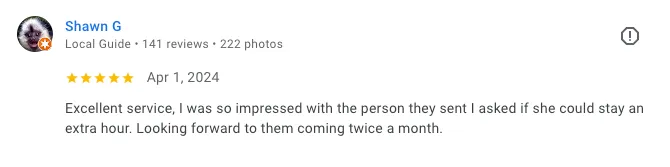
You book on our booking page, you get a flat-rate price before you commit anything, and we handle everything from there. Manhattan Beach is a neighborhood we serve regularly, and our teams know the drive out and the logistics of working in a place without direct subway access. We arrive with everything we need. There is no list of things to buy in advance.
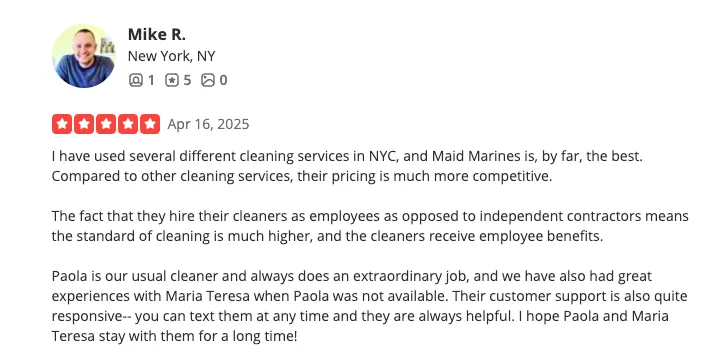
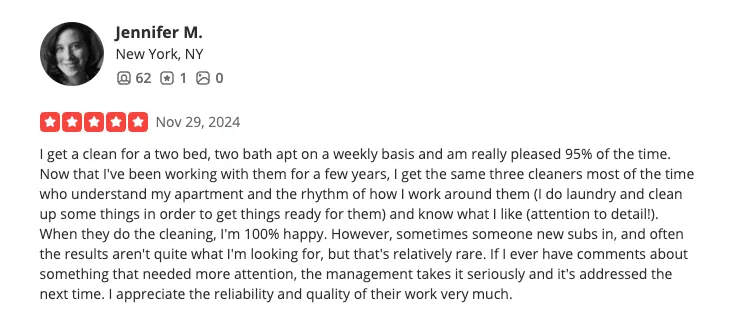
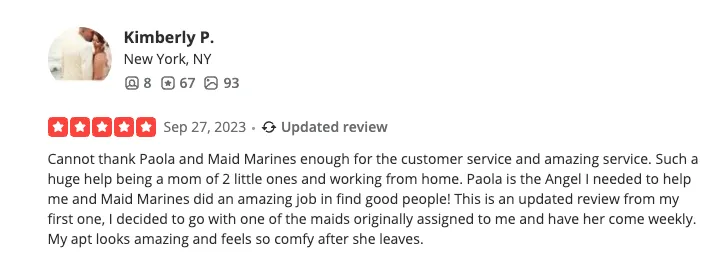
Our cleaners are W-2 employees, not gig-economy contractors. They are vetted, insured, and they work within a quality standard that is consistent from one visit to the next. If you have a specific floor type, a specific product preference, an area you want us to avoid, or a second bathroom that only gets used when family visits, you tell us once and it carries forward on your account.
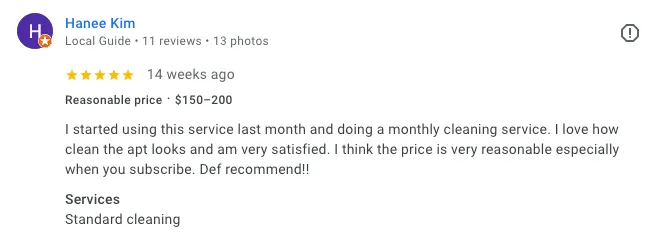
For homes that have not had a professional clean recently, we recommend starting with a deep clean and then moving to a regular schedule from there. The deep clean establishes the baseline. The recurring appointments maintain it. Most Manhattan Beach clients who book a first-time deep clean convert to a recurring schedule within the first two months. The math is straightforward once you see the difference.
We also do move-in and move-out cleaning for Manhattan Beach properties, which matters in a neighborhood where houses change hands at significant prices and both buyers and sellers have high expectations. A move-out clean that covers every surface, including the inside of every cabinet and every appliance, is a professional obligation to the next person who walks in. We treat it that way.
Nearby neighborhoods we also serve include Brighton Beach and Sheepshead Bay.