

Sheepshead Bay is the neighborhood that named itself after a fish, built one of the greatest horse racing venues in America on its marshland, fed more Brooklyn families than any other restaurant ever had, and then quietly got back to being a working-class waterfront community when the glamour moved on. The brick rowhouses on the blocks north of Emmons Avenue have been occupied continuously since the 1930s. The charter fishing boats at the piers have been going out since the 19th century. Walk down Sheepshead Bay Road toward the water on a Saturday morning and the salt air arrives before you see the bay, which is exactly how it has always worked.
This is also the neighborhood where Larry David grew up on East 14th Street, where Vince Lombardi walked to school, and where Louis Gossett Jr. learned whatever it was he learned before becoming the first Black man to win Best Supporting Actor at the Academy Awards. That is a remarkable output for a few square miles of attached rowhouses and co-op buildings in southern Brooklyn.
The housing in Sheepshead Bay goes three directions and each direction has its own cleaning logic
The neighborhood divides roughly by how you get to the water. The blocks closest to Emmons Avenue, along Avenue Y and Avenue Z, have the rowhouses the neighborhood is most known for. These are attached or semi-detached brick homes built between 1910 and 1955, two and three stories, with small front stoops, aluminum awnings on the windows, and detached garages in the back. They have been maintained by the same families in many cases for two and three generations. The kitchens and bathrooms in these homes often have original hex tile floors and cast-iron fixtures that require patience and the right products. You do not use abrasive pads on hex tile grout and you do not use acid-based cleaners on cast iron without knowing exactly what the finish is. We clean a lot of these houses and we know what they need.
Head north toward the subway station and the housing shifts to Art Deco apartment buildings from the 1930s and 1940s, the kind with geometric brick ornamentation, corner windows, and original terrazzo floors in the lobbies. Many of these converted to co-ops during the 1970s conversion boom and have been owner-occupied since. The apartments themselves are often one and two bedrooms with plaster walls, decent-sized kitchens, and the kind of bathroom tile work that looks period-correct and chips if you drop something heavy on it. These buildings have elevator access and most of them are reasonable about vendor scheduling. If your co-op board requires advance notice or a Certificate of Insurance, tell us when you book.
The third direction is east, toward Knapp Street and the blocks adjacent to Gerritsen Beach. Out here the housing opens up into detached single-family homes with yards, driveways, and in some cases full basements. This is the part of Sheepshead Bay that genuinely feels suburban, in the way that parts of Staten Island and eastern Queens feel suburban. Finished basements, garages, back gardens. Homes with 1,600 square feet on multiple levels. These are straightforward to quote once you tell us the full room count, including the basement, because the price is based on what you actually have.
A racetrack, a restaurant, and a fish with human teeth built the neighborhood’s identity
The sheepshead fish, after which the bay and the neighborhood are named, has human-looking teeth. Actual chisel-shaped front incisors and rounded rear molars that strongly resemble a sheep’s dental configuration, which is not something you expect from a marine animal. The fish was abundant enough in the bay’s brackish waters in the 19th century to give its name to the entire neighborhood. It is now almost never found in the bay, having been depleted by overfishing and habitat loss over the last century. The neighborhood remains named for a creature that can barely be found in the water it named.
The racetrack came in 1880. The Sheepshead Bay Race Track opened on the grounds north of what is now Avenue Z and immediately became one of the most prestigious venues in American thoroughbred racing. The Suburban Handicap, held here from 1884 to 1910, was considered the most important horse race in the United States at the time, more prestigious than the Kentucky Derby. Tens of thousands of people traveled to southern Brooklyn for the races. Gilded Age socialites, gamblers, and racing enthusiasts packed the grandstands.
The Hart-Agnew Act of 1908 banned racetrack betting in New York State. Without legal gambling the economics collapsed. By 1911 every New York track had closed. The Sheepshead Bay track ran briefly as an automobile racing venue, held some of the fastest speed records of the era, and was demolished in 1919. The grounds are now covered with the brick rowhouses that make up the neighborhood’s residential core. Nothing physical survives. The only trace is in the addresses.
Then came Lundy Brothers. Irving and Fred Lundy opened their restaurant at 1901-1931 Emmons Avenue in 1934 in a purpose-built Spanish Colonial Revival building with sand-colored stucco walls, red Mission tile roofs, wide arched entrances, and decorative wrought ironwork. The building spans nearly half a block and the restaurant inside it could seat over 2,800 diners at its peak. On summer Sundays in the 1940s and 1950s, Lundy’s was the highest-volume restaurant in the United States. Lines wrapped around the block. The formula was simple: cheap seafood, enormous portions, cash only, no reservations. Generations of Brooklyn families came here for clam chowder and lobster after a day on the boats or at the beach. Lundy’s closed in 1979. The building was designated a New York City Landmark in 1992. It currently houses a supermarket, which is the kind of ending that would have made perfect material for Larry David.

What a deep cleaning in Sheepshead Bay actually involves
Most homes in Sheepshead Bay have been occupied continuously for decades. These are not flip properties or luxury renovation projects. They are lived-in homes that have accumulated the kind of thorough cleaning needs that come from actual use over actual time.
The rowhouses have cast-iron radiators that run hot in winter. They accumulate dust from April through October while the heat is off, and when the steam kicks on in November that dust burns and fills the apartment with a smell you cannot ignore. Most cleaning services work around the radiator entirely. We dust it on every visit, along with the window AC unit and the vent covers, so there is less of it waiting there in November. If your rowhouse has had the same radiators since the 1940s, they need that attention at least once before heating season.
Kitchen range hoods in these homes get a serious workout. Sheepshead Bay has one of the most diverse cooking populations in Brooklyn. Russian families cooking borscht and sauteing vegetables. Chinese families running woks at high heat. Uzbek households making plov. Central Asian families deep-frying samsa. Every one of these cooking traditions creates grease and oil accumulation on range hood filters and backsplashes at a pace that standard weekly cleaning does not fully address. A proper deep clean means degreasing the range hood filter, cleaning the interior of the hood, and addressing the grease film on the backsplash tile behind and beside the stove.
The bathrooms in 1930s and 1940s apartments typically have small hex tile floors and subway tile walls with original grout lines that have been re-grouted, painted over, or both at various points over the last 80 years. This grout is porous and stains faster than modern sealed grout. We clean it with an appropriate grout brush and a non-bleach tile cleaner that lifts the staining without eroding the grout itself. If your bathroom grout is black, that is surface staining in most cases, not permanent damage. It takes longer to address than a younger bathroom but it responds to the right approach.
A neighborhood that crossed immigration waves and a hurricane and kept facing the water
Sheepshead Bay’s demographic history is a compressed version of New York immigration across 150 years. The Canarsie people fished the bay long before European settlement. The Dutch West India Company arrived in the 1630s. The English settlement of Gravesend was established in 1645 by Lady Deborah Moody, who had fled religious persecution in England and Massachusetts and established the only English-chartered town in the original Dutch colony. The bay’s southern shoreline was at the eastern edge of that land grant.
The fashionable resort period arrived in the 1870s with the completion of Ocean Avenue and the Long Island Rail Road’s Manhattan Beach Branch. Grand hotels rose along the waterfront, the Manhattan Beach Hotel and the Oriental Hotel becoming the most celebrated summer destinations for New York’s wealthy elite. The racetrack followed. Then the hotels closed, the racetrack was demolished, and the middle-class families moved in on the new subway lines. The BMT Brighton Line extension to Sheepshead Bay in 1908 made the neighborhood accessible to people who worked in Manhattan and wanted to live near the water without paying Manhattan prices.
The post-Soviet immigration wave that began in the 1970s and accelerated through the 1990s brought Russians, Ukrainians, Georgians, Uzbeks, and other communities from across the former Soviet Union. They were drawn by the proximity to Brighton Beach, the supply of affordable co-op apartments, and the existing Eastern European social infrastructure. Today Russian is heard on Emmons Avenue almost as commonly as English. Chinese immigration settled into the northern commercial sections near Avenue U, creating a dense corridor of Fujianese, Cantonese, and Sichuan restaurants and businesses. Turkish, Bangladeshi, and Central Asian communities added further layers.
Hurricane Sandy hit on October 29, 2012. The storm surge pushed water across Emmons Avenue and into the residential blocks behind it. Fishing boats ended up on the street. Homes flooded. The marina was damaged. Sheepshead Bay became one of the focal points for post-Sandy coastal resilience planning in Brooklyn, and the neighborhood spent the following years rebuilding, reinforcing drainage, and arguing with the city about flood barriers. The waterfront survived. The boats came back. The restaurants reopened.

While we clean, Emmons Avenue is waiting for you
Sheepshead Bay’s great civic gift is Emmons Avenue. It runs east-west along the entire northern edge of the bay, lined with marinas, charter fishing boat docks, restaurants, and the wide esplanade promenade facing the water. On a weekend morning when the charter boats are loading bait, the smell of salt water and diesel and fried seafood arrives together and the street becomes something that does not exist in most of New York. You can sit on a bench with coffee and watch the boats head out. You can walk the full length of the esplanade and back. You can eat at Randazzo’s, which has been serving clam chowder at 2017 Emmons Avenue since 1928.
Roll-N-Roaster at 2901 Emmons Avenue has been roasting beef sandwiches since 1970 and shows no interest in becoming anything other than exactly what it is. Brennan and Carr on Nostrand Avenue has been open since 1938. The original double-dipped roast beef sandwich is unchanged. These are the kinds of places that the neighborhood treats as infrastructure rather than dining destinations, which is the highest compliment you can give a restaurant.
The Ocean Avenue Pedestrian Bridge crosses the bay and connects directly to the Ocean Parkway bicycle path and the Brighton Beach boardwalk. Walk across and keep going toward the ocean. Brighton Beach, a short walk or bike ride away, has its own full universe of Russian bakeries, Black Sea fish restaurants, and boardwalk vendors. The two neighborhoods bleed into each other geographically and culturally and function as a single extended community for most purposes.
Your cleaning takes about three hours. That is enough time to walk to Emmons Avenue, eat lunch at Randazzo’s, walk the esplanade to the pedestrian bridge, cross to the Ocean Parkway path, and be back before we are done. If you want to be farther from home, Aviator Sports at the old Floyd Bennett Field hangars on Flatbush Avenue has ice skating, rock climbing, and an arena that fills an afternoon easily. Your Saturday is better spent any of those ways than scrubbing grout in a bathroom that we can handle for you.
Booking a cleaning in Sheepshead Bay
You pick your date and time on our booking page. You see your flat-rate price before you commit. The price is based on bedrooms, bathrooms, and square footage. A two-bedroom co-op on Ocean Avenue and a detached three-bedroom house near Knapp Street with a finished basement will be priced differently, so tell us what you actually have.
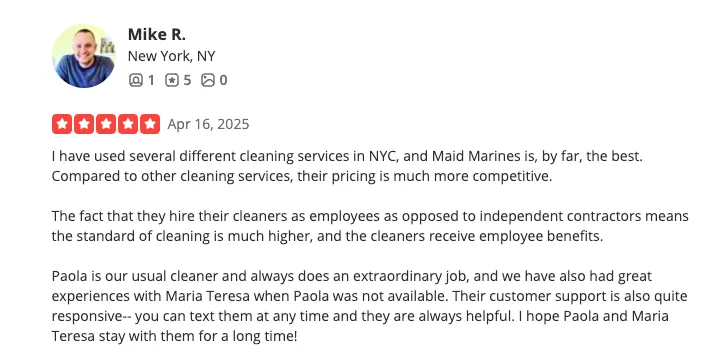
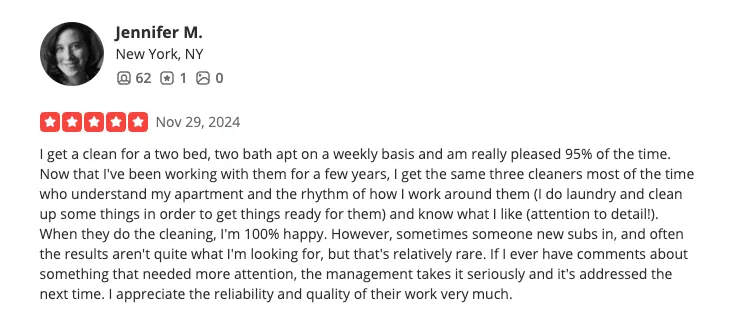
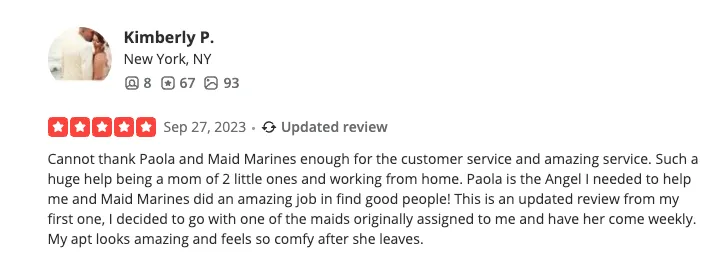
Our cleaners are W-2 employees, not gig workers. They are vetted, insured, and they arrive with everything they need. If your building requires advance notice for vendors, tell us once and we handle it. If you want a Russian-speaking team, mention it at booking. If your rowhouse has something specific about the floors or the radiators that the last service got wrong, tell us before the first appointment and we will not repeat the mistake.
Sheepshead Bay residents also use us for apartment cleaning on a recurring schedule, deep cleaning before or after renovation work, and move-in and move-out cleaning for the neighborhood’s active housing market. We also serve nearby Brighton Beach and Gravesend. If you are looking for a broader overview of what we do across the borough, our Brooklyn cleaning services page covers all of it.