
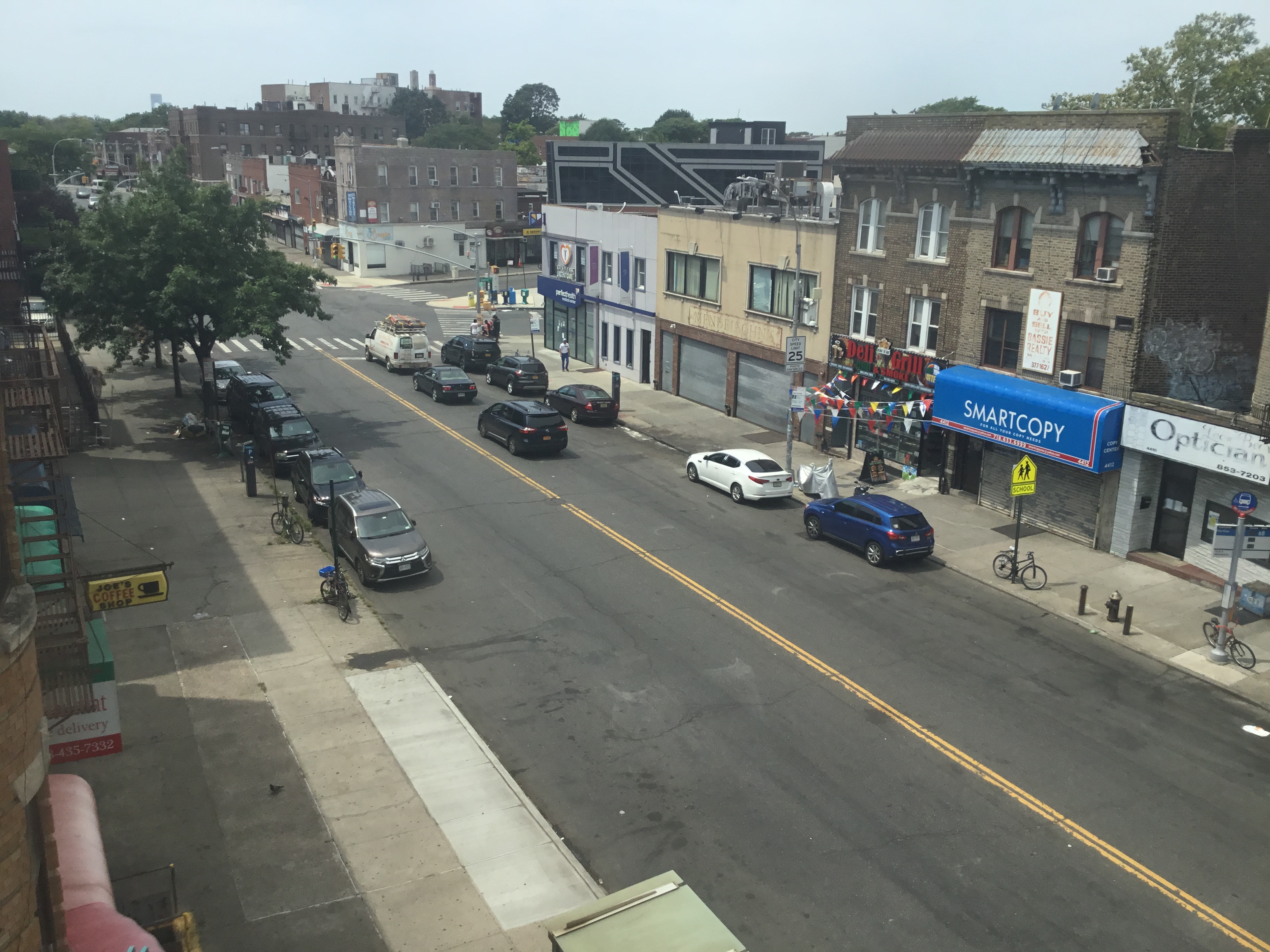
Mapleton went from open farmland to a completely built neighborhood in less than a decade, and you can still see the speed of that transformation in the physical fabric of the place. The two-family brick homes that line the side streets between 18th Avenue and Bay Parkway were built almost simultaneously, between roughly 1912 and 1930, on 30-by-100-foot lots that developers subdivided as fast as the Sea Beach Line crews laid track. When the N train opened in June 1915, it found a neighborhood already largely framed out and waiting. Mapleton is the product of a single sustained development moment, and the homes it produced have been housing southern Brooklyn families ever since.
That century of continuous family occupancy is what defines Mapleton’s cleaning context. These are not buildings that have been renovated into open-plan showrooms. They are working two-family homes where the upstairs owner and the downstairs renter have different cleaning schedules, different standards, and sometimes different relationships with professional services. The plaster walls collect dust in their own particular way. The wood floors have been refinished multiple times over a hundred years and carry that history in their finish. The kitchens in the original units are narrow and efficient, designed when kitchens were functional rooms rather than lifestyle statements.
How a subway line built an entire neighborhood in under ten years
The story of Mapleton begins not with buildings but with a transit decision. In the early 1910s, the BMT Sea Beach Line was being routed south through Brooklyn toward Coney Island, and the path passed through land that developers recognized immediately as an opportunity. Farmland adjacent to incoming subway infrastructure was valuable in a way that farmland without it simply was not. By 1915, when the line opened with stations at 18th Avenue, 20th Avenue, and Bay Parkway, the surrounding blocks were already densely packed with two-story brick semi-detached homes in Colonial and Neo-Renaissance styles.
The neighborhood’s name came earlier still, around 1903-1905, when developers began formally subdividing the old farmland of the Town of New Utrecht. The name Mapleton was pure marketing — an evocation of maple trees, pastoral Americana, and the aspirational suburban character they wanted buyers to associate with the place. There were no notable maple trees. The name was chosen to sell a vision of Brooklyn as a green refuge from Manhattan’s density, to working-class and immigrant families who could now imagine owning a proper two-family home on a proper street. The pitch worked. The neighborhood filled in almost overnight.
The Sea Beach Line stations in Mapleton served 4,000 passengers daily by December 1915, just six months after opening. That number captures the pace of the whole operation: farmland to transit-served residential neighborhood to functioning commuter community in roughly five years. The N train still runs the same route today, still serving the descendants of those original immigrant families and the newer waves who came after them.
The housing stock that cleaning services need to understand
Mapleton’s dominant building type is the two-family brick semi-detached home, and it comes with cleaning requirements that differ meaningfully from the brownstones of Park Slope or the high-rise apartments of Long Island City. These homes were built on narrow lots with compact floor plans designed for family life rather than for entertaining. The plaster walls are thick and durable but they hold dust differently than drywall. The original hardwood floors have often been refinished multiple times and may have layers of different finishes coexisting on the same boards. The moldings in older units carry a century’s worth of paint and need soft-bristle attention rather than aggressive scrubbing.
The two-unit structure creates a particular service dynamic. Many Mapleton homes are owner-occupied on one floor and rented on the other. The owner unit tends to be cleaned to a higher standard and on a more consistent schedule. The rental unit gets professional attention at move-out time and sometimes between tenancies. Our apartment cleaning service handles both configurations, with pricing per unit based on actual square footage so there are no surprises when it comes to the downstairs apartment after finishing the upstairs.
The pre-war mid-rise co-op buildings along 18th Avenue and Bay Parkway add a different layer. These five-story brick elevator buildings from the 1920s and 1930s have thicker walls, higher ceilings, and more ornate common areas than anything built after 1960. The apartments within them tend to be larger than their floor plans suggest, with rooms that feel like actual rooms. Co-op buildings in this part of Brooklyn sometimes require advance notice for vendors and may ask for a Certificate of Insurance. We provide that documentation before the first appointment and coordinate with building management as needed.
Eighteen years of serving over 100,000 homes across New York City
Maid Marines has cleaned over 100,000 homes across the five boroughs, and southern Brooklyn’s two-family home neighborhoods are well-represented in that number. The cleaning challenges specific to this part of Brooklyn — plaster dust, vintage woodwork, the narrow kitchens of pre-war construction, the particular challenges of walk-up apartments in buildings without elevators — are familiar to our teams in a way that only repeated experience produces. Our cleaners are W-2 employees who train on the full range of New York City housing stock, not gig workers dispatched from an app who may or may not have cleaned a 1920s Brooklyn two-family before.
For house cleaning in Mapleton, the standard approach covers all horizontal surfaces, bathroom fixtures, kitchen surfaces and appliances, floors throughout, and the interior details that accumulate grime over time: baseboards, door frames, and the dust that collects on top of door moldings in century-old plaster construction. Recurring service at two- or four-week intervals keeps the dust cycle manageable rather than letting it build to the point where a session becomes a project.
The 18th Avenue corridor as a map of the neighborhood’s immigrant history
The commercial strip running north-south through Mapleton along 18th Avenue is one of the more honest documents of immigrant succession in Brooklyn. J&V Pizzeria has been operating here since 1950, when the neighborhood was still predominantly Italian-American. It survived the departure of those families in the 1960s and 1970s, the arrival of Albanian, Soviet, and Middle Eastern immigrants in the 1980s and 1990s, and the growth of the Chinese community in the 2000s. It still serves the same pizza it has always served.
On the same blocks: Djerdan Burek, the Albanian bakery where the phyllo pastry is made in-house; Si n’shpi, the family-run restaurant where the menu reflects actual Albanian culinary tradition; kosher delis serving the Orthodox Jewish community; Chinese restaurants representing Fujianese and Cantonese cooking; Asian grocery stores; halal markets. These businesses coexist without particular tension because the neighborhood has been absorbing waves of new residents for over a century and has developed the institutional tolerance that comes from long practice. The Columbus Day parade and the Sukkot children’s carnival happen on the same commercial strip two weeks apart, with Albanian and Chinese businesses on either side of both.
Washington Cemetery anchors the neighborhood’s southeastern corner, 100 acres of Jewish burial ground established in 1850 that now functions as one of the largest open spaces in all of southern Brooklyn. Franklin Delano Roosevelt High School, built in 1965 at 20th Avenue and 59th Street, produced Vinnie Johnson, the Detroit Pistons guard who won back-to-back NBA championships in 1989 and 1990, and Alexander Vindman, the Army lieutenant colonel who grew up in Mapleton after his family immigrated from Soviet Ukraine and went on to testify at the 2019 presidential impeachment hearings. Both stories follow the same Mapleton arc: arrive as immigrants, build a life in the neighborhood’s two-family homes, accomplish something the neighborhood can point to.
Deep cleaning and move-out work for a neighborhood with active rental turnover
Mapleton’s rental market is active in the way that transit-served outer Brooklyn neighborhoods tend to be. One-bedroom apartments rent for approximately $1,500 to $1,900 per month, which is modestly below the Brooklyn average for comparable transit access, and turnover happens regularly. Move-out deep cleaning in a Mapleton walk-up apartment means cleaning inside every cabinet and closet, scrubbing bathroom tile and grout, cleaning oven interiors and refrigerator shelves, and bringing every floor surface to the condition a landlord expects when returning a security deposit. We provide a receipt with the service details and date for every appointment.
Move-in cleaning for new tenants covers the same scope from the opposite direction: clearing whatever the previous occupant left behind and making a space feel genuinely clean before moving furniture in. In pre-war buildings where the kitchen tile and bathroom fixtures date to the original construction, the cleaning approach needs to match the materials. Acidic products on old tile grout cause damage that is not easily repaired. We use pH-neutral cleaners on vintage ceramic and the appropriate product on each surface rather than the same all-purpose spray on everything.
Booking a cleaning in Mapleton
You book on our booking page, see your flat-rate price based on bedrooms, bathrooms, and square footage before you commit to anything, and choose your date and time from available slots. Most Mapleton appointments are available within one to three days. Saturday morning slots fill first in this part of Brooklyn, so booking three to five days ahead gives you the best selection.
If your building requires a Certificate of Insurance or advance vendor notice, note it in the booking instructions and we handle the documentation before the first appointment. If you have an owner unit and a rental unit to coordinate, we schedule them however makes sense for your situation. The recurring appointment assigns the same cleaner to your home so the building relationship, the pet’s comfort level, and the cleaning standards all stay consistent visit to visit.
We also serve nearby Bensonhurst, Borough Park, Midwood, Gravesend, and the rest of Brooklyn.