

Prospect Lefferts Gardens has a secret that most of Brooklyn has not found yet. The blocks east of Prospect Park between Empire Boulevard and Clarkson Avenue contain some of the most intact, most architecturally distinguished prewar residential streets in the entire city. Limestone rowhouses with original ironwork. Elm canopy so mature it forms a tunnel over the street. Deep setbacks that make the neighborhood feel suburban in scale three miles from Barclays Center. And nearly 90 percent of the residential buildings were put up before 1939, which means the floors, the radiators, the tile, and the millwork in most PLG apartments and rowhouses are old enough to require real knowledge to clean without causing damage.
The 1893 covenants that froze a neighborhood in time
The Lefferts Manor Company was founded in 1893 to develop approximately 600 lots purchased from the Lefferts family estate, which had farmed this land as part of the Dutch colonial Town of Flatbush since the 1600s. The developers imposed restrictive covenants on every lot they sold, specifying that all construction must be brick or stone, that buildings must be detached or semi-detached, that a minimum two-story height was required, and that no commercial use was permitted on any residential block. Deep setbacks from the street were mandatory.
Those covenants produced the neighborhood you can walk through today. Neo-Federal rowhouses with classical cornices and symmetrical brick facades. Renaissance Revival townhouses with rusticated stone bases and arched windows. Queen Anne semi-detached homes with wraparound porches and decorative shingles. On Chester Court, a private cul-de-sac off Flatbush Avenue near Rutland Road, 18 Tudor Revival townhouses are arranged around a shared courtyard in one of the most unusual residential configurations in Brooklyn. On Ocean Avenue, 12 brick and limestone townhouses face Prospect Park directly, forming the Ocean on the Park Historic District designated in 2009.
The New York City Landmarks Preservation Commission designated the Prospect Lefferts Gardens Historic District in 1979, protecting the Lefferts Manor blocks from demolition and exterior alteration. Chester Court received its own designation in 2014. Three separate landmark districts in a single neighborhood is unusual even among the most architecturally significant areas in Brooklyn, and it reflects how much there is to protect here.
The Lefferts family itself has a more complicated story. Peter Lefferts and his descendants farmed this land with enslaved labor for generations. The Lefferts Homestead, the 1783 Dutch colonial farmhouse built after the original was burned during the Revolutionary War to prevent British use, now stands inside Prospect Park as a free museum with programming that addresses this history directly. The family name is on the neighborhood, the historic district, the avenue, and the museum, and the full weight of what that name carries is now part of the public record.
Prewar limestone and century-old parquet are not cleaned the same way as modern apartments
The housing stock in PLG creates a specific set of cleaning requirements that a service working out of a template will get wrong. Walk the blocks between Flatbush Avenue and Bedford Avenue and most of what you are looking at dates to 1900 through 1935. That is not an abstraction. It means original hardwood floors finished with shellac or wax rather than polyurethane. Cast-iron radiators with fins that trap dust and burn it off when steam heat kicks on. Plaster walls that respond differently to moisture than drywall. Tile grout in kitchens and bathrooms that is old enough to be brittle if you hit it with bleach repeatedly.
Parquet laid in the 1920s gets a barely damp microfiber mop with a pH-neutral wood cleaner, nothing wetter. Water on old waxed parquet does visible damage faster than almost anything else. Cast-iron radiators, window AC units, and vent covers all get dusted, which is the part most services leave alone until someone complains about the smell in October. Bathroom tile gets non-acidic grout cleaner to preserve the sealer, which is already under pressure from a hundred years of use.
The apartment buildings along Flatbush Avenue and Rogers Avenue are a related but distinct category. The four-to-six-story prewar brick buildings in this corridor were built for the working middle class and they have the characteristic features of that construction type: lobby tile work, generous window proportions, and units that are large by New York standards. The kitchens in these apartments absorb decades of cooking residue in ways that modern kitchens do not, and the range hood and the walls behind the stove often need dedicated attention before recurring house cleaning can maintain them on a regular schedule.

Caribbean Brooklyn and the Flatbush Avenue corridor
Beginning in the postwar era, West Indian immigrants from Barbados, Trinidad and Tobago, Jamaica, Guyana, and Haiti began settling in PLG, drawn by affordable rents, proximity to church communities, and kinship ties with earlier arrivals. By the 1980s the neighborhood was predominantly Black and Caribbean-American, and the Flatbush Avenue corridor had become one of the most authentic Caribbean commercial strips in Brooklyn.
That corridor is still the neighborhood’s true public room. Peppa’s Jerk Chicken at 738 Flatbush Avenue is the most obvious landmark: wood-smoked jerk chicken that you can smell from half a block away, counter service, no frills, a following that has been showing up for decades. Ali’s Trinidad Roti Shop serves roti, doubles, and curry in the Trinidadian tradition. Lloyd’s Carrot Cake has been selling dense, spiced slices from the same narrow storefront through every phase of the neighborhood’s evolution. West African food stalls, Haitian bakeries, and Bangladeshi grocers fill out a Flatbush Avenue streetscape that is not curated for visitors and does not need to be.
The official name “Prospect Lefferts Gardens” was coined in 1968 by the Prospect Lefferts Gardens Neighborhood Association as a deliberate rebranding strategy, combining the park, the family name, and the garden-style housing to distinguish the area from the broader Flatbush designation. The name stuck within a decade. The PLGNA remains active today as a force in neighborhood organizing, alongside Equality for FlatBush, a 12-year-old anti-displacement organization that has been pushing back against rapid gentrification pressure since the mid-2010s.
The neighborhood’s demographic shift is real and documented. Rents have more than doubled since 2010. New restaurants, wine bars, and specialty coffee shops have opened along Flatbush and Rogers Avenues. Risbo, the Michelin-Recommended French rotisserie on Flatbush Avenue, draws diners from across Brooklyn. Glady’s on Franklin Avenue serves Caribbean-inspired food with a natural wine list. The neighborhood is in active transition, and the tension between its historic Caribbean-American character and the incoming demographic change is visible and palpable on any given Saturday afternoon on Flatbush.
Deep cleaning for rowhouses that have been rentals for generations
Lefferts Manor rowhouses and the prewar apartment buildings in PLG move through the rental market with some regularity, and the state in which they arrive can vary significantly. A move-in and move-out cleaning on a property that has been a rental for years is a different undertaking than a standard recurring clean. The range hood filter has usually been ignored through multiple tenancies. The bathroom caulk lines tend to accumulate mold at the seams. The window tracks hold years of dirt and dead insects. The inside tops of kitchen cabinets are coated in grease film.
We work through these properties systematically from the ceiling down: light fixtures and ceiling fans first, then shelves and the insides of every cabinet and drawer, then countertops and appliances, then floors. For a Lefferts Manor rowhouse with three stories plus a garden level, that is a full-day deep cleaning before a recurring schedule makes sense. We will tell you that upfront rather than showing up with a three-hour window and not getting through the house.
The same principle applies to apartments in the prewar elevator buildings on Rogers Avenue and Ocean Avenue that have had long-term tenants. The underlying surfaces are good, often excellent, but they need a proper reset before routine maintenance can keep them that way.

Your cleaning runs about three hours, and the park is right there
PLG has Prospect Park as its western border, which means you have 585 acres of Olmsted and Vaux designed landscape accessible on foot during a cleaning appointment. The southern entrance at Ocean Avenue and Parkside Avenue puts you on the Long Meadow directly. The Lefferts Historic House is inside the park near the Flatbush Avenue entrance, free and open to the public with Dutch colonial farmhouse interiors and rotating programming. The Prospect Park Boathouse opens each spring at the lake near the Willink entrance.
If you are staying closer to the neighborhood, Flatbush Avenue rewards a few hours of walking. Lloyd’s has the carrot cake. Peppa’s has the jerk. Ali’s has the roti. Risbo has a garden courtyard that is worth sitting in when the weather cooperates. The Maple Street Community Garden at Flatbush and Maple offers a quieter option if you want to be outside without navigating the full park.
The apartment cleaning window for most PLG apartments runs two to three hours. The house cleaning window for a full Lefferts Manor rowhouse runs longer. Either way, the neighborhood gives you useful things to do while we work.
What booking looks like for PLG
You pick your date and time on our booking page. You see your flat-rate price before you commit, based on bedrooms, bathrooms, and square footage. If your building or your landlord has access rules, you tell us once and we handle it from there.
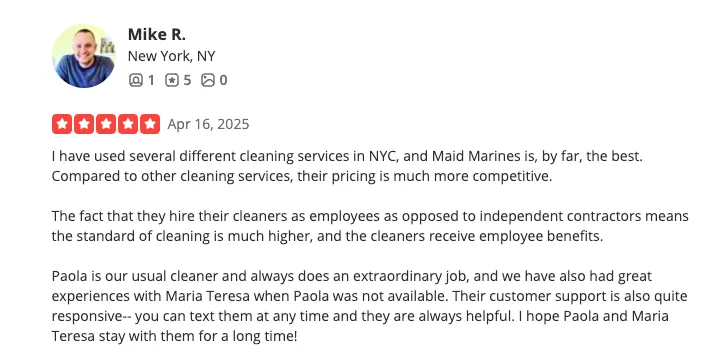
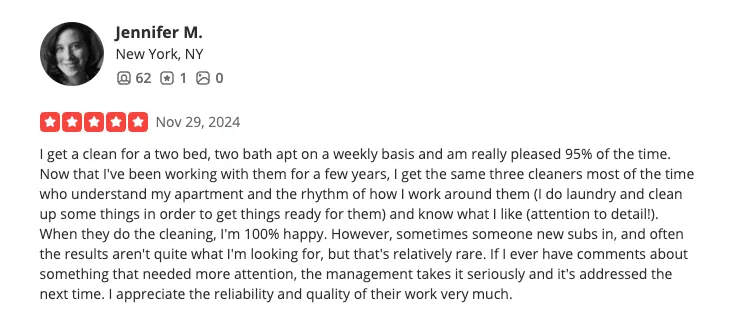
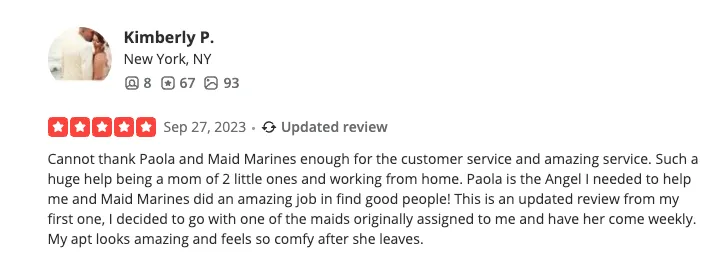
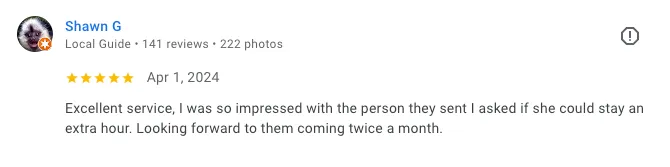
Our cleaners are W-2 employees, not gig workers. They are vetted, insured, and trained for prewar surfaces. The parquet on Rutland Road and the vintage tile on Rogers Avenue are not mysteries to us. If you want us to stay away from something specific, that goes in your account notes and stays there.
PLG residents use us for recurring weekly or biweekly maintenance, for deep cleaning before and after renovation work, and for move-in and move-out cleaning for the neighborhood’s active rental market. We also serve the surrounding neighborhoods of Flatbush, Crown Heights, and Prospect Heights.
The B and Q trains stop at Prospect Park station on Ocean Avenue, and the 2 and 5 trains stop at Sterling Street on Nostrand Avenue. Our teams get here. PLG is not a neighborhood that requires explanation about where it is or whether it is worth the trip.