

The blocks between Macon Street and Decatur Street, between Tompkins Avenue and Malcolm X Boulevard, contain what the Landmarks Preservation Commission has called one of the finest concentrations of intact Victorian residential architecture in the United States. That designation is not a real estate flourish. It is the reason more than 400 buildings on 12 consecutive blocks have been protected since 1971 from the demolition and inappropriate alteration that has erased equivalent building stock in dozens of other American neighborhoods. Walk those blocks today and you are walking through a cityscape that a developer named Curtis L. North began building in 1872, and that has survived everything New York has thrown at it.
Stuyvesant Heights is Bedford-Stuyvesant at its most concentrated and its most architecturally coherent. Where the broader Bed-Stuy neighborhood spans an enormous swath of north-central Brooklyn, Stuyvesant Heights is the smaller thing inside it: the historic district core, the brownstone rows that define the neighborhood’s visual identity, the streets whose names have become shorthand for a particular idea of what Brooklyn looks like. Stuyvesant Avenue, Lewis Avenue, Halsey Street, MacDonough Street. These are not abstractions. They are specific blocks of specific buildings, and the people who live on them know the ironwork on their neighbors’ stoops the way other people know their neighbors’ names.
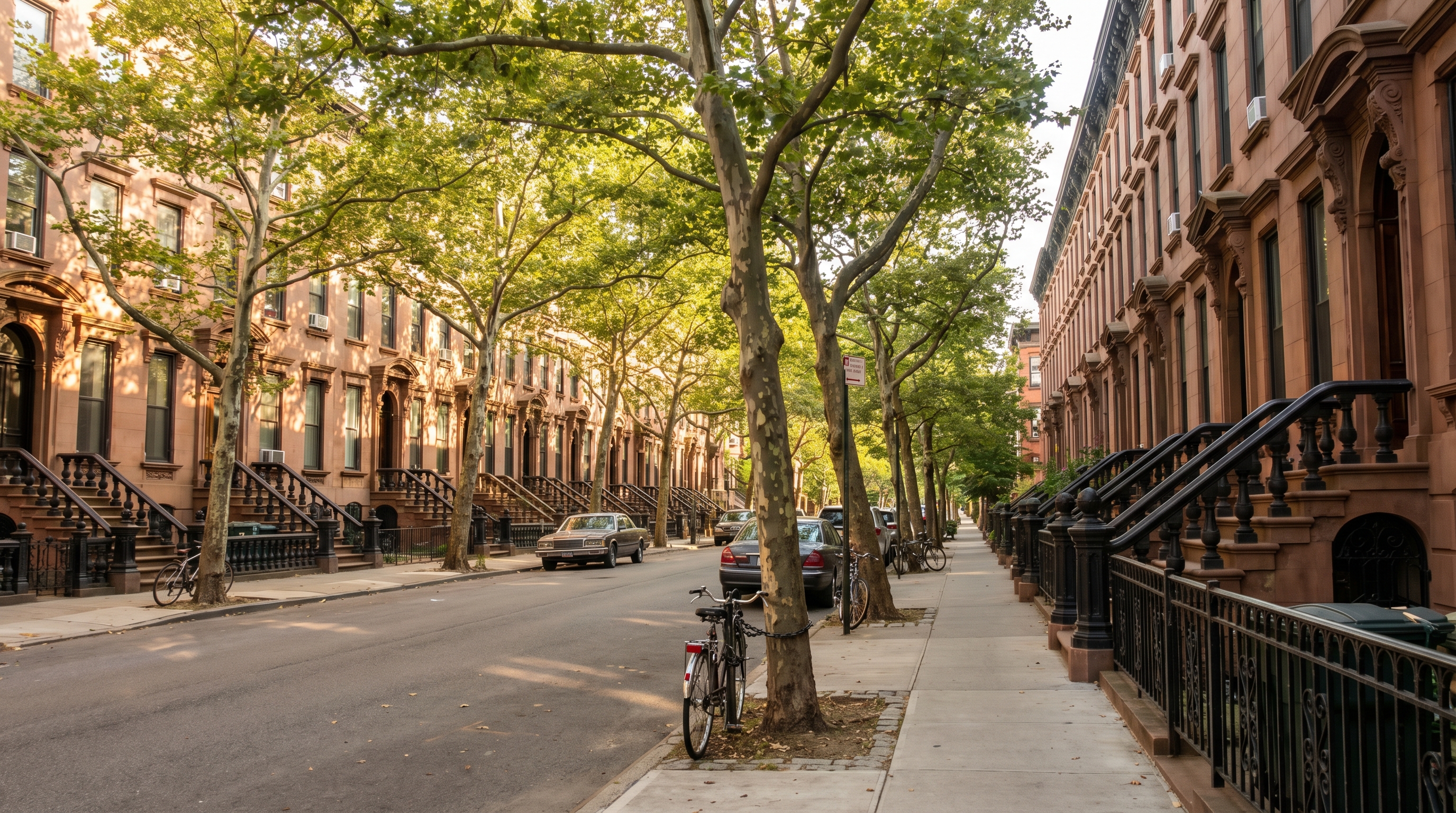
The founding of a neighborhood started on MacDonough Street in 1872
Before 1872, the elevated terrain of what would become Stuyvesant Heights was agricultural land. Brooklyn’s grid had been surveyed across this territory for decades, but the interior, without convenient water access, developed more slowly than the waterfront neighborhoods. The catalytic event was the completion of elevated rail connections to downtown Brooklyn, which made the gentle rise of Stuyvesant Heights accessible to the middle-class commuters developers were targeting.
Curtis L. North built the first masonry rowhouses in this section on MacDonough Street in 1872. That single development launched a construction episode that would fill in all 12 blocks of what is now the Historic District by approximately 1910. The architects who worked this territory, Magnus Dahlander among the most prolific, moved through a succession of styles that trace the whole arc of late Victorian residential taste. The Italianate houses from the early 1870s have curved lintels and bracketed cornices with Mediterranean richness. The Neo-Grec houses that followed in the 1870s and 1880s shifted to incised geometric ornament and spare classical restraint. The Queen Anne houses of the 1880s through 1900s broke into exuberant terra-cotta panels, polychrome brickwork, and asymmetrical bays. The Romanesque Revival houses that appear on blocks like Hancock and Halsey carry the massive rock-faced stone fronts and heavy rounded arches that mark H.H. Richardson’s influence on Brooklyn’s most ambitious residential buildings.
What these houses share is the material they are made of: the brown Triassic sandstone quarried in New Jersey and Connecticut that gives brownstone rowhouses their name and their warm, distinctive color. The typical Stuyvesant Heights brownstone rises three to four stories above a parlor floor elevated by a stoop of 8 to 12 steps. Ceilings on the parlor floor run 12 to 14 feet. The carved lintels, ornamental door surrounds, and rusticated stone bases are the work of craftsmen who were designing for a middle-class market that expected visual evidence of quality. The result is a streetscape that manages to be both coherent, because these buildings are all playing the same architectural game, and extraordinarily varied, because each decade brought different rules.
House cleaning for landmarked brownstones means knowing what you cannot do as much as what you can
The 1971 Landmarks Preservation Commission designation of the Stuyvesant Heights Historic District protects the exteriors of these buildings from inappropriate alteration. It does not protect the interiors. What protects the interiors, imperfectly, is a cleaning service that understands what it is looking at.
The parlor floors of unrenovated or carefully restored Stuyvesant Heights brownstones are among the most material-specific environments in residential Brooklyn. Original wide-plank hardwood floors, often old-growth heart pine or oak, frequently carry wax finishes that predate polyurethane and that water and harsh cleaners will permanently damage. Marble fireplace mantels, present in virtually every parlor floor in the Historic District, are porous stone that acidic products, including vinegar-based cleaners and most tile sprays, will etch and discolor. Carved plaster ceiling medallions and cornices will push dirt deeper into their crevices if you wipe them with a damp cloth. They need a dry soft brush. The Victorian hex tile in original bathrooms has grout that cannot tolerate acid.
Our house cleaning teams carry separate products for hardwood, stone, tile, and plaster surfaces and actually switch between them as they move through a house. They clean top-down so dust does not settle on already-cleaned floors below. The cast-iron radiators that appear on every floor of these buildings get attention between the fins, not just across the top, because the dust packed inside is what burns off in October when the steam heat returns. These are not special procedures reserved for premium packages. They are the standard we apply to every brownstone we work in, because anything less is not actually cleaning the house.
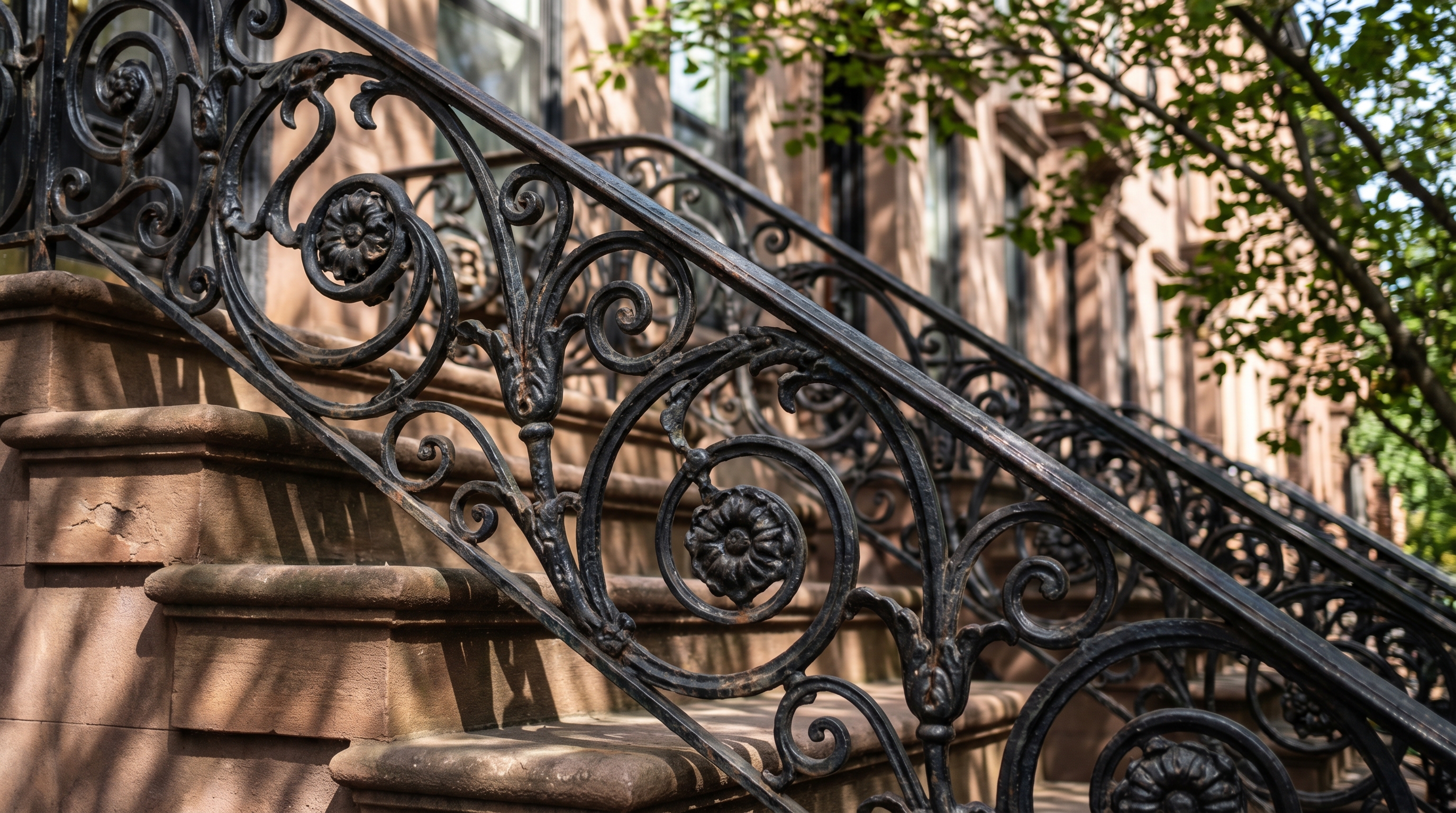
The ironwork on these stoops is among the most distinguished decorative art surviving in Brooklyn
The single most distinctive architectural feature of Stuyvesant Heights, arguably more distinctive even than the brownstone facades themselves, is the cast-iron ornamental work that survives on the blocks of the Historic District. The newel posts, stair railings, fence pickets, areaway gates, and basement window guards represent a cross-section of the Victorian decorative arts industry that has no equivalent anywhere in Brooklyn.
Each design is different. A Greek-key pattern appears on the railings of one house. The next house has foliate scrollwork with cast sunflowers at the newel caps. The house after that has Gothic tracery with pointed arches miniaturized in iron. Art Nouveau curves show up on the houses from the 1900s, the influence of the style that was then arriving from Paris. Walking a single block of the Historic District is, among other things, a tour of Victorian ornamental taste in metal from its earliest American phase through its maturity. No contemporary manufacturer replicates this work. When a piece is stolen, which happens, or damaged, which happens, it cannot be authentically replaced. This is not a metaphor for the neighborhood’s fragility. It is a literal fact about the irreversibility of certain losses.
This ironwork frames the stoops that are the social infrastructure of Stuyvesant Heights. The stoop is not furniture and not architecture exactly. It is the thing that places a household in relation to its street, the threshold where a private residence makes its formal presentation to the neighborhood. The families of the Great Migration, who began arriving in the 1940s as elevated rail made this part of Brooklyn accessible to Black families from the South and from an overcrowded Harlem, kept these stoops swept and these railings painted with the same care that the Irish, Jewish, and German families before them had demonstrated. The community that fought in the 1960s to control its own schools maintained the same standards on Macon Street and Halsey Street that made those blocks worth fighting for.
Max Roach grew up on Green Avenue and the neighborhood renamed an intersection for him in 2024
The cultural history of Stuyvesant Heights is dense enough that the neighborhood’s physical character can obscure it. The brownstones are so visually compelling that it is possible to walk through the Historic District attending only to architecture and miss entirely what those buildings contain and have contained.
Max Roach was raised at 541 Green Avenue, a few blocks from the core of the Historic District. He became one of the defining figures of American jazz, a founding voice of bebop alongside Charlie Parker and Dizzy Gillespie, and a drummer whose polyrhythmic approach permanently expanded what the drum kit could do. His 1960 album We Insist! Max Roach’s Freedom Now Suite was one of the first jazz albums explicitly dedicated to the civil rights movement. That he was a product of these particular streets, that the technical and political ambitions of his music were formed in the same blocks where you can still see the ironwork and the stoops, gives Stuyvesant Heights a specific claim on the intersection of aesthetic achievement and civic purpose. In 2024, the city renamed the intersection of Green Avenue and Marcy Avenue Max Roach Way.
Jackie Robinson’s first Brooklyn home was a brownstone in Stuyvesant Heights, where he lived when he joined the Brooklyn Dodgers in 1947. Chris Rock grew up in this part of Bed-Stuy, and his semi-autobiographical sitcom Everybody Hates Chris drew on the specific social textures of these streets. Mike Tyson grew up in Bed-Stuy before Cus D’Amato took him upstate. The neighborhood has produced, in the compressed geography of its 12 landmark blocks and their surroundings, an improbable concentration of figures who altered American culture.
The food scene on Lewis Avenue and Halsey Street is a destination, not an afterthought
Stuyvesant Heights has become one of the most lauded food neighborhoods in Brooklyn over the past twenty years, and the reputation was earned rather than bestowed. Peaches on Lewis Avenue has been feeding the neighborhood since the mid-2000s with Southern comfort food, a warm brownstone dining room, and a summer patio that is consistently full. Saraghina on Halsey Street helped start the neighborhood’s food renaissance with wood-fired Neapolitan pizza from a brick oven built permanently into the building, and the restaurant has earned a reputation that draws diners from across Brooklyn. Bar LunAtico on Halsey Street brings live jazz several nights a week and cocktails with genuine range. L’Antagoniste on Macon Street transports the classic Parisian brasserie to a brownstone block with enough skill to make the transplant convincing.
Beneath the destination restaurants, the everyday food culture remains Caribbean and soul food rooted. Jamaican patty shops, roti counters, Haitian griot plates, and West Indian bakeries on Tompkins Avenue and along the commercial stretches of Lewis Avenue have served the neighborhood’s long-term residents for decades. Church suppers at the dense concentration of Baptist, Pentecostal, and Adventist congregations remain important community food events. The layering of destination dining on top of this foundation gives Stuyvesant Heights a food culture with genuine historical depth, and Saturday morning here is one of the more pleasurable arguments for booking a cleaning and getting out of the house.
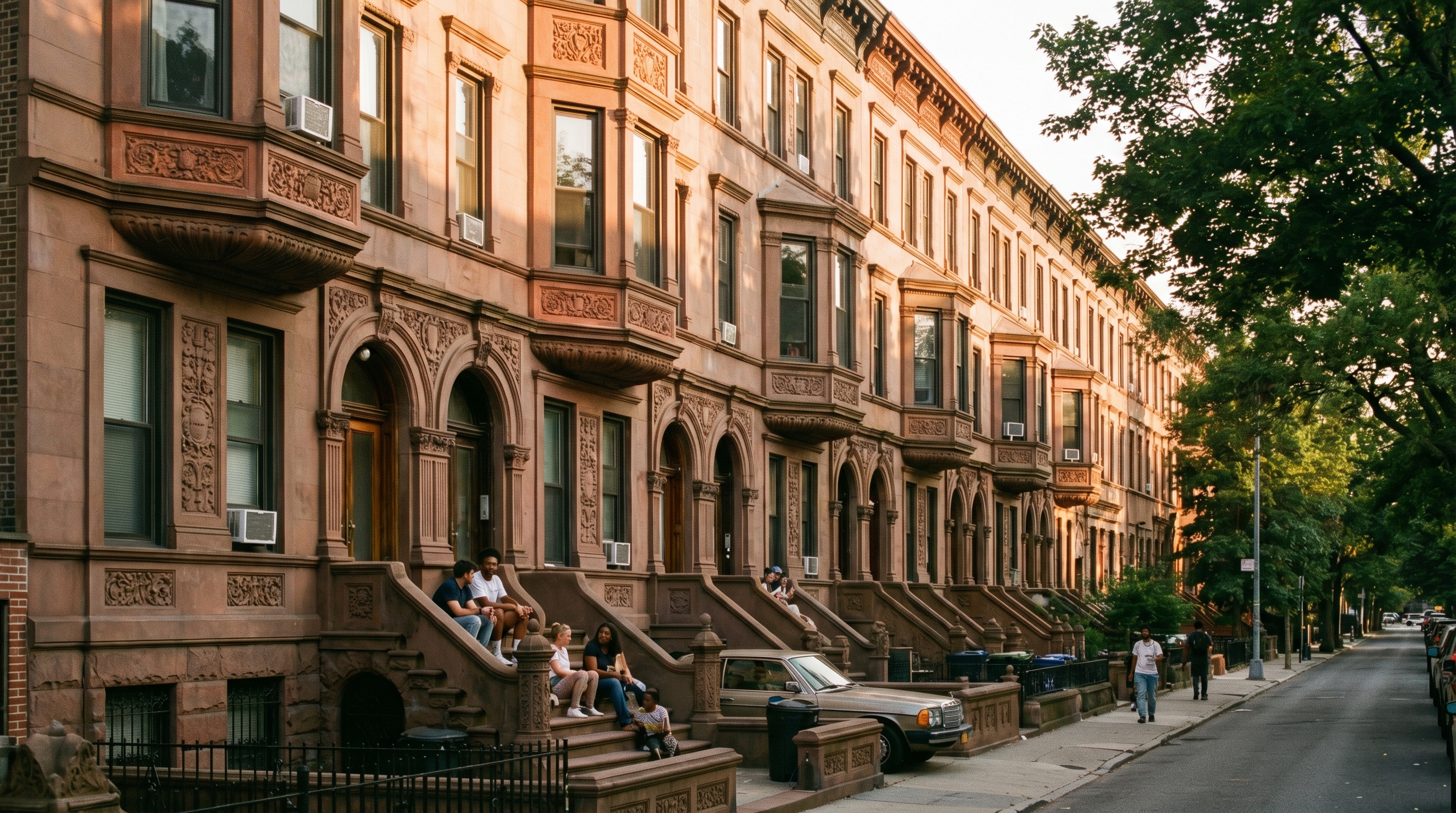
Deep cleaning for a neighborhood that takes renovation seriously
Stuyvesant Heights brownstones are actively and seriously renovated. The combination of landmark designation, which means the exterior fabric is protected and its character will be preserved regardless of what happens inside, and strong real estate demand has produced a class of buyers who invest substantially in period restoration. Floors are stripped and refinished. Fireplace mantels are restored. Original plaster is repaired rather than replaced. Brownstone facades are repointed. Kitchen and bath renovations are designed to complement the existing Victorian character rather than erase it.
The deep cleaning requirements of a fully renovated four-story brownstone are specific and demanding. Post-renovation contractor dust is fine enough to penetrate everywhere: inside cabinet interiors, on top of crown molding at 14 feet, between window sashes, inside radiator fins. Grout haze from newly tiled bathrooms requires careful treatment that depends on whether the tile is new ceramic, restored vintage hex, or original marble. Newly refinished hardwood floors cannot be wet-mopped for at least 72 hours after cure and need only a barely damp microfiber pass after that point. We clean after renovation crews in Stuyvesant Heights brownstones regularly enough that we know the standard contractor messes and how to address them without damaging the new surfaces.
We also handle move-in and move-out cleaning for the brownstone rental market, where floor-through apartments need to be cleaned to a standard that reflects the quality of the housing. A newly renovated floor-through in a landmarked brownstone with original details should not be turned over to a new tenant with contractor residue in the cabinet corners and dust on the plaster medallion. We have cleaned over 100,000 homes in New York and we understand the difference between a surface-level pass and a proper preparation.
What booking looks like for a Stuyvesant Heights home
You pick your date and time on our booking page. You see your flat-rate price before you commit. If your brownstone has four floors and a carriage house, tell us at booking and the price reflects both. If you need a COI for a new condo building on Malcolm X Boulevard, you tell us once and we file the paperwork before your first appointment. Our cleaners are W-2 employees, vetted and insured, and they arrive with product kits calibrated for the surfaces in Victorian brownstones.
We also serve nearby Bed-Stuy, Crown Heights, Clinton Hill, and Fort Greene.