
Fort Greene is the neighborhood that remembers. That is not a marketing phrase. It is the physical fact of the place. The Prison Ship Martyrs’ Monument stands on the highest point of the park, 149 feet of Doric column rising above the brownstone grid with a crypt beneath it containing the bones of over 11,500 American Revolutionary War prisoners who died on British ships in Wallabout Bay. More Americans died on those ships than in all the combat of the entire Revolutionary War. Walt Whitman fought for this park from the Brooklyn Eagle’s offices two blocks away. Richard Wright wrote Native Son in a third-floor room on Carlton Avenue. Spike Lee built his production company here and made the films that gave Brooklyn its cinematic identity. These are not separate stories. They are one continuous story about a place that has consistently produced and attracted people who were making something that mattered.
It is also a place with some of the finest residential architecture in any American city, and with the cleaning challenges that come with it.

Cleaning Fort Greene brownstones requires knowing what the original builders used
South Portland Avenue and South Oxford Street are as good as any residential streetscape in Brooklyn. Continuous rows of four-story Italianate and Romanesque Revival brownstones, their cornices intact, their stoops lined with morning light. The Fort Greene Historic District encompasses dozens of blocks like this, built between 1860 and 1900 by developers who were constructing homes for the professional and merchant class of a city that considered this neighborhood second only to Brooklyn Heights in social prestige.
Those buildings are beautiful. They are also complicated to clean.
The parlor floors, which sit one story above street level, have ceilings that run 11 to 14 feet. Plaster cornices with detailed profiles border the ceiling on every side. Fireplace mantels in white marble or veined stone anchor each room. The hardwood floors are old-growth, milled from trees that no longer exist, and harder than anything available today, but they are typically waxed rather than polyurethaned, which means the wrong product will cloud or lift the finish in a single visit. The kitchen level, one floor below, might have stone tile or original ceramic hex, depending on how the building was renovated. The garden level could be flagstone, terrazzo, or poured concrete. The bathrooms often have century-old hex tile where the grout cannot take acid.
Our house cleaning teams work top to bottom through these buildings so dust never settles on surfaces that have already been cleaned. The parlor floor hardwood gets a barely damp microfiber mop and a cleaner formulated specifically for wax finishes. Marble mantels and stone surfaces get pH-neutral products only. No vinegar, no citrus, nothing acidic on a surface that is carbonate. Carved plaster cornices get a soft brush and nothing wet applied directly. Cast-iron radiators, which collect a full season of dust between their fins and release it when the steam heat kicks on, get attention between the fins, not just across the top.
The detail work is not optional. It is the difference between cleaning that extends the life of original materials and cleaning that slowly damages them.
The Williamsburgh Savings Bank Tower is visible from every angle, and so is what has changed
The four-faced clock at 1 Hanson Place, set into the Art Deco and Byzantine tower that was the tallest building in Brooklyn from 1929 until the 1980s, is the visual anchor of the southwestern corner of Fort Greene. You can see it from DeKalb Avenue, from the park, from the G train platform on Fulton Street. When it was built for the Williamsburgh Savings Bank, its interior banking hall was one of the grandest commercial interiors in the borough, with a coffered ceiling and mosaic tilework that still exists under the luxury condominiums the building became in the 2000s.
That conversion is its own story about Fort Greene. The neighborhood’s Black population, which was over 40 percent in 2000 and is now closer to 20 percent, has been displaced by exactly the forces that make the neighborhood so appealing to new arrivals: architectural quality, cultural institutions, and transit access to eleven subway lines at Atlantic Avenue-Barclays Center. The BAM Cultural District, a hundred-million-dollar public investment in arts infrastructure, drove both the cultural programming and the real estate appreciation that priced out many of the families who had sustained those institutions across the 20th century. Fort Greene is a neighborhood wrestling with the consequences of its own success, and that tension is part of its character now.

The BAM Cultural District and the apartments above it need different things from a cleaning service
The southwestern edge of Fort Greene, where the Brooklyn Academy of Music, the Mark Morris Dance Center, BRIC House, UrbanGlass, and the Theatre for a New Audience cluster within roughly ten square blocks, is one of the most arts-dense addresses in any American city outside Manhattan. It also contains a concentration of newer construction condominiums and converted buildings that serve the professional and creative class who moved in after the district took shape.
These buildings are not brownstones. They have management offices, service elevators, vendor registration requirements, and in many cases co-op boards that require a Certificate of Insurance naming the building as an additional insured before anyone enters in a professional capacity. The doorman knows the regular delivery people and will stop anyone he does not recognize.
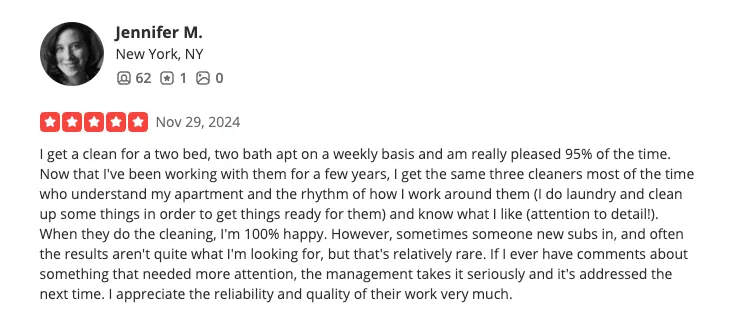
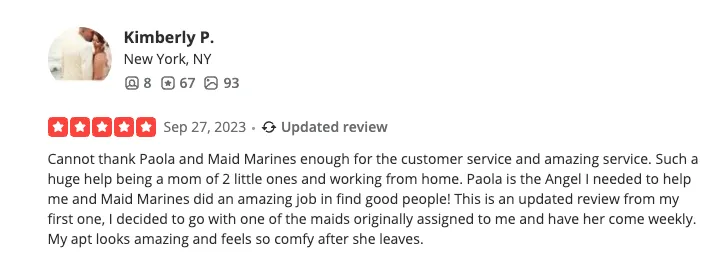
We handle this routinely. For recurring apartment cleaning, we assign the same team to your building so the front desk knows them and your management office does not receive a new vendor inquiry every two weeks. We furnish insurance paperwork before the first appointment. We coordinate service elevator windows. If you have had a cleaning service turned away at the lobby because the building had no record of them, that will not happen with us.
The apartments themselves in these buildings tend to be open-plan, with high ceilings, polished concrete or wide-plank engineered floors, and kitchens with stone countertops that need stone-safe products. They are faster to clean than a four-story brownstone but have their own material requirements. We carry products specific to engineered wood, polished concrete, and stone, and we use them selectively rather than reaching for the same all-purpose spray on every surface.
Richard Wright wrote Native Son two blocks from the park, and the Carlton Avenue address still has a plaque
The literary geography of Fort Greene is unusually dense. Walt Whitman lived at several addresses in the neighborhood, including one on Carlton Avenue, while editing the Brooklyn Daily Eagle and campaigning from its pages for the public park that opened in 1849. He is the reason Fort Greene Park exists at all. Richard Wright rented a room at 175 Carlton Avenue in 1938 and wrote the bulk of Native Son, which the Fort Greene Association has commemorated with a medallion on the building’s facade. John Steinbeck lived in Fort Greene at an early point in his career. These are not decorative facts. They reflect something real about the neighborhood’s ability, across different eras and under different social conditions, to attract and sustain serious creative work.
The Saturday farmers market at Fort Greene Park has some of this quality. It is one of Brooklyn’s most committed markets, with farmers who take their production seriously and vendors who are not doing this for foot traffic. You will find raw-milk cheese, heritage pastured meat, grain that was milled this week, and sourdough from bakers who have spent years getting the fermentation right. It is worth scheduling your cleaning for Saturday morning and spending the window at the market while we work.
A proper deep clean in a Fort Greene brownstone covers what contractors and years of occupancy leave behind
A Fort Greene brownstone that has not had a deep cleaning in several years has specific accumulations. The cast-iron radiators on each floor have gathered dust in the fins across multiple heating seasons. The crown molding at 14 feet has a layer of airborne grease from the kitchen below. The bathroom hex tile has grout that has darkened from mildew in a room with inadequate ventilation. The inside of kitchen cabinets has contact paper that has lifted at the corners and accumulated crumbs underneath it. The baseboards behind the furniture have not been touched since the last tenant moved out.
Our deep cleaning work in Fort Greene addresses these specifically. Radiator and vent covers get dusted, along with the sills and the wall above them. Crown molding and cornices get a brush and a dry wipe. Bathroom grout gets a targeted scrub with a product chosen for the tile type. Cabinet faces and door tops get degreased, and the interiors are an add-on you choose at booking. Baseboards get cleaned, including behind furniture light enough to shift. None of this is heroic. It is methodical, and it produces a different result than a routine maintenance clean.
We also handle move-in and move-out cleaning for the Fort Greene rental market, where floor-through apartments in brownstone conversions need to be spotless for new tenants and where landlords frequently need work done on a specific timeline. Post-renovation cleaning is another common request here, particularly after the kind of restoration work that exposes original plaster or refinishes old-growth floors. The construction dust and grout haze that contractors leave behind requires careful removal that will not damage newly finished surfaces.

Getting to anywhere in New York from Fort Greene takes under 25 minutes
The Atlantic Avenue-Barclays Center station at the southwestern corner of the neighborhood is the largest subway station in Brooklyn. Eleven lines converge there, including express service to Midtown Manhattan and the Long Island Rail Road. For residents of Fort Greene, this means Midtown in 20 to 25 minutes and Lower Manhattan in 10 to 15 minutes. The G train at Fulton Street connects through Brooklyn without going through Manhattan, which matters when you are going to Red Hook, Carroll Gardens, or Long Island City. The A and C trains stop at Lafayette Avenue and connect to JFK Airport.
This transit access, combined with the architectural quality of the housing stock and the BAM Cultural District, explains why Fort Greene consistently ranks among Brooklyn’s five most expensive neighborhoods. A restored single-family townhouse on South Oxford Street sells in the range of two to four million dollars. Floor-through rentals in brownstone conversions run three thousand to six thousand a month. These are not casual investments, and the people making them are not casual about their homes.
What booking looks like
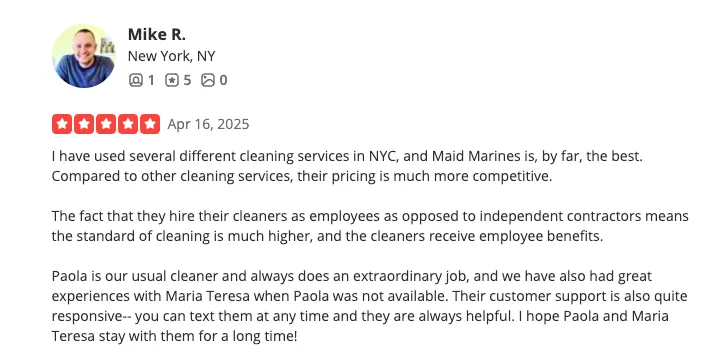
You choose your date and time on our booking page and see your flat-rate price before committing. If your brownstone has four floors, the price reflects that. If your co-op requires insurance paperwork, you tell us once and we take it from there. Our cleaners are W-2 employees, not gig workers, vetted and insured, and they arrive with the right products for the specific surfaces in your home.
We also serve nearby Park Slope, Bed-Stuy, DUMBO, Williamsburg, Greenpoint, and the rest of Brooklyn.