
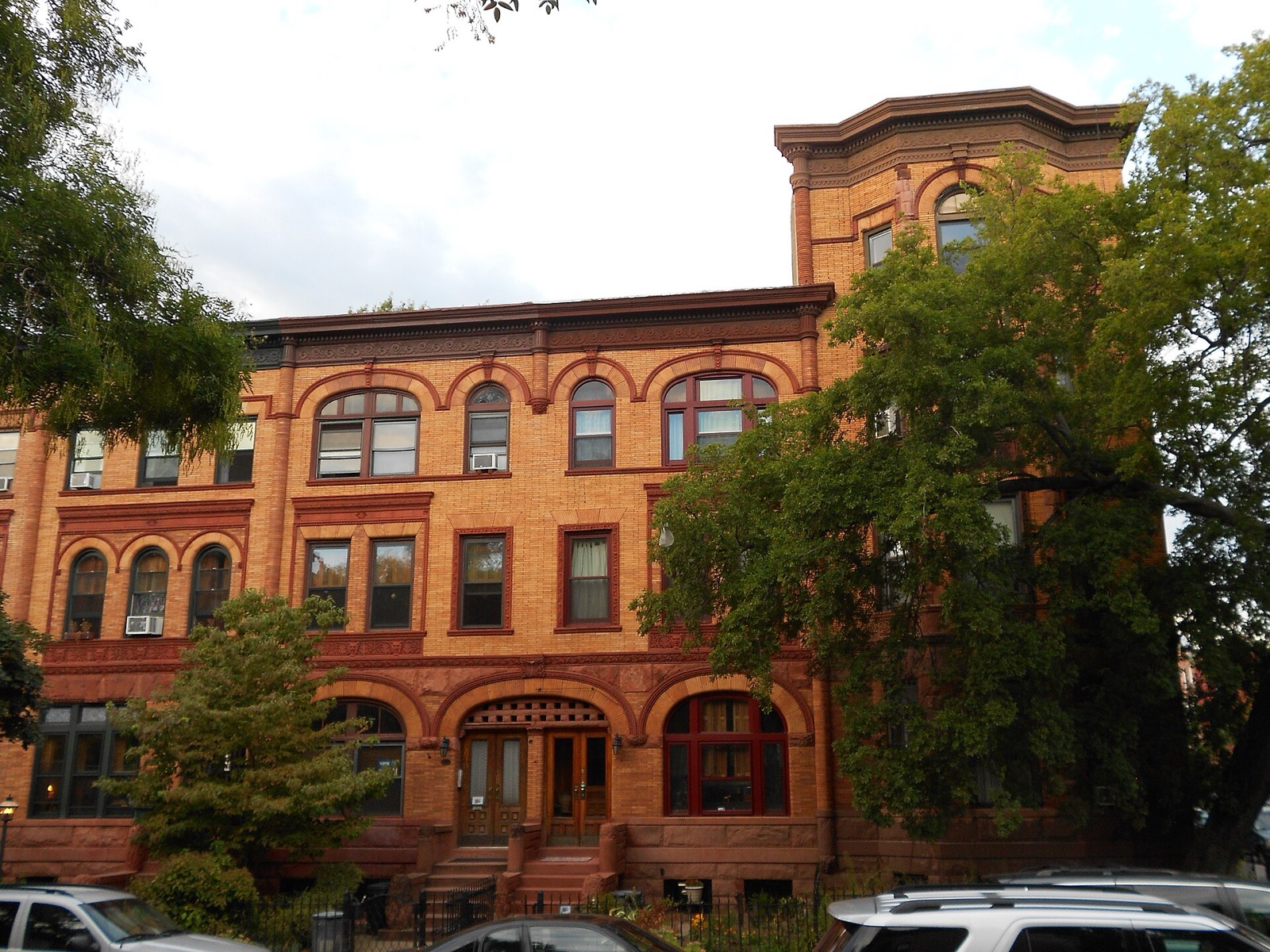
Walk down Decatur Street on a Saturday in October and you will understand immediately why people fight over this neighborhood. The brownstones line up with a Victorian seriousness that has survived 150 years of everything New York can throw at a building. High stoops rise from the sidewalk. Cast-iron newel posts anchor stair railings that were forged in the 1880s. Carved sandstone lintels frame windows on homes that predate the Brooklyn Bridge. Above everything, London plane trees arch their branches together into a green tunnel that filters the light into something between cathedral and garden.
Bedford-Stuyvesant contains approximately 8,800 buildings constructed before 1900. That is the largest concentration of intact Victorian residential architecture in the United States. It is not a marketing claim or a generous estimate. It is the reason the Landmarks Preservation Commission has designated three separate historic districts here, and it is the reason the brownstones on streets like MacDonough, Hancock, and Stuyvesant Avenue sell for numbers that would have been unthinkable twenty years ago.
But the architecture is only the beginning of what makes Bed-Stuy one of the most layered neighborhoods in American cities. This is the place where a free Black community called Weeksville was founded in 1838. Where the Great Migration families built the capital of Black New York. Where Shirley Chisholm ran for president. Where Jay-Z and Biggie grew up within a mile of each other. Where Spike Lee filmed the most important movie ever made about a single city block. And where, today, the tension between preservation and transformation plays out on every corner with an intensity that no other Brooklyn neighborhood can match.
The neighborhood started with Dutch farmland and a free Black longshoreman who bought his own plot
The land that became Bed-Stuy was Canarsie territory before the Dutch West India Company acquired it in the 1630s, paying in wampum and trade goods. The Dutch named their settlement Bedford, likely derived from “Bestevaar” (a term meaning roughly “grandfather”) or borrowed from the English county of Bedfordshire. By the 1660s, Bedford Corners was the first substantial European settlement east of the original Village of Brooklyn. Governor Peter Stuyvesant himself approved the local farmers’ road improvements in 1663, and the neighboring heights that would bear his name were still open farmland.
The two halves of the neighborhood grew separately for two centuries. Bedford remained a rural village through the Revolution. Stuyvesant Heights stayed as farms that were gradually subdivided after 1800. Then, starting in the 1870s, real estate developers platted a grid of residential streets and began the brownstone construction boom that would define the neighborhood forever.
But before the brownstone boom reached full speed, something remarkable was already happening on a road called Hunterfly.
Weeksville was one of the first free Black communities in America and it was right here
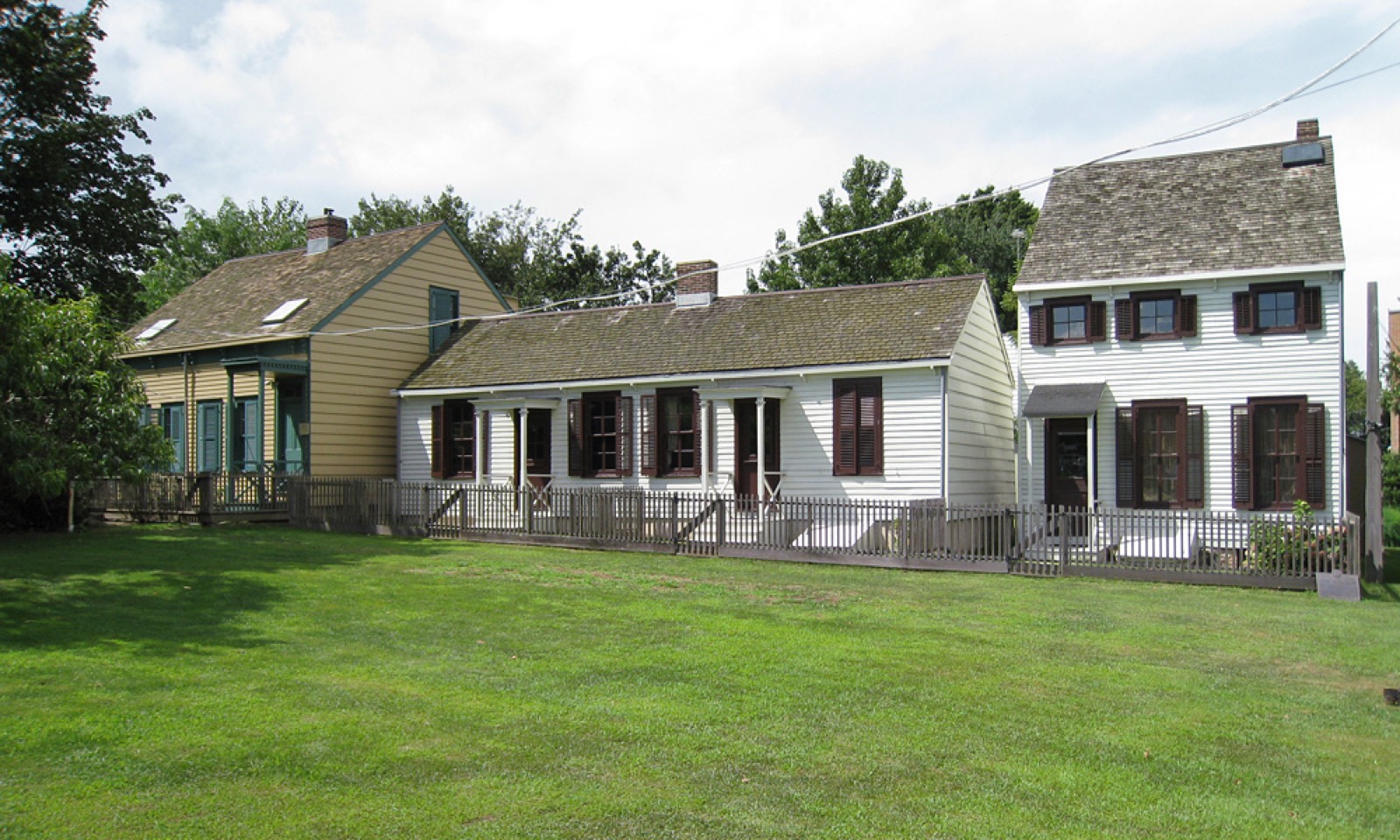
In 1838, James Weeks, an African American longshoreman, purchased land along the old Hunterfly Road (now Buffalo Avenue) at a time when free Black people could own property in Brooklyn. The community he built grew into something extraordinary. Weeksville developed its own church, its own school, its own cemetery, its own benevolent society, and one of the first African American newspapers in the country, the Freedman’s Torchlight. It produced the first female African American physician in New York State and the first African American police officer in New York City.
When the 1863 Draft Riots tore through Manhattan and mobs attacked Black residents, people fled to Weeksville for safety. The community sheltered them.
Weeksville was gradually absorbed by the expanding city grid in the late 19th century. Its remaining houses were scheduled for demolition before being rediscovered in 1968 by historian James Hurley and pilot Joseph Haynes, who spotted the old structures from a Cessna flying over Brooklyn. The surviving Hunterfly Road Houses at 158 Buffalo Avenue are now the Weeksville Heritage Center, and they are among the oldest surviving structures in all of Brooklyn.
The great brownstone boom built 8,800 homes in forty years
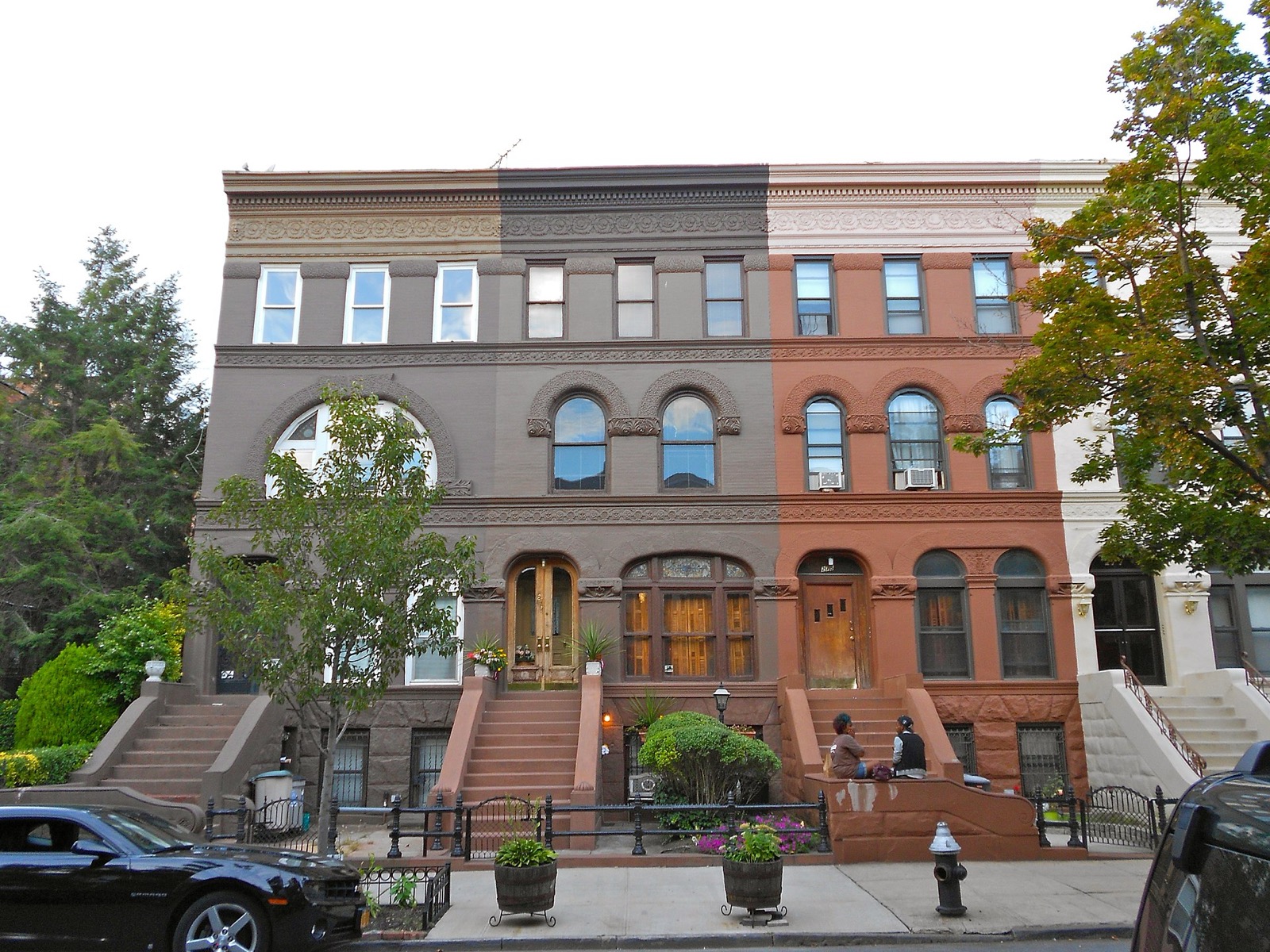
Between 1870 and 1910, Bed-Stuy experienced one of the largest residential construction booms in American urban history. Architects including Magnus Dahlander, George Poole Chappell, and the firm of Langston and Dahlander designed thousands of rowhouses in four dominant styles. Italianate homes from the 1870s and 1880s carry bracketed cornices, round-topped windows, and ornate cast-iron details. Neo-Grec houses from the same era feature incised decorative bands and geometric ornament. Queen Anne buildings from the 1880s and 1900s are the most ornamental, with terra-cotta panels, bay windows, and patterned brickwork. Romanesque Revival homes carry rock-faced stone fronts and rounded arches influenced by H.H. Richardson.
The first masonry rowhouses in the Stuyvesant Heights section went up on MacDonough Street in 1872, built for developer Curtis L. North. By 1890, the blocks between Tompkins, Stuyvesant, Macon, and Decatur Streets were largely complete. The Irish, German, and Jewish middle-class families who bought these homes were moving up from denser lower Brooklyn and Manhattan, seeking the leafy aspirational world the brownstones promised.
What they built has survived everything that followed. The brownstone sandstone may be soft (it comes from Triassic quarries in New Jersey and Connecticut) but the structures underneath are sound. The cast-iron stoop railings, the carved lintels, the plaster ceiling medallions, the wide-plank pine floors that are now 140 years old. All of it is still here because the bones were good.
Those same bones are why cleaning these homes requires more attention than cleaning a postwar apartment elsewhere in the city. A cleaner who does not know the difference between sealed and unsealed old-growth pine, or who uses an acidic product on porous brownstone sandstone, will cause damage that cannot be reversed. Our teams clean Bed-Stuy brownstones every week and they know what every surface in these buildings needs. You see your exact price for your specific home on our booking page before you commit to anything.
The Stuyvesant Heights Historic District protects 400 buildings across 12 blocks
Designated in 1971, the Stuyvesant Heights Historic District runs from Tompkins Avenue to Malcolm X Boulevard, Macon Street to Decatur Street. It contains over 400 architecturally significant buildings and some of the best-preserved Victorian streetscapes in the country. The ironwork alone is extraordinary. Cast-iron newel posts, stair railings, fence pickets, window guards, and areaway gates survive in patterns ranging from classical Greek-key to foliate Art Nouveau curves. The Landmarks Preservation Commission specifically cited this ironwork in its designation.
The Bedford-Stuyvesant/Expanded Stuyvesant Heights Historic District extended protection further. And in June 2024, the Willoughby-Hart Historic District was designated, protecting approximately 50 Neo-Grec rowhouses on Willoughby Avenue and Hart Street between Marcy and Nostrand Avenues. These are homes dating primarily to the 1870s and 1890s that nearly fell through the cracks of landmark protection.
Walking these blocks is like walking through a textbook on late-19th-century residential architecture, except the textbook is alive and people are sitting on the stoops.
The A train brought the Great Migration to Bed-Stuy and built Black New York
The opening of the IND Fulton Street Line in 1936 changed everything. The A and C trains running under Fulton Street suddenly connected Bed-Stuy to the rest of the city, and African American families who had been packed into an overcrowded Harlem could now reach a neighborhood with actual houses and actual space. Between 1940 and 1960, the Black population grew from roughly 63,000 to over 120,000 as the neighborhood’s earlier white residents left for the suburbs.
By 1960, Bed-Stuy was over 80 percent Black. It was the largest African American community in New York City and one of the largest in the United States. The concentration of talent, ambition, creativity, and political energy that gathered here over the next four decades produced an outpouring of culture that shaped the country.
Shirley Chisholm ran for president from these blocks
Shirley Chisholm was a product of Boys and Girls High School on Fulton Street and Brooklyn College. In 1968, she became the first Black woman elected to the U.S. Congress, representing Bed-Stuy’s 12th Congressional District. In 1972, she ran for the Democratic presidential nomination under the slogan “Unbought and Unbossed.” She did not win, but she cracked open a door that had been sealed shut, and the campaign remains one of the most significant in American political history.
The Bedford Stuyvesant Restoration Corporation, founded in 1967 after Senator Robert F. Kennedy visited the neighborhood and was shocked by the conditions, became the first community development corporation in the United States. The model of locally controlled community investment it pioneered has been replicated thousands of times across the country. But Bed-Stuy is where the concept was born. The Restoration Corporation still operates from its headquarters at 1368 Fulton Street, in a repurposed Sheffield Farms milk bottling plant that also houses the Billie Holiday Theatre and the Skylight Gallery.
Jay-Z grew up at 1260 Marcy Avenue and Biggie grew up on St. James Place
No other urban neighborhood in America has produced two comparably influential artists from the same generation and from the same square mile. Jay-Z was raised in the Marcy Houses, a NYCHA public housing complex of 27 six-story buildings between Flushing, Marcy, Park, and Nostrand Avenues. His childhood there is foundational to his entire artistic identity. Songs like “Where I’m From,” “Marcy Me,” and “December 4th” are direct dispatches from these blocks.
The Notorious B.I.G. grew up on St. James Place near Fulton Street, less than a mile away. His debut album Ready to Die and the posthumous Life After Death are canonical East Coast hip-hop, built on lyrical density and unflinching portraits of street life in this neighborhood. Both attended George Westinghouse Career and Technical Education High School in Downtown Brooklyn. Both came from Bed-Stuy. The two most influential rappers of the 1990s, walking the same streets.
The neighborhood also raised Lil’ Kim, Yasiin Bey (Mos Def), Chris Rock, Mike Tyson, Floyd Patterson, Lena Horne, and Norah Jones. Before the hip-hop era, Bed-Stuy had about 20 jazz clubs that brought in Miles Davis and Max Roach. The intersection of Greene and Marcy Avenues was renamed “Max Roach Way” in 2024.
Herbert Von King Park was designed by the same team that built Central Park
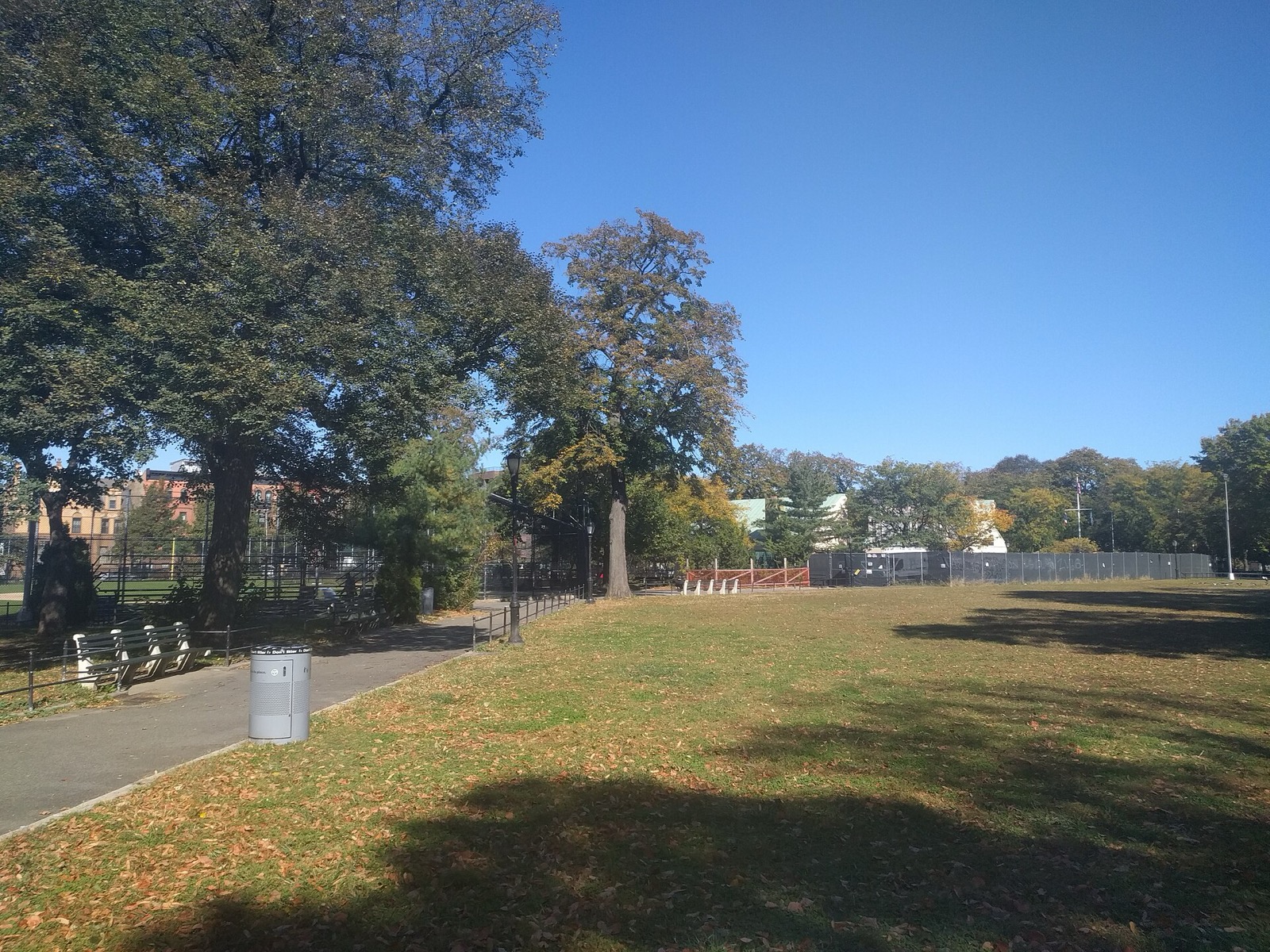
Frederick Law Olmsted and Calvert Vaux, who designed Central Park, Prospect Park, and much of the American urban park tradition, laid out what is now Herbert Von King Park between 1870 and 1871. Originally called Tompkins Park, it was renamed in 1985 for community leader Herbert Von King. The park predates most of the brownstone development that now surrounds it and has served as the neighborhood’s de facto town square for over 150 years.
A single southern magnolia tree on Lafayette Avenue across from the park is an official New York City landmark. It is estimated to be over 100 years old and is one of only a handful of individual trees in the entire city to receive this designation.
The park is where you go on a summer afternoon while your brownstone is being cleaned. The amphitheater hosts concerts and community events. The playgrounds are full. The canopy of trees is thick enough to cut the heat by ten degrees. Your Saturday belongs here, not behind a mop.
Spike Lee filmed Do The Right Thing on Stuyvesant Avenue in 1988
In the summer of 1988, Spike Lee spent eight weeks transforming a block of Stuyvesant Avenue between Quincy Street and Lexington Avenue into the set of what would become one of the most important American films of the 20th century. The crew built Sal’s Famous Pizzeria from scratch on an empty lot at the southwest corner of Stuyvesant and Lexington. Mister Senor Love Daddy’s radio station was placed inside 174 Stuyvesant Avenue. Mookie’s apartment was at 173 Stuyvesant, on the northeast corner of Quincy. Mother Sister (Ruby Dee) sat in her window at 167 Stuyvesant.
Do The Right Thing was released in 1989 and instantly became the definitive cinematic portrait of a single New York City block on the hottest day of the summer. The block still celebrates with an annual block party every June. The street corner was officially co-named “Do The Right Thing Way” by the city.
The Capitoline Grounds hosted professional baseball here in 1864
Before the brownstones and before the Great Migration, the block bordered by Nostrand Avenue, Halsey Street, Marcy Avenue, and Putnam Avenue was one of the first professional baseball fields in the country. The Capitoline Grounds opened in 1864 as the home of the Brooklyn Atlantics, who were world champions in 1859, 1860, and 1861. On June 14, 1870, the Atlantics defeated the Cincinnati Red Stockings here to end their historic 84-game winning streak. In winter, the grounds were flooded and used as an ice skating rink. If any player hit a ball over the circular brick outhouse in right field, they received a bottle of Champagne.
The field is gone now. There are brownstones on top of it. But the fact that professional baseball was played here before the neighborhood’s residential character even existed tells you how long this patch of Brooklyn has been producing things that matter.
The food runs from soul food church halls to James Beard finalists
Bed-Stuy’s food scene stacks three overlapping traditions on top of each other. The soul food lineage runs from the domestic kitchens of Great Migration families through the church suppers at some of the neighborhood’s 200-plus congregations to the current generation of formal restaurants. Fried chicken, collard greens, oxtail, mac and cheese, and cornbread have been served in these homes and halls for generations. The best soul food in the neighborhood remains largely unGoogled, inside church halls and kitchens you have to know someone to find.
The Caribbean layer is woven through the commercial fabric on Nostrand Avenue and beyond. Jamaican patty shops, Haitian griot plates, Trinidadian doubles vendors, and West Indian bakeries selling hard dough bread and coco bread to families who have been buying from them for decades. Despite gentrification pressure, this community has held on with a resilience that gives the commercial corridors a layered quality that purely gentrified neighborhoods lack.
Then there is the new wave. Peaches on Lewis Avenue serves shrimp and grits and farm-to-table soul food that has made it the neighborhood’s best-known restaurant. Saraghina on Halsey Street does wood-fired pizza in a converted storefront that helped launch the restaurant renaissance in the mid-2000s. One Nostrand Avenue Nigerian restaurant was named a James Beard Award finalist. Bar LunAtico offers live jazz most nights. L’Antagoniste serves French bistro cooking in a brownstone setting.
Your Saturday afternoon belongs at Peaches or Saraghina or the patty shop on Nostrand, not scrubbing your brownstone floors. Let us handle the floors while you eat.
Brownstone rowhouses need a floor-by-floor cleaning plan that changes at every level
A typical Bed-Stuy brownstone is three or four stories with a garden level below the stoop. Each floor tends to have different surfaces. The parlor floor might have the original wide-plank pine or restored oak. The kitchen level might have stone tile or reclaimed brick alongside modern quartz countertops. Bedrooms upstairs might have refinished pine or engineered hardwood. The garden apartment, if it is rented separately, could have anything from old linoleum to poured concrete.
You cannot use the same mop and the same product on all four floors. Our teams switch products as they move through the building and treat each level as its own job. This is also how we price it. A four-story brownstone with a garden unit takes more time and more care than a one-bedroom walkup, and the flat rate reflects that.
The limestone townhouses in the Stuyvesant Heights Historic District present their own set of concerns. Limestone is harder than brownstone sandstone but still porous, and the carved facades on Stuyvesant Avenue and Lewis Avenue collect soot and grime that needs careful handling. Inside, many of these homes have been gut-renovated with modern finishes layered over original bones. Reclaimed brick meets Carrara marble meets century-old molding in the same room. That mix demands attention to what product goes where.
Prewar walkups and new condos require completely different approaches
The three-to-six-story walkup buildings along Nostrand, Tompkins, and Myrtle Avenues are the other major housing type. These apartments are compact, usually rent-stabilized or recently turned over to market rate. The cleaning challenges are practical rather than architectural. Small kitchens that accumulate grease fast, hex tile bathroom floors with century-old grout lines that trap dirt, and cast-iron radiators that collect dust from April through September and then burn it off when the steam heat kicks on in October.
The new construction condos going up along Fulton Street and Nostrand Avenue are the opposite problem. The finishes are new and expensive. Engineered stone countertops that show every water ring. Wide-plank engineered floors that scratch if you use an abrasive pad. These buildings also come with management offices, COI requirements, service elevator rules, and advance-notice windows. If you have ever had a cleaner turned away at the front desk, you know how frustrating building logistics can be. We handle the paperwork before your first appointment. Tell us your building when you book your cleaning and we coordinate the rest.
Deep cleaning after a brownstone renovation is a specialty all its own
Bed-Stuy’s real estate market has been one of the most active in Brooklyn for two decades. The median home sale price hit $1.4 million by mid-2025. Renovations are constant. A brownstone gut renovation produces a specific kind of mess. Construction dust settles into restored plaster moldings, between radiator fins, inside window track channels, and on surfaces that the contractor’s cleanup crew will not touch with the care they require. A post-renovation deep clean in a brownstone is not the same job as a post-renovation deep clean in a new condo. The surfaces are older, more porous, and less forgiving.
We also handle move-in and move-out cleaning for the neighborhood’s active rental market. The turnover in Bed-Stuy is significant, especially in the walkup buildings and garden-level apartments that change tenants regularly. A proper move-out clean means getting the old grout lines back to their original color, cleaning inside the oven, and making sure the radiators do not look like they have been accumulating dust since the previous tenant arrived.
The neighborhood added 9,361 housing units in fourteen years and it is still growing
Between 2010 and 2024, Bed-Stuy added 9,361 new housing units. The Fulton Street corridor has been rezoned. New mixed-use buildings are rising along Nostrand Avenue and Fulton Street. Five-to-seven-story condo buildings now sit on lots that were vacant or held underutilized structures. The neighborhood’s population has reached 177,040 residents, and the demographic shift from 80 percent Black in 1990 to 40.7 percent Black in 2023 tells the story of a transformation as dramatic as any in American urban history.
The brownstones that once housed multigenerational Black and Caribbean families are now selling for $2 million to $4 million when fully renovated. The median rent for a one-bedroom has reached $2,800 to $3,100 per month. The institutions are still here. The Billie Holiday Theatre still produces its season. The Weeksville Heritage Center still tells its story. Boys and Girls High School is still open. The Bedford Stuyvesant Restoration Corporation, now over 58 years old, still operates. These institutions create a cultural gravity that distinguishes Bed-Stuy from neighborhoods where gentrification has simply replaced the community without remainder.
Our teams reach Bed-Stuy on the same trains everyone else uses
We get to Bed-Stuy via the A and C trains at Nostrand Avenue, Franklin Avenue, Kingston-Throop, and Utica Avenue. Via the G at Bedford-Nostrand. Via the J, M, and Z on the elevated line along Broadway. The A express from our base reaches Nostrand Avenue station in under 20 minutes. We know the neighborhood block by block because we work here every week, in brownstones and walkups and condos across all seven zip codes.
If you are in a brownstone and want each floor treated with the products it actually needs, that is our default approach. If you are in a walkup and want us to focus on the kitchen grease and the bathroom grout, we do that. If you just renovated and need someone who will get the construction dust out of your restored moldings without scratching the finish, we have been doing this in Bed-Stuy long enough to know exactly what it takes.
Bed-Stuy residents use us for recurring house cleaning and apartment cleaning on whatever schedule works. We also serve nearby Park Slope, Williamsburg, Greenpoint, and the rest of Brooklyn.