
In 1838, a freed Virginia-born stevedore named James Weeks purchased a plot of land in the Ninth Ward of central Brooklyn. He was not buying for investment in any speculative sense. He was buying because land ownership was one of the only forms of civic standing available to a free Black man in New York, and because a piece of land in a section of Brooklyn still outside the formal city limits offered something that Manhattan and western Brooklyn could not: distance from the legal and economic machinery designed to extract labor from Black people without giving them the rights of citizens.
The community that grew around Weeks’s purchase over the next three decades became one of the most remarkable places in antebellum American history. By the 1860s, Weeksville was home to nearly 500 families. It had a school for Black children, a home for elderly African Americans, an orphan asylum, one of the earliest African American newspapers in the country, and a community of property owners whose collective economic achievement surpassed the Black homeownership rate of 15 other American cities. Henry Highland Garnet, the abolitionist whose 1843 “Address to the Slaves” was too radical for Frederick Douglass, organized from here. Susan Smith McKinney Steward, the first African American female physician in New York State, practiced medicine here. When white mobs burned the Colored Orphan Asylum in Manhattan during the 1863 Draft Riots, hundreds of Black New Yorkers fled to Weeksville for safety, because this was a community that had built itself exactly for moments like that.
Then the Brooklyn street grid extended eastward. The Hunterfly Road, the Indigenous trail that James Weeks’s neighbors had built their houses along, was paved over. The community’s boundaries were subdivided. By the 1880s, Weeksville as a distinct identifiable community had largely been absorbed into the city’s anonymous urban expansion. For the better part of a century, the name survived as a geographic reference without the history attached to it.

What the city paved over could not be entirely erased
In 1968, a historian named James Hurley was flying in a small plane over Central Brooklyn, researching the area’s development from the air. Looking down at the blocks between Rochester and Buffalo Avenues, he spotted something that should not have been there: four wooden rowhouses sitting at a diagonal to the surrounding street grid. The angle of the Hunterfly Road, an Indigenous trail predating European settlement by centuries, had been preserved in the orientation of those four houses. The city grew over the road and around the houses, but could not straighten them.
What followed was the rediscovery of Weeksville. The four houses had survived more than a century of development, visible from the air when they were invisible from the street. They were designated New York City Landmarks in 1970 and listed on the National Register of Historic Places in 1972. The Weeksville Society purchased them in 1973 and began the preservation work that would eventually produce the Weeksville Heritage Center. In 2019, the Heritage Center became part of the NYC Cultural Institutions Group, the first new addition in over 20 years and the first Black cultural center in Brooklyn to receive that designation, a formal acknowledgment that the history it preserves belongs alongside the Metropolitan Museum and the Brooklyn Museum in the city’s cultural canon.
In March 2026, a $4 million renovation of the Hunterfly Road Houses was completed, returning them to their best physical condition in decades. The four wooden clapboard houses at 1698 Bergen Street, built between the 1840s and 1880s, are now in better shape than at any point in living memory.
The neighborhood that surrounds them is a working-class community of prewar brick apartment buildings, brownstone rowhouses, storefront churches, Haitian lunch counters, and Caribbean bakeries along Ralph Avenue and Bergen Street. It is a quiet neighborhood, majority-Black, with a strong Caribbean immigrant presence and the kind of street-level familiarity where people say hello and know which bakery has the best beef patties. It is also the neighborhood where the most consequential free Black community in pre-Civil War America once stood, and where four wooden houses still face the wrong direction because the street grid could not fully erase what came before.
The housing stock that defines what cleaning here requires
The majority of Weeksville’s residential units are in prewar brick walk-up apartment buildings from the 1920s through the 1940s. These four-to-six-story buildings are solidly constructed, most of them rent-stabilized, housing the working-class and Caribbean immigrant families who have been on these blocks for one generation or two. The apartments typically run from studios to three-bedroom floor-throughs, with nine-to-ten-foot ceilings, plaster walls, original hardwood floors in various states of preservation, and cast-iron steam radiators that have been throwing heat through the same pipes since the buildings were new.
The hardwood floors in prewar buildings of this era present specific care requirements that differ from modern polyurethane-coated wood. The original finish is almost always wax, not urethane, which means water and standard all-purpose cleaners will strip the finish rather than clean it. The prewar kitchen tile and bathroom hex tile require pH-neutral products because anything acidic attacks the grout over time. The cast-iron radiators collect dust between their fins all summer and burn it off in October when the steam heat starts. The plaster walls, thicker and harder than modern drywall, can be cleaned more aggressively without damage, but old plaster around window casements and baseboards sometimes shows hairline cracks where dust concentrates and a rough wipe makes it worse.
Beyond the walk-ups, a smaller portion of the housing stock is made up of brownstone and limestone rowhouses from the 1880s through the 1910s. These buildings post-date the Weeksville free Black community and were built as the city grid extended east, but they are the same architectural stock that defines adjacent Crown Heights and Prospect Heights: three-to-four-story rowhouses with carved stone lintels, cast-iron railings, original wide-plank hardwood floors on parlor and upper floors, and ornamental plaster in the public rooms. Where present in Weeksville, they are almost always configured as multi-family rentals, with a garden unit, one or two floor-throughs above, and sometimes a fourth-floor addition. The cleaning considerations are the same as anywhere in the brownstone belt: different floors may have different surface types, old-growth hardwood on parlor floors can be harder than anything milled today but is also more sensitive to moisture, and the carved plaster cornices above doorways require a soft brush rather than a damp cloth.
Several NYCHA developments operate in and adjacent to Weeksville, providing housing for residents protected from the market-rate displacement that has reshaped neighborhoods to the west. Our apartment cleaning teams service NYCHA apartments using the same products and the same standard as any other residential job. The buildings are part of the neighborhood.

Recurring cleaning in a neighborhood built on a longer view of time
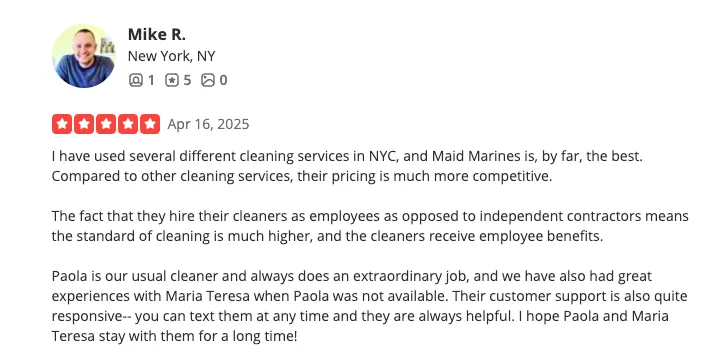
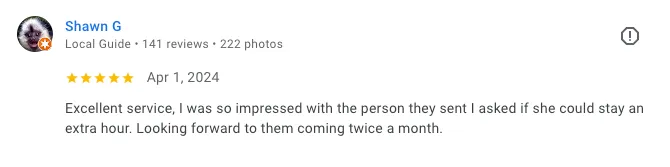
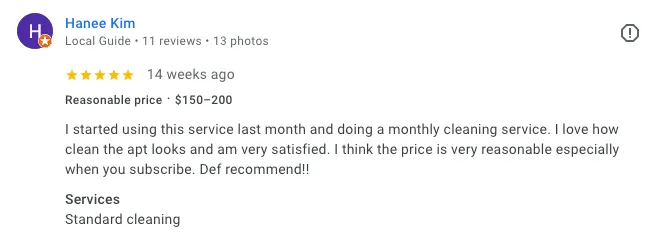
Maid Marines serves over 100,000 homes across New York City, and the recurring customers in Central Brooklyn neighborhoods like Weeksville tend to stay with us because the job requires local knowledge, not just a cleaning checklist. The prewar walk-up at the corner of Bergen and Ralph has different floors, different radiator configurations, and different traffic patterns than the brownstone conversion two blocks west. A cleaner who knows the building knows where the dust concentrates, which surfaces need the softer approach, and how to work through a four-flight walk-up efficiently without missing anything on the top floor.
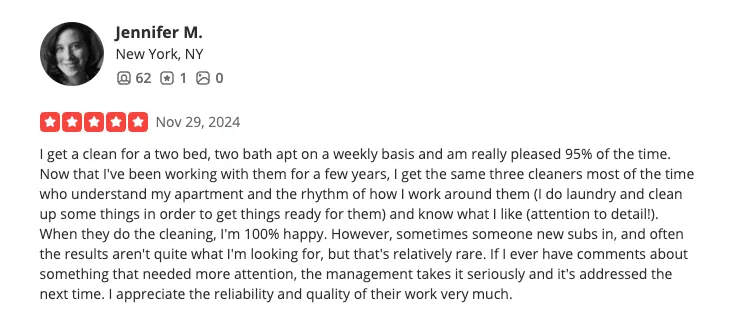
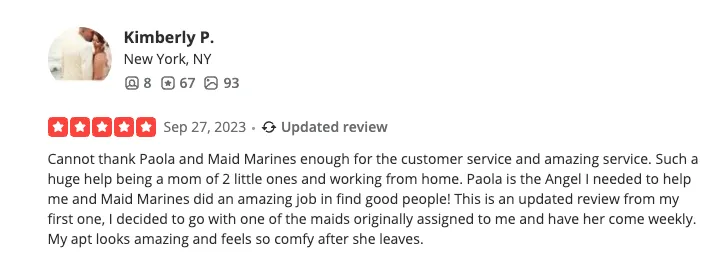
Our house cleaning teams are W-2 employees, not gig contractors. They are vetted, insured, and trained to the specific surface types they will encounter in Brooklyn’s older housing stock. For recurring appointments in Weeksville, we assign the same team to your home so your cleaner learns the apartment and you do not have to re-explain the wax floors or the cracked plaster near the bathroom window every time.
The C train at Ralph Avenue puts the neighborhood within reach of our Central Brooklyn service area, and we handle the full corridor from Crown Heights through Weeksville toward the eastern sections of the borough.
The floor your children crawl on comes from 1928 and needs to be treated accordingly
Weeksville’s prewar housing stock is particularly well-suited to families with young children: the apartments are solidly built, many are rent-stabilized, and the neighborhoods around Bergen Street and Atlantic Avenue are quieter than the commercial corridors. The floors those children crawl on, however, require specific attention from a cleaning service that knows what it is looking at.
We use non-toxic, fragrance-free products in every home where children are present. No bleach, no ammonia, no aerosol compounds in spaces where a child will be on the floor within the hour. The floors get a pH-neutral cleaner that dries without residue. The prewar hardwood gets the barely damp microfiber treatment rather than a wet mop. The kitchen and bathroom tile get grout-safe products that clean without attacking the mortar. These are not add-on requests. They are the standard for every family home we clean.
A deep cleaning in a Weeksville prewar walk-up covers the refrigerator and oven interiors, the tops of the window casements and the doors, the baseboards scrubbed by hand rather than wiped, and under the stove and refrigerator as far as reach allows. Cabinet interiors are an add-on you tick when you book, so it lands on the quote instead of the bill. For a move-in or move-out clean, we leave the apartment in the condition a new tenant deserves to find it: not cleaned to the standard of whoever left.
A neighborhood watching its western border with clear eyes
As Crown Heights’s western sections have been fully remade and rents have risen above $3,000 per month, the displacement pressure moves eastward. Weeksville, with its relatively longer subway commute to Midtown and its less-developed restaurant economy, has absorbed some of that pressure without fully succumbing to it. The Atlantic Avenue Mixed-Use Plan, approved in May 2025, permits up to 4,600 new apartments along the Atlantic Avenue corridor that defines Weeksville’s northern boundary. Community organizations in the neighborhood have been vocal in those debates, drawing on the same depth of historical identity that has defined this place since 1838.

The Weeksville Heritage Center is not only a museum. It is an active community institution that participates in planning arguments, rezoning debates, and the political organizing through which a neighborhood asserts its right to continue to exist for the people who live there. The same impulse that drove James Weeks to buy land here in 1838, the understanding that freedom without property, without institutions, without a physical place to stand is not freedom at all, runs through the community work that happens here today.
How to book
You can get your exact flat-rate price and pick a date on our booking page. The price you see before you confirm is the price you pay. No surprise upcharges for walk-up stairs, no add-on fees for prewar floors, no premium for the extra flight.
We also serve neighboring Crown Heights, Bed-Stuy, Prospect Heights, and the rest of Brooklyn.