

Dutch Kills has a street that follows the ghost of a creek. Dutch Kills Street cuts diagonally across the neighborhood’s grid at an angle that makes no sense until you know it is tracing a tidal waterway that flowed here for thousands of years before the 19th century covered it with factories, rail yards, and concrete. The street is a map drawn by water, and if you know what you are looking at, it tells you more about this neighborhood than anything built on top of it.
A tidal creek, a Dutch word, and an industrial city that buried them both
The name is its own history lesson. In the 17th century, Dutch West India Company settlers moving through western Queens mapped the watercourses using their own language. A “kill,” from the Dutch “kil,” meant a stream or tidal channel. The word still appears across the New York metropolitan landscape: Catskill, Peekskill, Fishkill, the Schuylkill in Pennsylvania. The Dutch Kills was a tidal creek, a tributary of Newtown Creek, navigable by small boats and serving as a natural boundary for the farmland that surrounded it. The “Dutch” modifier distinguished this particular waterway from others in the region. Dutch settlers worked this land from the 1640s. English rule came in 1664. Dutch place names outlasted both.
The Long Island Rail Road arrived at Hunter’s Point in 1836 as the first operational railroad in New York, making Long Island City its western terminus and kicking off an industrial transformation that accelerated for a century. Factories, warehouses, oil storage, and rail yards spread across western Queens. The Dutch Kills creek was progressively filled and built over as industrial land use demanded contiguous flat parcels. By the early 20th century most of the original waterway was gone. What survived was the name, and Dutch Kills Street, running at its stubborn diagonal, refusing to conform to the grid that was laid over it.

The Queensboro Bridge opened in 1909, designed by engineers Henry Hornbostel and Gustav Lindenthal, with its Queens anchorage at Queens Plaza on the southern edge of Dutch Kills. The bridge and the 7 train running above Jackson Avenue transformed the neighborhood into one of the most intensely developed commercial and residential corridors in outer-borough New York. Mixed-use brick buildings from the 1900s through the 1940s lined the commercial streets. Pre-war walkups filled in the residential blocks. Warehouse buildings with large floor plates and heavy timber framing occupied the lots where the industrial economy needed them.
What the housing stock actually looks like and what it means for cleaning
Dutch Kills sits at the hinge between three generations of building. The pre-war brick walkups along Jackson Avenue and Northern Boulevard represent the largest share of the housing stock, four to six stories of ornamental brick cornicing and standard two- and three-bedroom apartments. The industrial loft conversions scattered through the neighborhood come from the 1890s to 1920s warehouse era, with high ceilings, oversized factory windows, open floor plans, and exposed brick walls. The luxury towers, post-2000 glass-and-steel buildings climbing 20 to 40 stories, represent the fastest-growing share.
Each building type presents a completely different cleaning situation.
The pre-war walkups have plaster walls, cast-iron radiators, and sometimes original hex tile bathroom floors that need pH-neutral cleaners to avoid etching the grout. The radiators are worth being precise about. The dust that settles inside a cast-iron unit over the summer burns off when the heat comes on in October, and no cleaning visit prevents that. What we do is dust the radiator covers, the vent grilles, and the wall and floor around each unit on every visit, so the surface layer never gets a chance to feed the pile. In a building that has been occupied for eighty years, the difference between that and a quick pass with a dry cloth is not small.
The warehouse loft conversions require an entirely different approach. Polished concrete floors scratch permanently with an abrasive pad. Exposed brick stains if you use a wet cloth, because water drives grime into the mortar. Timber ceiling beams collect dust at heights that standard equipment does not reach. We bring extension tools and pH-neutral products to these buildings because the surfaces demand it. The approach you use in a glass tower two blocks away would damage a loft conversion in a week.
The new luxury towers along Queens Plaza and Jackson Avenue have their own demands: floor-to-ceiling windows that need a professional squeegee and proper glass solution, not a paper towel and spray bottle; engineered hardwood that dulls with too much product; quartz countertops that show every water ring. Many of these buildings also require a Certificate of Insurance before any vendor enters, plus service elevator scheduling and advance notice to building management. We handle the paperwork as a matter of routine. The building office does not need to be your problem.
One subway stop from Times Square, and the neighborhood that almost became something else entirely
Dutch Kills sits one 7 train stop from Times Square. The Court Square station connects to the E, M, G, N, and W lines. The Queensboro Bridge is on the southern edge of the neighborhood. The NYC Ferry docks at Hunters Point South, a fifteen-minute walk. No other neighborhood in western Queens has this convergence of transit options, and it is the primary reason the apartment cleaning profile here looks the way it does: young professionals who commute to Midtown, are almost never home during the day, and want a clean apartment waiting for them when they get back.
This transit proximity also explains the Amazon story. When Amazon announced Long Island City as one of two HQ2 locations in November 2018, the announcement was centered on blocks immediately adjacent to Dutch Kills. The neighborhood was months away from an unprecedented development acceleration. Amazon withdrew in February 2019 after sustained community opposition. The towers kept going up anyway. The population continued to grow. The median asking rent in the zip code hit figures that would have been unrecognizable ten years earlier. But Dutch Kills did not become the overnight company town it briefly appeared it might. The neighborhood’s pre-war building stock and irregular street grid, legacies of the old creek bed, gave it enough friction to resist the most wholesale transformation that the LIC waterfront blocks absorbed.
Dutch Kills Bar and the cultural layer that the developers found when they got here
In 2010, before the current wave of luxury towers had fully arrived, someone opened a pre-Prohibition cocktail bar on Jackson Avenue and named it for the neighborhood. Dutch Kills Bar at 27-24 Jackson Avenue has since been cited in national rankings of the best cocktail bars in America. It carves its own ice. It does not compromise on technique. It functions as a neighborhood bar with the values of a serious craft program, and it has more in common with the working-class character of Dutch Kills’ industrial history than with the glass towers that now share its block.
MoMA PS1, technically in the Hunter’s Point section a few blocks south, exerts a cultural gravitational pull on the entire Dutch Kills corridor. Alanna Heiss founded the Institute for Art and Urban Resources in 1971 and opened P.S. 1 Contemporary Art Center in 1976 in an abandoned 1899 Romanesque Revival public school building on Jackson Avenue. That single decision changed the trajectory of western Queens. Artists followed. Galleries followed. The warehouse buildings that nobody else wanted became the foundation of a creative community that attracted the professional class that attracted the developers that built the towers.
The irony is structural: creative workers generate the cultural cachet that attracts the capital that displaces them. Many of the artists who settled in Dutch Kills’ warehouse spaces in the 1980s and 1990s have been priced out to cheaper parts of the outer boroughs. What remains is the institutional infrastructure they created, and the loft conversions they turned into residential buildings, now renting for two to four thousand dollars a month.

The Queensboro Bridge in your window and what to do with your Saturday morning
Walk south from anywhere in Dutch Kills and the Queensboro Bridge fills your sightline. The 1909 cantilever bridge, designed by Lindenthal and designated a New York City Landmark in 1974, has its Queens anchorage at Queens Plaza, the redesigned transit hub where the 7, E, M, N, and W trains converge beneath the bridge’s approach ramps. The ornate ironwork and two-level roadway of the bridge are visible from most of the neighborhood. It is a specific kind of urban beauty, the beauty of engineering infrastructure that was never intended to be looked at and cannot stop being looked at.
A deep clean takes about three to four hours. That is enough time to walk the Queens Plaza Greenway path to the East River and back. It is enough time for MoMA PS1 on a quiet weekday when the crowds have not arrived. It is enough time for the waterfront at Gantry Plaza State Park, twenty minutes on foot, where the Pennsylvania Railroad gantries and the Pepsi-Cola sign and the full Manhattan skyline are all visible from the same lawn. Dutch Kills is the kind of neighborhood where your cleaning appointment can be the structure around a genuinely good morning.
What booking looks like from here
You select your date and time on our booking page and see your flat-rate price before you commit to anything. If your building has specific access requirements, you tell us once and we take it from there. For pre-war walkups, that usually means coordinating with the super. For newer buildings near Queens Plaza, it means a COI and a service elevator reservation. Our dispatch team handles both.
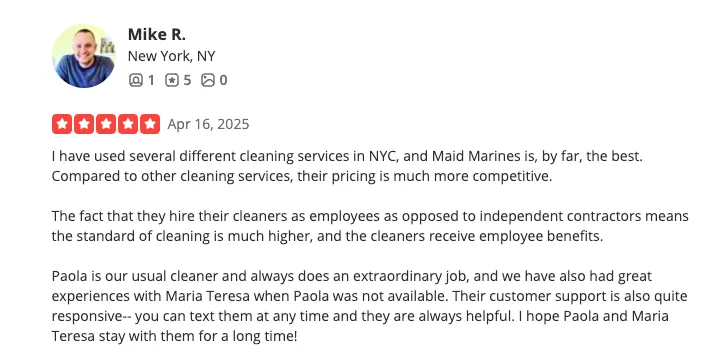
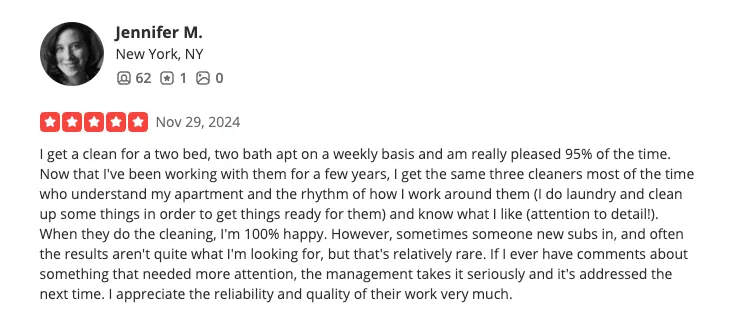
Our cleaners are W-2 employees. Not contractors from an app, not day workers who show up with whatever they happened to bring. They are vetted, insured, and they arrive with the products and tools that match your specific building type. The loft on Jackson Avenue does not get the same approach as the tower near Queens Plaza, and neither of them gets the approach we would use on a different kind of building entirely.
Dutch Kills residents also use us for move-in and move-out cleaning when the rental cycle turns over, which it does frequently in this zip code given how many residents are here on one- or two-year leases before moving again. Management companies inspect at the level of inside the cabinets and behind the appliances. We clean at that level. We also serve nearby Long Island City, Astoria, and Sunnyside for residents who want a cleaning service that covers the full western Queens corridor without switching providers.