
Long Island City was its own city once. That is not a metaphor. From 1870 to 1898, LIC had a mayor, a board of aldermen, a city hall, and municipal ambitions that stretched along the western Queens waterfront from Hunters Point to Ravenswood. Its first mayor, Abram D. Ditmars, won the inaugural election on July 5, 1870. Its last mayor, Patrick Jerome “Battle-Axe” Gleason, handed the keys over when Greater New York consolidated in 1898. The building that served as city hall still stands on Jackson Avenue. Most people walk past it without knowing.
That independent streak never fully disappeared. It just changed form. Over the next century LIC reinvented itself from an industrial powerhouse to a forgotten wasteland to an artist colony to the most aggressively developed residential frontier in New York City. No other neighborhood in the five boroughs has compressed so many identities into so short a span. And the architecture tells the whole story if you know where to look.
The waterfront factories that built LIC and the artists who inherited them
The Long Island Rail Road moved its Manhattan terminus to the Hunters Point waterfront in 1861, and the industrial transformation was immediate. Oil refineries, lumber yards, chemical plants, and paint factories crowded the East River shore. The Queensboro Bridge arrived in 1909, designed by Henry Hornbostel and Gustav Lindenthal, connecting Queens Plaza to East 59th Street in Manhattan and reinforcing LIC’s role as a manufacturing and distribution hub. Pepsi built a bottling plant on the waterfront. Enormous red brick warehouse blocks went up along Jackson Avenue and Vernon Boulevard, many with heavy timber frames, large window bays, and iron structural details that were purely functional at the time.
By the 1960s, the factories were closing. The chemical plants shut down. The refineries moved. The warehouses sat empty. And that emptiness turned out to be the most valuable thing that ever happened to Long Island City.
Artists discovered the abandoned lofts. The spaces were enormous, the ceilings ran 12 to 14 feet, the natural light poured through those oversized industrial windows, and the rent was essentially nothing. Alanna Heiss saw a derelict public school building on Jackson Avenue and decided it should be an art space. She founded the Institute for Art and Urban Resources in 1971, took over the 1899 Romanesque Revival schoolhouse, and opened it as P.S. 1 Contemporary Art Center in 1976. That single decision changed the trajectory of the neighborhood. Artists followed. Galleries followed. The creative infrastructure that LIC is still known for grew directly from Heiss putting art inside a building nobody else wanted.
The Pepsi-Cola sign survived the bottling plant and became the neighborhood’s monument
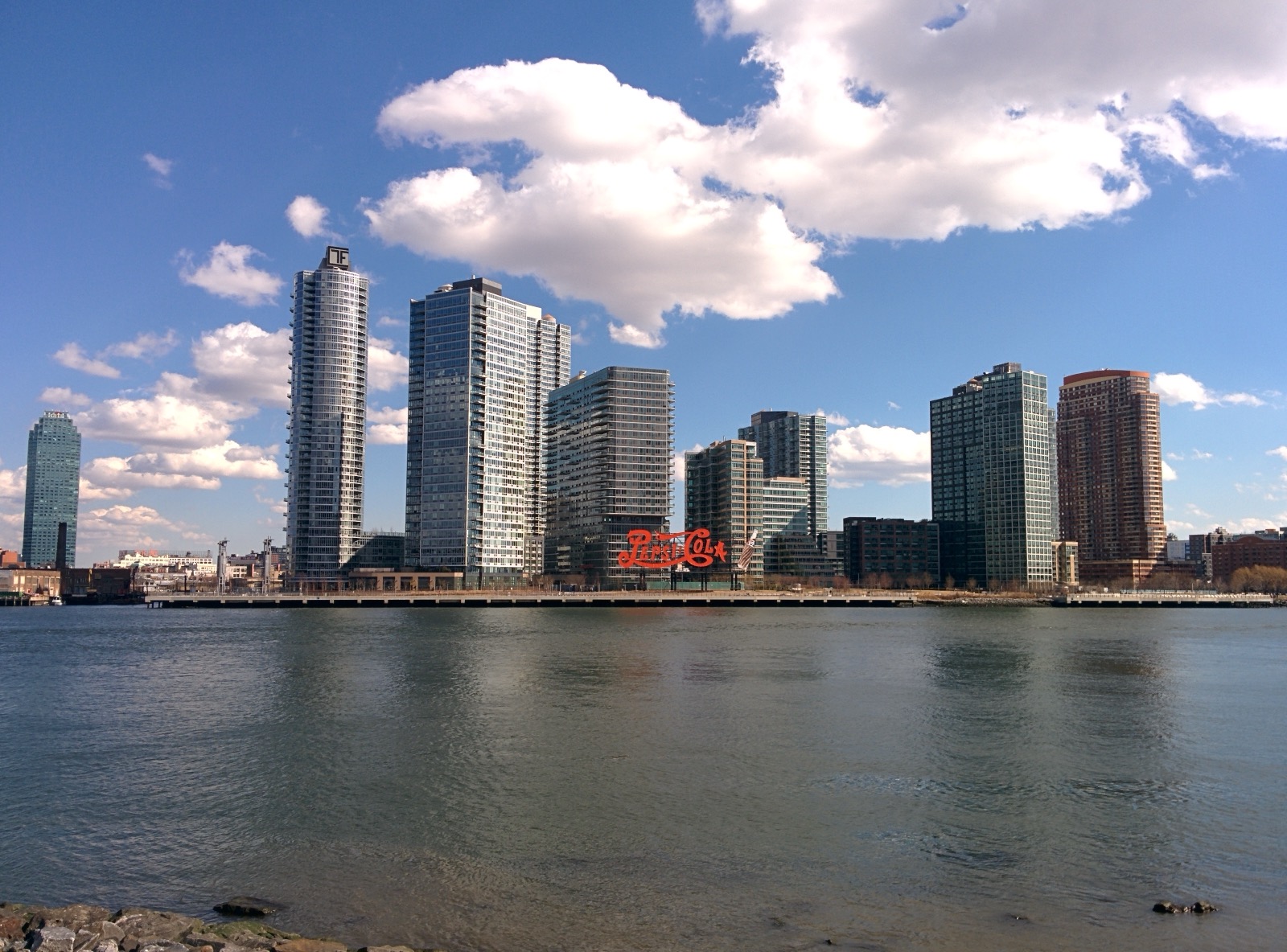
The most photographed object in Long Island City is a sign for a product that has not been manufactured there in decades. The Pepsi-Cola neon sign was originally erected atop the Pepsi bottling plant on the LIC waterfront, manufactured by the General Outdoor Advertising Company in 1939 and rebuilt by Artkraft Strauss in 1993. It stretches 120 feet wide and stands 60 feet tall, glowing ruby red in cursive script against whatever happens to be behind it.
What is behind it has changed completely. The bottling plant was demolished. Luxury apartment towers went up in its place. But the sign stayed. It was designated a New York City landmark on April 12, 2016, dismantled from its original rooftop perch and reassembled in a permanent location within Gantry Plaza State Park in 2009. Now it faces Manhattan across the East River, visible from the FDR Drive, a relic of the factory waterfront preserved as public art against a backdrop that the workers who made Pepsi here would not recognize.
The sign captures something true about LIC. This is a neighborhood that keeps its artifacts even as it demolishes the context around them. The gantries in the park are the same way. Built in 1925 by the James B. French patent for the Pennsylvania Railroad, they once loaded railcars onto barges for transport to New Jersey. They were designated NYC landmarks in 2012 and now stand as sculpture in a 12-acre waterfront park that opened in phases between 1998 and 2009. Children play on the lawns beneath structures that moved freight.
Isamu Noguchi chose LIC because nobody else wanted it
In 1961, the Japanese-American sculptor Isamu Noguchi left Manhattan and bought a single-story commercial building on the corner of 10th Street and 33rd Road in Long Island City. He was looking for space to work, and LIC had it. In 1974, he purchased the abandoned photogravure plant and gas station directly across the street and spent the next decade transforming it into what would become the first museum in the United States designed, built, and installed by a living artist to display their own work.
The Noguchi Museum opened on May 11, 1985, at 9-01 33rd Road on Vernon Boulevard. The converted 1929 red brick building holds Noguchi’s stone sculptures, paper lanterns, furniture designs, and stage sets for Martha Graham across 31,000 square feet of gallery space. But the outdoor sculpture garden is what most visitors remember. It is one of the most serene public spaces in all of New York City, a walled garden of trees, gravel, and stone that feels entirely removed from the neighborhood outside.
If real estate had cost in 1974 what it costs today, Noguchi would never have come to LIC. The museum exists because of cheap industrial vacancy, and it anchors the northern stretch of Vernon Boulevard’s cultural corridor the same way PS1 anchors the southern end along Jackson Avenue.
5Pointz was the graffiti mecca that became luxury condos overnight
The story of 5Pointz is one of the most controversial chapters in LIC’s transformation. The building at 45-46 Davis Street opened in 1892 as the Neptune Meter factory. Developer Jerry Wolkoff bought it in the early 1970s and eventually leased studio space to artists, with 200 tenants paying below-market rent in what came to be called the Crane Street Studios. In 2002, Wolkoff hired graffiti artist Jonathan Cohen to curate the building’s exterior, and Cohen transformed the entire 200,000-square-foot facade into a rotating gallery of aerosol art. The building was renamed 5Pointz, representing the five boroughs, and it became what its own website called “the world’s premier graffiti mecca.” Artists flew in from around the globe to paint there.
On the night of November 19, 2013, Wolkoff sent workmen to whitewash the entire exterior without warning. The building was demolished in 2014. Luxury apartment towers replaced it. Twenty-one artists sued under the Visual Artists Rights Act, and in 2018 a federal judge awarded them $6.7 million for the destruction of their work. The condos stand where the murals were.
5Pointz is gone, but the argument it represents is alive in every block of LIC. The industrial buildings that attracted artists and gave the neighborhood its character are the same buildings that developers see as underutilized real estate. Every warehouse loft conversion, every factory turned museum, every brick facade preserved while the interior gets gutted and rebuilt is a negotiation between what LIC was and what it is becoming.
Those converted loft spaces along Vernon Boulevard and Jackson Avenue still exist in significant numbers. They have open floor plans, exposed brick walls, original timber ceiling beams, and polished concrete or sealed concrete floors. They are beautiful and they are demanding. The wrong cleaning technique causes problems you cannot reverse. Polished concrete scratches permanently with an abrasive pad. Water on exposed brick pushes grime into the mortar and leaves marks that do not come out. The timber beams collect dust at heights that standard equipment cannot reach. Our teams bring extension tools and pH-neutral products specifically because these surfaces require a different approach than anything in the glass towers two blocks away.
One Court Square stood alone for decades as the tallest building in Queens
Before the residential towers arrived, LIC’s skyline had exactly one landmark on it. One Court Square, originally called the Citibank Building and later the Citicorp Building, was completed in 1990 at 23-15 44th Drive. It rises 658 feet and 50 stories, a blue-green glass monolith designed by Skidmore, Owings and Merrill. For over thirty years it was the tallest building in Queens by a wide margin, visible from the BQE, the Queensboro Bridge, and half of Brooklyn. Citigroup leased the entire tower as a back-office hub, and for most of the 1990s and 2000s the building was synonymous with LIC itself. When people in Manhattan pointed across the river and said “that building in Queens,” they meant One Court Square. It finally lost the tallest-in-Queens title in 2021 when the Skyline Tower at 23-15 44th Drive topped out at 778 feet, but the Citicorp tower remains the defining vertical element of the Court Square streetscape and the reason the 7 train stop carries that name.
The 2001 rezoning turned the waterfront into a wall of glass
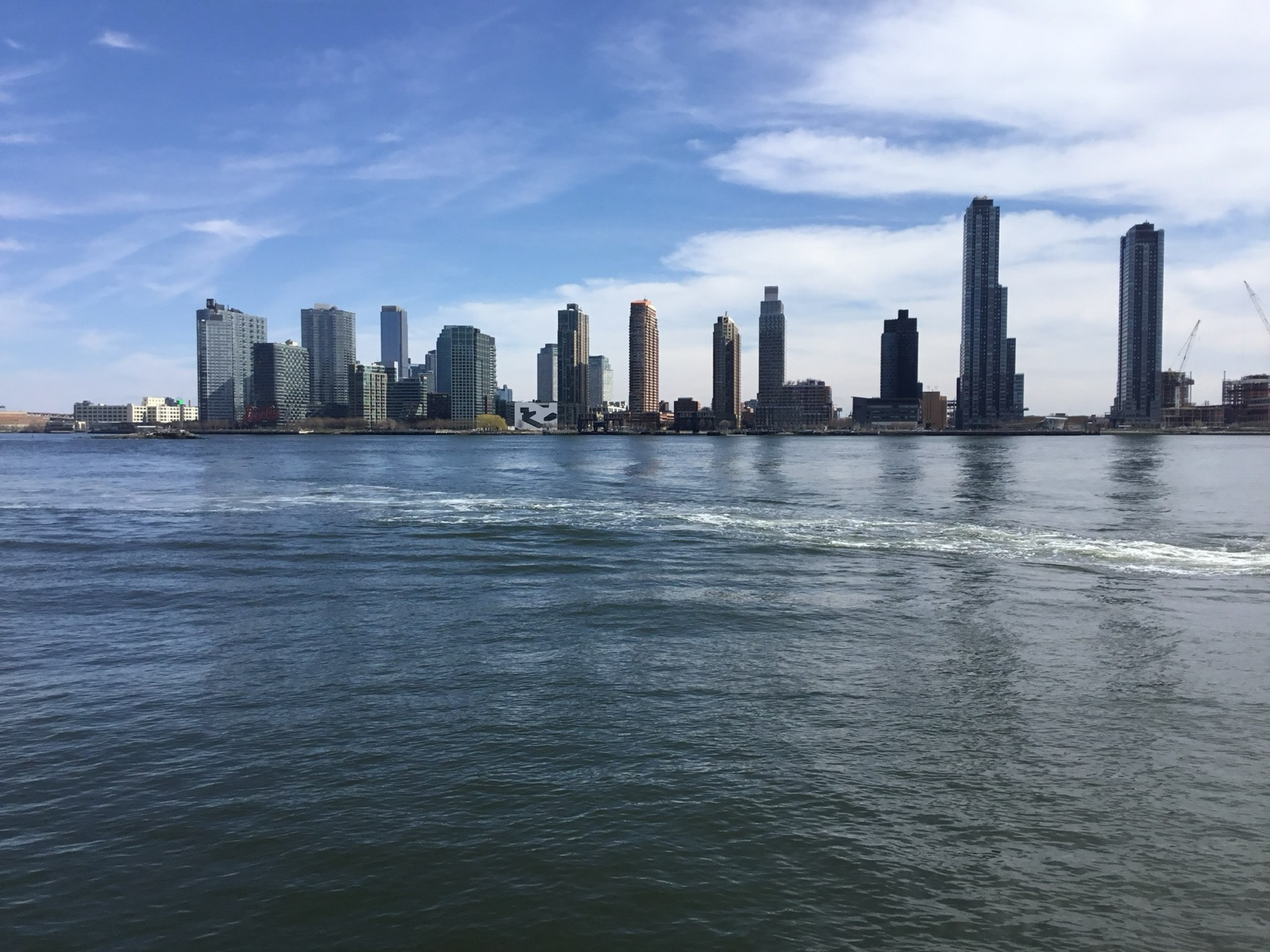
In 2001, the Bloomberg administration rezoned much of Long Island City from industrial to residential use. What followed was one of the most dramatic urban transformations in American history. Within fifteen years, the Queens West waterfront went from empty lots and derelict piers to a wall of 40 to 60 story glass towers. Tens of thousands of new apartments went up, nearly all of them marketed to Manhattan commuters who could ride the 7 train from Hunters Point to Times Square in five minutes.
The pace after 2010 was staggering even by New York standards. Between 2010 and 2020, LIC added more new residential units than any other neighborhood in the five boroughs. The Department of City Planning counted over 16,000 new units in that decade. Cranes were a permanent part of the skyline. Developers stacked towers along Center Boulevard, Jackson Avenue, and Queens Boulevard in a rush that turned empty industrial blocks into a dense residential district almost overnight. The neighborhood went from roughly 12,000 residents in 2000 to over 50,000 by 2025. Nothing else in Queens has grown that fast, and the physical evidence is a waterfront wall of glass that did not exist when the Noguchi Museum was the only reason most people crossed the Queensboro Bridge into this part of the borough.
The towers share a common set of finishes. Engineered quartz countertops that show every water ring if a puddle sits too long. Wide-plank engineered hardwood that dulls with too much product. Frameless glass shower enclosures that streak with anything ammonia-based. And the floor-to-ceiling windows that define every unit on the waterfront, where every smudge is visible from Gantry Plaza twelve stories below and from the FDR Drive across the river.
This is the most common apartment cleaning job in LIC and it has its own protocol. The window panels are an add-on you choose at booking, and our teams work them with a squeegee and a professional glass solution, not paper towels and household spray. The quartz gets a non-abrasive pH-neutral cleaner. The engineered hardwood gets a damp microfiber mop with a product formulated to clean without building residue. These are the same finishes in hundreds of LIC apartments and the routine is locked in.
The renter population in these towers is 76 percent of the neighborhood total, mostly aged 25 to 40, and many stay only a year or two before moving. That turnover rate means move-in and move-out cleaning is one of the most requested services in this ZIP code. Management companies inspect units before releasing security deposits and they check the details. Inside the cabinets, behind the integrated panel appliances, into the tracks of the sliding closet doors, across every inch of bathroom tile. We handle these turnovers regularly and know what the building offices look for.
MoMA PS1 turned a 19th century schoolhouse into one of the world’s great art spaces
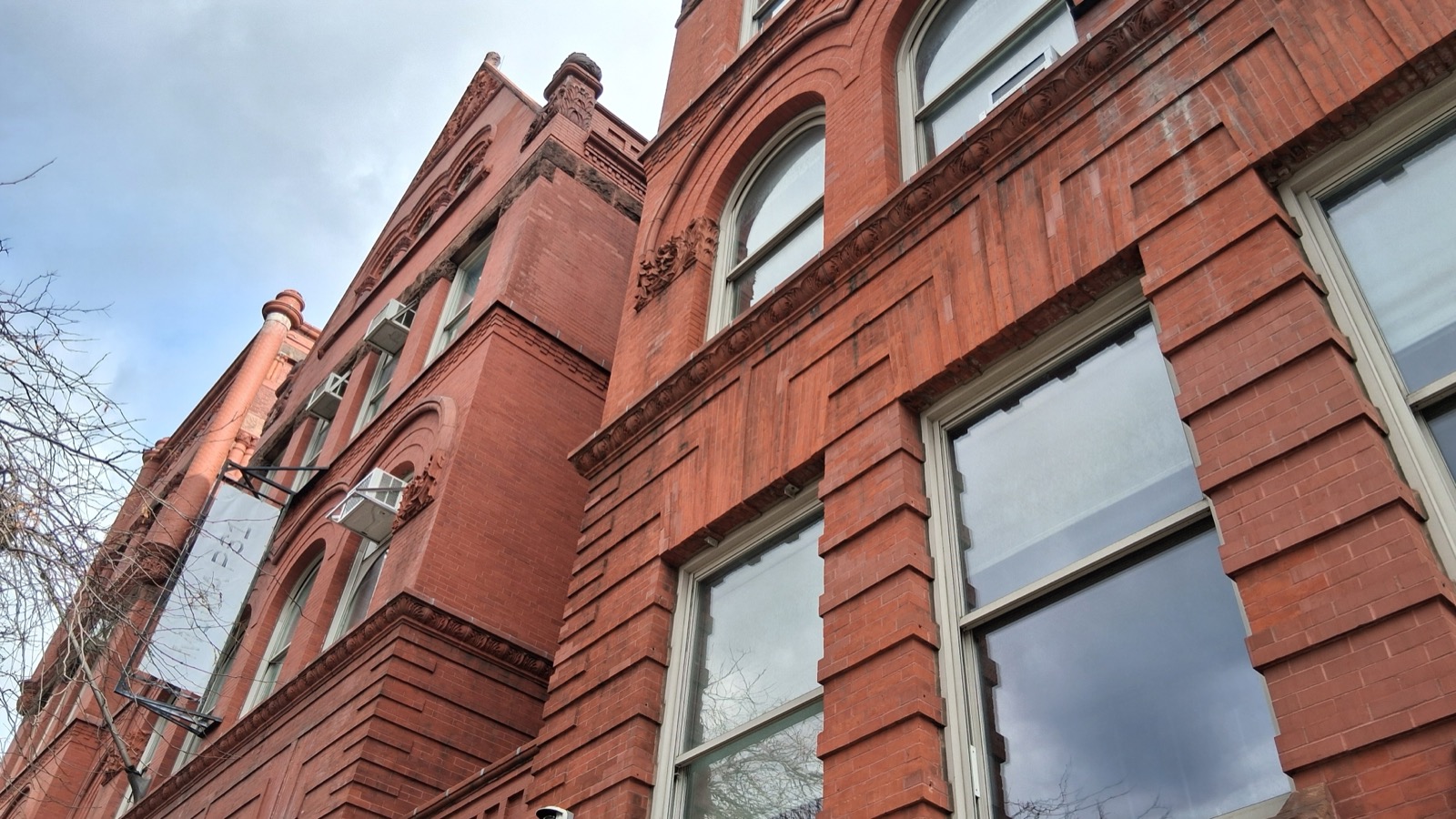
The building at 22-25 Jackson Avenue was constructed in 1899 as a public school in the Romanesque Revival style. By the 1970s it was abandoned. Alanna Heiss saw possibility in the empty classrooms and high ceilings and opened P.S. 1 Contemporary Art Center in 1976, making it one of the oldest and most influential contemporary art institutions in the country. Frederick Fisher and Partners renovated the building in 1997, creating the distinctive courtyard that hosts the annual Warm Up summer concert and DJ series, one of the signature cultural events in all of New York City.
PS1 affiliated with the Museum of Modern Art in 2000, becoming MoMA PS1. James Turrell has a permanent installation there. The galleries rotate with experimental and cutting-edge work that you will not find in Chelsea or the Upper East Side museums. Admission is free with a MoMA ticket, and on a weekday afternoon you can walk through the entire building without a crowd.
SculptureCenter sits nearby at 44-19 Purves Street, housed in a 1907 trolley repair shop that was redesigned by Maya Lin and reopened in 2002. The building was originally built for the subway system but never used for that purpose. In the 1940s it manufactured cranes and hoists. Now it shows pioneering contemporary sculpture. Socrates Sculpture Park, a 4.5-acre open-air museum on a former landfill at 32-01 Vernon Boulevard, rounds out a cultural corridor that no other outer-borough neighborhood in New York can match.
Hunters Point preserves 1880s row houses two blocks from 50-story towers
Walk two blocks east of the Queens West waterfront towers and the scale drops to three stories. The Hunters Point Historic District is a 17-block area centered on 45th Avenue between 21st and 23rd Streets, containing 47 row houses constructed between 1871 and 1890. The Landmarks Preservation Commission designated it in 1968, describing it as “a notable residential area which retains, on both sides of the street, a feeling of unity and repose, little changed since it was first built.”
The houses display Italianate, French Second Empire, and Neo-Grec architectural styles common in the second half of the 19th century. Many still have their original stoops, stone lintels, and bracketed pediments. The street was subdivided for development from the old Van Alst farm in the 1870s, and its elegant stone facades earned it the nickname “White Collar Row.” These are brick and brownstone buildings with plaster interiors, original moldings, and the kind of craftsmanship that no longer gets built at any price point.
The juxtaposition is one of the most extreme in any American city. You can stand on 45th Avenue looking at houses that have barely changed in 140 years and see a 50-story glass tower filling the sky behind them. The protected status means these row houses will outlast whatever gets built around them next. Their surfaces, from the limestone stoops to the plaster ceiling medallions inside, require cleaning products and techniques that match the age and fragility of the materials. These are not the same job as a tower unit and they do not get the same approach.
The Amazon headquarters that almost was and the neighborhood that kept building anyway
In November 2018, Amazon announced Long Island City as one of two locations for its second headquarters. The deal promised 25,000 jobs averaging $150,000 per year and up to $3 billion in state and city tax subsidies. For a few months, LIC was the most talked-about neighborhood in America.
The opposition was fierce. Local politicians, community organizers, and housing advocates argued that the corporate subsidy package was excessive, that the promised jobs would accelerate displacement of working-class residents, and that the infrastructure could not handle the influx. In February 2019, Amazon canceled the deal. No headquarters. No 25,000 jobs. Just a vacant waterfront site and a neighborhood that had briefly glimpsed one possible future before watching it evaporate.
The towers kept going up anyway. The population continued to grow. The waterfront site that Amazon would have occupied has been designated for mixed-use redevelopment. As of 2026, LIC ranks among the top projected growth markets on multiple real estate indices, with three Queens neighborhoods in StreetEasy’s top ten hottest markets list. The median asking rent hit $4,345 per month in 2025, up 5.5 percent year over year. Studios start around $2,800. A two-bedroom in a new luxury tower runs $5,000 to $6,500.
The Amazon episode revealed something about LIC that the development numbers alone do not show. This is a neighborhood with a genuine working-class community, predominantly Hispanic and South Asian residents who have lived in the older housing stock near the Queensboro Bridge and along the interior blocks for decades. They predate the art scene. They predate the towers. They are increasingly priced under pressure, but they have not been displaced wholesale, and the older walkups and pre-war six-story buildings where they live represent an entirely different cleaning environment than the waterfront glass.
Six subway lines make LIC the best-connected neighborhood outside Manhattan
No other neighborhood outside Manhattan has six subway lines. The 7 train runs from Hunters Point Avenue and Vernon-Jackson Avenue to Times Square in roughly five minutes. The E and M trains stop at 23rd Street-Ely Avenue. The G train connects Court Square to Brooklyn. The N, R, and W trains serve Queens Plaza. The F train stops at 21st Street-Queensbridge. Add the Long Island Rail Road at Hunters Point Avenue Station, the NYC Ferry at Hunters Point South, and the Queensboro Bridge bicycle and pedestrian path, and you have transit access that rivals most of Manhattan.
This connectivity is the structural fact underneath everything else about LIC. The towers exist because the commute is five minutes. The rents are high because the commute is five minutes. The population skews young professional because the commute is five minutes. And for a cleaning service, it means our teams can reach any building in the neighborhood efficiently from our Queens dispatch.
Your Saturday belongs at Casa Enrique or Gantry Plaza, not scrubbing quartz countertops
Casa Enrique opened on 49th Avenue in 2012 and became the first Mexican restaurant in New York City to earn a Michelin star, awarded in 2014. Chef Cosme Aguilar serves regional Chiapas cuisine, with the mole de Piaxtla as the signature dish and a mezcal and tequila program developed by his brother Luis. It is a genuine destination restaurant that happens to be in LIC rather than Manhattan, and you can walk there from most waterfront towers in under ten minutes.
John Brown Smokehouse on 44th Drive has been serving Kansas City-style barbecue since the neighborhood was still mostly empty lots and parking garages. Sweetleaf Coffee on Jackson Avenue predates the residential boom by years. Mu Ramen draws a crowd for creative Japanese-American dishes. The bar and restaurant corridor along Jackson Avenue through Court Square has grown from industrial desolation to a dense strip of new American, Asian fusion, and gastropub options.
Your cleaning takes about two to three hours. That is enough time to walk the full waterfront from Gantry Plaza north past the Pepsi-Cola sign to Socrates Sculpture Park and back. It is enough time for the Noguchi Museum sculpture garden and a coffee. It is enough time for PS1 on a quiet weekday. LIC has more cultural density per square mile than neighborhoods that have existed as residential districts for a hundred years longer. Use it. Your apartment will be done when you get back.
What booking looks like
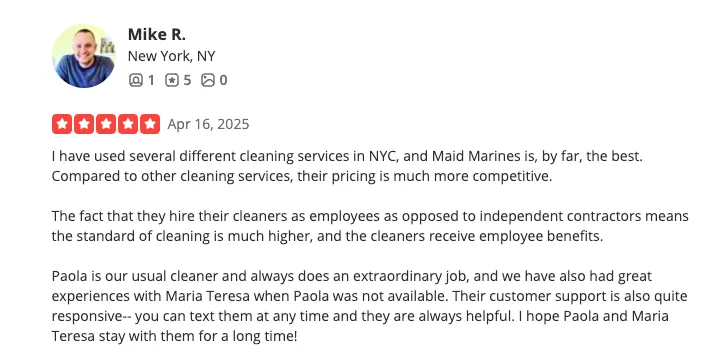
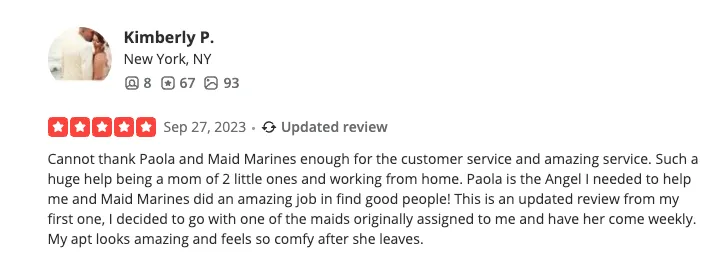
You pick your date and time on our booking page. You see your flat-rate price before you commit to anything. If your building requires a COI or has a service elevator protocol, tell us once and we handle it from there. Our cleaners are W-2 employees, not contractors from an app. They are vetted, insured, and they arrive with everything they need.
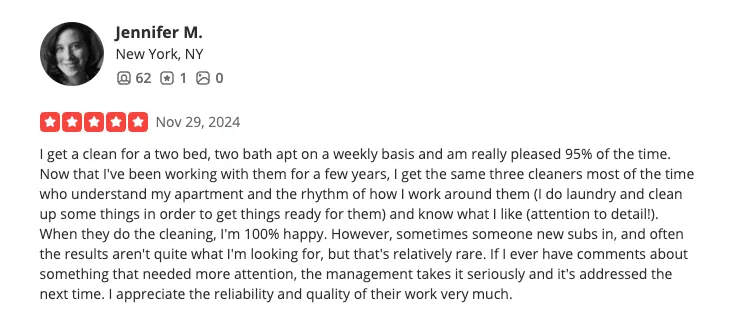
LIC residents also use us for recurring apartment cleaning on a weekly or biweekly schedule, which is the most common setup for the tower professionals who want a clean apartment waiting when they get home from Midtown. If you need a deep clean to reset a space before settling into a routine, that covers everything from the inside of the oven to the HVAC vents the previous tenant never touched. We also serve nearby Astoria, Sunnyside, and Greenpoint across the creek in Brooklyn.