
Kew Gardens does not announce itself. There are no famous restaurants with lines around the block, no tourist landmarks with gift shops, no neighborhood Instagram moment. What it has is a hillside full of English Tudor houses that look like they were transplanted from Surrey, a Victorian cemetery at the center of the neighborhood, a LIRR station that gets you to Penn Station in under twenty minutes, and one of the most specific food cultures in all of New York City running along its main commercial street. It is a neighborhood that has known exactly what it is for over a century and has never felt the need to explain itself.
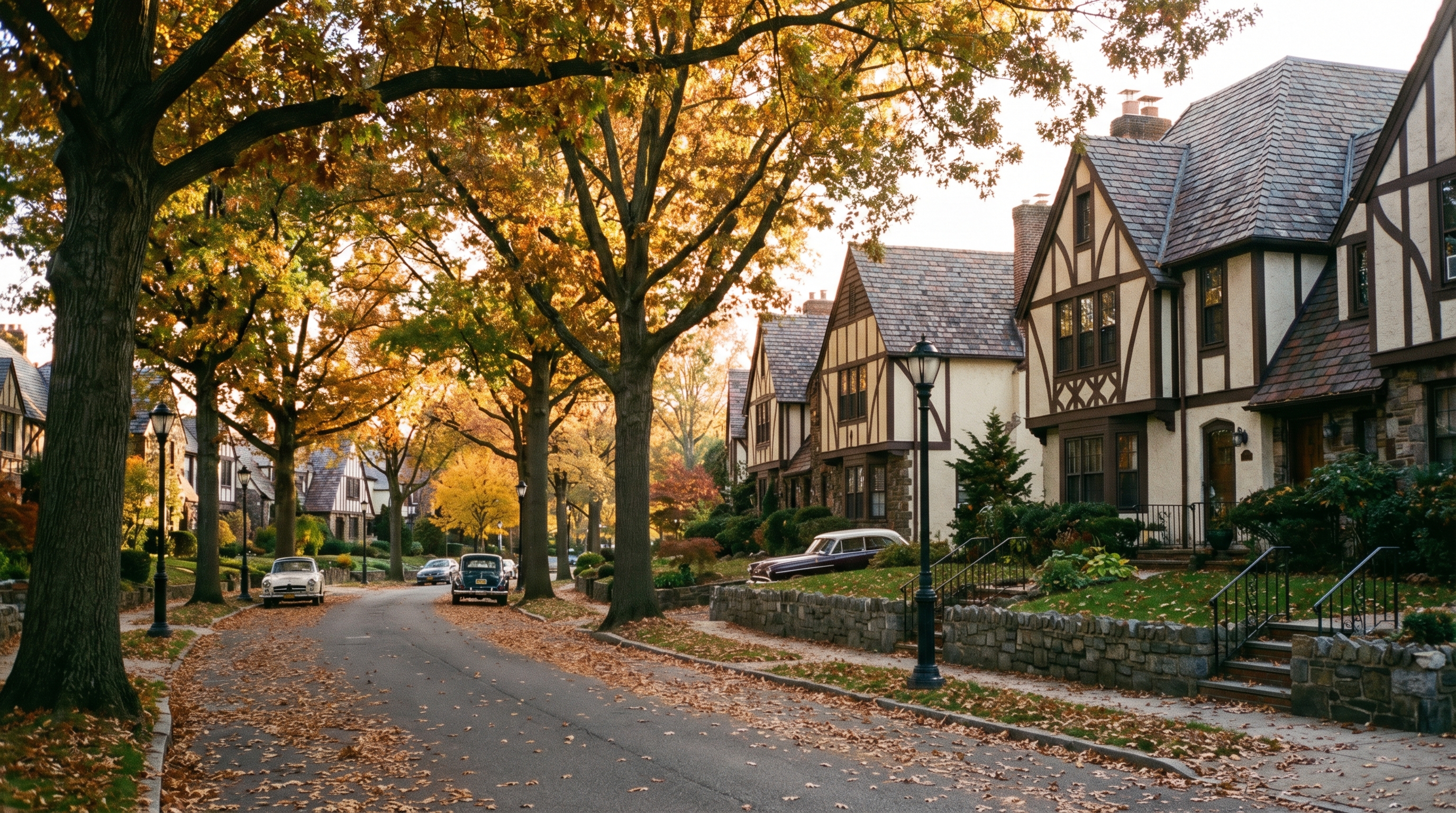
The homes on Mowbray Drive and Grenfell Street, curving streets that follow the natural contours of a glacial moraine rather than any grid, are the reason Kew Gardens became what it is. The developers who laid out this neighborhood in 1910 looked at what Olmsted had done in Forest Hills, what the English garden suburb tradition had produced in places like Hampstead and Bedford Park, and they designed accordingly. Deed restrictions, curvilinear roads, setbacks, minimum lot sizes, architectural consistency. They got it right the first time, and the historic district that resulted was officially recognized by the Landmarks Preservation Commission in 2006, over ninety years after the first homes were built.
The man who named this neighborhood after a royal botanic garden set everything in motion
The story of Kew Gardens begins with a wealthy New York lawyer named Albon Platt Man, who purchased a large parcel of rolling hillside land in central Queens in the 1860s and built an estate he called Maple Grove. Man was familiar with the Royal Botanic Gardens at Kew in Richmond-upon-Thames, Surrey, one of the world’s great botanical institutions, established in 1759 under Princess Augusta and later expanded by William Chambers and Sir Joseph Banks. He named his estate after them. The name evoked the carefully maintained English grounds, the aristocratic garden suburb tradition, the sense of enclosure and deliberateness that Man wanted his estate to carry.
Man died. The estate passed through other hands. In 1910, the Rickert-Finlay Realty Company purchased the property and commissioned landscape planners to lay out a planned residential community. They retained Maple Grove Cemetery, which had been established on a corner of the estate in 1875, a Victorian rural cemetery in the picturesque tradition with carriage paths, stone mausoleums, and mature trees. They laid curvilinear streets that traced the terrain rather than flattening it. They kept the name Kew Gardens because it worked. It still works.
The cemetery is still there, in the heart of the neighborhood, shaded by hardwoods that were mature when Teddy Roosevelt was president. The curving streets still follow the moraine hills. The Tudor and Arts and Crafts houses that went up between 1910 and 1940 still stand largely intact, behind stone retaining walls and iron fences, with front gardens and private driveways and an atmosphere more reminiscent of an English village than of a borough of New York City. This does not happen by accident. It happens because the people who live here care about it.
Tudor Revival houses and prewar co-ops require two completely different cleaning approaches
Walk from the hillside streets of the historic district down to Lefferts Boulevard and you have crossed a century of construction and two entirely different sets of cleaning challenges.
The homes on Mowbray Drive, Grenfell Street, Sycamore Drive, and Beverly Road are English Tudor Revival and Arts and Crafts houses built between 1910 and 1940. Stucco exteriors, tile roofs, leaded glass windows, original oak woodwork, plaster walls. The stucco is porous. It absorbs water and stains if you spray toward the wall surface. The leaded glass has cames, the soft metal strips that hold the glass panels together, which corrode with anything ammonia-based. The plaster walls show moisture marks if you are careless. The slate entryway tiles, original in many of the older homes, scratch permanently with grit tracked in from the garden paths. These homes deserve a cleaning approach that knows what it is dealing with before the first mop hits the floor.
Three blocks east on Lefferts Boulevard, the housing stock flips entirely. Six-story brick elevator buildings from the 1920s and 1930s, with Art Deco lobby details, canopied entrances, and apartments that have real dining rooms, nine-foot ceilings, crown molding, and original parquet. Many of these buildings converted to co-op ownership in the 1970s and 1980s, and the co-op boards run them with the seriousness of people who bought in a neighborhood they intend to stay in. The parquet in these apartments is individual wood blocks set in glue that swells and pops loose if you saturate it. We damp-mop only, pH-neutral hardwood solution, microfiber, dry immediately. No steam, no vinegar, no bucket-and-wring approach.
The cast-iron radiators in both the historic district homes and the Lefferts co-ops get the same treatment we bring to every prewar building in the city: covers wiped, grilles dusted, the floor and wall around the unit vacuumed, every visit. The fins trap dust from April through September, and when the steam heat turns on in October, that dust burns off and fills the apartment with a scorched smell that most people assume is normal. Keeping the surface layer down through the summer is what makes that first October morning bearable. Whatever has already packed down inside the sections is a shop-vac job rather than a cleaning-visit job, and we would rather tell you that than bill you for it.
Don Rickles grew up on these streets and the courthouse has defined the neighborhood ever since
There are two facts about Kew Gardens that tell you most of what you need to know about its character. The first is that Don Rickles, the legendary insult comic who entertained Frank Sinatra, made hundreds of appearances on The Tonight Show, and voiced Mr. Potato Head in the Toy Story franchise, grew up here. The second is that the Queens County Supreme Court and Courthouse Complex, a WPA-era neoclassical civic building completed in 1939, sits at Queens Boulevard and Union Turnpike and has defined the neighborhood’s professional identity ever since.
Rickles was born in 1926 and grew up in Kew Gardens before moving to Manhattan to pursue a career that would make him one of the most beloved performers of the twentieth century. His particular brand of comedy, the “insult comic” persona that could eviscerate a room while leaving everyone laughing, had a Queens directness to it that made sense once you knew where he came from. The neighborhood he grew up in was already, by the 1930s and 1940s, a solidly middle-class place full of professional families who had moved out from Brooklyn, lawyers and businesspeople and their families, people who took their neighborhood seriously.
The courthouse accelerated that tendency. Judges and attorneys and court administrators live within walking distance of their workplace. Legal professionals constitute a higher share of the commercial and residential population here than anywhere else in Queens. The law offices along the Lefferts Boulevard corridor, the diners full of lawyers eating breakfast before arraignments, the professional character that runs through the neighborhood at every level, all trace back to that neoclassical courthouse on Queens Boulevard.
Paul Auster, the American novelist whose New York Trilogy is among the most celebrated urban fiction of the late twentieth century, had family connections to Kew Gardens. Ross Bagdasarian, the creator of Alvin and the Chipmunks, was associated with the neighborhood. Gary Ackerman, the longtime Queens congressman, lived here for decades.
The Bukharian Jewish community transformed Lefferts Boulevard into one of the most specific food corridors in New York
After the Soviet Union collapsed in 1991, Jewish families from Uzbekistan, Tajikistan, and other former Soviet Central Asian republics began arriving in Queens in numbers that changed the borough’s character. Forest Hills and Kew Gardens became the primary centers of this community in the United States, and today the area holds one of the largest concentrations of Bukharian Jews in the Western Hemisphere.
The Bukharian Jewish community carries a cultural tradition that goes back 2,500 years, a blend of Central Asian, Persian, and Jewish influences that has produced one of the most distinctive and underrecognized cuisines in New York City. Walk down Lefferts Boulevard on any afternoon and you will find restaurants serving plov, the Uzbek rice pilaf cooked with lamb, carrots, and spices that is the community’s signature dish. They serve samsa, baked lamb-filled pastries from a tandoor oven. Lagman, hand-pulled noodles in a savory broth. Kebabs over charcoal. The bakeries produce non, the large round flatbreads baked fresh in a tandoor every morning, warm and chewy and unlike anything you can find outside of Central Asian communities.
These restaurants double as community gathering places. On Friday afternoons before Shabbat, they fill with three generations at the same table, speaking a mix of Russian, Bukharan Judeo-Tajik, and English. The cultural investment in family occasions is deep, visible in the catering halls and synagogues that the community has built throughout the neighborhood over the past thirty years.
The cooking traditions that come with this community are directly relevant to cleaning. Heavy use of oil for frying, stewing, and grilling builds up grease film on range hoods, backsplashes, and upper cabinet faces that all-purpose cleaners do not touch. Many households maintain kosher kitchens with separate zones for meat and dairy preparation that require designated cleaning supplies and no cross-contamination between zones. We bring commercial-grade degreasers for ambitious kitchens and we have the kosher kitchen protocol down from years of work in Forest Hills and Kew Gardens. You tell us what your kitchen looks like and we adjust before we start.

The Kitty Genovese case put this neighborhood in textbooks but tells you almost nothing about living here
On March 13, 1964, Kitty Genovese was stabbed to death near the LIRR station at Austin Street and Lefferts Boulevard. A New York Times report published two weeks later claimed that 38 neighbors had witnessed or heard the attack without calling the police, and the story became one of the most famous crime narratives in American history, spawning decades of social psychology research on what became known as the bystander effect or Genovese syndrome.
The original account was substantially wrong. Later investigation established that the 38-witness figure was exaggerated, that several people had called the police or taken other action, and that the narrative published in the Times was constructed in ways that the facts did not support. The social psychology research that followed is itself contested. But the story attached itself to Kew Gardens in the public consciousness with a permanence that the correction never undid.
The actual neighborhood bears no relationship to that decades-old news story. The corner at Austin Street and Lefferts Boulevard is marked only by the awareness of longtime residents. The people who live here, the legal professionals, the Bukharian families, the homeowners in the historic district who tend their Tudor houses with genuine care, go about their daily lives in a neighborhood that is, by most available measures, one of the safer and more stable parts of Queens.
What the incident does illustrate, in hindsight, is that Kew Gardens was a neighborhood in transition in 1964, absorbing demographic change faster than its institutions could keep up with. The stability that defines the neighborhood today was not inevitable. It was built over the following decades by people who chose to stay, invest, and maintain.
A recurring cleaning is how the courthouse professional community hands off the maintenance problem entirely
The legal professionals who anchor Kew Gardens’ commercial character are, as a category, time-poor. Judges and attorneys and court administrators work long hours in a building a short walk from their homes, which is exactly why they moved to this neighborhood in the first place. The commute is optimized. The LIRR gets them to Penn Station in seventeen minutes if they need to be in Manhattan. The E and F trains at Union Turnpike put them in Midtown in twenty-five minutes on a slow day.
What they do not have is time on Saturday morning to scrub the bathtub in a 1930s co-op with nine-foot ceilings and original parquet that requires a specific product and specific technique. That is where we come in. You pick your date and time on our booking page. You see your flat-rate price before you commit. If your co-op building requires a Certificate of Insurance on file or 48-hour advance notice for vendors, tell us once when you set up the first appointment and we handle it from there.
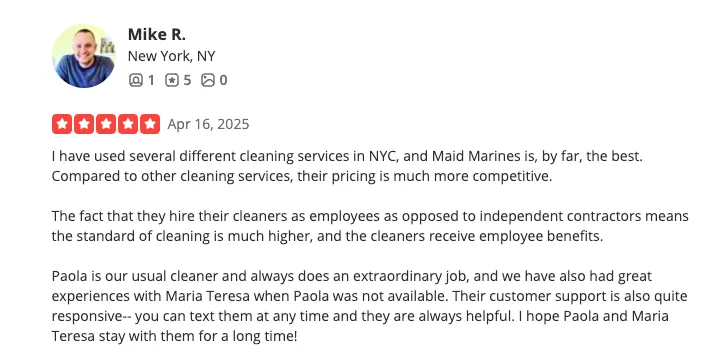
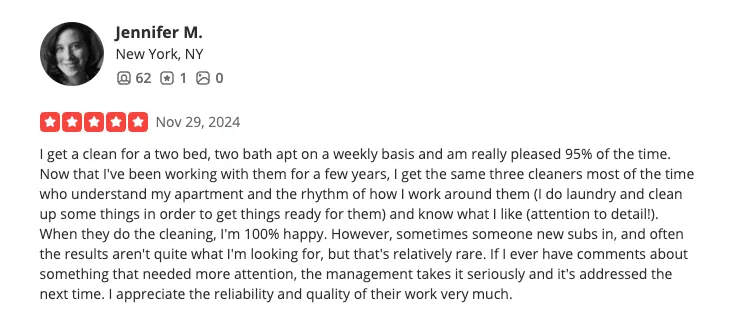
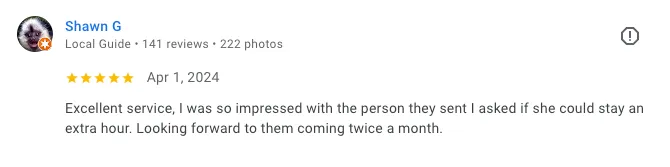
Our cleaners are W-2 employees, not gig workers. They are vetted, insured, and they bring everything they need. If your building has specific access requirements, a lockbox code, a doorman who holds keys, a service entrance on the side street, we learn that on the first visit and follow the protocol from then on. The same team comes to the same home on every recurring visit so they know your parquet, your radiators, your stucco walls, and your kitchen layout before they start.
Kew Gardens residents also use us for deep cleaning before Passover or after a long winter, and for move-in and move-out cleaning in the active co-op resale market along Lefferts Boulevard. We also serve nearby Forest Hills, Sunnyside, Astoria, and the rest of Queens.
Your cleaning window runs about three hours and this neighborhood gives you several good options for all of them
Lefferts Boulevard alone fills a cleaning window without any effort. Walk it from the LIRR station south toward Metropolitan Avenue and you have Bukharian restaurants, Uzbek bakeries, Chinese restaurants, classic Queens diners, and a movie theater that has been showing films in this spot for as long as anyone can remember. The Kew Gardens Cinema is the kind of single-screen neighborhood theater that most cities lost decades ago. Matinee programming most afternoons.
If you want to eat rather than sit in a theater, the restaurant situation on Lefferts Boulevard is one of the most specific and underappreciated in the outer boroughs. The Bukharian restaurants are the reason most food writers who have discovered this neighborhood come back. Plov and samsa and lagman noodles in a room where everyone at the surrounding tables is a regular. A few blocks further south on Lefferts is Don Peppe, the cash-only, no-reservations Italian-American institution that appears on best Italian restaurant lists in New York year after year. Enormous portions, no menu on the wall, they tell you what is good that day.
Or you walk instead of eating. Maple Grove Cemetery, the 1875 Victorian rural cemetery at Park Lane South and 80th Road, is one of the more unusual green spaces in Queens. Stone mausoleums, carriage paths, 150-year-old hardwood trees, and complete quiet in the middle of a residential neighborhood. It is the kind of place that feels like a discovery even after you have known about it for years.
From the cemetery, you are a few minutes walk from the historic district streets. Mowbray Drive in autumn, when the oak and maple canopy turns gold and amber over the curving road, is the reason people who move to Kew Gardens do not leave. The houses sit behind stone walls, with iron fences and front gardens that the owners maintain with obvious care. These are homes where people live deliberately.
The LIRR station is there if you would rather spend your cleaning window in Manhattan. Penn Station in seventeen to twenty minutes means you can have lunch in Midtown, walk the Highline, or run an errand across the borough and be back before we finish. House cleaning done, afternoon yours, Saturday intact.