

Linden Hill does not appear in the travel guides. It does not have a famous hotel or a landmark that draws visitors from other boroughs. What it has is this: a glacial ridge above Flushing Creek, solid cooperative apartment buildings from the 1950s and 1960s, Mexican and Puerto Rican families who have made the neighborhood entirely their own, and a position five minutes from the busiest Chinese commercial corridor in the Western Hemisphere while feeling nothing like it. That combination is not accidental, and it is not a paradox. It is Queens operating at its natural resolution.
A ridge, a name, and the trees that gave it both
The neighborhood is named for the landscape, not for a person. That already makes it unusual among Queens place names, which tend to honor developers, landowners, or the distant English towns that nostalgic colonists were trying to remember. Linden Hill takes its name from two plain facts: there is a hill, and the American linden trees once grew on it.
The hill is a glacial drumlin, the elongated ridge left behind when the Laurentide Ice Sheet retreated from this part of Long Island roughly 20,000 years ago. The retreating glaciers deposited material in a characteristic elongated form, creating the gentle elevation that still defines Linden Hill’s topography and gives its southern and western faces their views toward Flushing Creek and the expressway below. The Matinecock people, who occupied this part of the Town of Flushing before European contact, used the ridge terrain for settlement and farming. Good drainage, elevated position, proximity to the creek. The basic requirements of useful land in any era.
The linden trees (American basswood, Tilia americana) were drawn to the same conditions that drew people: well-drained elevated soil, full sun on the ridge slopes. Linden trees are large, deciduous hardwoods known for their dense shade canopy and the fragrant cream-colored flowers that bloom in early summer. By the time the neighborhood had enough residents to need a name, sometime in the mid-to-late 19th century, the trees on the ridge were its most distinctive feature. The name stuck and has outlasted the trees themselves, most of which are gone.
The terrain remains. The ridge is still the physical logic of the neighborhood, and understanding it helps explain why Linden Hill developed so differently from the flat commercial land of Flushing proper to the south. Development on a ridge goes slowly. You cannot pour a foundation as easily as you can on flat land. The retail strips stayed on Northern Boulevard at the bottom. The residential character stayed on the ridge above.
The postwar cooperative that became the neighborhood’s backbone
Linden Hill’s defining building type arrived in a concentrated wave between 1945 and 1965, when city planners and private developers confronted New York’s postwar housing shortage by building large cooperative apartment complexes on whatever available residential land remained in the outer boroughs. The Flushing ridge had exactly what that moment required: accessible by trolley and bus, elevated and pleasant, distant enough from Manhattan that land was affordable, close enough to Flushing’s commercial center to be practical for families.
The buildings that went up in that period are not architecturally distinguished. They are six to ten stories of brick, arranged in superblock configurations with shared courtyards and parking lots between them. The windows are standard issue. The lobbies are functional. The apartments run from studios to three-bedrooms with the kind of dimensions that were considered generous by 1955 standards and feel compact by the standards of a detached house. None of this is a criticism. These buildings were designed to be lived in by working families who owned their units through a cooperative structure, which meant they had a financial stake in maintenance, a voice in management, and a reason to stick around.
That ownership structure has proven to be one of the most durable stabilizing forces in New York residential life. Linden Hill’s cooperative buildings absorbed demographic shifts that displaced and destabilized other Queens neighborhoods, partly because the co-op structure gave each wave of residents the same incentive the last wave had: maintain the building, manage it well, and protect the investment. The Irish and Italian families who moved in during the 1950s were followed by Latino families from Mexico, Puerto Rico, and South America. The buildings did not change character so dramatically as to become unrecognizable. The maintenance culture transferred.
Today those co-op apartments sell for $150,000 to $350,000 with monthly maintenance fees, which makes them among the most genuinely affordable ownership options in northern Queens. The entry price is significantly below comparable Flushing condominiums. The trade-off is the co-op board, which has real authority over who moves in and what vendors enter the building. That authority shapes how a cleaning service has to operate in Linden Hill in ways that differ from the walk-up rental market in other parts of Queens.
The cultural crossroads that only Queens can produce
Fifty-five percent of Linden Hill households speak Spanish as their primary language. This is the most striking demographic fact about the neighborhood, not because Spanish-dominant communities are unusual in Queens, but because of where this one sits. Walk south on any street from Linden Hill to Northern Boulevard and cross into Flushing, and the street-level language shifts to Mandarin within two blocks. Linden Hill abuts the largest Chinese American commercial district outside Asia, and the two communities live side by side in a productive, low-drama adjacency that generates the kind of daily cultural texture you cannot manufacture.
The Mexican American community here traces roots largely to Puebla and Oaxaca. The neighborhood’s taquerias run al pastor and barbacoa that reflect the specific regional cuisines of those states, not a generalized Mexican American restaurant menu. Puerto Rican families with multigenerational roots in northern Queens have established the social infrastructure of mofongo spots, bodegas, and community organizations that make a neighborhood feel inhabited rather than merely occupied. South American arrivals from Colombia, Ecuador, and the Dominican Republic round out the Latino composition that now constitutes roughly 55 to 60 percent of the neighborhood’s 54,000 residents.
The Irish American and Italian American heritage communities, once the majority here, still account for roughly 20 to 25 percent of residents. They have not been displaced so much as folded into a neighborhood that continues to function on the same working- and middle-class terms they established. The co-op culture helped with that continuity. When the ownership structure stays intact, the neighborhood identity has something to hold it together across generational demographic change.
What the housing stock actually requires from a cleaning team
The postwar cooperative apartment is a specific type of home with specific maintenance realities that differ from the pre-war walkups of western Queens and the glass towers of Flushing’s downtown. The construction era matters. Buildings from the 1950s and 1960s used materials and built-in features that are now approaching 60 to 70 years old, maintained well in most cases but aging in ways that require care.
The parquet floors installed in most Linden Hill co-op apartments during the postwar build-out are thinner than modern engineered hardwood. The individual wood tiles are bonded with a mid-century adhesive that reacts poorly to water saturation. A wet mop repeated over years will lift the tile edges, buckle the surface, and create the kind of floor damage that a co-op board will hold you responsible for on resale. The right approach is dry or barely damp microfiber with a pH-neutral cleaner that evaporates quickly. We vacuum the joints between tiles before mopping to pull out the compacted debris that a mop would push deeper. The result is a floor that looks maintained rather than washed.
The kitchens in these buildings frequently retain their original steel cabinet faces, which scratch with abrasive cloths and react badly to anything acidic. We put product on the cloth, not on the surface, and we use non-abrasive all-purpose cleaners that cut grease without etching the metal. The bathroom tile grout in a 1960 co-op is 65 years old. Steam machines and aggressive scrubbing can crack grout that has been chemically stable for decades. We use a stiff brush and grout-appropriate cleaner rather than the tools that would make fast visual progress at the cost of structural damage.
The two-family brick homes that make up the residential streets away from the co-op complexes have their own characteristics. Pre-HVAC construction from the 1920s and 1930s means cast-iron radiators and the dust accumulation patterns that go with forced steam heat. The radiator fins are where the dust actually lives, not the top surface that most cleaning services wipe and move on. We use a radiator brush and vacuum attachment to clean between the fins, which is the difference between a clean-looking radiator and a radiator that does not fill your apartment with burning dust smell when the heat kicks on in October.
The co-op approval process is a reality in Linden Hill that is worth addressing directly. Your building’s co-op board has genuine authority over vendor access, and some boards are more involved in that process than others. We provide the paperwork they need: Certificate of Insurance, business registration, whatever the board requires, and we coordinate the timeline so your first appointment is not delayed by documentation that should have been submitted a week earlier. Tell us your building and the co-op contact when you book and we handle the coordination from there.
What Linden Hill gives you on a Saturday
The neighborhood is quiet in the way that residential northern Queens is always quiet, which is not the same as empty or lacking. Flushing Memorial Fields runs baseball and softball leagues through the summer that fill weekend mornings with families, coolers, and organized noise. The Leonardo Ingravallo Playground fills with co-op building residents in the afternoon. The Flushing War Memorial anchors the park complex with the kind of monument that serves a neighborhood rather than a tourist.
Francis Lewis Boulevard and Utopia Parkway handle the daily errands. Bodegas, Latin supermarkets, Chinese-owned shops, and informal food vendors serve a population that knows exactly what it needs from its commercial corridors and expects to find it within walking distance. The Whitestone Bagel Factory has been making water-boiled bagels and bialys since 1997, a holdover from the neighborhood’s Eastern European Jewish past that survived the demographic transition on the strength of what it produces.
For a proper outing, Flushing is ten minutes east. The Main Street corridor is the full range of Asian cuisines concentrated in a way that does not exist anywhere else in the country. Flushing Meadows Corona Park is fifteen minutes south: 849 acres, the Unisphere, the Queens Museum, the New York Hall of Science, two stadiums, and a meadow that rewards the walk. LaGuardia Airport is fifteen minutes west on the Whitestone Expressway. The Whitestone Bridge to the Bronx is ten minutes. Linden Hill’s geographic position in northern Queens is more connected than the neighborhood’s quiet streets suggest.
None of this requires you to spend your Saturday cleaning. A recurring cleaning appointment on a schedule that works around your life means the co-op is maintained without consuming the weekend hours that the neighborhood and the borough have better uses for.
Booking in Linden Hill
You pick your date and time on our booking page. You see the flat-rate price before you commit to anything. If your co-op board requires a vendor approval process, tell us when you book and we handle the paperwork and coordination before your first appointment. Most Linden Hill co-ops need 48 to 72 hours advance notice for first-time vendors. We know what they typically ask for and we provide it without making you the go-between.
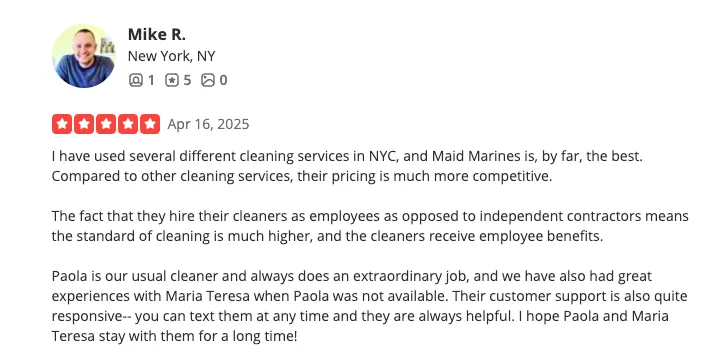
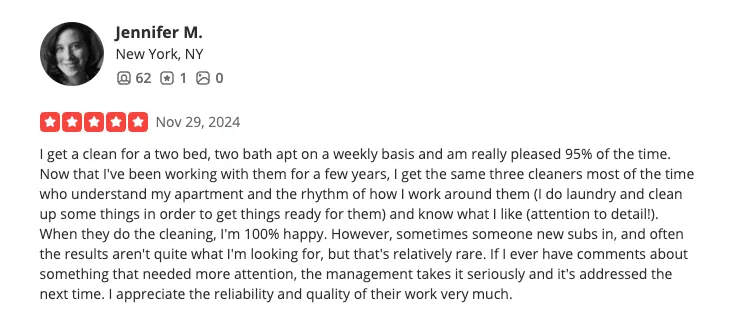
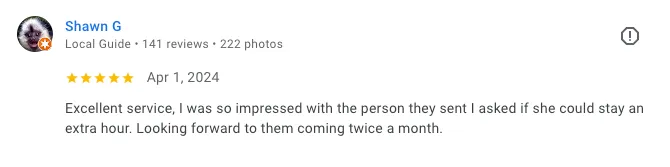
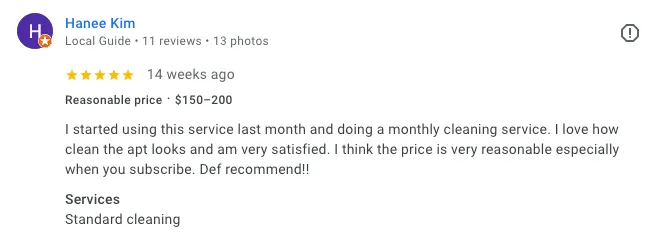
Our cleaners are W-2 employees, not gig workers. They carry everything they need into the building. They know the parquet floors, the steel cabinet faces, the cast-iron radiators, and the grout in 1960s tile bathrooms. They adjust their approach for what the surface actually is rather than running the same routine regardless of what is underfoot.
Linden Hill residents use us for deep cleaning before moving in or after moving out, for the first-visit reset that establishes a clean baseline in an apartment that has been occupied for years without a professional service, and for recurring cleaning on weekly or biweekly schedules that keep the co-op maintained without the time investment of doing it yourself. We also serve nearby neighborhoods in northern and central Queens, including Forest Hills and Astoria.