
Kings Bay exists because two organizations decided it should. In the winter of 1951, the Brooklyn Public Library opened a storefront branch on Nostrand Avenue to serve the families moving into the new apartment buildings and the freshly opened Nostrand Houses public housing complex. A year later, a Jewish community center opened across the street and called itself the Kings Bay YM-YWHA. Neither institution took the name from history. There was no bay, no king, no documented earlier use of the phrase. They chose a name that sounded like it belonged, drawing on Kings County (the official name for Brooklyn since the colonial era) and the proximity to Sheepshead Bay to the south, and the institutions made the name stick.
That origin story matters because it explains everything about what Kings Bay is today. Unlike neighborhoods shaped by geography or industry, Kings Bay is a neighborhood whose identity is civic. Its character lives in what the Y and the library do, who they serve, and how they adapt to each generation of residents along this stretch of Nostrand Avenue.
The ground beneath Kings Bay was once the most glamorous racetrack in America
The 50 acres now occupied by the Nostrand Houses and the surrounding blocks were, from 1880 to 1910, the site of the Sheepshead Bay Race Track. For a decade it was the most prestigious horse racing venue in the United States. The Vanderbilts, Whitneys, and Belmonts came to this ground to watch and wager on races that drew national attention. Hotels, restaurants, and resort infrastructure grew up around it, and the Nostrand Avenue corridor took its form as a through-road connecting the bay to the interior.
Anti-gambling legislation ended the races in 1910. The track closed, the resort economy collapsed, and southern Brooklyn entered a quiet residential period as working-class families moved south along the extended streetcar and subway lines. The decisive transformation came in 1950 when the New York City Housing Authority opened the Nostrand Houses on the old racetrack site. Designed by architects William E. Haugaard and Andrew J. Thomas and built for returning veterans and young working families, the complex brought 1,148 apartments and thousands of residents to the Nostrand Avenue corridor. The community institutions that define Kings Bay today emerged directly in response to the needs of those residents.
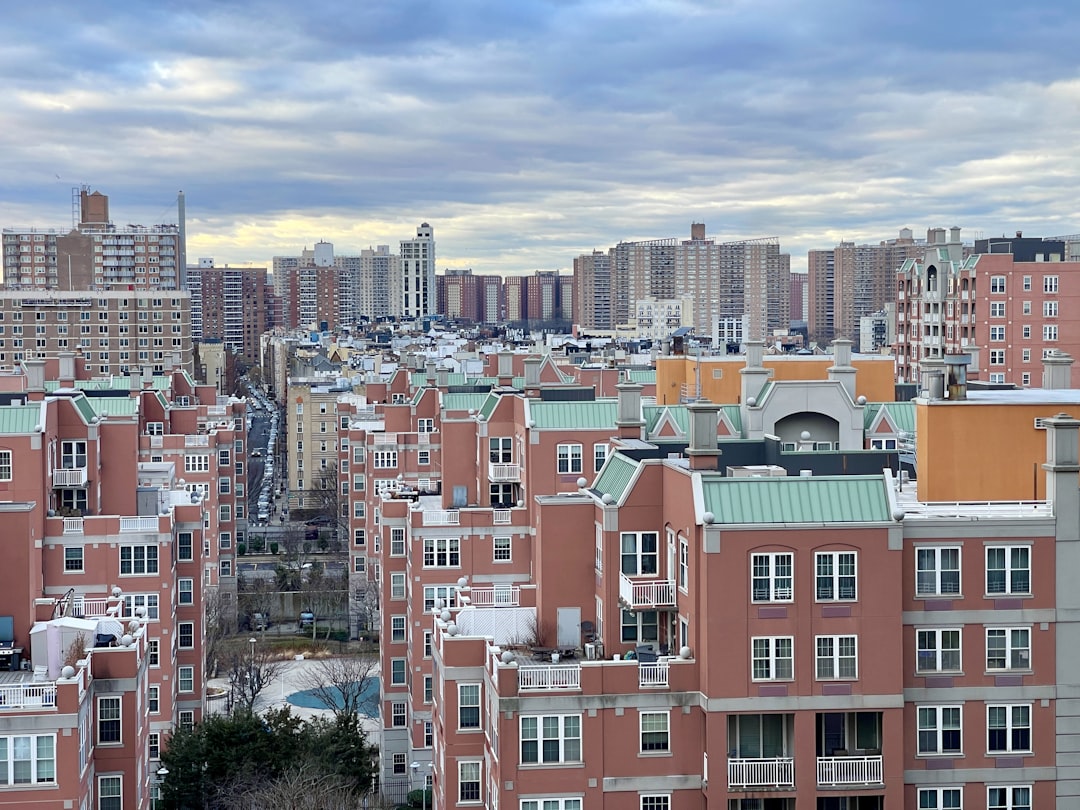
The neighborhood that resulted from that sequence, a Gilded Age racetrack giving way to postwar public housing surrounded by mid-century co-ops and two-family homes, is the physical landscape our cleaners work in. Every generation has left its layer. The trick is cleaning each layer correctly.
Postwar brick buildings require a different approach than prewar construction
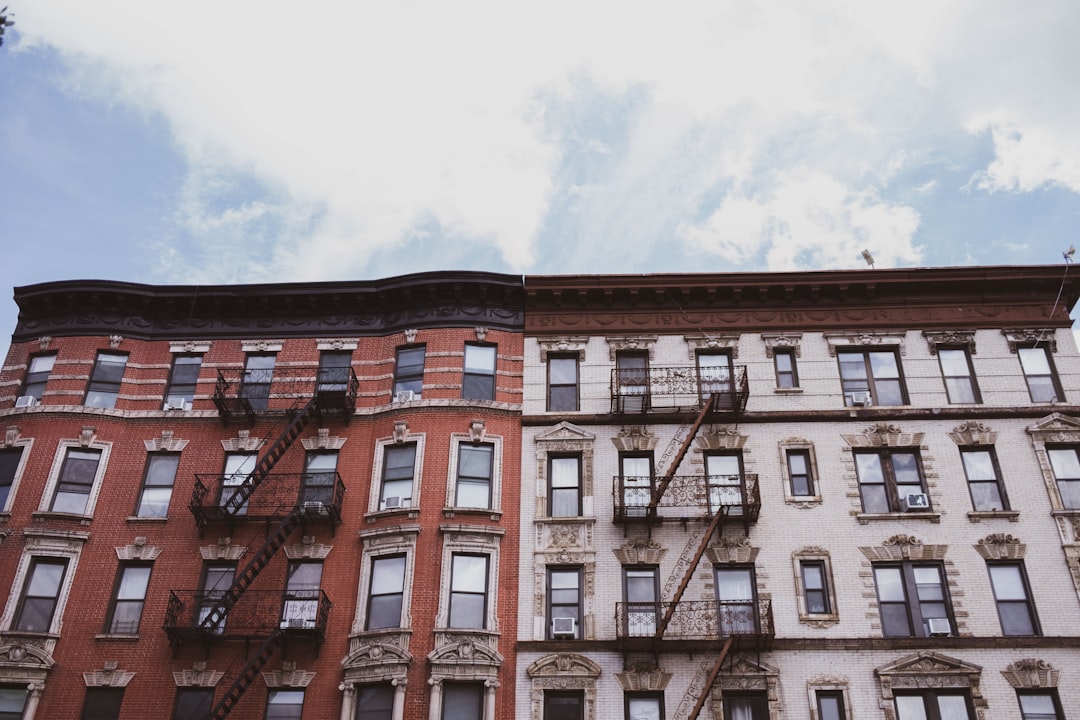
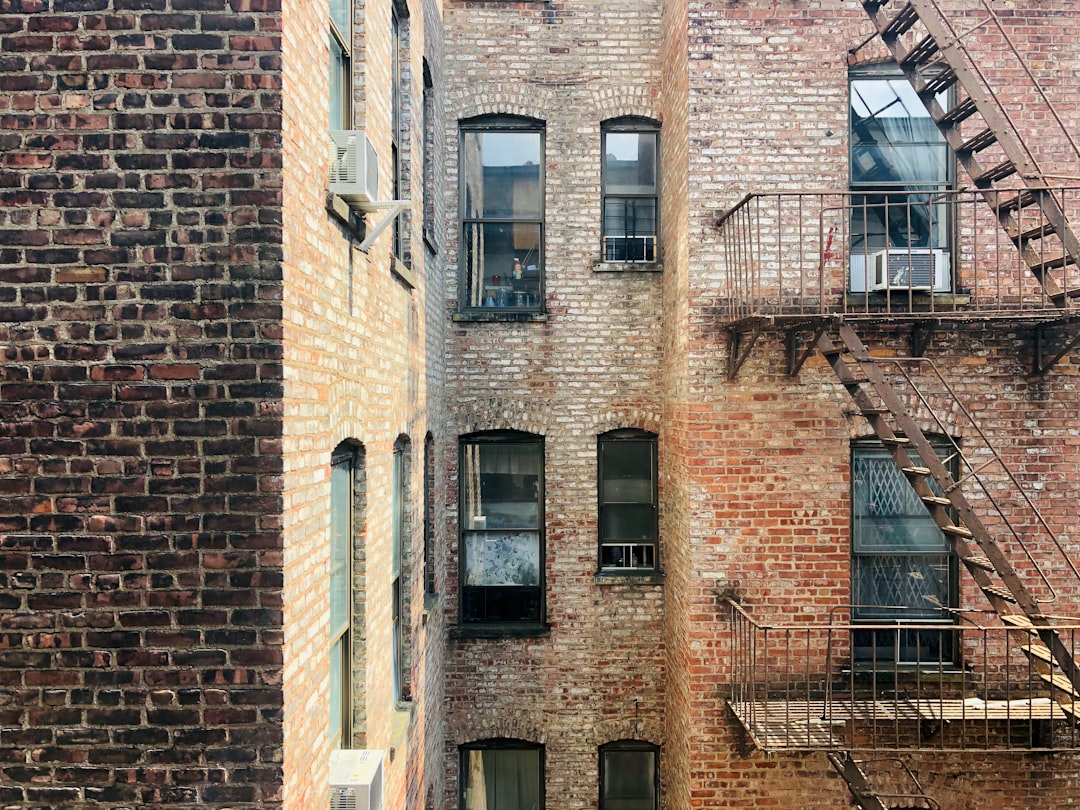
Kings Bay’s dominant housing type is the four- to six-story brick apartment and co-op building constructed between 1950 and 1970. These buildings are not architecturally distinctive, but they are solid. Red or orange brick facades, standard-depth apartments, minimal decorative detail, and the practical durability that characterized postwar New York construction. The interiors reflect the same practical sensibility. Compact galley kitchens, bathrooms with standard tile, eight-foot ceilings, and hardwood or parquet floors that have survived sixty to seventy years of use.
Our house cleaning teams know these buildings. The kitchens are typically small enough that a thorough cleaning takes attention to detail rather than scale: the gap behind the stove, the underside of cabinet shelves, the range hood filter. The bathrooms often have original hex tile or subway tile from the early 1960s where grout has darkened over decades. We clean that grout correctly, not just across the surface. The parquet floors that appear in many units from this era need a wood-safe cleaner and a barely damp mop, not the wet approach that damages the adhesive beneath individual blocks.
The two-family homes on the residential side streets (Bragg Street, Batchelder Street, Brigham Street) have a different set of cleaning considerations. Narrower floor plans with stairways, shared entryways that collect tracked-in grit, and the particular dust patterns that come from a home built in the 1930s or 1940s. These homes have been through multiple owners and multiple renovation generations. The kitchen might be entirely modern while the bathroom still has its original cast-iron tub. We adjust.
The Nostrand Houses are undergoing the largest transformation in the neighborhood’s history
In December 2023, Nostrand Houses became the first NYCHA development in New York City to vote, in a democratic process with 808 residents casting ballots, to become a Public Housing Preservation Trust site. In July 2025, the Trust and NYCHA selected the Community Modernization Group to oversee a $400 million renovation of the complex’s 1,148 apartments, upgrading kitchens, bathrooms, and building systems for more than 2,200 residents without displacing them.
This is the defining story of Kings Bay in the 2020s. The residents of Nostrand Houses organized, voted, and secured the largest capital investment in the neighborhood’s history. The renovation model they pioneered is being watched across New York City as a potential template for NYCHA transformation. For the 2,200 people living in these apartments, it means kitchens and bathrooms that work and building systems that do not fail during cold snaps. For the surrounding neighborhood, it means the anchor institution at its center is being strengthened rather than slowly eroded.
Kings Bay is not a neighborhood in the grip of gentrification pressure the way Williamsburg or Bed-Stuy has been. Development interest from the north is present but modest: a newer cafe here, a condo conversion there. The real change happening here is civic and institutional. That distinction matters when you are thinking about why to live here, and it matters when you are thinking about what kind of cleaning service you want in your home.
Apartment cleaning in a neighborhood this diverse requires attention to how people actually live
The 11229 ZIP code that anchors Kings Bay houses roughly 78,000 residents with a demographic composition that reflects successive waves of southern Brooklyn settlement. Russian and Eastern European Jewish families, the dominant cultural layer since the Soviet emigration wave of the 1970s through 1990s, make up the largest share. Chinese and Central Asian residents have grown to a significant presence. Black and Hispanic residents have a longstanding presence in and around the Nostrand Houses complex.
This demographic diversity shows up in how homes are used and what cleaning approaches fit. Multi-generational households are common. Kosher kitchens require different handling than standard ones. There can be no cross-contamination between surfaces used for meat and dairy preparation, and we communicate before the visit to understand the household’s specific requirements. We ask. We accommodate. We do not guess.
Homes with elderly residents who are present during cleaning need a team that works around occupied rooms without creating disruption. Homes with young children need non-toxic, fragrance-free products on every surface. We use those products as standard in family homes, not as a special request. If your home has specific requirements, tell us when you book.
We have cleaned over 100,000 homes across New York City. The range of what we have encountered in southern Brooklyn alone covers almost every variation of household setup. Kings Bay is not unusual in the complexity of its residents’ lives. It is just specific to this corner of the borough.
Deep cleaning and move-out work in buildings that have seen decades of use
A thorough deep cleaning in a Kings Bay co-op or rental apartment means reaching the places that standard recurring service does not touch. The interior of the refrigerator. The oven. Cabinet interiors top and bottom. The exhaust fan cover in the bathroom. The tracks of sliding windows that collect grit from Nostrand Avenue traffic. The baseboards where dust settles along the wall-floor joint in buildings with forced-air heat.
Move-in and move-out cleaning is a regular part of our work in this neighborhood. The rental market in the 11229 area turns over steadily, and buildings in this vintage have the kind of accumulated grime that accumulates when cleaning is not done systematically between tenants. We document our work with photographs if you need records for your security deposit or your landlord. We know exactly what building managers in postwar Brooklyn rental stock are looking at when they do a walkthrough.
The neighborhood’s transit and commercial life are both built around Nostrand Avenue
The B44 bus on Nostrand Avenue is the primary transit lifeline for Kings Bay. Running the full eight miles from Sheepshead Bay to Williamsburg, with Select Bus Service on a portion of its route, it connects the neighborhood in both directions along the spine that defines it. The nearest subway is the Q train at Kings Highway, roughly half a mile to the north, where a 40 to 50 minute ride reaches Midtown Manhattan. The Avenue U station is also accessible for residents near the northern edge of the neighborhood.
Car ownership is moderate to high here, and the flat southern Brooklyn terrain makes driving practical for residents who prefer it. Parking exists. The supermarkets along Kings Highway accommodate a car-oriented shopping pattern. But the neighborhood’s daily commercial life on Nostrand Avenue (the grocery stores, medical offices, dry cleaners, Russian bakeries, and food service businesses between Avenues U and X) is walkable from almost every address in Kings Bay.
What Kings Bay lacks in destination restaurants and boutique retail it makes up for in access to its neighbors. Avenue U to the north brings a full range of international dining. Emmons Avenue to the south brings waterfront seafood and the fishing pier culture that has operated continuously since the 1880s. Marine Park, Brooklyn’s largest, is accessible by bus or car for athletic fields, salt marsh, and 530 acres of open space. The neighborhood serves its residents through proximity, not pretension.
What booking a cleaning in Kings Bay looks like
You go to our booking page, enter your address, select the number of bedrooms and bathrooms, and see your flat-rate price before you commit to anything. There is no quote process, no phone calls, no hidden upcharges for stairs or compact galley kitchens.
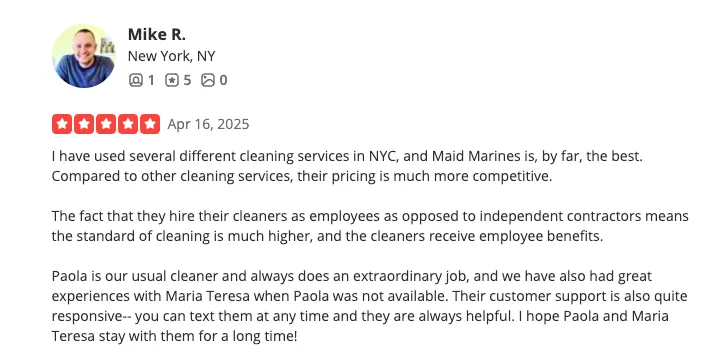
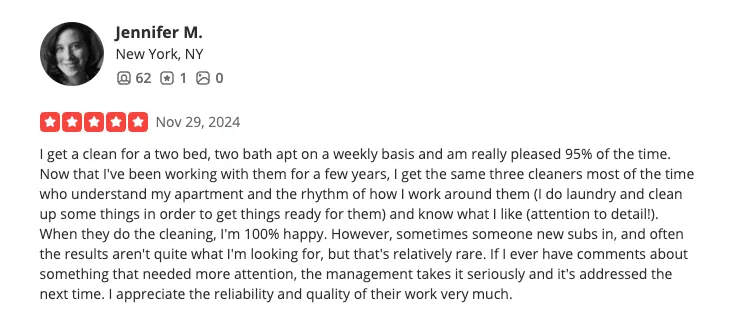
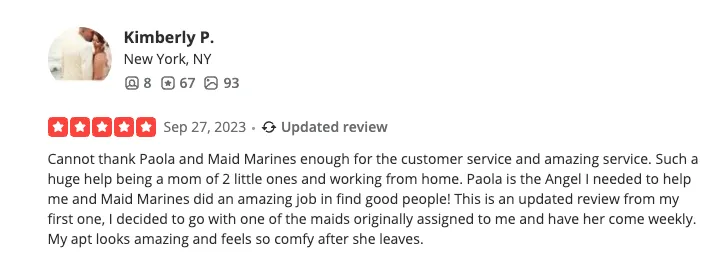
Our cleaners are W-2 employees, not independent contractors. They are background-checked, insured, and trained. They show up with the products appropriate for postwar Brooklyn buildings: wood-safe for parquet, pH-neutral for older tile, non-toxic as the default in any home with children or pets. For recurring service, the same cleaner comes every time. Your building staff learns the team. Your household adjusts to a consistent rhythm.
We also serve nearby Sheepshead Bay, Gravesend, Midwood, Bergen Beach, Brighton Beach, and Bensonhurst, and the rest of Brooklyn.