
Vinegar Hill is the smallest neighborhood in Brooklyn, and it is the most improbable. Pressed against the wall of the Brooklyn Navy Yard, cut off from the south by the raised scar of the Brooklyn-Queens Expressway, bypassed by almost every subway line in the borough, it occupies a few city blocks between DUMBO and the East River that most New Yorkers have never visited and many have never heard of. What survives on those blocks is one of the oldest intact clusters of residential architecture in New York City, a Federal and Greek Revival streetscape from the 1820s through the 1850s with Belgian block streets that have never been asphalted over, a quietness that does not belong to the 21st century, and a community of residents who specifically chose to live somewhere that resists every definition of a modern New York neighborhood.
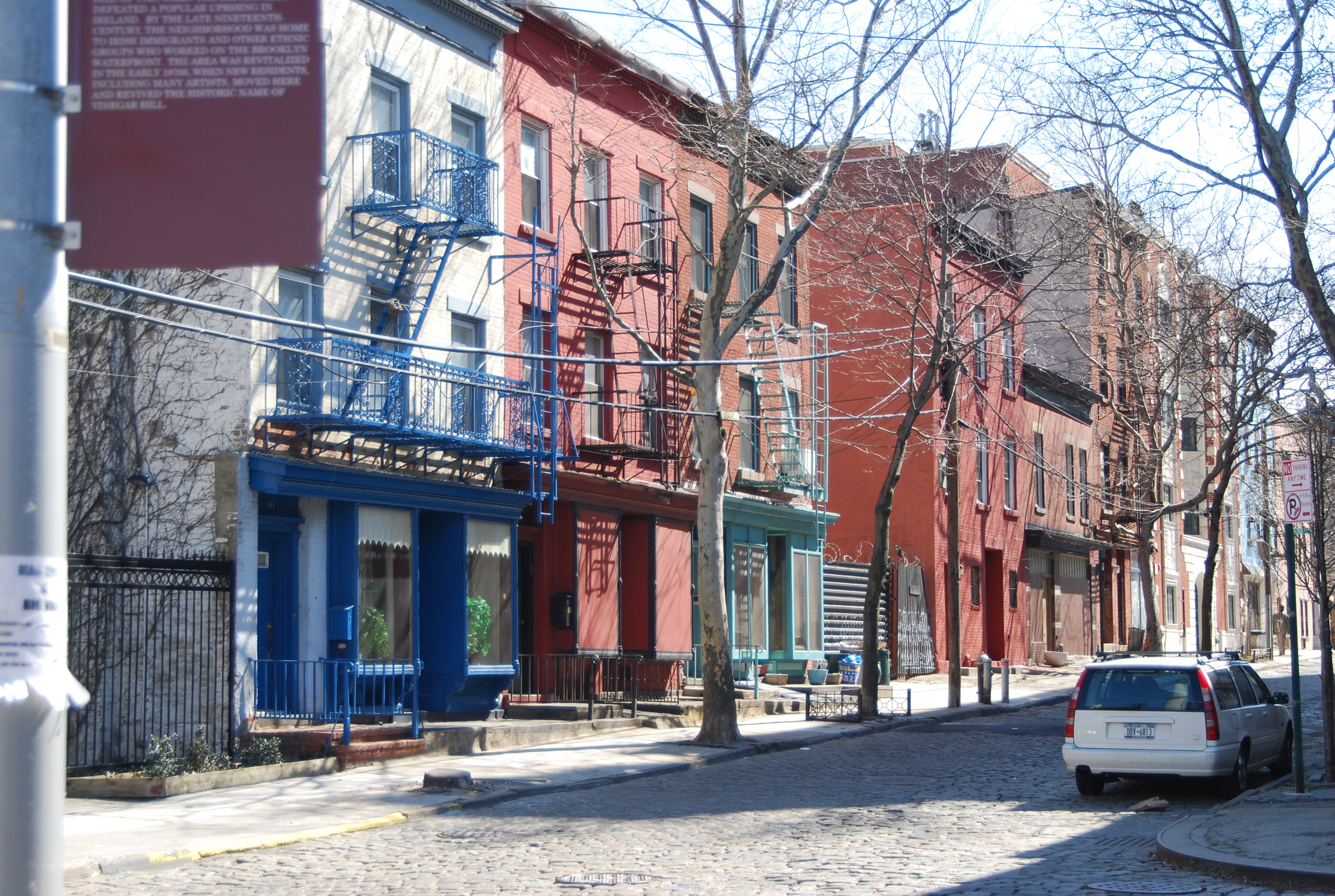
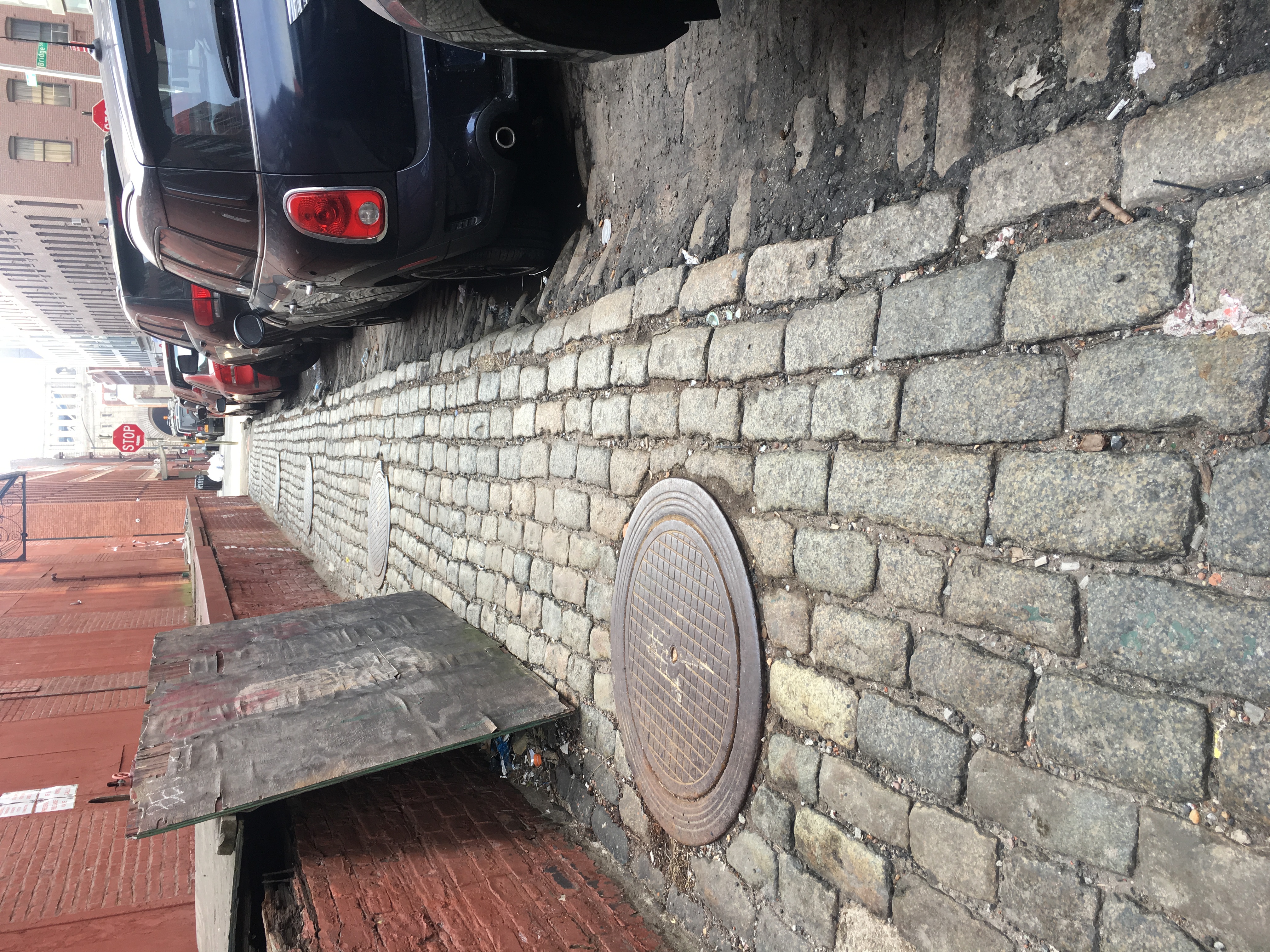
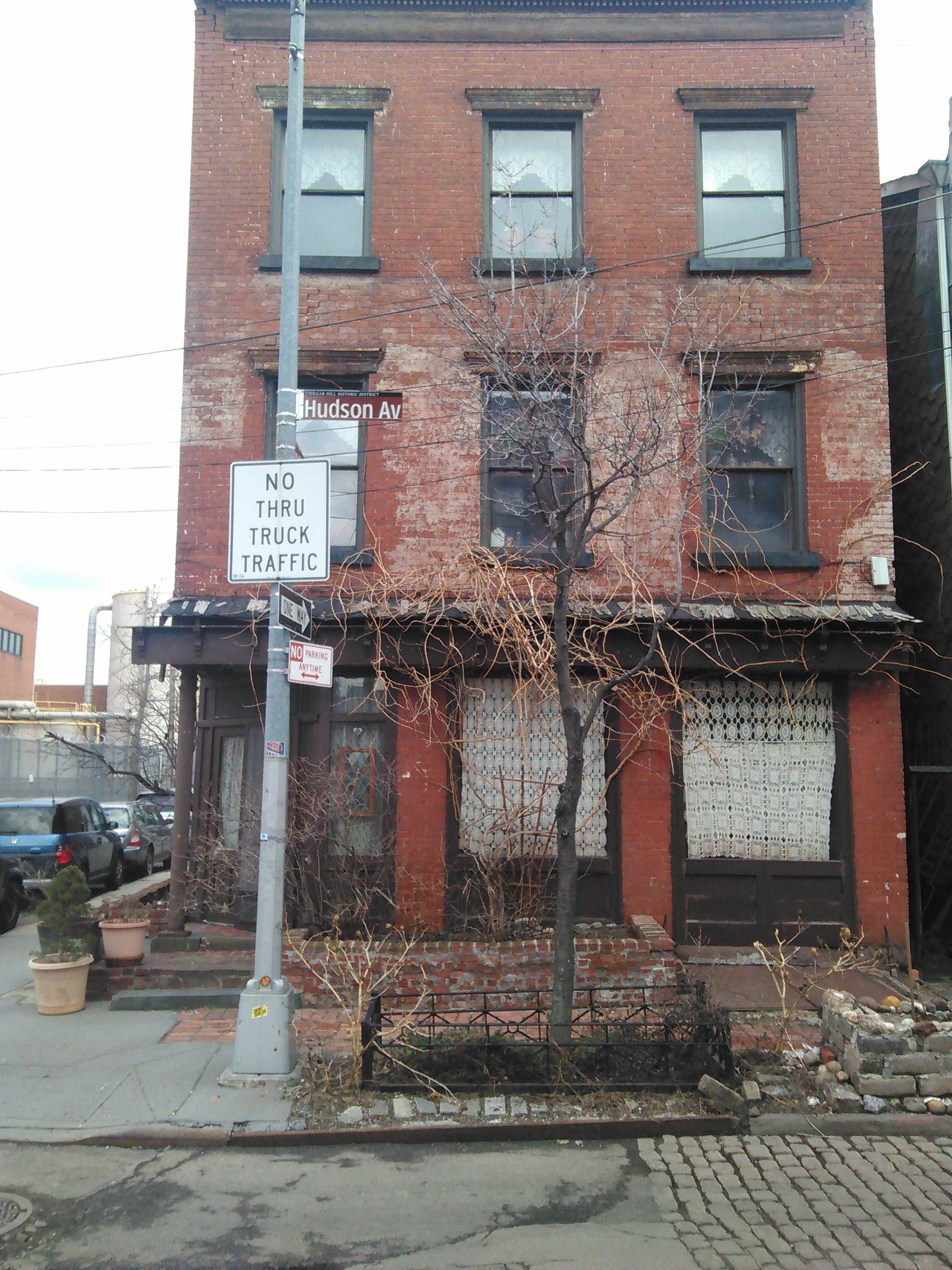
Walking in from DUMBO, where gallery spaces and high-end restaurants and tourist crowds fill the converted warehouse district, is like stepping through a change in atmospheric pressure. The noise drops. The scale compresses. The buildings shrink to two and three stories. And if you turn onto Hudson Avenue, the ground changes underfoot, because you are walking on Belgian block granite that was quarried in Europe and carried across the Atlantic Ocean as ship ballast in the 1800s, and it sounds and feels different from asphalt.
The Belgian block streets and Federal rowhouses are why cleaning here requires different thinking
The homes of Vinegar Hill are among the oldest residential structures in Brooklyn, and they were built with materials and finishes that do not respond well to the standard approach of one product applied everywhere. The Federal-style rowhouses along Hudson Avenue and Front Street date primarily to the 1820s and 1840s. Their wide-plank hardwood floors are old-growth wood, harder than anything milled today but almost always finished with wax rather than the polyurethane that coats modern floors. Alkaline cleaners strip wax. Excess water damages it. The floors that have survived nearly two centuries of daily use need a barely damp microfiber mop and a product formulated specifically for wax-finished wood, not the multi-surface spray that works fine in a 2005 condominium.
The same logic applies throughout these buildings. Marble window sills and stone stoops require pH-neutral treatment, never vinegar and never anything acidic. Original wrought-iron railings want a dry or very lightly damp cloth, not chemical spray that accelerates oxidation. Decorative plaster cornices above doorways need a soft brush, because a damp cloth pushes grime deeper into the detail rather than lifting it. Cast-iron radiators collect months of dust between their fins over a summer and burn it off when the steam heat returns in October, so the fins need attention between visits, not just across the top.
Our house cleaning teams carry separate products for hardwood, stone, tile, and iron surfaces, and they switch as they move through the building. They work top-down on every visit so nothing dislodged from a high shelf or cornice settles onto a floor that was cleaned twenty minutes earlier. These details are not special requests in Vinegar Hill. They are the standard.
John Jackson named this village after an Irish rebellion and built Brooklyn’s oldest neighborhood
The land was bought in 1791 by John Jackson, an Irish shipbuilder who saw commercial opportunity in the unoccupied waterfront north of what was then the village of Brooklyn. Jackson established a private shipyard and built houses for his workers. In 1800 he sold 40 acres to the federal government for the Brooklyn Navy Yard, which would become the most important naval installation in the United States. The land he retained, he organized into a village and named after the Battle of Vinegar Hill, a site near Enniscorthy in County Wexford, Ireland, where British forces crushed the Irish Rebellion of 1798.
The naming was deliberate marketing. In giving his settlement the name of a site of Irish martyrdom and resistance, Jackson was sending a signal to Irish immigrants arriving in New York in growing numbers: come here, you are among your kind. They came. The neighborhood became predominantly Irish, then Lithuanian, as immigrant communities succeeded one another throughout the 19th century and early 20th. By the 1930 census, Lithuanian immigrants constituted approximately 75 percent of Vinegar Hill’s population, one of the highest ethnic concentrations of any single immigrant group in any New York neighborhood.
The Federal rowhouses those communities built along Hudson Avenue and Front Street survived because the neighborhood was too marginal and too small to attract the urban renewal demolitions that erased comparable blocks elsewhere in Brooklyn. When the Navy Yard closed in 1966 and the neighborhood’s economic anchor disappeared, the buildings simply sat. Artists discovered them in the 1970s, recognized the extraordinary preserved character of the streetscape, organized for historic district designation, and created the community that exists today.
The loft conversions and the rowhouses are two entirely different cleaning environments
Vinegar Hill’s housing stock divides cleanly into two categories that share a ZIP code but not much else. The first is the 19th-century Federal and Greek Revival rowhouses that define the historic district, typically two to three stories, organized as floor-through apartments or small multi-unit buildings, with the proportions of domestic life in 1840s Brooklyn. The second is the industrial loft conversions, former factory and warehouse buildings repurposed as residential space beginning with the artist influx of the 1970s, characterized by high ceilings of 12 to 16 feet, exposed brick, open floor plans, and concrete floors.
Each type requires different thinking. The rowhouses have small rooms, low thresholds, and surfaces with 180 years of accumulated refinements and repairs. The lofts have enormous volumes of vertical space where dust accumulates on beams and high shelving, concrete floors that need a different product than hardwood, and exposed brick that holds dust in its mortar joints rather than on a smooth paintable surface. A cleaning team that approaches a Vinegar Hill loft the same way they approach a Vinegar Hill rowhouse is going to miss things in both.
For apartment cleaning on a recurring basis, we assign the same team to your home on every visit. They learn the surfaces, learn the quirks of your building’s construction, and learn what you care about. That consistency produces noticeably better results in homes with as much variation and character as the ones in this neighborhood.
The Navy Yard on the northern edge has transformed the economic context without changing the residential core
The Brooklyn Navy Yard’s 300 acres, which constitute the entire northern and eastern boundary of Vinegar Hill, were decommissioned by the federal government in 1966 after 165 years as the most significant naval installation in the country. The USS Monitor, the USS Maine, the USS Arizona, and the USS Missouri were all built at or significantly associated with this yard. Its closure ended the employment relationship that had sustained the surrounding neighborhood since John Jackson sold the land in 1800.
The city took over the yard and the Brooklyn Navy Yard Development Corporation has spent the decades since building it into a hub of creative manufacturing, technology, and arts organizations. The yard now houses over 500 businesses and 14,000 workers, including film production studios, a vertical farm, jewelry manufacturers, and dozens of tech startups. BLDG 92, the yard’s museum, offers free exhibitions on its history. The Commandant’s House, believed designed by Charles Bulfinch and completed around 1807, sits on the highest ground of the yard and was home to Commodore Matthew Perry from 1841 to 1843, in the years before he led the naval expedition that opened Japan to Western trade.
The yard’s transformation has put sustained upward pressure on Vinegar Hill real estate. Buyers priced out of DUMBO, which has become one of Brooklyn’s most expensive residential areas, have been moving eastward into Vinegar Hill for years. Median sale prices in the neighborhood have reached approximately $1.2 to $1.6 million, with price per square foot among the highest in Brooklyn given the premium attached to the historic character.
Deep cleaning in a two-century-old rowhouse is not the same as deep cleaning a modern apartment
A deep cleaning in a Federal rowhouse means addressing the accumulation that builds up in spaces that predate the idea of standardized apartment maintenance. Baseboards in homes from the 1820s are often original millwork with profile details that standard mop-and-wipe cannot reach. Crown molding at 10 feet collects grease and dust that settles over months. The gap between a cast-iron radiator and the wall it sits against may not have been cleaned since the radiator was installed. Bathroom tile in older Vinegar Hill buildings frequently has original grout that cannot tolerate acid. Window tracks in wood-frame sashes are built differently from the aluminum channels in modern construction.
We have cleaned over 100,000 homes across New York City, including a substantial and growing number in Vinegar Hill and the surrounding historic waterfront neighborhoods. The patterns repeat. Older homes have more surface area with distinct cleaning requirements. They reward the teams that pay attention to what a surface actually is rather than applying one method uniformly.
For move-in and move-out cleaning, the additional scope is inside all cabinetry and drawers, the interior of the refrigerator, inside the oven, behind and underneath appliances, and accumulated grime in bathroom tile and caulking. In Vinegar Hill buildings where tenancies have been long, the behind-appliances category especially rewards attention.
The neighborhood’s very smallness creates the cleaning conditions that define it
Vinegar Hill has approximately 4,884 residents in a neighborhood that amounts to fewer than a dozen meaningful streets. There is no grocery store within the historic district, no pharmacy, no chain retail. The few businesses that operate here serve residents and the people who seek the neighborhood out specifically. Vinegar Hill House on Hudson Avenue, the neighborhood’s flagship restaurant, has been the community’s dining anchor since 2008, serving seasonal American food in a former general store with a wood-burning fireplace. Bridge Coffee Shop provides a morning gathering place. The rest of daily life happens in DUMBO five minutes away or Downtown Brooklyn fifteen minutes on foot.
This smallness and self-selection means the people who live in Vinegar Hill have made a deliberate choice to live somewhere that does not behave like the rest of New York. They chose the Belgian block streets and the Federal rowhouses and the transit inconvenience and the residential quietness. They chose a neighborhood that still sounds different underfoot from everywhere around it. Cleaning the homes of people who made that specific choice means taking the buildings as seriously as the residents do.
When you are ready to book, the process takes about sixty seconds on our booking page. You see the flat-rate price before you commit, and the price reflects the actual size and condition of your home. We also serve nearby DUMBO, Brooklyn Heights, Bed-Stuy, Williamsburg, and the full stretch of Brooklyn cleaning services across the borough.