
DUMBO is roughly 15 blocks wedged between two of the most photographed bridges on earth, and every one of those blocks tells a different version of the same story. A Dutch farmer started rowing people across the East River here in 1642 for six cents a fare. Robert Gair accidentally invented the cardboard box in a factory on Washington Street in 1879. Artists coined the neighborhood’s ungainly name in 1978 hoping it would keep developers away. A developer bought 12 buildings for $12 million anyway, got laughed at for years, and eventually built one of the wealthiest residential enclaves in New York City. The buildings that housed all of this history are still standing. Some of them now cost $16 million to live in.
A Dutch farmer’s rowboat service became Brooklyn’s first connection to the rest of the world
Before bridges, before subways, before the word Brooklyn meant anything to anyone beyond Long Island, there was a man and a boat. In 1642, Cornelis Dircksen, a Dutch settler who farmed near the foot of what is now Fulton Street, began ferrying passengers across the East River from the Brooklyn shore to New Amsterdam. The arrangement was informal. When someone needed a ride, they blew a horn attached to a tree on the waterfront. Dircksen would stop whatever he was doing, walk to the shore, and row them across for roughly six cents. He ferried farmers carrying wheat and tobacco, cattle being transported to market, and ordinary people who needed to get from Long Island to the tip of Manhattan and back.
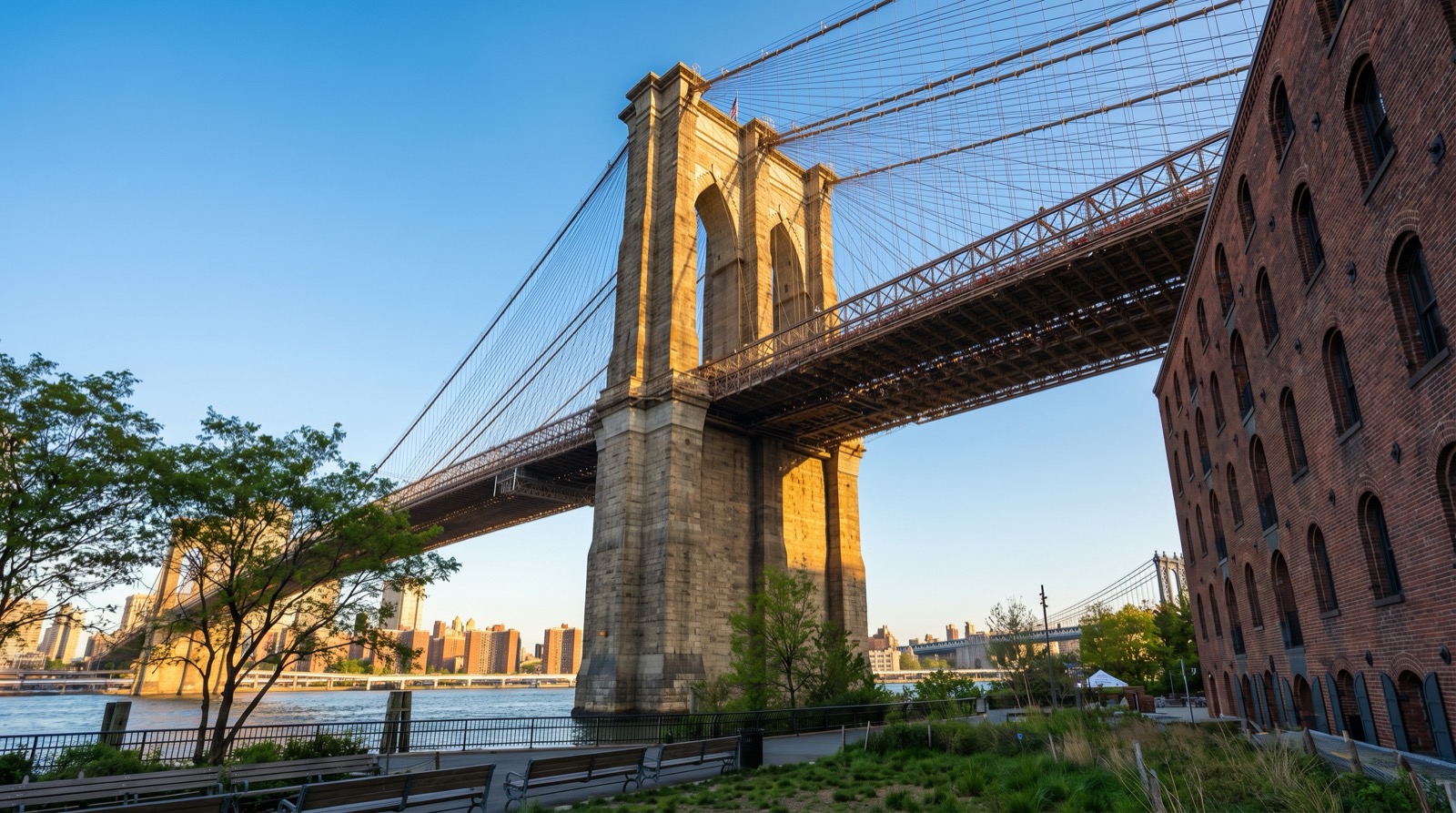
The crossing point where Dircksen launched his boat became the most important transit hub in Brooklyn’s history. For 241 years, from 1642 until the Brooklyn Bridge opened in 1883, this strip of waterfront was how people moved between the two sides of the East River. Robert Fulton introduced steam ferry service at the same spot in 1814, and the landing was renamed Fulton Ferry. The neighborhood grew up around the crossing. Taverns, boarding houses, chandleries, and warehouses packed the blocks above the water. Walt Whitman rode the ferry obsessively and wrote about it. The entire commercial life of Brooklyn flowed through this narrow waterfront, and the economic gravity of the ferry landing shaped the streets that still exist today.
When the Brooklyn Bridge opened on May 24, 1883, the ferry was finished. The crowds moved above the river. The waterfront blocks emptied out. And the neighborhood entered a new chapter that would last a century, one defined not by passengers crossing water but by factories filling the sky with the smell of roasting coffee and the sound of cardboard being cut.
Robert Gair’s accidental invention in a DUMBO factory changed how the modern world is packaged
The story of the cardboard box starts with a mistake. In 1879, Robert Gair, a Scottish immigrant who ran a paper bag factory in Manhattan, was watching his machines stamp out seed bags when a metal ruler in one of the presses shifted out of position. Instead of creasing the paper, the ruler cut it. Thousands of bags were ruined. But Gair realized something. If a single machine could both cut and crease paper in one pass, you could mass-produce a flat piece of cardboard that folded into a box. No hand assembly. No separate cutting step. Just one machine, one motion, one box.
Gair patented the idea and moved his rapidly expanding operation to 55 Washington Street in DUMBO in 1888. He needed space that Manhattan could not offer, and the abandoned waterfront blocks between the bridges had it. Over the next three decades, Gair built a complex of enormous reinforced concrete warehouses along Washington, Water, Front, and Jay Streets. The buildings were among the earliest large-scale reinforced concrete factory structures in the United States. At its peak, the Gairville complex employed thousands of workers and produced millions of boxes annually. Every pizza box, cereal box, shoe box, and shipping carton in the modern world traces its ancestry to 55 Washington Street.
Gair was not the only industrialist to see the value of the Brooklyn waterfront. John Arbuckle built a massive coffee roastery nearby that became the first company to sell pre-roasted, pre-packaged coffee in America. The Brillo soap pad factory operated in the neighborhood. Manufacturers of spices, rubber, and printing supplies filled every available warehouse. The smell of roasting coffee once defined the entire East River waterfront. The neighborhood was known as Gairville, and for decades it was one of the most productive manufacturing zones in the world.
The Gair buildings still stand. You can see the incised name “GAIR” on the facades of several structures on Washington Street. Etsy’s global headquarters now occupies the same building where Robert Gair’s machines stamped out millions of boxes. The reinforced concrete walls and enormous steel-framed windows that were built to flood factory floors with natural light now illuminate open-plan offices where people sell handmade jewelry online. The walls have not changed. What happens inside them has.
Etsy moved its headquarters to 117 Adams Street in 2016, taking over 200,000 square feet of a Gair-era warehouse and becoming the largest single employer in the neighborhood. The company chose DUMBO specifically because the handmade-goods ethos lined up with the manufacturing history of the buildings they were moving into. A cardboard box factory turned into a marketplace for handcrafted goods. That is the kind of narrative arc that writes itself. Around Etsy, a cluster of tech and creative companies filled the surrounding lofts. WeWork, Enormous, Huge, and dozens of smaller studios turned DUMBO into Brooklyn’s version of a tech campus, except the campus is made of hundred-year-old concrete and the commute involves walking over Belgian block cobblestones that were laid when horses pulled the delivery wagons. Those cobblestones are actually granite setts, hand-cut and placed without mortar, and they survive because nobody repaved them during the 50 years when the neighborhood was abandoned. They are simultaneously the most photographed and the most ankle-threatening feature of the neighborhood.
The buildings that survived because nobody wanted them became the most expensive lofts in Brooklyn
Deindustrialization hit DUMBO hard after World War II. Manufacturing left for cheaper land in New Jersey and the Sun Belt, and the massive warehouses emptied out. By the 1960s, the neighborhood was essentially abandoned. A handful of stubborn industrial tenants hung on. The streets were deserted, the warehouse windows dark, the Belgian block cobblestones splitting apart in the absence of anyone who cared.
New York City’s 1971 policy allowing artists to live and work in former industrial lofts opened a door that nobody expected to swing so far. Artists priced out of SoHo and TriBeCa discovered DUMBO’s vast empty warehouses. The appeal was obvious. Enormous loft spaces with 12 to 18 foot ceilings. Dramatic natural light from floor-to-ceiling factory windows. Views of the Manhattan skyline that most people only see in photographs. And rents that were, for a brief historical moment, close to nothing.
The artist community that took root in the 1970s gave the neighborhood its name. In 1978, residents coined the acronym DUMBO, for Down Under the Manhattan Bridge Overpass. They chose the most unflattering possible name on purpose, believing that “DUMBO” would sound so silly and unattractive that real estate developers would never bother with the neighborhood. The name was supposed to be a shield. It became a brand.
The irony is that the artists who named it DUMBO to repel money ended up creating the exact cultural gravity that attracted it. The loft parties, the open studio weekends, the warehouse galleries showing work that no Chelsea dealer would touch in the 1980s. All of it built a narrative that developers could sell. By the time David Walentas started converting buildings, the story of DUMBO was already written by the people he was displacing. The name they picked as a joke now appears on luxury condo marketing materials, restaurant awnings, and the signage for a neighborhood where a one-bedroom in a former box factory starts above $800,000. Nobody thinks the name sounds silly anymore. It sounds expensive.
David Walentas paid $12 million for 12 buildings and got laughed at for a decade
The shield did not work. In the early 1980s, David Walentas, a developer who ran a company called Two Trees Management, made a bet that was considered ridiculous at the time. He purchased 12 buildings in the vacant industrial district, including much of the Gair complex, from Harry Helmsley for approximately $12 million. The investment seemed foolish. DUMBO was desolate. There were no restaurants, no shops, no residents beyond the artist squatters. The streets were dark. The buildings leaked.
Walentas was patient in a way that most developers are not. He kept the neighborhood intentionally underdeveloped, controlling conversion timelines to ensure that gentrification happened in stages rather than all at once. By the 1990s, the bet was beginning to pay off. Small businesses, media companies, and design studios started filling the converted lofts. The Clock Tower Building at 1 Main Street, a landmark 1885 factory with a four-faced Renaissance Revival clock tower visible from across the East River, was converted to luxury condominiums in 1998. Its penthouse sold for what was then a Brooklyn record.
The artists who named the neighborhood were gradually priced out. The tech workers and creative professionals who replaced them have begun facing the same pressure from above. Two Trees Management and its co-founder Jed Walentas now control a significant portion of DUMBO’s commercial and residential real estate, making DUMBO perhaps the most landlord-consolidated neighborhood in New York City.
On December 18, 2007, the New York City Landmarks Preservation Commission voted unanimously to designate DUMBO as the city’s 90th historic district. The designation protects the warehouse facades, the Belgian block streets, the factory windows, and the architectural character that makes the neighborhood unlike any other place in Brooklyn. The materials that earned that designation need cleaning approaches built for what they actually are. The reinforced concrete, the century-old brick, the timber beams, the cast-iron columns. These are not surfaces you hand to a crew with a bottle of all-purpose spray and hope for the best. They are surfaces that need people who know what they are touching.
The most photographed street in Brooklyn exists because of a bridge engineer’s geometry
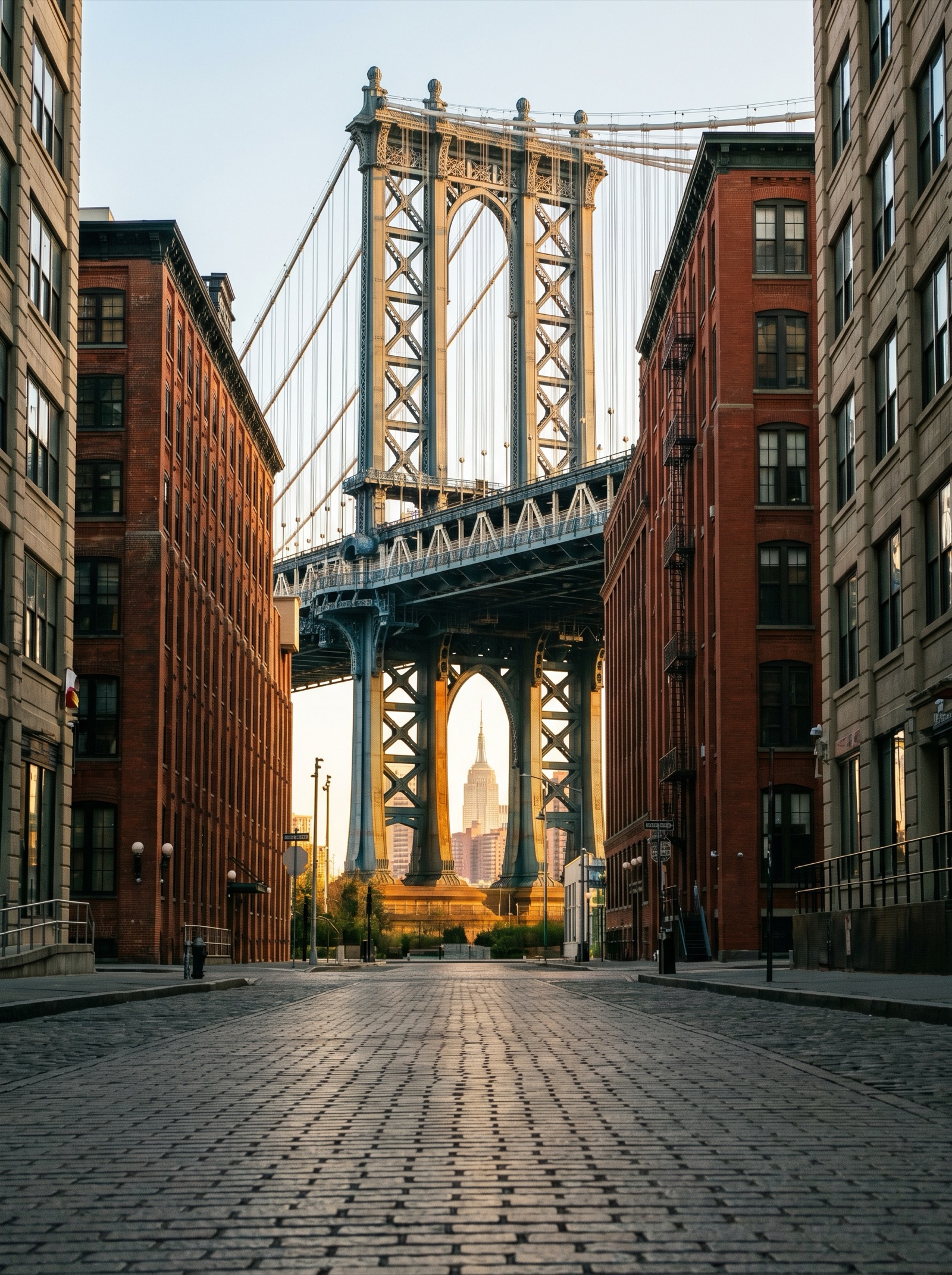
The view down Washington Street is one of the most reproduced images in New York City. Standing at the intersection of Washington and Water Streets, looking north, the Manhattan Bridge’s twin approach structures rise from either side of the street, framing the Empire State Building in the arch between the bridge’s massive steel supports. Belgian block cobblestones run toward the bridge. Red brick warehouse buildings line both sides. The composition is so perfect that it looks designed, but it is an accident of infrastructure. When the Manhattan Bridge was built in 1909, engineers placed the approach lanes on either side of Washington Street to distribute the weight across the anchorage. The gap between them created the frame.
People have been photographing this view since the bridge went up over a century ago. The spot has appeared in films including Once Upon a Time in America, The Dark Knight Rises, and Godzilla. Television shows from The Blacklist to The Marvelous Mrs. Maisel have shot scenes here. On any given weekend, the intersection is packed with tourists, engagement photographers, influencers, and anyone else who wants the shot. The cobblestones, the brick, the steel, the skyline. It is the most Instagrammed urban composition in Brooklyn, and it is free and open to anyone who walks up.
The engagement photographers have turned the intersection into an unofficial outdoor portrait studio. On peak weekends in spring and fall, you can count four or five couples posing simultaneously on the Washington Street crosswalk, each with a photographer crouched low to catch the bridge arch behind them. Tripod legs wedge between the granite setts. Reflectors bounce afternoon light off the brick facades. The actual residents of the block have learned to time their grocery runs and stroller walks around the golden hour crush. The pizza delivery cyclists from Juliana’s weave through the photo shoots without slowing down. It is the most public intersection in Brooklyn and simultaneously one of the most intimate, because everyone standing in it is either proposing, celebrating, or pretending the crowd is not there.
The Manhattan Bridge also carries B and D subway trains across the East River directly above the neighborhood. The periodic rumble of trains is part of DUMBO’s ambient soundtrack. Locals learn to love it or learn to live with it. What they also learn is that the vibration from the bridge shakes fine particulate loose from every surface it can reach, and apartments on Washington Street and Front Street accumulate visible dust faster than almost anywhere else in the city.
Jane Walentas spent 25 years restoring 48 wooden horses one brushstroke at a time
Not every transformation in DUMBO was driven by real estate economics. In 1984, Jane Walentas, wife of developer David Walentas, purchased a decommissioned 1922 carousel from a defunct amusement park in Youngstown, Ohio. The carousel had been built by the Philadelphia Toboggan Company. Its 48 horses, attributed to carvers John Zalar and Frank Carretta, were covered in 62 years of “park paint” layered on top of the original fine art painting. Jane began restoring the carousel at her studio in DUMBO, hand-scraping away decades of paint with an X-acto knife to reveal the original colors and details underneath.
The restoration took 25 years. Jane Walentas repainted each horse by hand, matching the original color schemes and brushwork of the 1920s craftsmen. When the work was complete, she and David donated the carousel to Brooklyn Bridge Park. The glass pavilion that houses it was designed by Jean Nouvel, the Pritzker Prize-winning architect who also designed the Louvre Abu Dhabi and 100 Eleventh Avenue in Chelsea. At night, the pavilion becomes a lantern. The shadows of the carousel horses rotate on the glass walls, visible from across the waterfront, marking the hour like a mechanical clock.
Jane’s Carousel opened to the public on September 16, 2011. It sits at Pier 1 in Brooklyn Bridge Park, a few feet from the East River, between the stone pier of the Brooklyn Bridge and the steel pier of the Manhattan Bridge. A ride costs two dollars.
On a Saturday afternoon the carousel line wraps past the Nouvel pavilion and onto the gravel path, mostly toddlers gripping their parents’ hands and pointing at the horses through the glass. The organ music drifts across the lawn. Kayakers launch from the Pier 2 boathouse fifty yards south, paddling out into the East River current with the suspension cables of the Brooklyn Bridge overhead. Pier 5 has a full-size soccer pitch and pickup games that run all weekend. Pier 6 has a sand volleyball court and the Fornino pizza kiosk where you can eat a margherita facing Governors Island. The park’s Squibb Bridge, a bouncy pedestrian walkway designed by Ted Zoli, connects the waterfront to the Brooklyn Heights Promenade above, swaying slightly underfoot in a way that alarms first-time crossers and delights everyone else. None of this existed 20 years ago. The piers were rotting. The waterfront was fenced off. Now it functions as DUMBO’s backyard, and the reason a 900-square-foot loft with bridge vibration and no dishwasher still lists for $1.2 million is that this park is three minutes from the front door.
Empire Stores survived the Civil War and a century of abandonment to become a food hall with a view
The seven contiguous warehouses at 55 Water Street were built between 1868 and 1885 to store coffee, sugar, molasses, wool, and rubber arriving on ships at the Brooklyn waterfront. The buildings survived the entire industrial era, then the collapse of that era, then decades of vacancy. By the 1960s, Empire Stores was abandoned. It sat empty for half a century while the neighborhood around it slowly changed.
In 2013, Brooklyn developer Midtown Equities was selected to redevelop the complex. Studio V Architecture and S9 Architecture designed the renovation, adding a modern rooftop addition with floor-to-ceiling glass that frames the Brooklyn Bridge. The flagship West Elm store opened in August 2016 as the first tenant. Time Out Market New York followed in 2019, occupying 24,000 square feet on the upper floors with a fifth-floor rooftop that offers one of the best views in Brooklyn. The food hall curates rotating vendors from across the city, with enough variety that you can spend two hours grazing and still not try everything.
The Tobacco Warehouse next door at 45 Water Street tells an even stranger preservation story. The 19th-century tobacco storage building was never given a permanent roof. It has stood open to the sky for over a century, its brick walls enclosing nothing but air and weather. Since 2015, the roofless ruin has served as the home of St. Ann’s Warehouse, the internationally recognized avant-garde theater company. Productions stage under the open sky, with 19th-century brick walls as the set. Shows have launched from this space to Broadway, London, and stages around the world.
Brooklyn Bridge Park turned abandoned industrial piers into the neighborhood’s living room
The creation of Brooklyn Bridge Park, officially begun in 2008 and substantially completed over the following decade, was the public investment that transformed DUMBO from a curiosity into one of the most desirable neighborhoods in New York City. The park converted 1.3 miles of abandoned industrial piers and waterfront stretching from the Manhattan Bridge to Atlantic Avenue into public lawns, playing fields, sports facilities, playgrounds, a kayak launch, a greenmarket, and the kind of open space that changes how people experience a neighborhood.
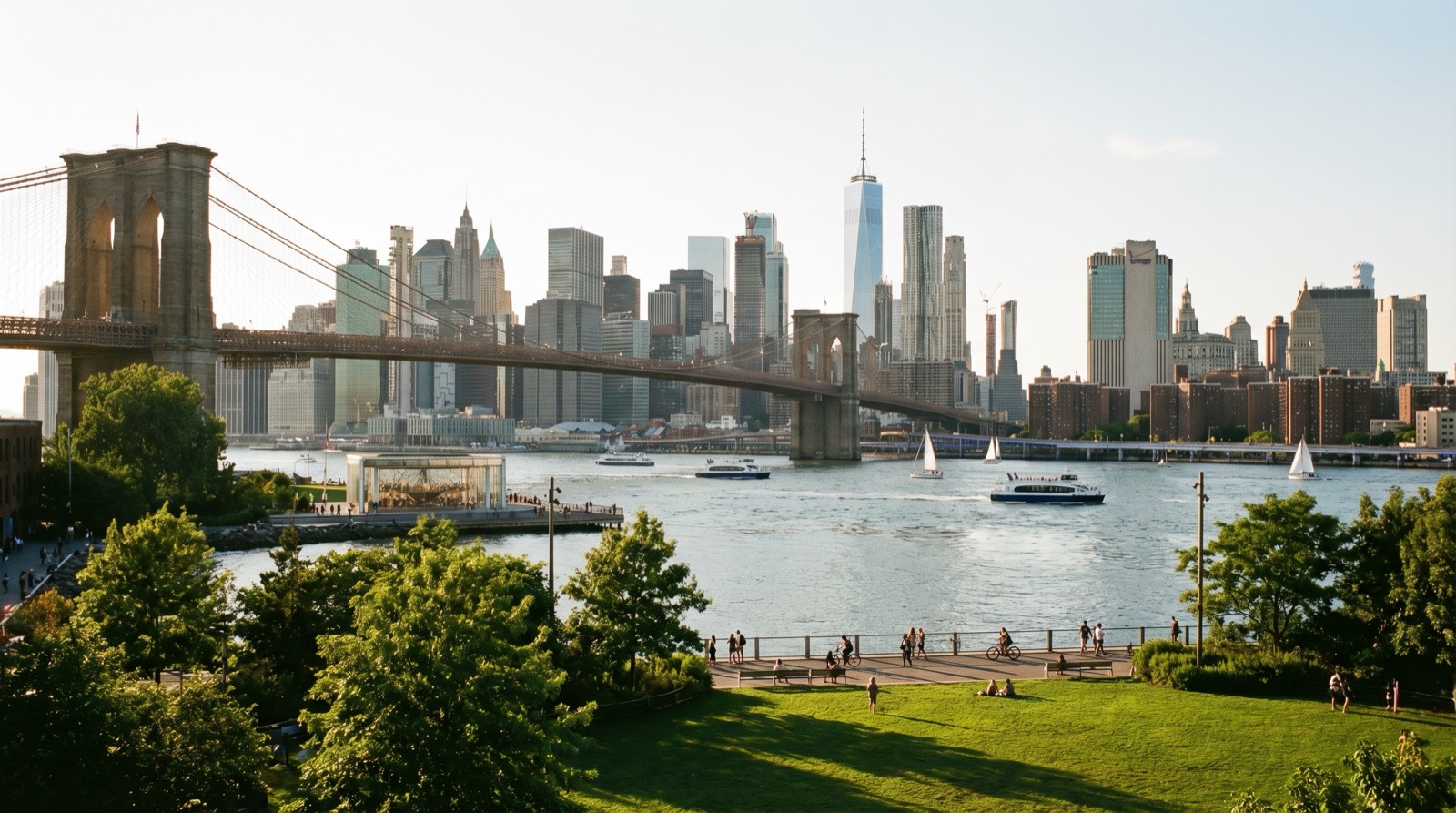
The view from the park’s piers is widely considered one of the finest urban panoramas in the world. The Manhattan skyline stretches across the East River at dusk, the lights coming on tower by tower. The Brooklyn Bridge’s Gothic arches frame the Financial District. Boats pass on the river. The park is not a backdrop. It is the reason people moved here, the reason they stay, and the reason property values between the two bridges sit among the highest in the outer boroughs.
Your Saturday is better spent on the promenade watching the light change over the water than scrubbing tile grout in a loft bathroom. That is what a recurring cleaning handles. The park is right there. The waterfront is right there. The time it takes to properly clean a 2,400 square foot warehouse conversion with 16 foot ceilings is the same time it takes to walk the full length of the park, eat at Juliana’s, and still be back before the crew finishes.
The River Cafe opened on a barge beneath the Brooklyn Bridge when nobody else would come
In 1977, when DUMBO was abandoned and the waterfront was empty, Michael O’Keeffe opened a restaurant on a converted coffee barge at 1 Water Street, directly beneath the Brooklyn Bridge. It took him twelve years of convincing the city before he received approval to start building in 1974. When the River Cafe finally opened, it was the only dining destination in a neighborhood that had none. The setting was extraordinary. Candlelit tables on the water with the full Manhattan skyline spread across the windows. It was one of the first fine dining restaurants in New York City to emphasize locally sourced food and high-end California wines.
The River Cafe has now been operating for nearly 50 years. It holds a Michelin star, first earned in 2010 and regained in 2014 after a rebuild following Hurricane Sandy. The prix fixe dinner runs north of $175. A reservation requires weeks of advance planning. The restaurant that opened when the neighborhood was worthless is now surrounded by some of the most expensive real estate in Brooklyn. The River Cafe did not follow the neighborhood’s success. It preceded it by three decades.
Down the block, Juliana’s Pizza at 19 Old Fulton Street keeps one of the great New York pizza debates alive. Founded by Patsy Grimaldi using his family’s original coal-oven recipe, Juliana’s draws lines that wrap around Old Fulton Street. Grimaldi’s Pizzeria, the other legendary coal-oven operation, sits nearby at 1 Front Street. The two spots represent one of those New York arguments that never gets resolved and never needs to be. Kinjo at 46 Front Street runs a 14-seat sushi omakase counter at $95 per person in the shadow of the Manhattan Bridge. Hildur, which opened in February 2025 in the former Gran Electrica space, brings Scandinavian-French bistro cooking to 1 Front Street.
Warehouse lofts from the 1890s and glass towers from the 2020s need completely different cleaning
Walk three blocks in DUMBO and you cross from one century of construction to another. The Gair warehouse conversions along Washington, Water, and Jay Streets have 12 to 18 foot ceilings with original timber beams, cast-iron columns running down open floor plans, exposed brick walls with century-old mortar joints, and enormous steel-framed industrial windows. Every one of those features collects dust differently and reacts to cleaning products differently. The timber beams need telescoping poles. The exposed brick gets a soft dry brush, never a wet cloth, because moisture pushes grime deeper into the mortar and leaves permanent dark spots. The polished concrete floors get a flat microfiber mop with pH-neutral solution and nothing else.
Walk south to Olympia at 30 Front Street or One John Street and the job changes entirely. These are 2020s luxury towers with concierge desks, private amenity floors, and unit finishes selected from a developer catalog. Engineered stone countertops that show water rings within minutes. Custom cabinetry with finishes that react to ammonia-based cleaners. Floor-to-ceiling glass where every streak is visible to anyone walking through Brooklyn Bridge Park below. Olympia, completed in 2024 and designed by Hill West Architects, stands 33 stories and 401 feet tall. Its penthouse sold for $16.25 million, setting the Brooklyn record for price per square foot at $3,297. The building has the highest private tennis court in New York City. The surfaces inside require product-specific care that has nothing in common with what works three blocks north in a Gair-era loft.
Two Trees Management controls a significant portion of DUMBO’s rental stock. The newer condo buildings have their own management offices with vendor registration requirements. The Clock Tower Building at 1 Main Street has its own protocols. Getting past the front desk is half the job. When you book your cleaning, tell us your building name or address. Our dispatch team coordinates the COI paperwork, elevator scheduling, and notice windows before your first appointment. We work in DUMBO buildings regularly and know what most of them require before we call.
The bridge dust never stops and the Belgian block streets grind grit into every ground-floor unit
DUMBO sits underneath two of the busiest bridges in New York City. The Manhattan Bridge carries B and D subway trains directly over Washington Street and Front Street, and the vibration shakes fine particulate loose from every surface it can reach. The Brooklyn-Queens Expressway runs along the northern edge. The Belgian block streets, those rounded granite setts that survived from the industrial era because nobody bothered to repave them during the decades of abandonment, generate grit under tire and foot traffic that migrates into ground-floor units through every crack and doorframe.
The result is that apartments in DUMBO accumulate visible dust faster than almost any neighborhood we serve. Horizontal surfaces, window sills, the tops of cast-iron columns, the ledges of those oversized factory window frames. Clients on the bridge side of the neighborhood who book monthly apartment cleaning often switch to biweekly once they see the difference. We adjust our approach for DUMBO by building extra attention to bridge particulate into the standard scope for recurring clients. If you are on Washington or Front, you already know how fast it builds up. We know too.
Our cleaners are W-2 employees, not gig workers. They are vetted, insured, and they arrive with all products and equipment matched to your specific floor and surface types. If you are in a Gair-era loft with timber beams at 16 feet, we bring the right tools. If you are in a new tower with custom finishes, we note the requirements in your file. DUMBO residents also book us for deep cleaning before and after the renovation work that warehouse conversions constantly require, move-in and move-out cleaning for the neighborhood’s active condo resale market, and recurring cleaning to stay ahead of the dust that the bridges send down whether you want it or not. We also serve nearby Williamsburg, Park Slope, and the rest of Brooklyn.