
Roosevelt Island is a two-mile strip of land in the middle of the East River with roughly 12,000 people living on it. From a Manhattan office window it looks like a sliver of green between two boroughs. From the red tramway cabin swinging 250 feet above the water, it looks like a narrow park with buildings on it. From street level, once you step off the tram or climb the long escalator from the F train platform 200 feet underground, it looks like a small town that someone accidentally placed inside New York City.
That impression is not wrong. Roosevelt Island functions like a small town. People recognize each other on Main Street. There is one grocery store, one real restaurant, one governing corporation that manages the public spaces. Block-by-block, the island has more history per acre than almost anywhere in the five boroughs, but most New Yorkers have never set foot on it. The residents like it that way.
The housing stock is almost entirely high-rise apartments, from 1970s co-ops built as part of a utopian urban planning experiment to brand-new luxury towers in Southtown. Cleaning these apartments is our daily work across Manhattan, and Roosevelt Island presents its own version of the familiar patterns. Doorman buildings with COI requirements. River-facing windows that show every streak. Compact layouts where a missed corner is visible from the couch. But the island also has buildings unlike anything else in the city, starting with an apartment complex built inside the dome of a 19th-century asylum for the mentally ill.
Roosevelt Island cleaning starts with understanding why these buildings exist at all
The story of this island is one of the strangest in New York. For most of its modern history, it was not a place where people chose to live. It was a place where the city sent the people it did not want to see.
The Lenape knew it as Minnehanonck and fished the East River currents around it. Dutch settlers called it Varken Eylandt, which translates to Hog Island, because they used the water as a natural fence to contain their pigs. The name was as literal as names get. By the early 1700s an English family named Blackwell had acquired the island, and they ran it as a private farm for nearly 150 years. The Blackwell farmhouse, built around 1796, still stands on the island today. It is one of the oldest surviving structures in Manhattan.
In 1828, the City of New York bought the island from the Blackwells for $32,000. The purpose was institutional. Manhattan was growing fast and the city needed somewhere to put the populations it was struggling to manage. Prisoners, the mentally ill, the sick, the destitute. An island in the middle of the East River, accessible only by boat, was perfect. Out of sight, across the water, contained by geography.
Over the next century, the city built 26 separate institutions on this narrow strip of land less than a quarter mile wide. A penitentiary that held Boss Tweed and Mae West. A workhouse. A charity hospital. The New York City Lunatic Asylum, anchored by a dramatic octagonal dome designed by Alexander Jackson Davis, which at its peak held 1,700 patients. A smallpox hospital designed by James Renwick Jr., the same architect who built St. Patrick’s Cathedral. A medical research laboratory. The island became a city within the city, populated entirely by people who had no choice about being there.

Nellie Bly exposed what was happening inside Roosevelt Island’s asylum in 1887
The conditions inside the Lunatic Asylum were exactly what you would expect from an overcrowded, underfunded 19th-century institution housing people society had discarded. But nobody outside the island knew the details until a 23-year-old journalist named Nellie Bly decided to find out for herself.
In 1887, Bly checked into a boarding house and began acting erratically until a judge declared her insane and had her transported to the Women’s Lunatic Asylum on what was then called Blackwell’s Island. She spent ten days inside. The food was rotten. Patients were beaten. The baths were ice water. Women who were not mentally ill when they arrived became so from the conditions. Bly documented everything and published the account as a series of articles in the New York World, later collected as a book called Ten Days in a Mad-House.
The articles triggered a grand jury investigation and led to $1 million in additional funding for the asylum. They also established undercover investigative journalism as a legitimate form of reporting. The island’s most lasting contribution to American public life happened because a young reporter let herself be committed to the place everyone else was trying to forget existed.
Today, Amanda Matthews’ installation The Girl Puzzle stands near the Smallpox Hospital ruin at the southern end of the island, referencing Bly’s work. The ruin itself, a Gothic stone skeleton open to the sky, is deliberately preserved in its collapsed state. The city lights it from within at night. It is one of the most haunting landmarks in New York, and it sits about 500 feet from luxury condominiums where apartments sell for over a million dollars.
The island went from asylum to planned utopia in a single generation
By the mid-20th century, most of the institutions had closed or relocated. The island was renamed Welfare Island in 1921, and by the 1960s it was largely abandoned. The buildings that had held thousands of inmates and patients stood empty, their roofs collapsing, their interiors open to weather and vandalism.
Then the city did something unusual. Rather than selling the land to developers piecemeal, it executed a 99-year lease with the New York State Urban Development Corporation in 1969. The architects Philip Johnson and John Burgee drew up a master plan for something that had almost never been attempted in New York: a fully planned residential community. The vision was specific. Mixed-income housing. Pedestrian-first streets. Almost no cars. Two residential clusters, Northtown and Southtown, connected by promenades along both waterfronts. A deliberate mix of races and income levels at a time when most of New York’s housing was segregated by both.
The island was renamed Roosevelt Island in 1973 in honor of Franklin Delano Roosevelt. The first residents moved in in 1975. The aerial tramway opened in 1976, and for 13 years it was the only direct connection to Manhattan. The F train station did not arrive until 1989, built 200 feet underground.

The founding residents were people who specifically wanted what Roosevelt Island was offering: a quiet, walkable, integrated community with Manhattan views and a deliberate distance from Manhattan intensity. Many of them stayed for decades. Some are still here. When longtime residents say they are “going into the city,” they mean crossing the river to Manhattan, even though they technically never leave the borough. That language tells you everything about the psychological distance the island creates.
High-rise apartment cleaning on Roosevelt Island follows Manhattan rules with island-specific details
Nearly every residential building on Roosevelt Island is a professionally managed high-rise with a doorman or concierge desk. This is familiar territory for anyone who does apartment cleaning in Manhattan. The access protocols, the COI requirements, the elevator reservations for move-in days, the package rooms where your cleaner checks in before heading upstairs. Roosevelt Island buildings run on the same systems as the Upper East Side towers visible across the river.
The differences are in the details. The older co-ops from the 1970s, buildings like Westview, Eastwood, and Island House, were built as part of the original planned community. They have solid construction and functional layouts, but the kitchens and bathrooms are from a different era. Smaller countertops. Older tile. Grout lines that have absorbed decades of use. These apartments benefit from a thorough deep cleaning on the first visit to reset surfaces that regular maintenance has not fully reached, followed by recurring cleaning to keep them in shape.
The newer towers in Southtown and the Riverwalk development are a different job. These are modern luxury apartments with open floor plans, floor-to-ceiling windows facing the East River, stone countertops, and the kind of finishes that show fingerprints and water spots immediately. The windows are the defining feature. River-facing glass in a high-rise on Roosevelt Island means direct sunlight hitting every streak, every smudge, every dried water droplet. Interior window glass is an add-on rather than part of the clean, and in these units it is the one to add — the views are the reason people pay what they pay. Tick it at booking and the price comes up with it.
The Octagon is the most architecturally unusual apartment building in New York
At 888 Main Street, the restored dome of the original 1839 Lunatic Asylum rotunda rises above a modern glass-and-steel residential tower. The building is called The Octagon, and there is nothing else like it in New York City.
Alexander Jackson Davis designed the octagonal tower as the administrative entrance to the asylum. It was built from local gneiss stone and featured a dramatic domed ceiling. After the asylum closed, the tower stood derelict for decades, its dome open to the elements. In 2006, developers restored the original dome and rotunda and built a luxury residential complex around it. The historical structure is incorporated into the building’s lobby and common areas, with the new residential wings extending behind it.

The apartments inside The Octagon have layouts that follow the curve of the original structure. This means rooms that are not rectangular, walls that bend, and furniture arrangements that do not follow the standard Manhattan grid. Cleaning an Octagon apartment means adapting to geometry that a typical apartment does not have. Dust collects differently along curved baseboards. Vacuum paths change. The corners where two curved walls meet are tighter than standard right angles. Our cleaners work the room perimeter rather than straight parallel lines, which is a small adjustment that makes a real difference in these units.
The building also has a pool, a gym, and landscaped grounds. Residents tend to use the amenities heavily because the island’s car-free layout encourages staying close to home. That means more foot traffic through common areas and more of the outdoor environment, river moisture and tree pollen especially, being tracked into apartments through the building’s ground-level entries.
Cornell Tech changed the island’s population and its cleaning patterns
In 2011, Mayor Bloomberg held a competition inviting universities to propose applied sciences campuses somewhere in New York City. Cornell University, partnering with Technion, the Israel Institute of Technology, beat Stanford, Carnegie Mellon, and Columbia for the right to build on Roosevelt Island’s southern end. The campus opened in September 2017 and represents a $2 billion investment in a 12-acre site.
The Bloomberg Center on the campus was a Passive House-certified building, and The Bridge was the world’s largest Passive House building at the time of its construction. These are buildings designed for extreme energy efficiency, with sealed envelopes and mechanical ventilation systems that filter incoming air. The technology is relevant beyond the campus itself. Several newer residential buildings on the island have adopted similar ventilation and sealing standards, which means apartments that trap less outdoor particulate but recirculate indoor air more aggressively. In practical terms, that means dust from cooking, skin cells, and fabric fibers stays in the apartment longer rather than being exchanged with outdoor air. Regular cleaning matters more in these sealed environments, not less.
Cornell Tech also brought a new demographic to the island. Graduate students and young faculty in computer science, engineering, and design. Many are international. Most are comfortable booking services digitally and expect transparent pricing. They tend toward smaller apartments, tighter budgets, and a preference for efficiency. A studio or one-bedroom apartment cleaning on a biweekly schedule is the most common booking pattern we see from the Cornell Tech population.
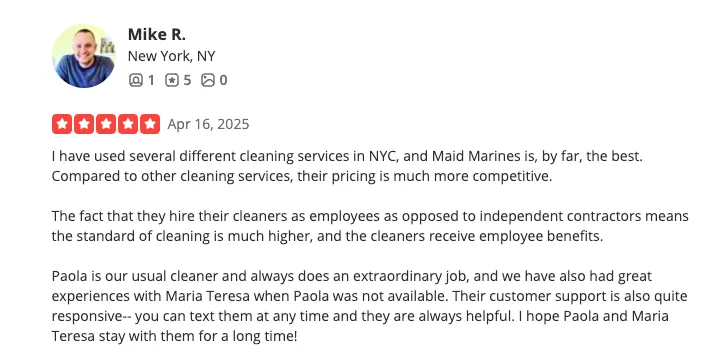
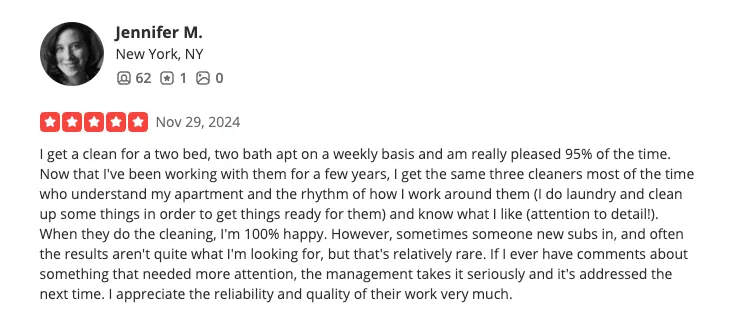
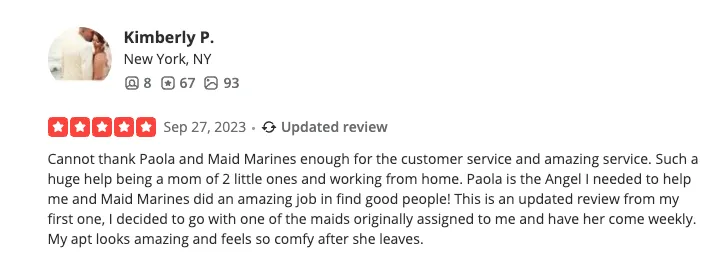
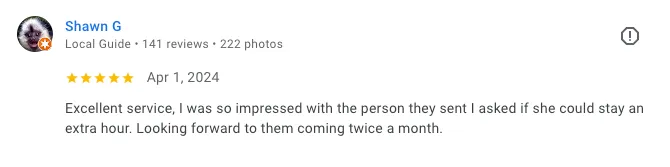
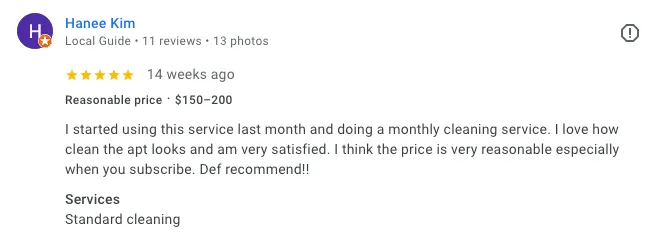
The longer-term resident community, people who moved to the island in the 1980s and 1990s for the original vision of integrated small-town living, has a different pattern. Larger apartments in the older co-ops. Weekly or biweekly recurring service. Strong preference for the same cleaner every visit. Word of mouth on an island of 12,000 people travels exactly the way it does in any small town. One good or bad experience reaches the neighbors fast.
Four Freedoms Park and the lighthouse are worth the walk while your apartment is being cleaned
The southern tip of Roosevelt Island holds one of the finest public spaces in New York City. Franklin D. Roosevelt Four Freedoms Park was designed by the architect Louis Kahn in the 1970s, but construction did not begin until decades later. Kahn died in 1974 without seeing it built. The project sat unfunded for nearly 40 years until philanthropist William vanden Heuvel and others finally raised the money. The park opened in 2012, built almost exactly to Kahn’s original drawings.

The design is a long triangular lawn lined with 120 linden trees, narrowing to a granite point that extends over the East River. At the point, a bronze bust of FDR faces out toward the water, framed by inscriptions of the four freedoms from his 1941 State of the Union address. Freedom of speech, freedom of worship, freedom from want, freedom from fear. The scale is intimate. The materials are simple. The effect is one of the most moving memorial experiences in a city full of monuments.
At the opposite end of the island, the Blackwell Island Lighthouse stands at the northern tip. Built in 1872, the 50-foot Gothic Revival tower was designed by James Renwick Jr. A persistent legend holds that much of the foundation and lower structure was built by a man named John McCarthy who was institutionalized at one of the island’s facilities. Whether the story is true or not, it captures something real about the island’s history. The people who were confined here also built pieces of it.

Walking from the lighthouse at the north to Four Freedoms Park at the south takes about 30 minutes along the waterfront promenade. The entire route is car-free. You pass the Octagon, the Chapel of the Good Shepherd, Blackwell House, the Strecker Memorial Laboratory, and the Smallpox Hospital ruin. It is a walk through the full span of the island’s history, from colonial farmhouse to asylum to utopian community to tech campus. If you have a cleaning appointment booked, that walk is a good use of the time.
The car-free layout means less tracked-in grime than most Manhattan neighborhoods
One of the practical benefits of Roosevelt Island’s planned-community design is how clean the outdoor environment stays compared to the rest of Manhattan. There is almost no through traffic. The Motorgate garage at the northern end holds most residents’ cars, and the rest of the island is pedestrian. No delivery trucks idling on the block. No construction dust from a building going up next door. No exhaust soot coating the windowsills.
This shows up in the apartments. Roosevelt Island units accumulate less of the black particulate that coats surfaces in neighborhoods along major avenues. Window exteriors stay cleaner longer. Balconies and terraces, which many of the newer buildings have, do not develop the grimy film that a Midtown balcony would in the same timeframe. The dominant particulates on the island are organic, pollen from the cherry trees and lindens along the promenades, and mineral, salt spray and moisture from the East River itself.
The river moisture is the more relevant factor for cleaning. Apartments on the western side of the island face Manhattan across the water, and the prevailing winds carry moisture from the East River directly into those buildings. High-floor units with operable windows develop a thin salt residue on sills and frames that needs regular wiping. Bathroom humidity in river-facing apartments tends to run higher, which means mold prevention in tile grout and around shower enclosures is a recurring priority. We flag this during the first visit and adjust the cleaning checklist accordingly.
Move-in and move-out cleaning on Roosevelt Island fills a specific gap
The Riverwalk development has added hundreds of new units to the island over the past several years, with Riverwalk Heights completing 357 apartments in 2024. The Southtown buildout means a steady stream of move-ins, and the older co-ops in Northtown see regular turnover as longtime residents downsize or relocate and new families move in.
Move-in and move-out cleaning on Roosevelt Island covers everything the next occupant will touch or see. Inside cabinets, appliance interiors, baseboards, window tracks, bathroom fixtures, light switch plates, and the closet shelves where the previous tenant’s life left its dust. New construction units in Riverwalk still have construction dust, adhesive residue from protective films, and drywall particulate in cabinet corners even after the developer’s cleaning crew has been through. We handle all of it.
For residents leaving one of the older co-ops, the move-out cleaning is about resetting a space that has been continuously occupied, in some cases for decades. That means addressing the accumulated evidence of daily life that a casual cleaning pass will miss. The kitchen exhaust fan housing. The inside of the oven. The baseboards behind where the couch sat for ten years. The building management on Roosevelt Island is attentive and the deposit inspections reflect that. A proper move-out cleaning is worth it.
Booking is straightforward for Roosevelt Island residents
You pick your date and time on our booking page. You see your flat-rate price before you commit. If your building requires a COI, let us know and we will have it on file before your cleaner arrives. If you have an Octagon unit with curved walls or a co-op with vintage surfaces that need specific handling, you tell us once and we note it on your account permanently.
Our cleaners reach the island by F train or tramway, the same way most residents commute. We serve Roosevelt Island as part of our full Manhattan coverage, including nearby neighborhoods on the Upper East Side and Lenox Hill. Our team members are W-2 employees, not gig workers. They are vetted, insured, and they carry everything they need. You do not supply products or equipment.
The island’s small-town character means a good cleaning experience gets talked about at the farmer’s market and in the elevator. We have built our cleaning service across New York City on that kind of word of mouth, and Roosevelt Island is exactly the kind of community where it matters most.