
Midtown Manhattan has roughly 315,000 people living in it, which makes it one of the most populated neighborhoods in the city. Most people do not think of it that way. They think of office towers, Times Square, tourists with backpacks walking four abreast on the sidewalk. And that is accurate for the daytime version of Midtown, when 800,000 commuters pour in from every direction and the streets between 34th and 59th become the densest commercial district on earth. But the residential version of Midtown is a different place entirely, and it has been here longer than most people realize.
Tudor City went up in the late 1920s on a bluff above 42nd Street, 3,000 apartments arranged around private gardens on a street elevated above First Avenue. The prewar co-ops along Park Avenue and Sutton Place have housed families since the 1930s and 1940s. Rent-stabilized walk-ups in the far West 40s and 50s have kept working actors, musicians, and service workers in the neighborhood for decades. And since 2014, the supertall residential towers along 57th Street have added a layer of housing that is visible from most of the five boroughs. Midtown is not just a place people work. It is a place people live, in buildings that range from century-old co-ops with plaster walls and cast-iron radiators to glass towers where the penthouse sold for $238 million.
The cleaning needs in those buildings have almost nothing in common with each other. That is what makes Midtown different from a neighborhood where the housing stock is uniform.
Prewar co-ops along Park Avenue and Sutton Place need cleaners who understand old construction
The residential spine of Midtown East runs along Park Avenue, Sutton Place, and Beekman Place, in buildings that went up between the 1920s and 1940s. These are white-glove co-ops with stringent board approval processes, doormen who know every resident by name, and interior finishes that reflect the spacious domestic standards of the prewar era. High ceilings, thick plaster walls, original hardwood floors, crown molding, and the kind of detailed millwork that nobody installs anymore.
These apartments also have cast-iron radiators, original bathroom tile, and plaster that reacts poorly to water and abrasive contact. The cleaning challenge in a Sutton Place co-op is knowing what not to do. Water on unsealed plaster leaves marks. Ammonia-based products on original hardwood strip the finish. Steam on marble bathroom tile pushes moisture into the stone and causes spalling over time. The surfaces in these apartments are irreplaceable in the literal sense. Nobody is manufacturing this crown molding or this hex tile anymore.
We use pH-neutral solutions on the floors, dry microfiber on plaster walls and decorative molding, and extension dusters on the radiator covers, the vent grilles, and the crown molding above them. That last one matters. Most cleaning services treat a radiator as a shelf, wipe the top of the cover, and move on. We dust the whole cover and clear the floor and baseboard behind it, which is where a summer of dust has been collecting before it burns off in October and fills the apartment for a week. The cast iron behind the cover is a specialty job, and we would rather say so than take your money for it.
Tudor City is one of the oldest planned residential communities in New York and it cleans like one
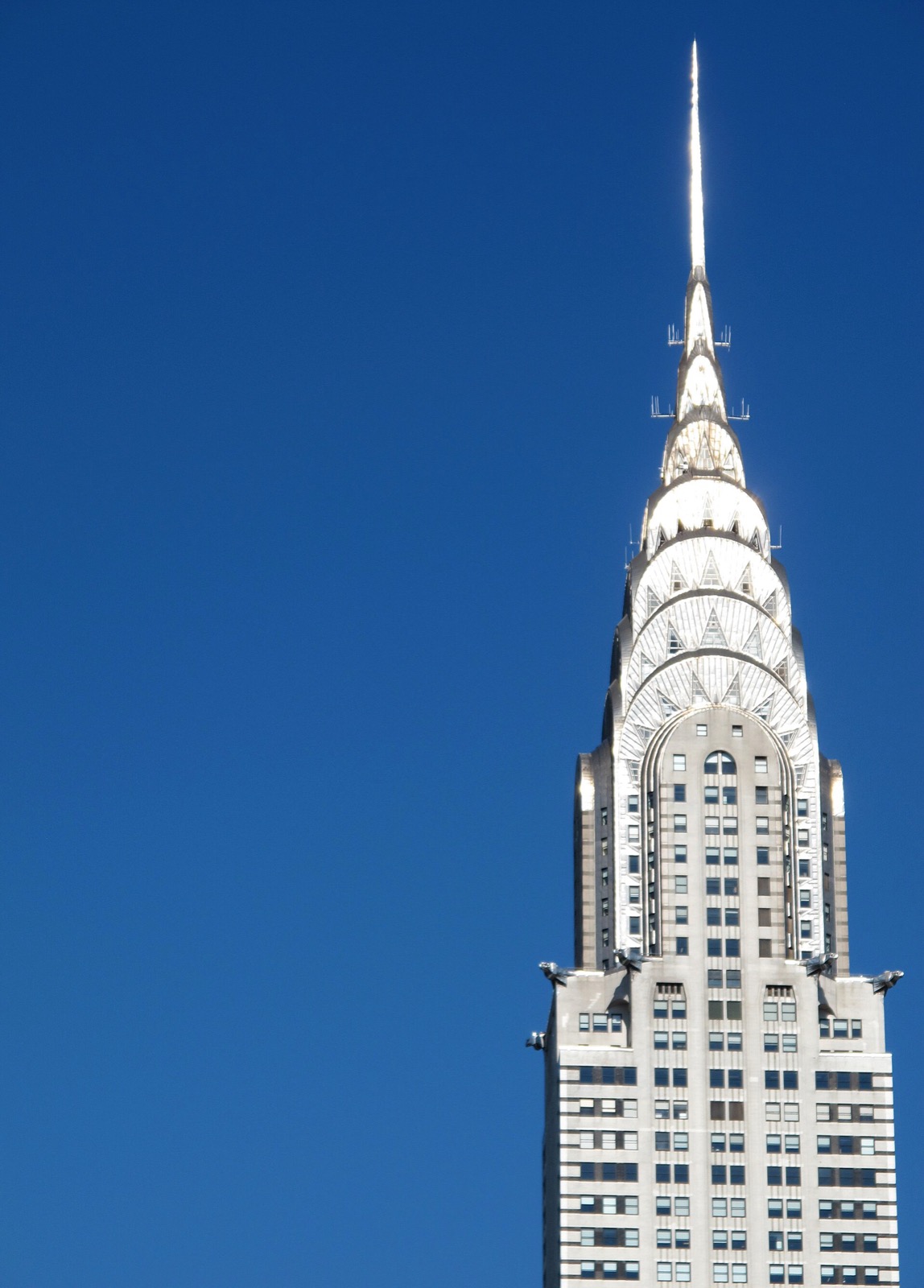
Tudor City occupies a full superblock on the east side of Midtown, roughly 40th to 43rd Streets between First and Second Avenues. Fred French developed the complex between 1925 and 1928, building 12 residential buildings with approximately 3,000 apartments around private gardens on a street elevated above the surrounding grid. The complex was designed to face inward, toward its own gardens, because at the time of construction the East River waterfront below was lined with slaughterhouses and industrial facilities. The windows on the east-facing walls were deliberately kept small or omitted entirely to avoid the view and the smell.
The slaughterhouses are gone. The United Nations complex occupies the riverfront now. But Tudor City’s inward-facing residential character remains. The apartments have the proportions and finishes of their era. Plaster walls, original casement windows, compact but well-laid-out floor plans, and the kind of prewar construction where you can hear very little of what your neighbor is doing because the walls are thick enough to matter.
Cleaning in Tudor City means working with the building’s management protocols, navigating hallways and service areas that reflect 1920s layout conventions, and treating surfaces that have been maintained for nearly a century. The original casement windows collect grit along the tracks and require careful cleaning to avoid damaging the hardware. The plaster walls, as in any prewar building, get dry microfiber only. Our teams know Tudor City because we clean there regularly, and the consistency matters. These buildings have management offices that notice when a vendor does not follow procedure.
The luxury high-rises between Park Avenue and the Hudson River have different problems entirely
The modern residential towers in Midtown are a different world from the prewar stock. Glass-curtain-wall construction, engineered stone countertops, heated bathroom floors, smart home systems, and floor-to-ceiling windows that show every streak and smudge because the light pours in from the 30th floor with nothing to block it.
The finishes in these apartments are expensive but not fragile in the same way as prewar construction. Engineered quartz does not etch like marble. Engineered hardwood does not absorb moisture like original pine. But the cleaning challenges are real. Dust moves freely in open floor plans with minimal interior walls. Floor-to-ceiling glass on a high floor catches light at angles that reveal every water mark and fingerprint. And the buildings themselves impose logistical layers that do not exist in a walk-up. Service elevator reservations, COI requirements, advance notice windows, and doorman coordination.
We handle the building logistics as part of the service. When you book, you tell us your building’s requirements once. We file the COI, schedule the service elevator, and coordinate with your doorman or concierge. Most luxury high-rises in Midtown require some combination of 24 to 72 hours advance notice and insurance documentation. Our dispatch team deals with Midtown buildings regularly and knows what most of them need before we even ask.
Hotel-to-condo conversions brought commercial-grade finishes into residential spaces
One of the defining real estate trends in Midtown over the past decade has been the conversion of aging office buildings and hotels into residential condominiums. The post-pandemic office vacancy spike accelerated this. Older Class B and C office towers in the 40s and 50s between Third and Eighth Avenues are being gutted and rebuilt as apartments, and former hotels are being converted to condo ownership.
These conversions produce apartments with unusual finishes. The bathrooms often retain or replicate commercial-grade marble and stone tile. The kitchens sometimes have restaurant-style ventilation hoods and fixtures. The layouts can be idiosyncratic because they were designed around a different use. A hotel bathroom converted to residential use might have a stone floor, a glass shower enclosure with commercial hinges, and a vanity top made from a material you would not find in a standard apartment building.
We treat the stone surfaces in these units the same way we treat marble in the prewar co-ops. pH-neutral cleaners only. No vinegar, no citrus-based products, no abrasive pads. The commercial-grade fixtures get careful attention to avoid scratching the plating. If a conversion has kept the hotel’s original bathroom marble, that stone has already survived decades of heavy use. Our job is to clean it without adding damage.
Rent-stabilized apartments in the west 40s and 50s are the other Midtown
The residential population of Midtown is not all luxury. The blocks west of Eighth Avenue, extending into the Hell’s Kitchen border, contain meaningful stocks of rent-stabilized walk-up and mid-rise apartments from the mid-20th century. These units house the working and middle-class residents who give the neighborhood its human texture. Actors, musicians, restaurant workers, longtime New Yorkers who secured a lease 20 or 30 years ago and held onto it.
These apartments have the characteristics of their construction era. Original hardwood floors that are often softer pine or fir, not sealed oak. Plaster walls. Compact kitchens. Radiators. The flooring in particular needs attention because unsealed softwood scratches more easily and absorbs moisture faster than modern engineered flooring. We use a flat microfiber mop with a pH-neutral wood floor cleaner on these floors. No steam. No vinegar. No ammonia.
The other challenge in Midtown’s rent-stabilized stock is the particulate load. Apartments along Eighth Avenue, near the Port Authority, and along the major crosstown corridors at 34th, 42nd, and 57th Streets absorb diesel exhaust, brake dust, and street-level grit faster than apartments in quieter neighborhoods. A recurring apartment cleaning keeps that accumulation from building up on every horizontal surface. We wipe windowsills, baseboards, and the tops of door frames where particulate collects, because in Midtown those surfaces get dirty faster than you would expect.
The Chrysler Building was the tallest in the world for eleven months and the neighborhood has not stopped building since
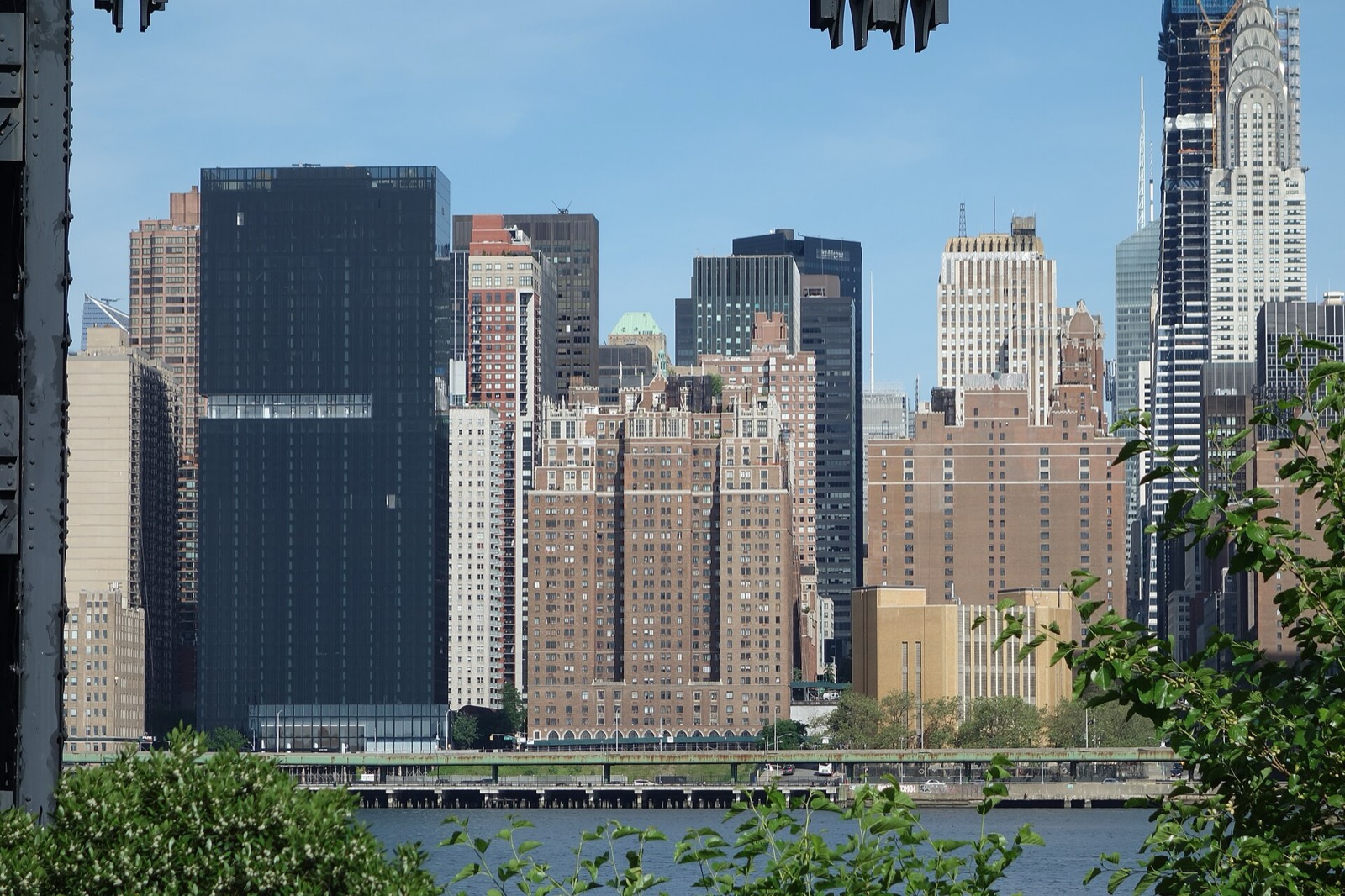
Midtown’s skyline is a textbook of 20th-century architecture, and the residential buildings draw from the same tradition. The Chrysler Building went up in 1930. William Van Alen had its 185-foot stainless steel crown assembled inside the building and raised through the roof in 90 minutes, secretly surpassing the Bank of Manhattan at 40 Wall Street to become the tallest structure in the world. It held the title for eleven months before the Empire State Building opened in 1931. Both buildings were completed during the Great Depression. The Empire State Building was finished in 410 days with 3,400 workers on site simultaneously at peak construction.
Rockefeller Center, built between 1930 and 1939, was an even more ambitious project. John D. Rockefeller Jr. spent $125 million of personal money on a 22-acre complex built on land he leased from Columbia University. He had no property rights. He was a tenant on a 24-year lease, building one of the most celebrated urban complexes in history on rented ground. The golden Prometheus statue, the sunken plaza, the Christmas tree, Radio City Music Hall, the bas-relief sculpture and murals throughout the complex. It was simultaneously a monument to ambition and a jobs program during hard times.
The most recent chapter is Billionaires’ Row, the cluster of supertall residential towers along 57th Street. 432 Park Avenue rises 1,396 feet on a concrete shaft barely 96 feet wide. Central Park Tower reaches 1,550 feet. A penthouse at 220 Central Park South sold in 2019 for $238 million, the most expensive home sale in American history. These towers are partly investment vehicles for global wealth, with significant portions of their units used as pied-a-terre or left vacant entirely.
That range of residential stock, from a rent-stabilized walk-up in the West 40s to a $238 million penthouse on 57th Street, defines the cleaning challenge of Midtown. The approach changes not just block by block but floor by floor.
Grand Central Terminal is the commuter hub and the neighborhood’s living room
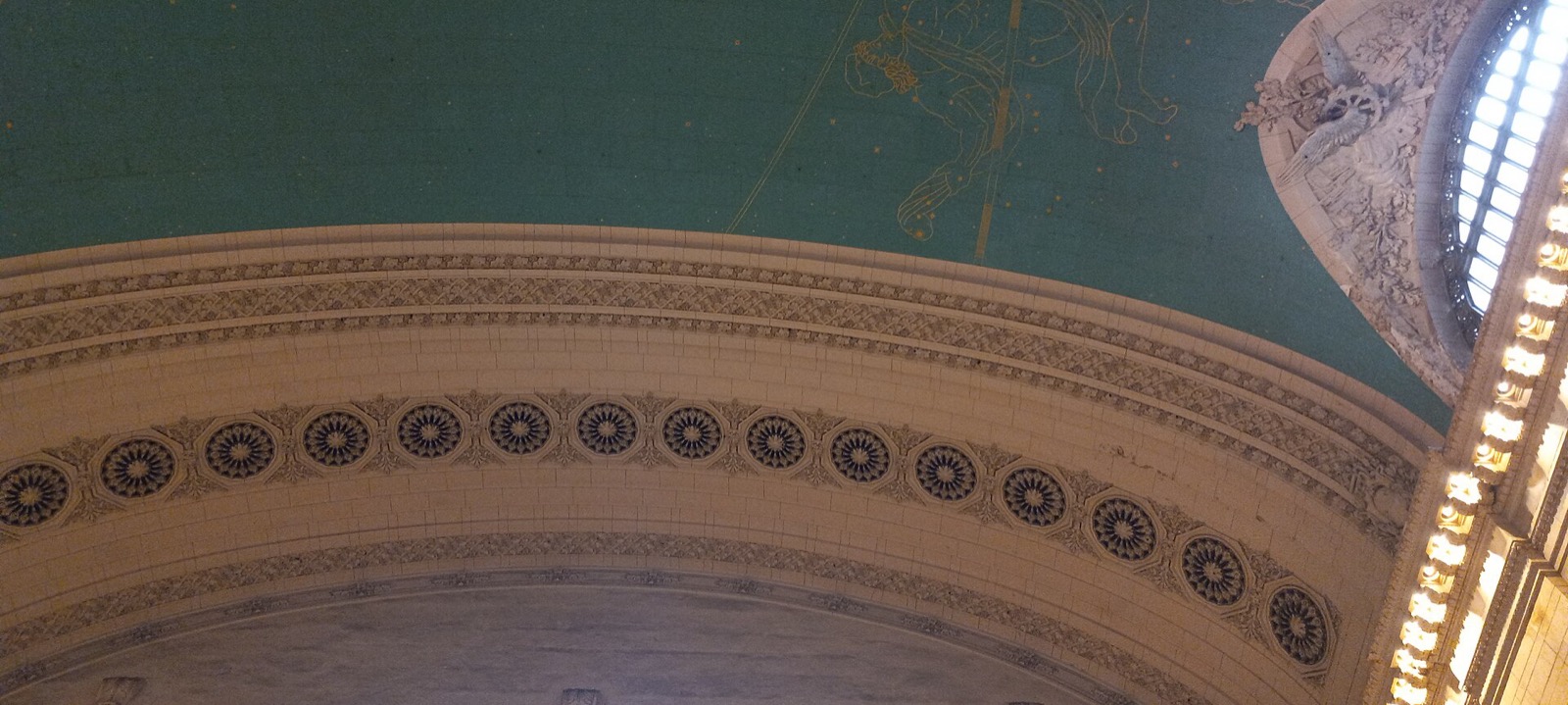
Grand Central Terminal opened in 1913 at 42nd Street and Park Avenue, designed by Warren and Wetmore in the Beaux-Arts style that defined institutional architecture of the era. The main concourse has 75-foot windows and a turquoise astronomical ceiling painted with 2,500 stars. The constellations are reversed, painted as if seen from outside the celestial sphere rather than from earth, which is either a mistake or a deliberate artistic choice depending on which historian you ask.
The terminal has 44 platforms on two underground levels, more than any other train station in the world. Metro-North commuter rail serves the Harlem, Hudson, and New Haven lines, carrying over 86 million riders annually. The lower level holds the dining concourse and the Oyster Bar, which has been serving since 1913 under vaulted Guastavino tile ceilings. The Campbell Bar, in the former stationmaster’s office, is one of the best cocktail bars in the city.
For Midtown residents, Grand Central is less a transit hub and more a living room. You walk through it to get coffee, pick up groceries at the market, meet someone for lunch, catch a train. It is the anchor of the neighborhood’s daily rhythm. Penn Station at 34th Street handles Amtrak, the Long Island Rail Road, and New Jersey Transit. Times Square at 42nd and Broadway is the largest subway station in the system. Between the three nodes, Midtown has more transit access per square foot than any district in the Western Hemisphere. Our cleaning teams use this same infrastructure. We are never more than a few subway stops from anywhere in Midtown.
Your cleaning takes about two to three hours and Midtown has more to do in that time than anywhere in New York
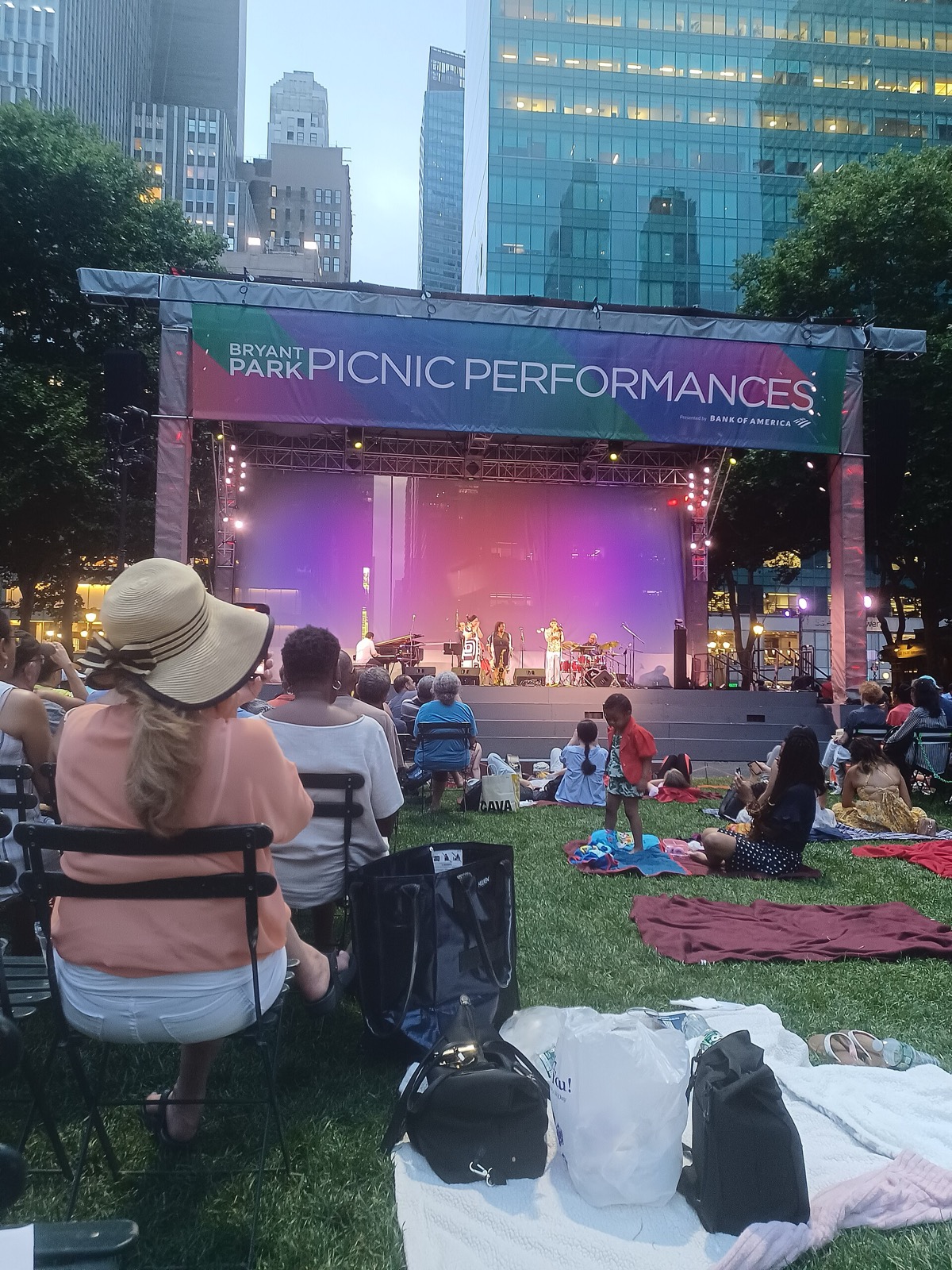
Bryant Park sits between 40th and 42nd Streets behind the New York Public Library. Nine acres of green space with reading rooms, chess tables, seasonal events, and a lawn that fills with people on any day the weather permits. In winter, the ice skating rink is free and the holiday market runs over 100 vendors. It is the best public space in Midtown and one of the best in the city.
If you want food, Grand Central Market has Murray’s Cheese, Eli Zabar, and a working produce market inside the terminal. The Oyster Bar downstairs has been open for over a century. Urbanspace Vanderbilt across the street serves fast, good lunch-counter food. Keen’s Steakhouse on 36th Street has been open since 1885, with 90,000 clay pipes hanging from the ceiling and a mutton chop that justifies the trip alone.
MoMA on 53rd Street is two to three hours minimum. Friday afternoons are free. Rockefeller Center is a walk-through destination year-round, and Top of the Rock offers the observation deck view that includes the Empire State Building, which the Empire State Building’s own observation deck cannot. The Theater District runs 40 shows on any given week. Koreatown on 32nd Street stays open until 4 AM if you need a midnight meal.
The point is that a Midtown cleaning appointment is not time you need to spend sitting in a coffee shop watching the clock. The neighborhood has more options for filling two or three hours than anywhere else in the city. Your apartment gets handled. You do something you actually want to do. That is the trade.
What booking looks like for Midtown residents
You pick your date and time on our booking page. You see your flat-rate price before you commit. If your building has specific access requirements, COI needs, or service elevator protocols, you tell us once and we handle it from there. Our dispatch team works with Midtown buildings constantly and knows the logistics of most major residential buildings in the neighborhood before you finish explaining them.
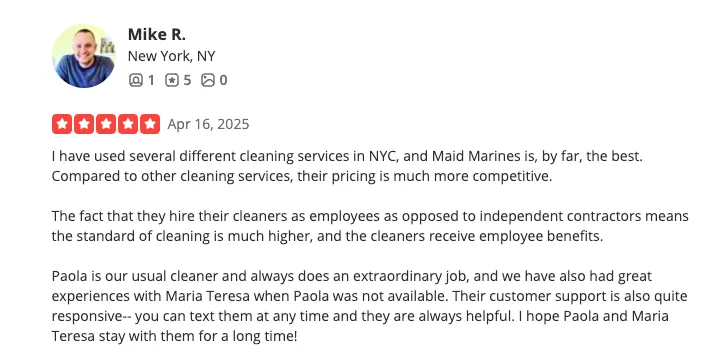
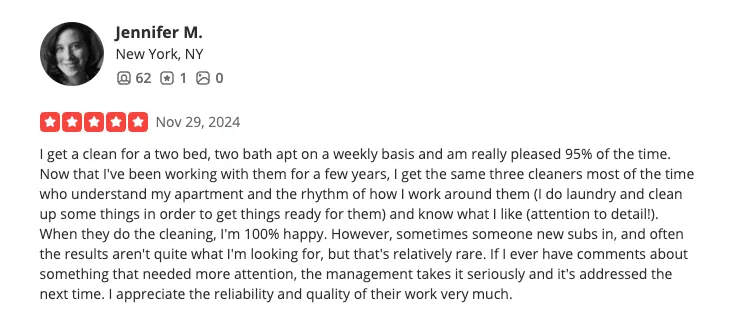
Our cleaners are W-2 employees, not gig workers. They are vetted, insured, and they show up with everything they need. If you have a pied-a-terre and want us to clean the day before you arrive, we coordinate with your doorman. If you have a prewar co-op with surfaces that need careful handling, we note it on your account permanently. If you are in a conversion with unusual finishes, we adjust our approach for the materials in your specific unit.
Midtown residents also use us for deep cleaning before or after renovation work, move-in and move-out cleaning for the neighborhood’s active rental and condo market, and recurring apartment cleaning on a schedule that works around your life. We also serve nearby Chelsea, Hell’s Kitchen, and Tribeca.