
Turtle Bay is the neighborhood where the United Nations conducts the world’s diplomacy five blocks from brownstone townhouses where Katharine Hepburn gardened for sixty years. The cleaning approach changes depending on which block you are on. A 1940s prewar co-op on Second Avenue with original plaster molding and herringbone hardwood needs a fundamentally different set of products and techniques than a glass-curtain-wall condo in the UN Plaza towers. And a four-story Turtle Bay Gardens townhouse with a private shared rear garden is a different job entirely from either of those. This is a neighborhood where the housing stock spans a full century of construction, the residents include some of the most internationally mobile professionals in New York, and the buildings have doorman protocols and security procedures that most cleaning services have never dealt with.
The name Turtle Bay comes from a Dutch cove that disappeared two centuries ago
The original Turtle Bay was a real place. A small, sheltered inlet along the East River, roughly where East 47th Street meets First Avenue today, appeared in Dutch colonial records as “Deutel Bay,” from the Dutch word “deutel” meaning a clasp or peg, likely describing the hooked shape of the creek. English-speaking settlers translated or adapted the name into “Turtle Bay,” possibly because of the turtles found in the shallow cove, possibly through phonetic drift from the Dutch. The cove was tidal, used for fishing, and surrounded by marsh and low-lying farmland that smelled of the tanneries and slaughterhouses that operated along its edge.
By the mid-1800s the cove was filled in. The shoreline moved east as Manhattan extended its waterfront with landfill and infrastructure. The name survived even though the physical bay did not. Three hundred years later, the anglicized version of a Dutch surveyor’s notation is still the name of the neighborhood.
The land surrounding the bay was part of the Beekman family estate for most of the 18th century. William Beekman’s property, called Mount Pleasant, stretched from the river inland, with a farmhouse whose gardens ran down to the water. The estate’s most significant historical moment came in September 1776 when British General Howe used the Beekman mansion as his headquarters and ordered the execution of Nathan Hale, the American spy whose last words became one of the most quoted phrases of the Revolution. The mansion was demolished around 1874 and nothing physical marks the site today, but the connection between Turtle Bay and one of the foundational moments of American independence is real.
Slaughterhouses became the seat of world diplomacy in under a decade
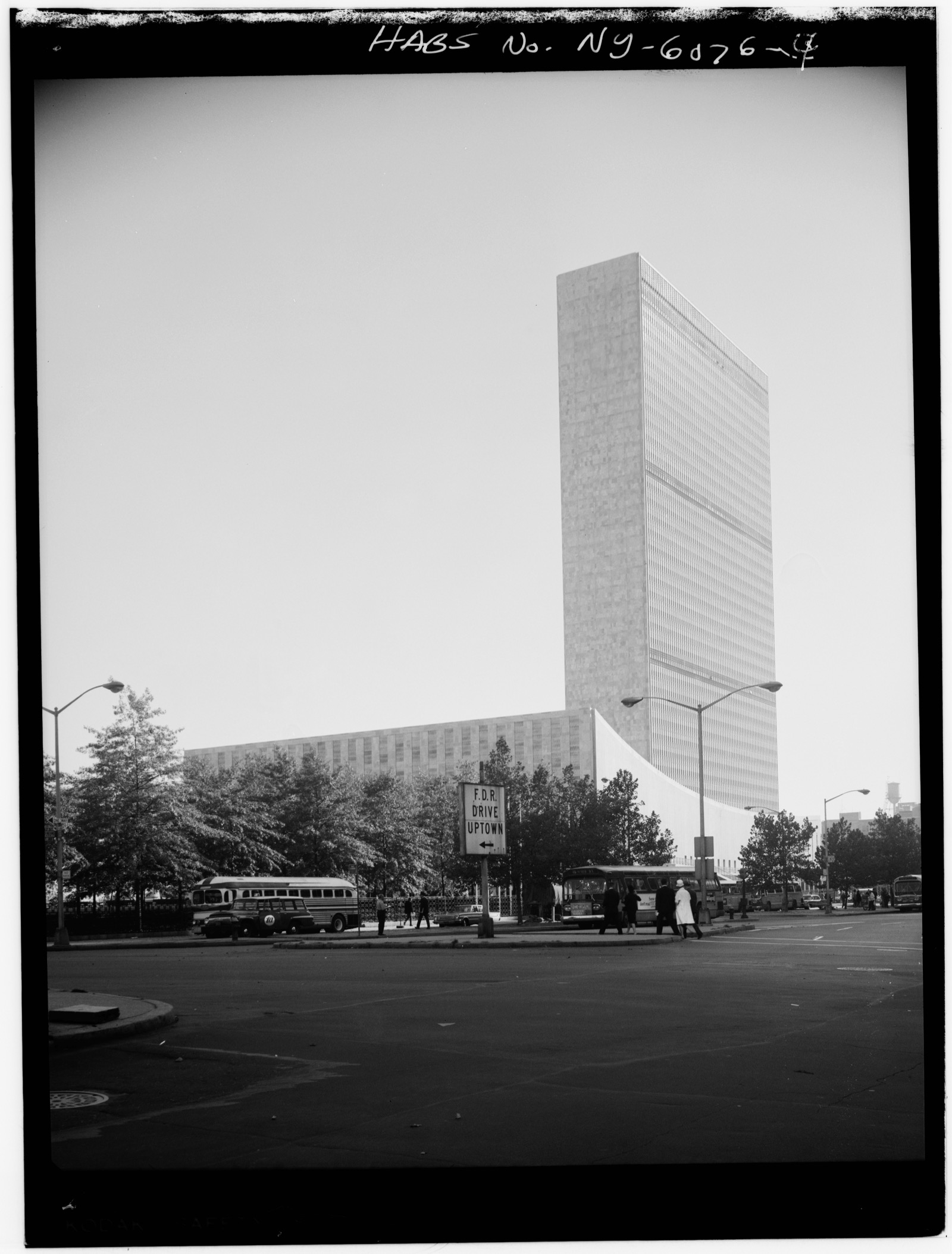
The most consequential transformation in Turtle Bay’s history happened between 1946 and 1952. Before the United Nations arrived, the 17-acre site along the East River between 42nd and 48th Streets was occupied by a concentration of slaughterhouses, rendering plants, and meatpacking facilities. The smell was notorious. The waterfront was industrial. The inland residential blocks, while pleasant, were overshadowed by the noxious edge of the river.
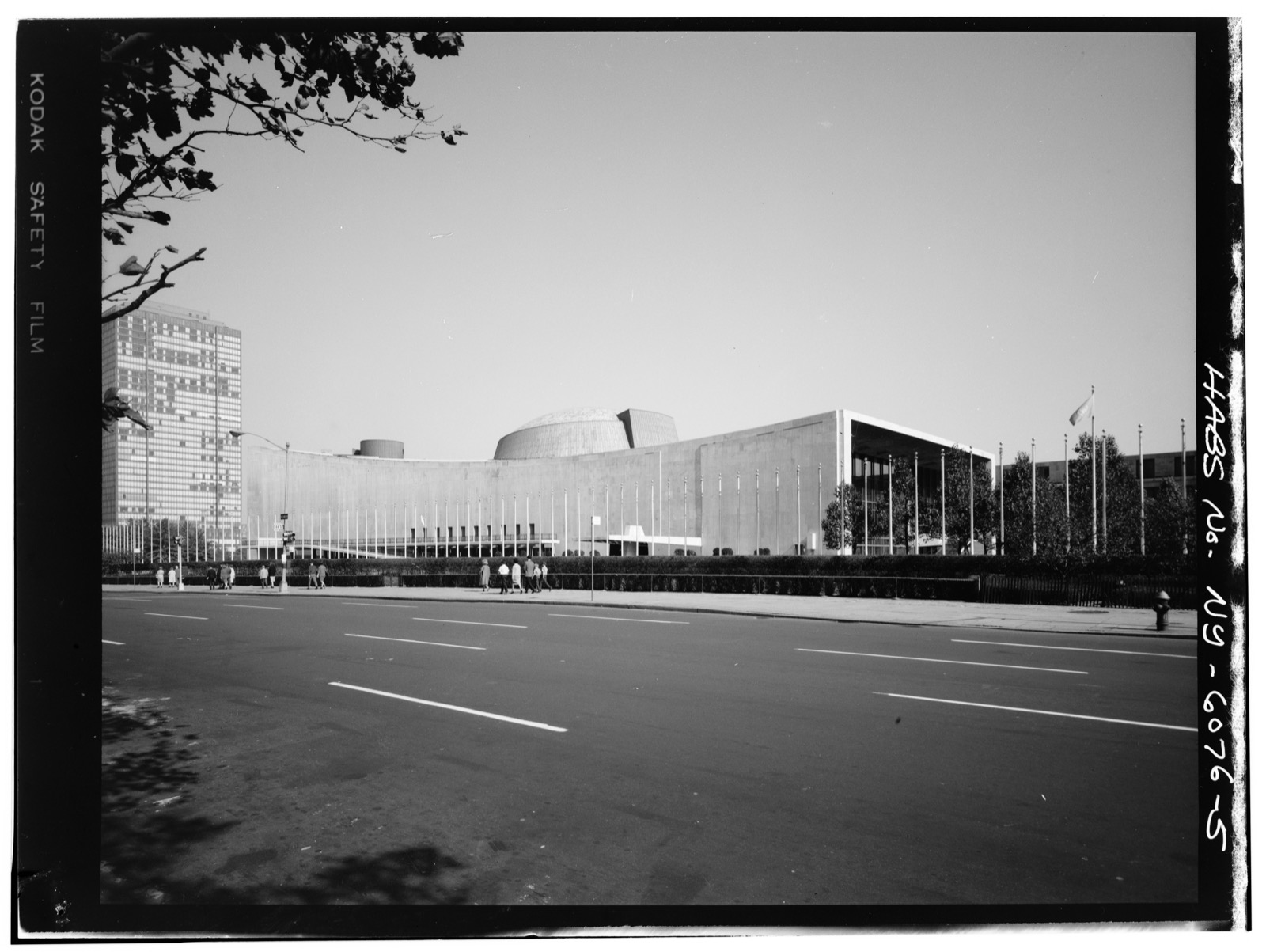
In 1946, John D. Rockefeller Jr. purchased the entire site for $8.5 million and donated it to the United Nations. An international team of architects led by Wallace Harrison, with contributions from Le Corbusier and Oscar Niemeyer, designed the complex that would become one of the most recognized building ensembles in the world. The Secretariat Building, completed in stages between 1948 and 1952, rises 39 stories in green-tinted glass and marble. It was one of the first fully glazed curtain-wall skyscrapers in the United States and immediately changed the Manhattan skyline. The General Assembly Building, with its distinctive dome visible to television audiences worldwide, sits at the southern end. The Conference Building connects the two and contains the Security Council chamber (a gift from Norway), the Economic and Social Council chamber (from Sweden), and the Trusteeship Council chamber (from Denmark).
The UN campus is technically international territory. Under the 1947 Headquarters Agreement, it operates outside the jurisdiction of the City of New York. The campus has its own fire department, post office, and security force. The NYPD and FDNY have only limited authority on the grounds. This legal distinction is invisible most of the year, but during General Assembly week each September, when motorcades and police escorts fill First Avenue and world leaders converge on the campus, the international character of the neighborhood becomes unmistakable.
The diplomatic community that the UN attracts has shaped Turtle Bay’s residential character in a way no other Manhattan neighborhood can claim. Mission buildings, UN-affiliated organizations, and the residences of ambassadors and senior diplomats are scattered throughout the blocks between First and Third Avenues. The restaurants reflect this. You can eat Japanese at Sushi Yasuda, Greek at Ammos, Turkish at Pera, and French at Jubilee within a ten-block radius. The multilingual conversations in elevator lobbies and the flags outside mission buildings along First Avenue are daily reminders that this neighborhood operates on a global frequency.
Twenty brownstone rowhouses share a private garden that has existed for over a hundred years
The Turtle Bay Gardens are the neighborhood’s most remarkable residential feature. In 1919 and 1920, philanthropist Charlotte Hunnewell Martin purchased twenty brownstone rowhouses on East 48th and 49th Streets, ten on each block, and hired architect Edward C. Dean to unify their rear yards into a single shared private garden. The resulting half-acre of mature trees, ornamental plantings, and a central fountain created something that barely existed in Manhattan and still barely does: a genuine communal green space shared by private homes in the middle of the densest city in the country.
The houses themselves are 19th-century Italianate and Romanesque Revival brownstones, substantially intact on their street-facing facades. They are designated a New York City Landmark. But the real distinction is the garden behind them, which operates under a permanent restrictive covenant that requires unanimous consent of all twenty owners to dissolve. The covenant has held for more than a hundred years. The garden has been continuously maintained.
The residents of those twenty houses have included some of the most accomplished people in American cultural life. Katharine Hepburn moved into 244 East 49th Street in 1937 and stayed until her death in 2003, making her one of the longest-tenured celebrity residents of any New York neighborhood. She was known for gardening in the shared rear garden, talking to neighbors over the fence, and fiercely protecting the block’s privacy. E.B. White and his wife Katharine White lived at 229 East 48th Street, where White wrote the essays that became “Here Is New York,” still the most beautifully observed piece of writing about the city. Stephen Sondheim, the greatest Broadway composer and lyricist of the twentieth century, lived on East 49th Street within the Gardens block. Mary McCarthy, Tyrone Power, and other writers and actors lived there at various points. The intimacy of the shared garden, the modest scale of the houses compared to the towers surrounding them, and the privacy of the arrangement made the Gardens a haven for people who wanted quality of life over visibility.
These townhouses are all owner-occupied and rarely come to market. When they do, prices run from $8 million to over $20 million. They are cleaned differently from the apartments in the surrounding towers. A Turtle Bay Gardens townhouse is a multi-floor house with original woodwork, plaster surfaces, hardwood floors, and a rear garden that tracks in leaves and dirt from October through spring. Our team sends two cleaners and allows three to four hours. The same team returns each visit because the house has surfaces and details worth learning once.
Prewar co-ops along Second Avenue carry an allergen load that newer buildings do not
The avenues and crosstown streets of Turtle Bay are lined with prewar apartment buildings from the 1920s and 1930s. These are mostly limestone and brick high-rises with classical detailing, doormen, and the kind of interior layouts that newer construction cannot replicate. Higher ceilings, deeper closets, plaster walls, and hardwood floors that have been refinished fewer times than you might expect. Mixed in with the prewar stock are postwar slab towers from the 1950s through 1970s, plus newer glass-fronted condo buildings along First and Second Avenues.
The prewar buildings create specific cleaning challenges that the postwar towers do not. Original plaster walls and decorative crown molding cannot be cleaned with water or spray solutions. The plaster absorbs moisture and discolors. Decades of cooking oil, dust, and cigarette smoke (from the era when smoking indoors was standard) have penetrated the plaster in apartments that were not renovated to the studs. Herringbone hardwood floors need pH-neutral solutions only. No steam cleaners, which can warp the wood. No vinegar-based products, which dull polyurethane over time. No excess water, period.
The steam radiators in these buildings are the biggest annual cleaning challenge. Cast-iron radiator fins collect dust all summer. When the building turns on the heat in October, that dust burns off and fills the apartment with a scorched-lint smell and visible particles. A surface wipe on the top of the radiator does nothing. Most of that dust sits down inside the cast iron where only a heating contractor reaches it, so what a cleaning crew handles is the casing and the space around it: covers, grilles, sill, floor and baseboard. We recommend a September or early October deep clean for any Turtle Bay prewar apartment to get the room itself ahead of the season.
The newer condo buildings along First Avenue and UN Plaza are straightforward by comparison. Glass and steel surfaces, engineered hardwood or stone floors, and modern ventilation systems that keep dust loads lower. These buildings have strict visitor registration and security screening procedures, especially the ones adjacent to the UN campus. We coordinate with the concierge in advance, carry ID, and arrive pre-registered. After the first visit the building knows our team.
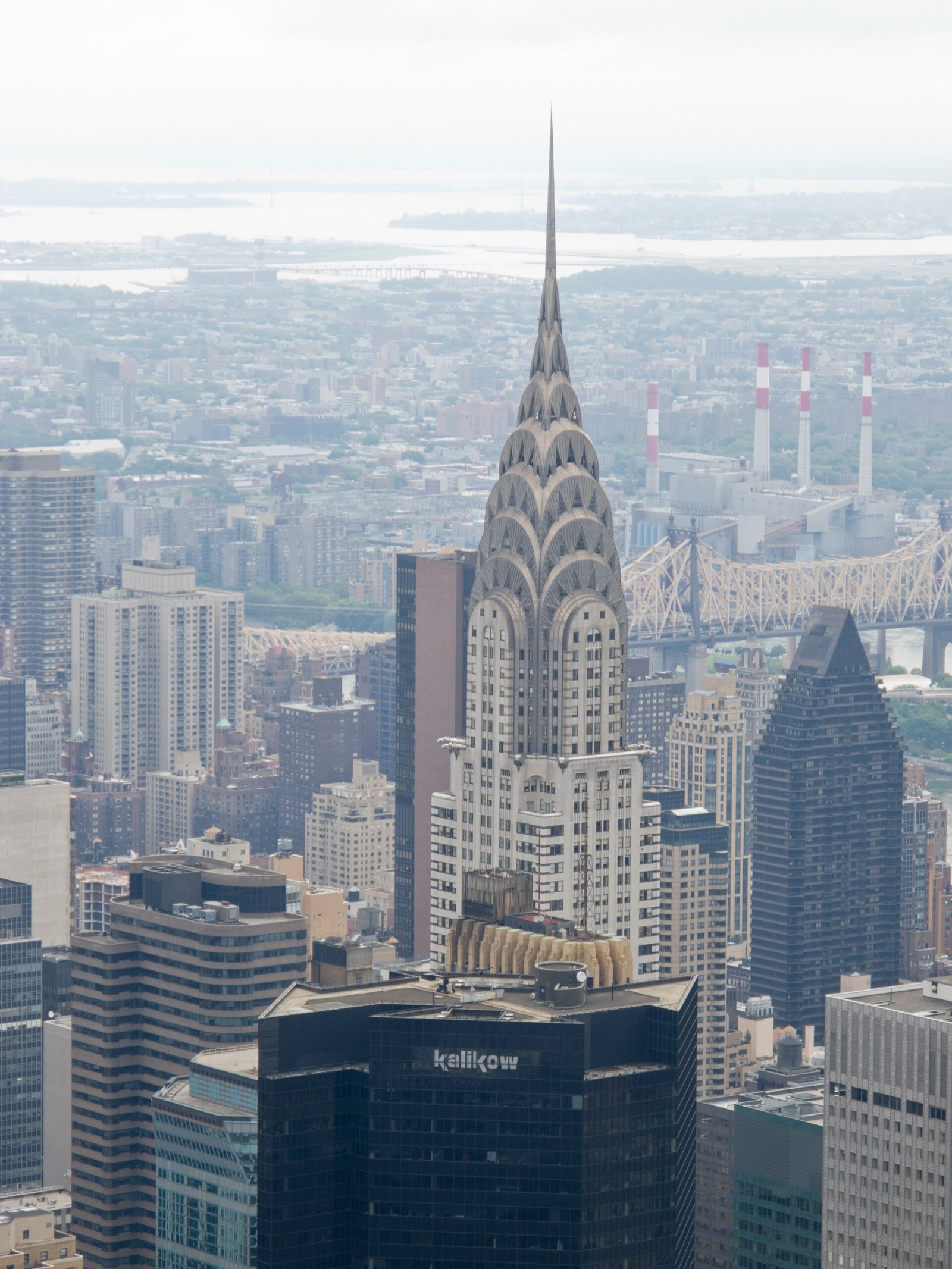
The Chrysler Building is the most beloved skyscraper in New York and it marks the neighborhood’s western edge
The Chrysler Building at 405 Lexington Avenue, completed in 1930, sits at the boundary where Turtle Bay meets the Midtown commercial core. Its stainless steel sunburst crown, eagle gargoyles at the corners, and radiating Art Deco ornament make it arguably the most aesthetically admired skyscraper in the world. William Van Alen, the architect, kept the steel crown a secret during construction and had it hoisted through the top of the building and into place at the last minute, briefly making it the world’s tallest structure. It held that title for exactly eleven months, until the Empire State Building opened in April 1931.
The ground-floor lobby, with its Art Deco elevator doors and geometric marble floors, is open to the public. Walk through it on a weekday and you share the space with office workers who barely notice the most beautiful lobby in Manhattan because they pass through it twice a day. Grand Central Terminal, one of the most important transit hubs in the world, sits a block west. Turtle Bay residents use the 4, 5, 6, and 7 trains at Grand Central, the 4, 5, and 6 at 51st Street, and the E and M trains at Lexington Avenue and 53rd Street. The M15 bus runs along First and Second Avenues. The M42 and M50 crosstown buses serve the heart of the neighborhood.
Turtle Bay cleaning covers prewar co-ops, UN district condos, and landmarked townhouses
The housing stock in Turtle Bay breaks roughly into four categories. Luxury prewar cooperatives account for about 40 percent of the residential inventory. These are the Second and Third Avenue doorman buildings with white-glove service, classical facades, and the original interiors that require careful handling. Postwar doorman high-rises make up another 25 percent, mostly rental and condo towers from the 1950s through 1970s with simpler maintenance needs. The newer luxury condominiums along First Avenue and UN Plaza, including buildings designed by Kevin Roche and John Dinkeloo with blue-green reflective glass facades, account for roughly 15 percent. And the Turtle Bay Gardens townhouses and scattered brownstones on the side streets make up the remaining stock.
For recurring apartment cleaning, most Turtle Bay clients book biweekly service and leave access with the doorman. The neighborhood skews toward middle-aged and older professionals with median household incomes between $130,000 and $160,000. Many residents are senior professionals, diplomats, and executives who travel frequently. The cleaning arrangement is almost always key-with-doorman, scheduled cleaning on a fixed day, and a clean apartment waiting when they return. No coordination calls, no rescheduling, no disruption.
For the townhouses and larger prewar apartments, house cleaning with a two-person team is the right fit. The multi-floor layouts, original surfaces, and sheer square footage require more time and a team that knows the building. We send the same pair every visit.
For tenants moving in or out of the neighborhood’s rental inventory, move-in and move-out cleaning covers inside cabinets, appliance interiors, baseboards, window sills and ledges, and every surface a landlord or management company will inspect. Turtle Bay has steady rental turnover in the postwar buildings and we handle these regularly.
Your cleaning takes about two to three hours so here is how to spend them
Turtle Bay sits between Grand Central and the East River, which means you have a transit hub, a waterfront, a diplomatic district, and several of the best restaurants in Midtown within walking distance. Walk east to the UN Visitor Centre for a guided tour of the General Assembly Hall and Security Council chamber. Walk west to Grand Central and spend an hour in the lower level food hall. Walk along the East River esplanade toward the 34th Street ferry terminal. Sit in Dag Hammarskjold Plaza and watch the UN district foot traffic. Or eat your way through one of the most concentrated pockets of international dining in Manhattan. Sushi Yasuda for omakase. Sparks for a steak. Pera for Turkish mezze.
The nearby neighborhoods all have their own pages. Kips Bay is directly south along the medical corridor. Gramercy Park is southwest, with its own locked park and prewar housing stock. Midtown is the commercial core to the west. The Upper East Side starts above 59th Street to the north.
What booking looks like for Turtle Bay residents
You pick your date and time on our booking page. You see your flat-rate price before you commit. If your prewar co-op has surfaces that need specific handling, you tell us once and we note it permanently on your account. If your building requires a COI or advance vendor registration, we handle the paperwork before the first visit. Our cleaners are W-2 employees, not gig workers. They are vetted, insured, and they show up with the right products for your specific apartment or townhouse.