
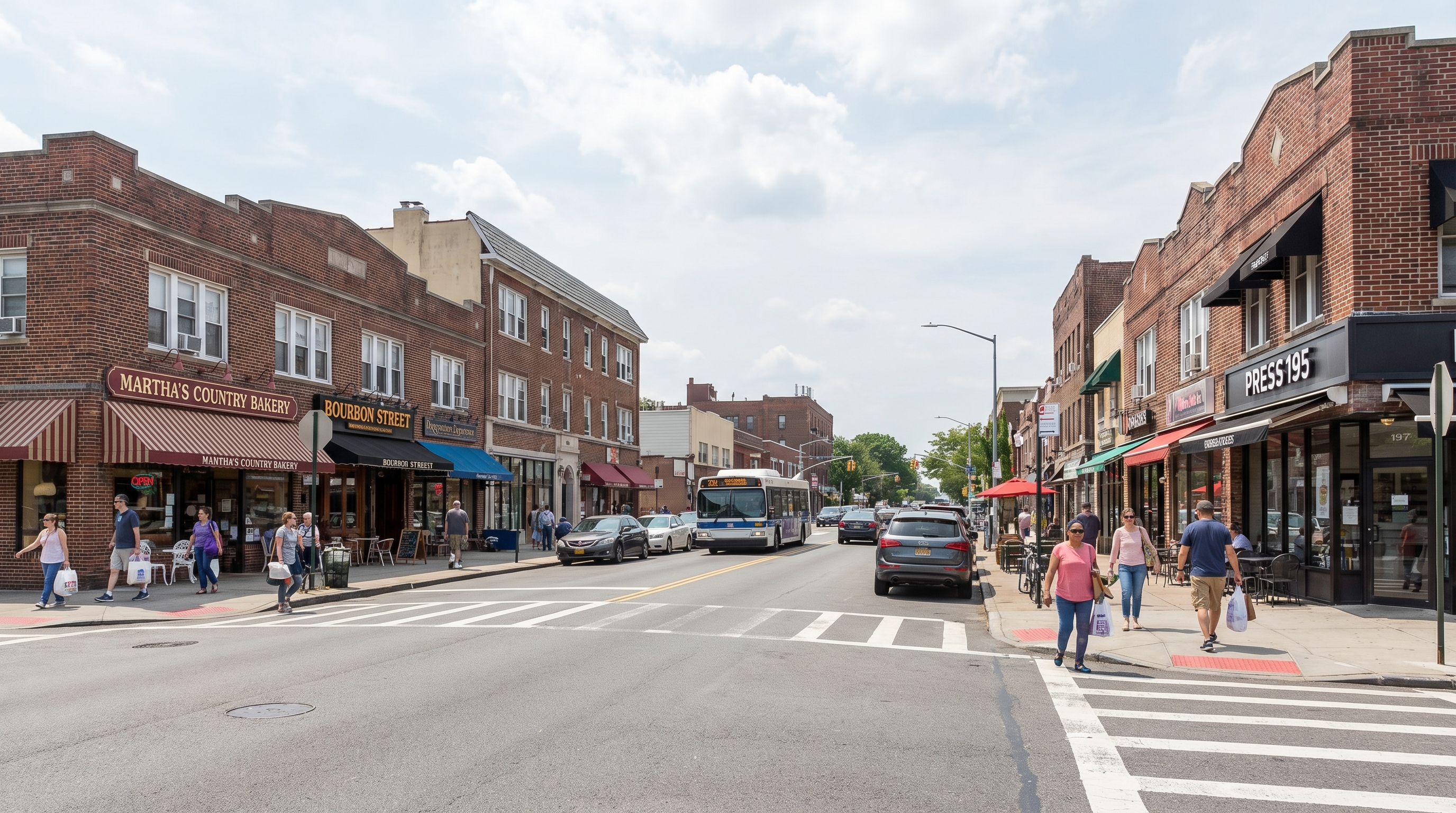
Bayside is a Queens neighborhood built on a simple promise that kept working for over a hundred years: a real house, a real yard, a twenty-five minute train to Midtown, and a main street with a restaurant where they know your name. The brick Tudor Revivals on the interior blocks and the waterfront estates near Little Neck Bay are not accidental. They are the product of a neighborhood that has kept attracting exactly the kind of family that wants to own a home, stay in it, and send their kids to the local school. What has changed is who those families are. The Irish and Italian homeowners who filled Bayside after World War II have been joined and in many blocks largely replaced by Korean American and Chinese American families who made the same calculation their predecessors did: the schools are good, the train is reliable, and the water is right there. Bell Boulevard on a Friday night looks different than it did in 1975, but the logic of the neighborhood is identical.
Bayside Tudor Revivals and Cape Cods require cleaning that matches the house
The dominant residential type in Bayside is the brick Tudor Revival built between 1920 and 1940. Two stories, steeply pitched roof, arched front doorway, a small yard in back, and typically four bedrooms with one or two bathrooms. These homes are usually on 40 or 60-foot lots with mature street trees that have been growing for eighty or ninety years. They are solidly built, well-maintained by generations of owners who take ownership seriously, and full of original details that need specific care.
The hardwood floors in these houses are often original and unfinished or finished with shellac from the 1930s. Modern wet-mopping methods that work fine on polyurethane-sealed floors can warp and stain these original boards. We use dry microfiber on original hardwood and ask you during booking whether the floors have been refinished so we can adjust accordingly.
The Cape Cod bungalows from the postwar era, concentrated in the blocks filling in from the late 1940s onward, have a different profile. Smaller footprint, dormers upstairs, finished attic space that most cleaning services treat as storage and skip. We include the upstairs dormer rooms in the quote and clean them the same as any other bedroom, because they are bedrooms, and because they accumulate dust faster than any other room in the house given the lower ceiling pitch and reduced airflow.
Two-family semi-detached homes are also common in Bayside, and we handle them often. The owner lives in one unit and rents the other. We can clean either unit independently, or both on the same day with a schedule that works for both households.

A colonial farm on Little Neck Bay became one of Queens’ most stable neighborhoods
The land that became Bayside belonged to the Matinecock people before English colonists began arriving in the 1650s. The bay was the point: striped bass, oysters, clams, and waterfowl made the waterfront a productive resource. The English settlers who followed named the place for its most obvious geographic feature. Bayside is beside the bay. The name has not changed in 370 years.
The neighborhood stayed rural and agricultural through the early 1800s, with large waterfront estates occupying the choicest land near Little Neck Bay. The event that changed everything arrived in 1866 when the Long Island Rail Road opened the Bayside station on its Port Washington Branch. The station made daily commuting to Manhattan possible, and developers immediately began subdividing the farmland into residential lots. The Victorian and Edwardian homes that survive in the Bay Terrace area date from this first wave of development. Substantial two- and three-story houses on generous lots, built for prosperous New York families who wanted waterfront access without living in the city.
The second wave came after both World Wars. Returning veterans and their families needed housing, the GI Bill made mortgage financing available to working-class buyers for the first time, and Bayside’s combination of transit access, schools, and open lots made it a natural landing spot. The Cape Cods and raised ranches filling in the southern and eastern blocks mostly date from the late 1940s and 1950s. Irish, Italian, and Jewish families from inner Brooklyn and the Bronx settled heavily during these years, establishing the ethnic character the neighborhood carried through the 1970s.
The demographic evolution of the past fifty years has happened through homeownership transfer rather than rental displacement, which is a meaningful distinction. When a family leaves Bayside, they sell their house. The buyers since the 1970s have been disproportionately Korean American and Chinese American families making the same calculation. The physical fabric of the neighborhood has remained intact through the transition because the mechanism of transfer is ownership. The same 1932 Tudor Revival that an Italian-American family built and maintained for forty years is now owned and maintained by a Korean-American family with the same investment in its condition. This is why Bayside looks the way it does.
Fort Totten, at the northern tip of the neighborhood, is a different kind of history entirely. The pentagonal masonry battery and related fortifications were built in the 1860s as part of the harbor defense system for New York City and remained an active Army base through the twentieth century. The fortifications are among the best-preserved Civil War-era military structures in New York City. The site is now a city park, open to the public, with waterfront views across Little Neck Bay toward Nassau County that are genuinely hard to beat.
Deep cleaning a Bayside house means knowing what you’re actually dealing with
A four-bedroom Tudor Revival in Bayside presents different deep cleaning challenges than a Manhattan apartment in almost every respect. The volume alone is different: 2,000 to 2,500 square feet across two full stories, plus a basement that the owners use for storage, laundry, and sometimes a finished den. Range hoods above gas ranges that have been cooking real food for decades. Radiators with cast-iron fins that trap dust. Tile grout in original bathrooms where the tile dates to the 1940s.
The kitchen is usually where the most work is concentrated in Bayside homes. Households that cook seriously produce grease films on surfaces that require actual degreasers, not all-purpose sprays. We clean range hood undersides, backsplash grout, cabinet faces near the range, and stovetop grates that get pulled up rather than wiped around. This takes more time than a standard kitchen clean, and the price reflects that, but it’s the difference between a kitchen that looks clean and one that actually is.
The bathrooms in original Bayside Tudors often have 1920s and 1930s tile in good condition that needs careful treatment. Original hex tile floors with narrow grout lines hold dirt in the grout and need an actual scrub brush, not just a mop passing over the surface. We use appropriate brushes and grout-safe cleaners on these floors rather than the same approach we’d use on modern porcelain.
The basement is an optional add-on that many Bayside homeowners include with a first-time deep clean. Finished basement spaces accumulate dust behind stored items and in HVAC return vents. We vacuum out the vents, clean behind and under furniture, and treat the space like the room it is rather than the afterthought many services treat it as.

Bell Boulevard is Bayside’s living room and it has been since the railroad arrived
Bell Boulevard runs north to south through the heart of Bayside, and the stretch between 35th Avenue and Northern Boulevard is where the neighborhood shows itself most clearly. It is not glamorous. It is not trendy. It is a real main street where the restaurants are full on weekends, the Irish pub has been pouring pints for the same regulars for fifteen years, and the Korean BBQ places turn tables all night on Fridays.
The Korean dining scene on Bell Boulevard and Northern Boulevard is one of the most fully developed in New York City outside of Flushing. Multiple Korean barbecue restaurants with table-embedded grills for galbi and bulgogi. Korean fried chicken spots. Tofu stew houses. Korean bakeries. The commercial corridor evolved as Bayside’s Korean American community grew large enough to sustain not just restaurants but institutions: Korean-language churches with thousands of members, Korean Saturday schools, Korean-language newspapers. This is a community center, not a landing pad.
Alongside the Korean restaurants, Bell Boulevard still has the Italian-American trattorias, the Greek diners open around the clock, and the Japanese sushi spots that reflect the neighborhood’s layered history. You can eat your way around East Asia and southern Europe within a four-block walk. The diners are worth knowing about specifically: old-school Greek-owned operations that have been functioning as Bayside’s 24-hour community meeting room for decades, where the coffee is bottomless and the booths are comfortable. They are the right place to sit during a three-hour apartment cleaning.
Crocheron Park on the northern edge gives the neighborhood something most of Queens does not have: actual waterfront access with walking paths, tennis courts, and picnic areas along Little Neck Bay. The Bayside Marina provides boat slips for residents who keep vessels on the water. These are quality-of-life features that belong to a very short list of New York City neighborhoods. They are part of why people choose Bayside and why they stay.
What booking looks like from Bell Boulevard
You pick your date and time on our booking page. The price is a flat rate based on bedrooms, bathrooms, and square footage, and you see it before you commit. If you are in a co-op in Bay Terrace and your building needs a Certificate of Insurance or advance vendor notice, you tell us once and we handle the coordination before your first appointment.
Our cleaners are W-2 employees, not gig-economy contractors. They are insured, vetted, and equipped. They bring their own supplies. If you have original hardwood floors that need dry treatment, if your kitchen range hood needs a real degreasing, if you have a finished basement you want included, you tell us when you book and we account for all of it in the quote and in how the team approaches your house.
Bayside residents also use us for move-in and move-out cleaning when houses change hands, for post-renovation deep cleaning after work on older homes, and for recurring house cleaning on whatever schedule fits. We serve the full northeastern Queens corridor including the surrounding communities of Fresh Meadows, Auburndale, and Flushing.