
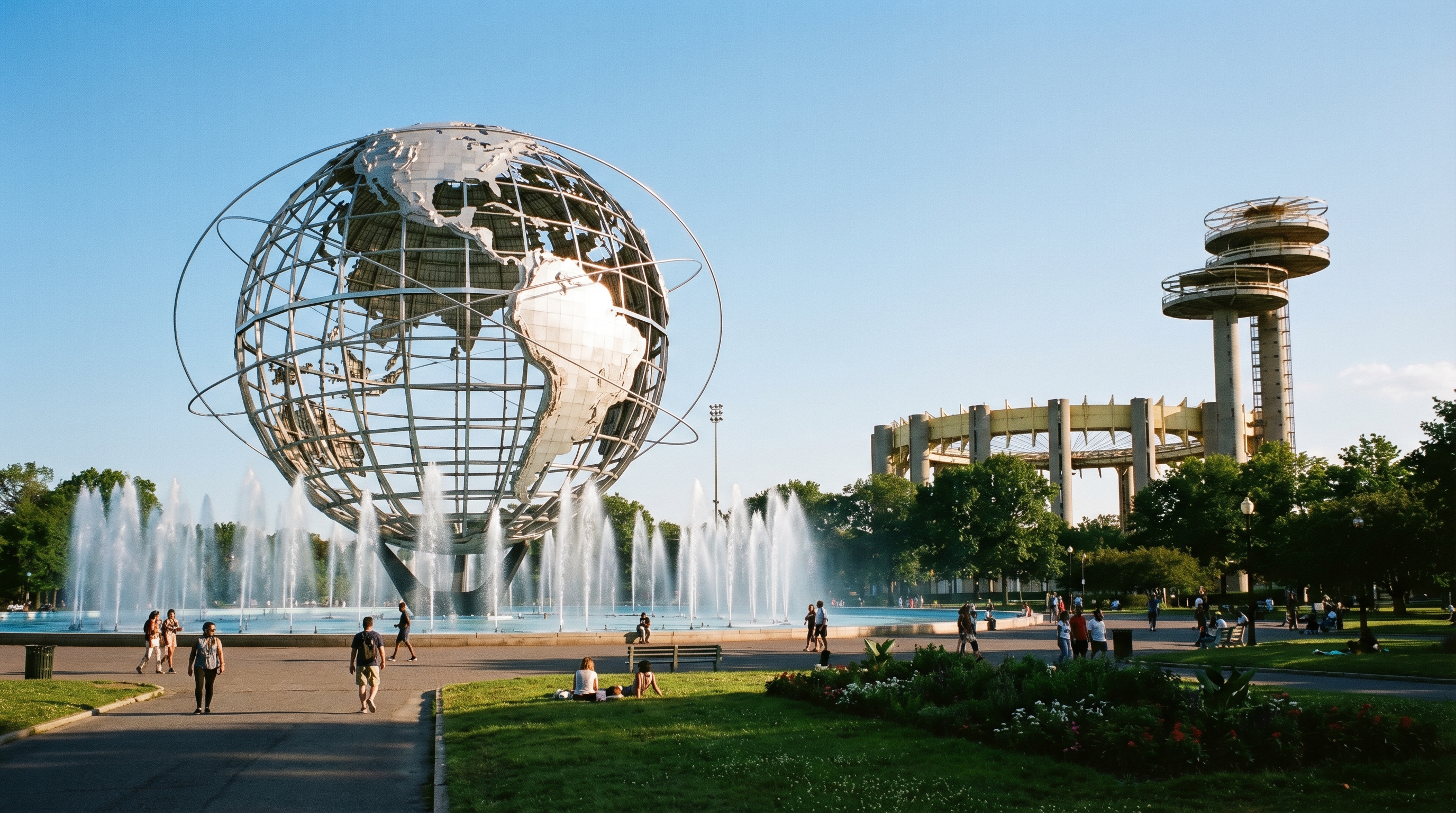
Flushing was founded 134 years before the Constitution on a principle of religious freedom, named after a Dutch port city by a Dutch governor, and transformed in the last fifty years into the largest Chinatown outside Asia. The 7 train deposits you at Main Street into one of the most genuinely international urban spaces on the planet. The corner of Main Street and Roosevelt Avenue is the third-busiest pedestrian intersection in New York City. The commercial strip that runs south from the station entrance never fully closes. The underground food courts beneath the New World Mall and the Golden Shopping Mall serve regional Chinese specialties at all hours. And two miles west, in Flushing Meadows-Corona Park, the 140-foot stainless steel Unisphere built for the 1964 World’s Fair still stands over the reflecting pool.
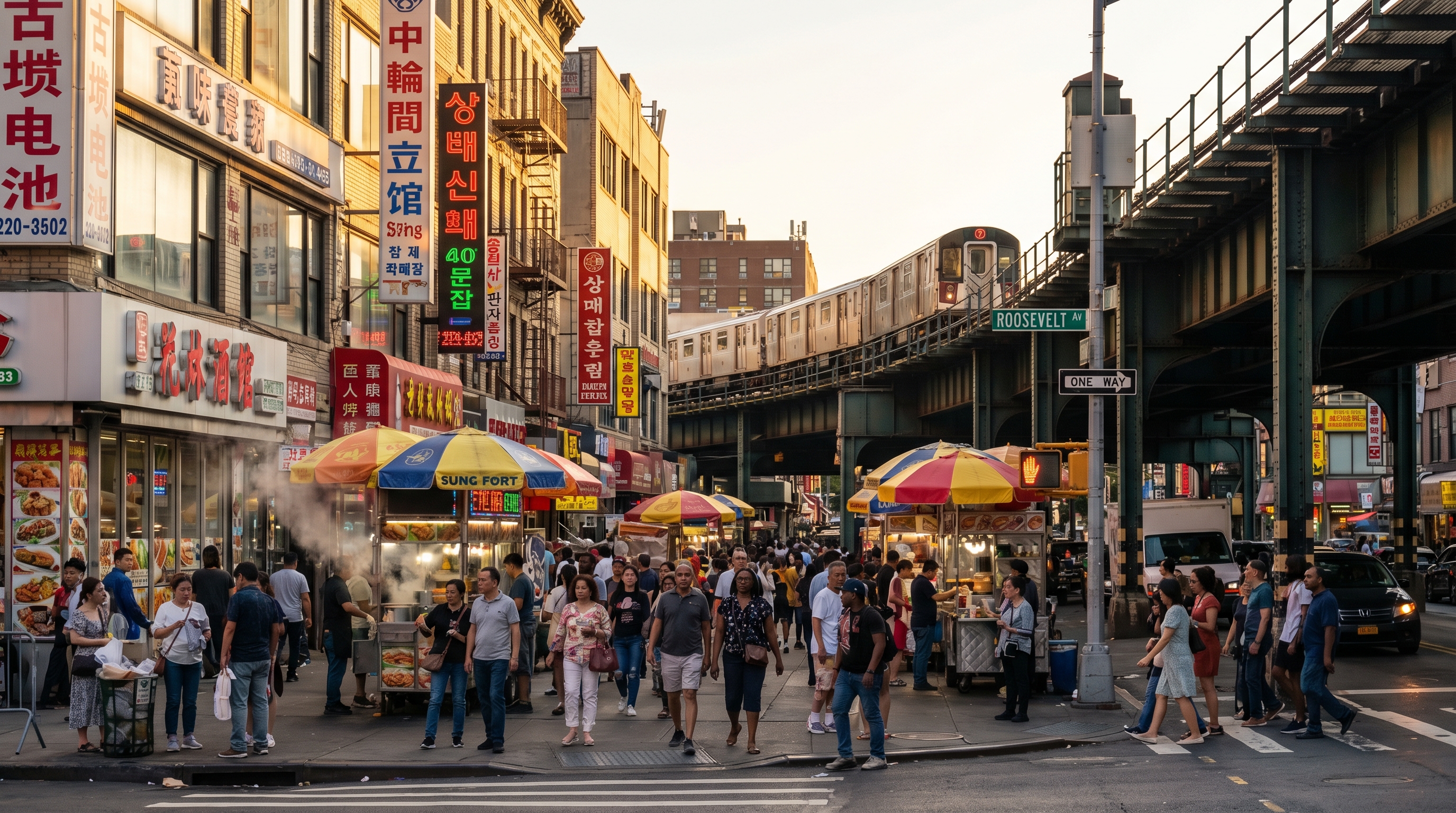
The people who live here occupy every kind of home the outer boroughs offer. Prewar brick rental buildings on the quiet residential streets north and east of downtown. New condominium towers twenty to forty stories tall rising along Northern Boulevard and Main Street. Two-family Colonial and Cape Cod homes in the blocks toward Auburndale and Whitestone. Co-op apartments in mid-century buildings with Flushing’s established older families. All of it in a neighborhood so dense with daily life that the concept of quiet time feels negotiated.
What Flushing apartments and houses actually need from a cleaning service
Flushing’s housing stock is not uniform and the cleaning approach should not be either.
The prewar brick apartment buildings south and east of downtown, most of them four to seven stories with no elevator, were constructed in the 1930s and 1940s. The original hardwood floors in these buildings have gaps between the planks where grit and moisture accumulate. A standard wet mop pushes that grit deeper into the seams and eventually warps the boards from below. The plaster walls dent if you bump them in a narrow hallway. The cast-iron radiators have fins that collect dust all summer and release it as a burning smell when the steam heat kicks on in October. These buildings need careful handling, not a fast sweep-and-go.
The new towers on Northern Boulevard and Main Street are a different job. Engineered stone countertops that show every water ring. Bathroom tile with clean grout that needs to stay that way. Floor-to-ceiling windows where streaks are visible from the street. These buildings have doorman lobbies, service elevator protocols, and vendor notice requirements that need to be sorted before the first visit.
The single-family and two-family homes in the northern residential sections, along streets like 162nd Street, Parsons Boulevard, and the blocks near Bowne Park, are another category entirely. Two stories, small yards, garages. Multiple bathrooms, a full kitchen, a basement in some cases. The traffic patterns in these homes concentrate dirt at entries and stairs.
Kitchens where serious cooking happens need a different first visit
Flushing kitchens work hard. The neighborhood has one of the densest concentrations of home cooking in New York City, and that cooking involves oil. Wok cooking, frying, roasting, braising in pots that simmer for hours. The byproduct is a grease film that builds on every horizontal surface near the stove: backsplash tile, cabinet faces above the range, the range hood exterior, the underside of the microwave if it sits above the stove.
A standard recurring clean maintains a kitchen that is already in reasonable shape. It wipes down counters, cleans the stovetop, and addresses visible grime. It is not designed to strip months of accumulated grease film from tile grout or pull the filter from a range hood that has not been deep cleaned in a year.
If your kitchen has been cooking seriously for more than a few months without a deep clean, that first visit needs to be a proper reset. We degrease the backsplash, clean inside the range hood, address the cabinet faces, and pull out whatever has accumulated at the back of the stovetop behind the burner grates. Once that layer is gone, recurring maintenance keeps the kitchen functional. Without the reset, each cleaning just moves the film around.
The residential blocks north of downtown have their own pace
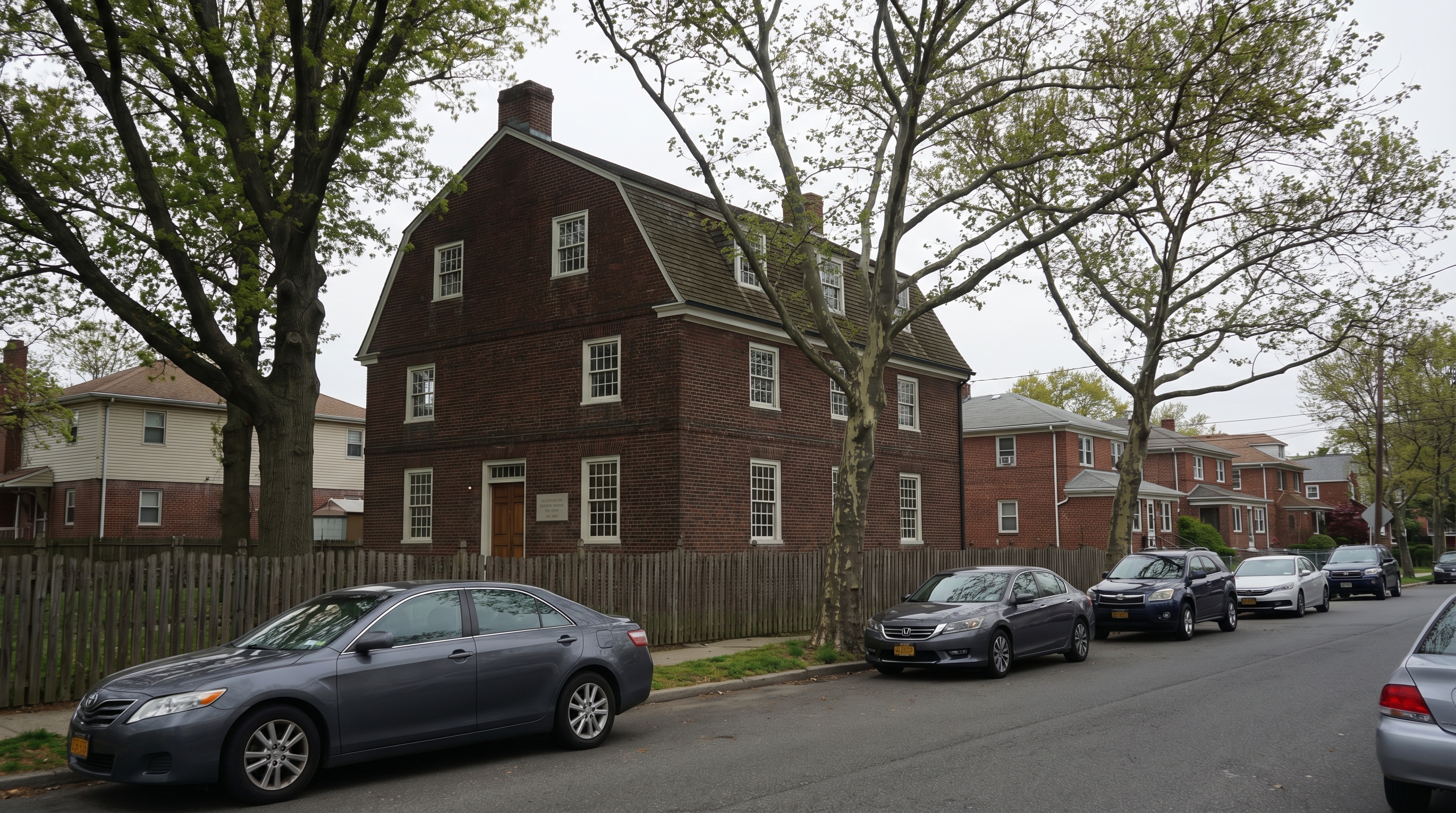
A few blocks north of the Main Street commercial corridor, Flushing shifts registers entirely. The blocks around Bowne Park, between Northern Boulevard and the quieter residential streets toward Auburndale, are tree-lined and unhurried. This is where the Kingsland Homestead sits at 143-35 37th Avenue, a 1785 Dutch-English colonial farmhouse preserved by the Queens Historical Society in a small park. The Bowne House at 37-01 Bowne Street, built in 1661 and one of the oldest surviving houses in New York City, is on a residential block surrounded by parked cars and apartment buildings. The Friends Meeting House at 137-16 Northern Boulevard, built in 1694 and the oldest surviving religious building in Queens, still holds regular Quaker meetings.
The single-family homes in these blocks sell for $750,000 to $1.4 million. Two-family homes with a rental unit provide income that offsets the mortgage. The homeowners here are often long-established Flushing families, as well as newer buyers drawn by the 7 train’s direct run to Midtown and the more suburban character of these streets compared to the dense commercial core.
House cleaning for these homes follows a different cadence than apartment cleaning. Multiple floors, multiple bathrooms, yards that track dirt through back doors. We clean these homes on recurring schedules that account for the full square footage and the way traffic moves through a two-story house with a family living in it.
Flushing Meadows and the World’s Fair structures two miles from your front door
The park at the western edge of Flushing is not a neighborhood amenity in the normal sense. Flushing Meadows-Corona Park at 897 acres is one of the largest parks in New York City, and it holds a concentration of major public institutions with no equivalent in the outer boroughs. The Unisphere. The Queens Museum. The New York Hall of Science. Citi Field, home of the New York Mets, at 41 Seaver Way. The USTA Billie Jean King National Tennis Center, host of the US Open, one of the four Grand Slam tournaments in professional tennis.
The Unisphere was built for the 1964 World’s Fair and is the world’s largest globe sculpture, at 140 feet tall and 900,000 pounds of stainless steel. It can be seen from aircraft on approach to LaGuardia Airport. When the fountains run in summer, the reflecting pool around it fills and the steel catches light from every angle.
The US Open runs every August into September at the USTA Tennis Center, drawing over 700,000 fans across the tournament’s two weeks. The elevated Mets-Willets Point station on the 7 train is one stop from Flushing-Main Street and sits at the park entrance. You can walk from the Main Street commercial core to Arthur Ashe Stadium in about twenty minutes.
A history that started with religious freedom and ended up on the International Express
Flushing was settled in 1645 and named Vlissingen by Dutch Governor Willem Kieft after the Dutch port city of Vlissingen in the province of Zeeland. The English simplified this to Flushing after taking control in 1664. The name has nothing to do with plumbing. It is a straightforward anglicization of a Dutch place name.
In 1657, thirty residents of the town signed the Flushing Remonstrance, a petition demanding that Governor Peter Stuyvesant allow religious freedom, specifically the right of Quakers to worship without persecution. The document is one of the earliest formal statements of religious freedom in what would become the United States, predating the First Amendment by 134 years. The original is at the New York State Archives in Albany. The Quaker Meeting House on Northern Boulevard, built in 1694, is the physical result of that petition and still holds meetings today.
The Long Island Rail Road reached Flushing’s Main Street terminal in 1836, turning the agricultural town into a commuter suburb. The IRT Flushing Line subway terminal opened in 1928, and the dense apartment construction that followed gave Flushing its current urban form. Taiwanese immigration beginning in the 1970s, accelerated by the 1965 Immigration and Nationality Act, transformed Main Street over two decades into the commercial corridor it is today. Through the 1980s and 1990s, immigration from mainland China, Korea, South Asia, and other Asian nations continued at high volume. The result is a neighborhood where over 30,000 individuals born in China alone currently live, making Flushing Chinatown larger by that metric than the Manhattan Chinatown.
A Tribe Called Quest grew up here. Q-Tip and Phife Dawg, two of the most critically lauded hip-hop artists in the history of the form, came from Flushing. The neighborhood’s streets and geography are embedded in their records. Fran Drescher, the comedian who played Fran Fine on The Nanny and later became president of SAG-AFTRA, was born and raised here.
The 7 train, which runs from Flushing-Main Street directly to Times Square in 25 to 30 minutes, passes through Jackson Heights, Elmhurst, and Corona on the way. The Clinton administration designated it a National Millennium Trail under the name the International Express. The riders who fill it each morning speak more than 100 different languages among them. The Flushing-Main Street station processes more daily riders than the majority of stations in Manhattan.
Your apartment takes about two and a half hours so here is what to do with them
The New World Mall food court at 136-20 Roosevelt Avenue, in the basement level below the mall, is the gold standard of Chinese American dining in the United States. James Beard-level food writers have said this without qualification. Dozens of stalls from different Chinese provinces, each running its own regional specialty, operating simultaneously in a subterranean bazaar. Give yourself ninety minutes and go hungry.
A few blocks away, the Golden Shopping Mall at 41-28 Main Street runs a smaller but legendary underground food court of its own, the original Flushing food stall experience. Nan Xiang Dumpling House on Prince Street near Roosevelt Avenue has a line for a reason. The xiao long bao are the benchmark for soup dumpling quality in New York.
The Queens Botanical Garden at 43-50 Main Street is 39 acres of garden adjacent to the downtown core, free most of the year, and traces its heritage to the 1939 World’s Fair. The Queens Museum in Flushing Meadows is a short walk or one subway stop and the Panorama of the City of New York, a 9,335-square-foot scale model of all five boroughs, is worth the trip alone.
The Korean commercial corridor along Union Street and the side streets west of Main Street offers Korean barbecue restaurants, Korean fried chicken shops, and Paris Baguette bakeries for a different hour’s worth of eating.
The 7 train from Flushing-Main Street reaches Times Square in under thirty minutes. You can leave your apartment to our team, go anywhere in the city, and come back to a place that looks and smells like someone took care of it.
What booking looks like in Flushing
You pick your date and time on our booking page and see your flat-rate price before committing to anything. If your building requires advance notice for vendors, a Certificate of Insurance, or service elevator scheduling, tell us when you book and our dispatch team handles it before your first appointment. Most high-rises along Northern Boulevard and Main Street have specific vendor protocols and we coordinate with building offices regularly.
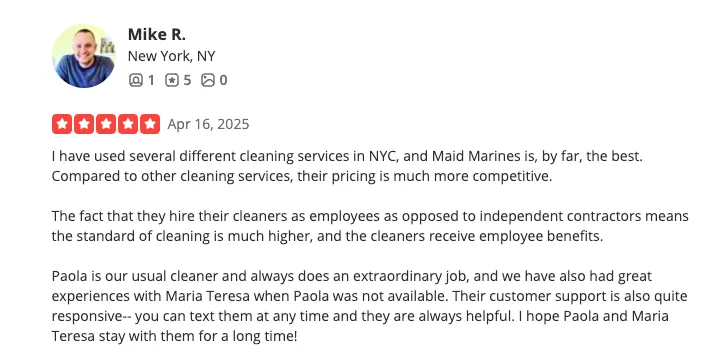
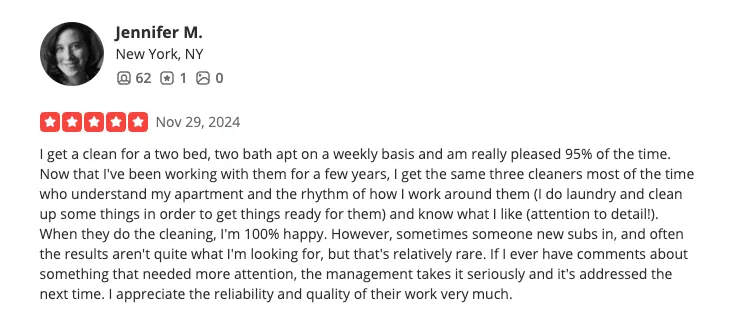
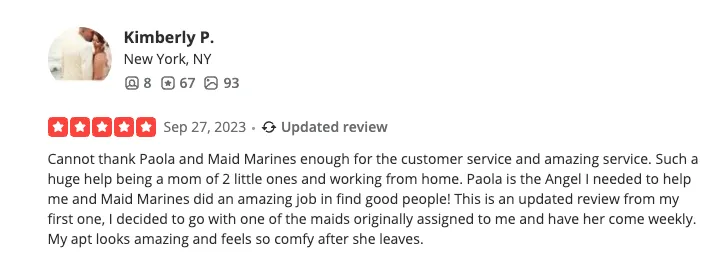
Our cleaners are W-2 employees, not gig workers. They are vetted, insured, and they arrive with everything they need. We have cleaned over 100,000 homes in New York City and we understand the difference between the buildings in this neighborhood. Prewar walkups, new luxury towers, co-ops in the residential sections, two-family homes near Bowne Park. The products and approach change depending on what we are walking into.
We handle move-in and move-out cleaning for Flushing’s active condo and rental market, deep cleaning for kitchens and bathrooms that need a proper reset, and recurring apartment cleaning on whatever schedule fits your life. We also serve nearby Astoria, Long Island City, and Forest Hills.