
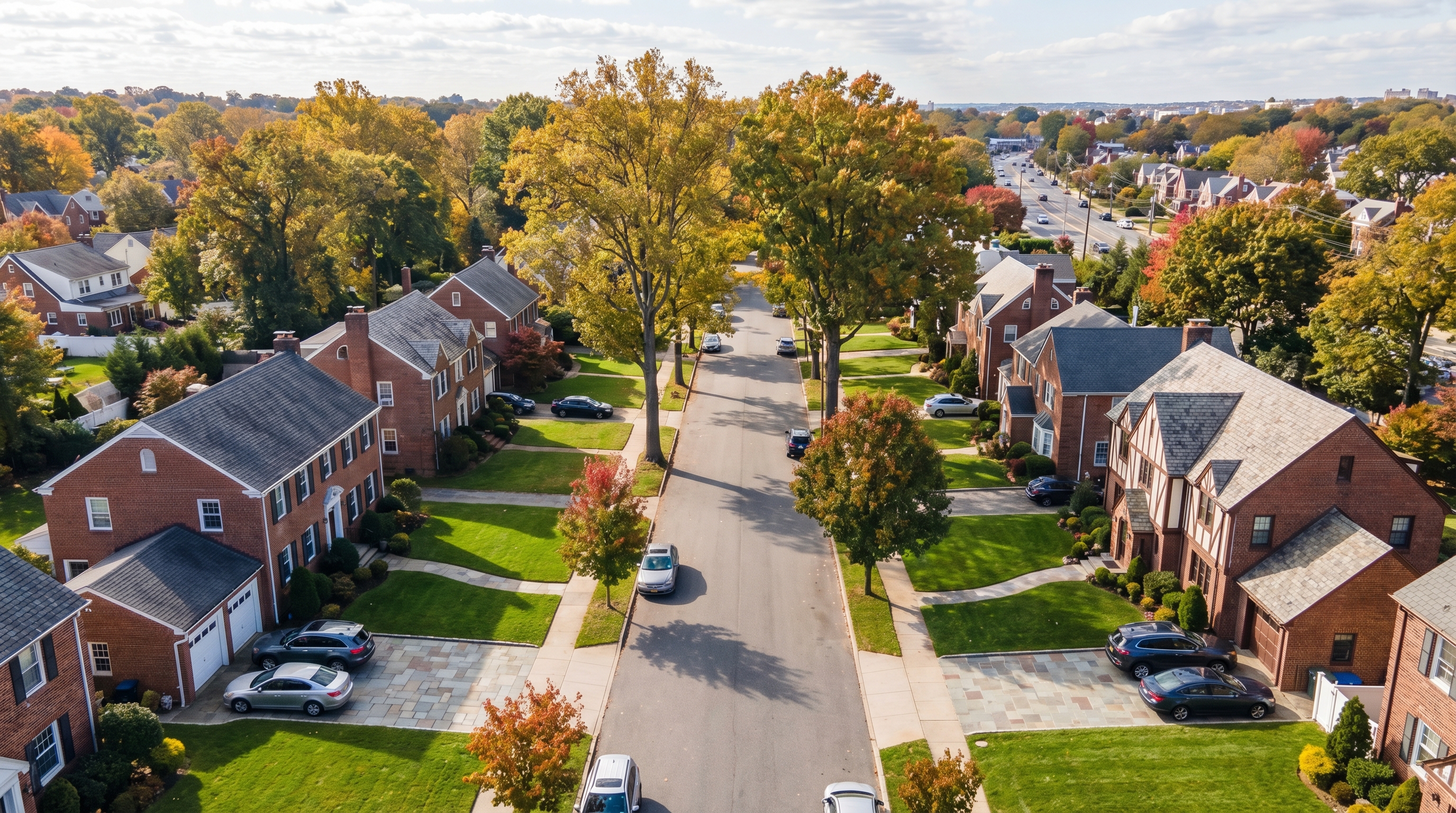
Little Neck’s housing stock is a century-old inventory of well-built single-family homes on generous lots, and the cleaning job reflects that. These are Colonial Revival and Tudor Revival brick houses with finished basements, multiple floors, original hardwood, and driveways that deposit grit at the front door every time someone walks in. Over 100,000 homes across New York City have been cleaned by Maid Marines, and the single-family home in northeastern Queens is its own distinct category, different from a Manhattan co-op, different from a Brooklyn brownstone, different in ways that matter when someone is cleaning it.
The homes on these blocks were built for a specific kind of domestic life
The LIRR station at Little Neck opened in the mid-19th century and did to this neighborhood what it did to every stop along the Port Washington Branch: turned farmland into a commuter suburb, and turned a commuter suburb into one of the most consistently desirable addresses in northeastern Queens. The developer who built the blocks off Little Neck Parkway and Commonwealth Boulevard in the early 20th century was selling a particular vision. Two-story brick house on a 50 to 60 foot lot. Driveway on the side. Formal front facade with symmetrical windows. Generous rooms with 9-foot ceilings. A basement for mechanicals and storage. A backyard for the family. That vision, executed in Colonial Revival, Tudor Revival, and Craftsman styles across hundreds of blocks, is still standing. And it still requires the kind of cleaning that corresponds to the way it was built.
These are multi-floor homes. Dust moves down staircases and accumulates on parlor floors. The basement finishes a lot of jobs that started upstairs with the radiators, the dogs, the kids. The entry area from the driveway, whether front door or back, is the primary dirt vector in every Little Neck house we have ever cleaned. Anyone who has lived in one of these homes knows the routine: shoes at the door, mat inside, a dedicated entry where the grit stops before it reaches the wood. Our house cleaning teams work the same way. Entry areas first, every visit, before anything else moves through the house.
Wok kitchens and Korean cooking require a different approach to the range and backsplash
About half of Little Neck’s residents are Korean American or Chinese American, and that fact is directly relevant to how we clean kitchens in this neighborhood. Korean cooking, particularly at home, involves regular wok work, stovetop braising, and the kind of frying that builds grease film on surfaces that American cooking does not reach. The range hood collects it. The backsplash collects it. The upper cabinet faces that sit above the stove collect it in a fine film that turns brownish yellow over months of daily cooking. Standard all-purpose cleaner does not cut it.
We bring commercial-grade degreasers to kitchens in Little Neck as a baseline. Not because we assume anything about a client, but because this neighborhood has a cooking culture that generates that load, and arriving unprepared wastes everyone’s time. The first visit into a kitchen that has been the site of daily Korean cooking for a year takes longer than the recurring visits that follow. We establish a clean baseline, and then the ongoing visits stay manageable. If you keep a shoes-off household, and many Little Neck families do, the floors matter even more than usual, and we treat them accordingly.

Deep cleaning for homes that run three floors and a basement
A Little Neck Colonial or Tudor with two floors and a finished basement is a substantial cleaning job when done correctly. The crown molding in the formal rooms on the main floor collects dust that falls down onto surfaces below if you clean out of order. The staircase between floors is its own micro-environment, with spindles and risers and treads that trap debris in every crevice. The basement, finished or not, tends to be where the radiator overflow ends up and where pet hair accumulates along baseboards because the air circulation down there is different from upstairs. The bathroom tiles in basements are often older than the ones upstairs and need different chemical handling.
A proper deep cleaning in one of these homes starts at the top and works systematically down. Crown molding before the floors on each level. Inside the radiator fins, not just across the top. The window wells in the basement that no one remembers until they look at them. The grout in the original bathroom tile that has absorbed a decade of soap film. We have cleaned enough single-family homes in northeastern Queens to know what the standard walk-through misses and what the detailed version catches. If you are doing a pre-season deep clean, a pre-sale clean, or recovering from a renovation, let us know the context and we approach it accordingly.
Moving in or out of a Little Neck home
The co-op resale market in Little Neck is smaller than in most Queens neighborhoods, but the single-family home turnover is real. When a family buys a Colonial on Little Neck Parkway that has not been professionally cleaned in years, or at all between ownership, the move-in cleaning is a full-day project. Inside kitchen cabinets that held someone else’s groceries. The bathroom tile grout that absorbed the previous owner’s shower routine. The basement corners and window ledges that no one touched during the walkthrough. We do a complete top-to-bottom pass on every room, including the basement, before you put your furniture in.
Move-out cleans for renters in Little Neck’s two-family homes are a different job. The unit needs to pass a landlord inspection, which means baseboards, inside the refrigerator, bathroom fixtures, and floors all need to reach a standard that a casual tidying does not achieve. We know what landlords in this neighborhood look for and we clean to that standard.
Your cleaning takes about three hours so here is how to spend them at the edge of the city
Little Neck sits at one of the most distinctive geographic positions in all of New York City. The Nassau County line runs along the neighborhood’s eastern edge, and you can walk from a Queens residential block into the Village of Great Neck in a matter of minutes, crossing a jurisdictional boundary that changes the property tax structure, the school district, and the municipal services without changing the character of the streets. This is genuinely unusual. Most New Yorkers live nowhere near the city’s boundary. Little Neck residents walk it daily.
Udalls Cove Park Preserve, on the northern edge of the neighborhood at Little Neck Bay, is the other geographic distinction. This is one of the last functioning tidal marsh ecosystems within New York City, a place where herons stand in tidal channels and horseshoe crabs emerge from the bay every May to spawn on the flats, as they have been doing for hundreds of millions of years. You can walk the preserve trail in under an hour. The entire experience costs nothing and requires nothing except an hour of slow walking and attention to the marsh.

For food during your cleaning window, Northern Boulevard’s Korean commercial corridor is one of the finest stretches of Korean dining in the New York metropolitan area. The Korean barbecue restaurants here serve LA galbi and bulgogi over live charcoal with the full banchan spread. Walk in on a weekday and there is usually no wait. The Korean bakeries on the same strip, with their display cases of red bean pastry and honey bread, are worth stopping into for coffee and something sweet. If you want to go further, Great Neck village across the Nassau line has a restaurant row on Middle Neck Road that puts dinner options within a ten-minute drive of home.
You pick your date and time on our booking page. You see your flat-rate price before you commit. For a two-floor Colonial or Tudor with a basement, the price reflects the full home. Our cleaners are W-2 employees, not gig workers. They are vetted, insured, and they arrive with the right supplies for the surfaces in a home this age and this type.
We also serve nearby Forest Hills, Hollis, Astoria, and the rest of Queens.