

Brookville is one of New York City’s quietest neighborhoods and one of its least-discussed. It sits at the southeastern edge of Queens, where the borough presses up against Nassau County along Hook Creek, a tidal creek that has marked the boundary between city and suburb for centuries. The streets here are residential in the true sense. Detached Cape Cods, ranch homes, and split-levels on wide lots with driveways. Lawn mowers on Saturday mornings. Families who have owned their homes for decades. A neighborhood where the person next door might have grown up in the house they are still living in. That kind of stability is uncommon in New York, and it shapes everything about what it means to live and keep a home in Brookville.
From Lenape fishing grounds and Dutch farmland to a neighborhood built on homeownership
The land that became Brookville was flat, marshy, and productive long before any city planners drew lines through it. The Lenape people used Hook Creek and the adjacent wetlands as seasonal fishing and hunting grounds for generations. The shallow tidal creek and the Jamaica Bay ecosystem it feeds into supported an abundance of fish, shellfish, and migratory birds that made southeastern Queens one of the more resource-rich coastal zones in the region.
Dutch and English farmers arrived in the 17th century and found the same flat, drained farmland that had sustained the Lenape. For the next two centuries, southeastern Queens was agricultural territory. Truck farms growing vegetables for New York City markets dotted the landscape from Rosedale through Springfield Gardens and along the corridors that are now Rockaway Boulevard and Farmers Boulevard. The terrain was too low and too marshy for the dense row-house development that was pushing east through Brooklyn, which meant Brookville stayed agricultural long after neighboring parts of the borough had urbanized.
The neighborhood’s name reflects this agricultural past. Brookville follows the naming convention common in 19th and early 20th century American residential development: a natural feature combined with the suffix “-ville,” meaning town or settlement. The natural feature in question is almost certainly Hook Creek, which still runs along Brookville’s eastern edge and still marks the city line. Whether there was a specific, smaller brook that inspired the name is not documented, but the water was always the defining feature of this corner of Queens. Across that creek is Nassau County, and standing on Brookville’s eastern streets you are as close to suburbia as you can get without leaving New York City.
The neighborhood’s modern form took shape in the post-World War II era, when African American families who had been systematically excluded from much of outer-borough and suburban homeownership found a foothold in southeastern Queens. Neighborhoods like Laurelton, Springfield Gardens, Cambria Heights, and Brookville became destinations for Black middle-class families who wanted exactly what the white postwar suburbs were offering their populations: homeownership, space, safety, and proximity to city employment. The families who arrived in the 1950s and 1960s were postal workers, teachers, transit employees, nurses, and public school administrators. They bought Cape Cods and split-levels, paid off their mortgages, and stayed. Their children grew up and in many cases bought nearby, creating the multi-generational community that defines Brookville today.
This is one of the most significant stories of Black wealth accumulation through property ownership in New York City history, and it happened block by block, family by family, across the southeastern Queens corridor that runs from St. Albans through Brookville to Rosedale. The homes here are not incidental to that story. They are the mechanism through which it happened.
Cape Cods, ranches, and the specific cleaning challenges of post-war Queens housing
Brookville’s housing stock is almost entirely post-war single-family homes. No pre-war walk-up apartments, no gallery-district lofts, no converted industrial buildings. What you have instead are Cape Cods, ranch-style homes, split-levels, and two-story Colonial Revivals, built mostly between the 1940s and 1970s, on individual lots with driveways and yards. This is a part of New York City that functions like a suburb in most of the ways that matter for daily life.
The Cape Cods that make up a large portion of the neighborhood are one-and-a-half-story homes with steep rooflines, dormers, and a predictable layout: living room and kitchen on the main floor, two or three bedrooms either downstairs or upstairs in the dormered space, and frequently a finished basement below. These homes were built to be practical and durable. Original hardwood floors on the main level, carpet in the bedrooms, tile in the bathrooms. Many have seen modest additions over the decades, a rear family room extension, an expanded kitchen, a finished garage conversion.
The ranch homes are single story with wider footprints, common on the lots closest to Hook Creek where the terrain was flatter and the drainage more variable. Ranches in southeastern Queens often have finished basements that effectively double the home’s usable square footage, and those basements see real family use: recreation rooms, home offices, spare bedrooms, laundry. The basement in a Brookville ranch is not storage overflow. It is living space that needs the same attention as the floors above.
Split-levels and Colonial Revivals round out the stock. The split-levels have that distinctive staggered floor plan, with a kitchen and living area on one level, bedrooms a half-flight up, and a family room or garage a half-flight down. Each transition between levels carries its own finish: different flooring, different ceiling heights, different surface conditions. A recurring house cleaning for a split-level needs to account for the way the home actually moves rather than treating every surface as equivalent.
The two-family homes, less common here than in denser Queens neighborhoods but present on the blocks closer to Rockaway Boulevard, tend to have a ground-floor unit and an upper unit with separate entrances. Owner-occupied two-families in Brookville typically have the owner on one floor and a tenant on the other. We clean individual units all the time.
The southeastern Queens corridor and what it means to maintain a home here
Brookville is part of a continuous belt of Black middle-class homeownership that runs across southeastern Queens from St. Albans and Hollis through Cambria Heights, Laurelton, Springfield Gardens, and Rosedale. This corridor has been one of the most stable residential communities in the city for the past 60 years, and the physical evidence of that stability is visible in the condition of the housing stock itself.
Homes in Brookville are well-maintained. This is a neighborhood of owner-occupants with equity to protect and standards to uphold. The houses are not museum pieces, they are lived-in homes, but they are homes where the owner cares about the condition of the floors, the grout in the bathrooms, the kitchen tile, the carpet in the bedrooms. There is a civic pressure to maintain your property that comes with living in a community where everyone else is doing the same. The homes are old enough to require real upkeep. A Cape Cod built in 1955 has original hardwood that needs to be treated carefully, not flooded with a wet mop. It has original bathroom tile that can be cracked by the wrong scrubbing pad. It may have original cast-iron fixtures in the bathroom that will pit if you use harsh chemicals.
The finished basements that most of these homes have add a cleaning dimension that walkup apartments never present. Basements in southeastern Queens homes accumulate dust, humidity, and the particular kind of grime that comes from being the room where everyone takes off their shoes and drops everything from the car. If the basement has carpet, it holds allergens that the floors above do not. If it has vinyl tile over a concrete slab, moisture migrates through in wet months and leaves a residue. We know southeastern Queens basements and we clean them as part of the house, not as an afterthought.
The yards and driveways that come with Brookville homes bring in dirt that urban apartments never deal with. A rear yard that sees regular use tracks grass clippings and soil through the back door. A driveway that ends at a side entrance means the kitchen or utility room near that door sees more foot traffic than any other room. We clean the high-traffic entry zones first and pay attention to where the outside comes in.
Hook Creek, Jamaica Bay, and the ecological edges that define the neighborhood
Brookville exists at an ecological transition point that most New Yorkers never think about. The city ends here at Hook Creek, a tidal waterway that has been the Queens-Nassau County border for centuries. Across the creek is Valley Stream, Long Island. On this side is New York City, though the houses, the streets, and the pace of life look nearly identical on both sides of the water.
Hook Creek feeds into Jamaica Bay, the largest body of water in the national park system that most Americans have never heard of. Gateway National Recreation Area wraps around Jamaica Bay from the Rockaway Peninsula through Broad Channel to the Floyd Bennett Field complex in Brooklyn, and the ecological richness of that system extends into the wetland edges of Brookville’s eastern boundary. Migratory birds pass through in spring and fall in numbers that would surprise anyone who knows this only as urban Queens. Shorebirds and warblers use the tidal creek margins. Great blue herons stand in the shallows throughout the year.
This ecological proximity has a practical effect on the neighborhood. The low-lying terrain near Hook Creek sits in a flood zone. After major storms, some of the streets closest to the creek have flooded. This is a known and growing concern as the frequency and intensity of coastal flooding events increases. Homeowners in the eastern blocks of the neighborhood are aware of it, and some have taken measures ranging from upgraded basement waterproofing to elevated mechanical systems. For cleaning purposes, this means basements in the eastern sections of the neighborhood are more likely to have experienced moisture intrusion and need more attention to corners, baseboards, and any carpet near the foundation.
The wetland character of the neighborhood’s edges also means that natural debris moves through the area differently than in fully urbanized neighborhoods. Leaves, mud, and pollen track into homes more aggressively in certain seasons. A deep cleaning in spring, after the mud season has run its course and the pollen has peaked, resets the surfaces in a way that monthly maintenance cannot fully accomplish.
The LIRR, Belt Parkway, and a neighborhood that moves by car
Brookville is honestly car-dependent, and there is no point pretending otherwise. The nearest subway is the A train at Springfield Boulevard, which requires a bus connection. The Q84 runs along Rockaway Boulevard, and the Q85 and Q113 cover other corridors, but bus travel in southeastern Queens moves slowly. Most adults in Brookville drive.
What the neighborhood has instead of subway access is the Long Island Rail Road. Laurelton Station on the Far Rockaway branch sits within a 10 to 15 minute walk or a short drive from most Brookville addresses and runs trains to Penn Station in roughly 35 to 40 minutes. For residents who commute to Manhattan on a regular schedule, the LIRR is the practical answer. It is faster than any subway connection from this part of Queens and runs with enough frequency during commute hours to be usable.
The Belt Parkway connects Brookville to the rest of southeastern Queens, Brooklyn, and the highways heading toward Manhattan or out to Long Island. Green Acres Mall in Valley Stream is about 15 minutes east. Jamaica’s commercial corridor is 15 to 20 minutes north. The airport is close enough that flight paths are a regular part of the neighborhood’s ambient noise.
This car-dependent reality shapes how cleaning services work in Brookville. Our teams drive to this part of Queens. There is no walk-up from the subway. We park in the driveway, bring everything we need from the car, and work through the house in a single uninterrupted session. The self-contained nature of detached homes in this neighborhood actually makes the logistics cleaner than the co-op management offices and service elevator protocols we navigate in other parts of the city.
What booking looks like in Brookville
You pick your date and time on our booking page. You see your flat-rate price, based on bedrooms and bathrooms, before you commit to anything. Most Brookville clients give us a key or a garage code at the first booking and we handle access the same way every visit after that.
If you have a two-family home and want us on one floor only, that is straightforward. If you have a finished basement that needs to be on the rotation, you add it when you book. If you are moving into or out of a home in the neighborhood, move-in and move-out cleaning is something we handle frequently in southeastern Queens, where the homes are large enough that a full turnover clean takes the better part of a day.
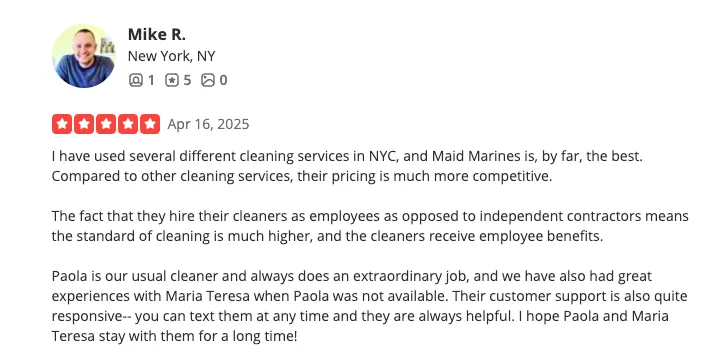
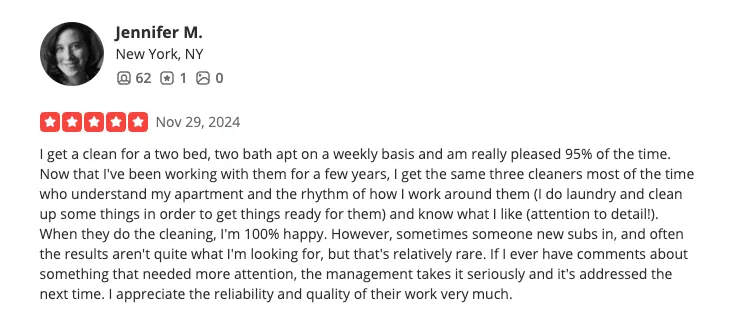
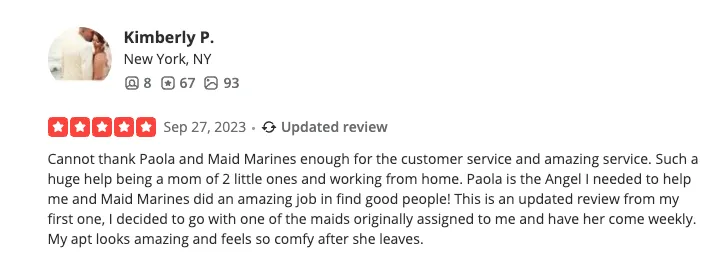
Our cleaners are W-2 employees, not gig workers. They are vetted, insured, and they show up with everything they need. We also serve nearby Springfield Gardens, Laurelton, Rosedale, and St. Albans.