
Elmhurst is the neighborhood that proves the phrase “most diverse place on Earth” is not hyperbole. Sociologist Roger Sanjek spent fourteen years doing fieldwork here and titled the resulting book “The Future of Us All,” which was not a modest claim. In 2.1 square miles of attached brick row houses, mid-rise walkups, and dense commercial strips, residents speak over 150 languages. The elementary school district tests students in more than 100 of them. No city planner designed this. It accumulated through six decades of individual decisions by people arriving from Guangzhou, Dhaka, Quito, Bangkok, Seoul, Bogota, and another hundred places, each one looking for affordable rent and a grocery store that stocked the produce they grew up with. The result is a neighborhood that functions differently from any other in New York, and that requires a different kind of attention to maintain.
What Cord Meyer’s apple orchards became
The land that makes up Elmhurst was apple country before it was anything else. In the 1700s, the rolling terrain of the Town of Newtown supported some of the most productive orchards in the American colonies. The variety they grew here, the Newtown Pippin, became America’s first internationally exported apple. Benjamin Franklin introduced them at the Court of St. James. Thomas Jefferson grew them at Monticello. Queen Victoria reportedly had a tariff on American produce lifted specifically to keep receiving them. The orchards that supplied the English court sat where Elmhurst Avenue and 82nd Street run today.
The name “Elmhurst” itself arrived in 1896, coined by real estate developer Cord Meyer, whose Cord Meyer Development Company controlled thousands of acres across central Queens and would go on to create Forest Hills and Kew Gardens from the same blueprint. Meyer needed a name that would sell to respectable middle-class buyers preparing to move into a neighborhood the elevated subway was just beginning to reach. He planted elm trees along the newly laid-out avenues and combined “elm” with the Old English “hurst,” meaning a wooded hill or copse. It was pure marketing copy dressed as a place name. The actual elm trees he planted are almost entirely gone. The name stayed.
The Town of Newtown, which Elmhurst sits at the center of, was one of the original five towns of Queens County when the English established county governance in 1683. Before that, in 1642, English settlers under Dutch colonial administration established a community called Maspat on the land, later relocated after conflicts with the Matinecock people to a site that became Middelburgh, then Newtown. The Matinecock, a sub-group of the Lenape, had hunted, fished, and farmed these gentle hills and freshwater streams for centuries before European contact. The transition from Indigenous land to colonial farmland to apple orchard to streetcar suburb to the most linguistically dense neighborhood on Earth happened in stages over roughly 380 years.
The subway arrived in 1917. Row houses and two-family brick homes spread across the neighborhood through the 1920s and 1930s. The early residents were predominantly Italian, German, and Jewish, working-class homeowners who built lives in the same modest brick attached houses that still form the residential backbone of the neighborhood today. By the 1940s, Elmhurst was a solidly middle-class Queens neighborhood that looked a great deal like the surrounding borough.
Then everything changed.

The transformation that made Elmhurst a laboratory for the whole country
Beginning in the 1960s and accelerating through the 1970s and 1980s, Elmhurst underwent one of the most complete demographic transformations of any American neighborhood in the 20th century. White families left for Long Island and New Jersey in large numbers. In their place came successive waves of immigration that layered one community on top of another without erasing the previous one. Chinese, Korean, Colombian, Bangladeshi, Filipino, Ecuadorian, Thai, Pakistani, and dozens of other communities arrived in waves and set down roots in the same row houses and walkup apartments.
By the 1990s, the transformation was complete enough that journalists and academics were writing about Elmhurst as a case study in something that had not existed before. Not a neighborhood that was diverse in the sense of having two or three identifiable communities, but one where the categories themselves had started to dissolve into something harder to name. Children from families that had generations of conflict in their home countries sat in the same classrooms. Korean grocers supplied produce to Colombian households. Bangladeshi landlords rented to Thai tenants. This was not the melting pot of older American mythology, which implied assimilation into a single culture. It was something else. Parallel, layered, occasionally friction-filled, and genuinely unprecedented.
The Broadway corridor is where this plays out most visibly. Walk two blocks and you pass Cantonese bakeries, Ecuadorian ceviche restaurants, Bangladeshi sweet shops, Colombian rotisserie chicken joints, Thai grocery stores with rambutan and lychee in crates on the sidewalk, and Halal butchers with hand-lettered signs in multiple scripts. The food is cheap and the quality is high because the customers are not tourists. They are people who grew up eating this food and know immediately when something is wrong with it. That kind of cultural accountability produces an authenticity you cannot manufacture.
Anthony Bourdain visited Elmhurst multiple times and wrote about it. Serious food writers make the R train trip from Manhattan regularly. There is no other street in New York where you can eat your way through fifteen countries in a single afternoon for under thirty dollars.
The 1920s brick row house and what it actually requires
Elmhurst’s residential backbone is the two-family attached brick row house built in the 1920s and 1930s. These are not glamorous buildings. They were built quickly and affordably for working-class families who needed functional homes near the subway. Two or three stories, brick front, a small front garden with an iron fence, a ground-floor attached garage on many blocks, and a layout designed for exactly one thing: two families, one above the other, sharing a wall with the neighbor.
What makes these homes demanding to maintain is their age and their particular construction vocabulary. The original hardwood floors in the upper units have widened their plank gaps over a century of seasonal humidity changes. Water pushed into those gaps with a standard wet mop does not evaporate quickly in units with limited air circulation. It works into the subfloor and weakens it. The bathroom hex tile floors in the pre-war units have grout lines that narrow cleaning products can permanently stain if the product is wrong for the surface. The cast-iron radiators on every floor have fins that run parallel to the wall and collect dust through the summer, then burn it off in October when the steam heat comes on, filling the apartment with a smell that takes several heating cycles to resolve. We dust the radiator covers and the vent grilles above them on every visit, which keeps the loose summer layer from settling any deeper. Most cleaning services walk past the radiator entirely.
The kitchens are where Elmhurst homes diverge most sharply from other parts of Queens. This is a neighborhood where people cook every day, cook seriously, and cook with oil. Bangladeshi, Chinese, Colombian, Thai, and Filipino cuisines all involve frying, wok cooking, or deep frying at temperatures that aerosolize oil into the kitchen air. That oil settles on every surface. Over weeks it builds into a film on the backsplash tile, inside the range hood filter, on the cabinet faces above the stove. A surface wipe will not touch it. The first visit in a kitchen with months of accumulated buildup needs to be a deep clean that strips everything back to the original surface with degreasers that do not leave residue on the tile or cabinet finish. Once that reset is done, recurring visits keep it from returning.
Many two-family homes in Elmhurst are owner-occupied on the ground floor with the upper unit rented. This means our teams regularly navigate the particular dynamics of buildings where the landlord lives twenty feet below the apartment being cleaned. We are quiet, professional, and do not create incidents in shared buildings. We have been working in Elmhurst long enough to know what that requires.
Elmhurst Hospital and the six weeks that changed how the country thought about Queens
On March 25, 2020, a video taken inside Elmhurst Hospital Center went viral and became one of the defining images of the COVID-19 pandemic. The footage showed patients on gurneys in hallways, overwhelmed staff in improvised protective equipment, and refrigerator trucks parked outside the hospital to serve as temporary morgues. The hospital at 79-01 Broadway, the public facility serving all of central and western Queens, had been receiving patients for weeks before the broader city understood what was coming. Elmhurst’s density, its large immigrant and uninsured population, its multigenerational households, and its dependence on in-person service economy work made it one of the neighborhoods most exposed to early transmission.
The footage from Elmhurst Hospital became the single image that convinced millions of Americans that what was happening was genuinely catastrophic. Elected officials referenced it. The president referenced it. International news organizations broadcast it. The neighborhood that the rest of the city had mostly ignored for decades was suddenly at the center of the national conversation about public health, inequality, and what the American healthcare system actually delivered to its working-class immigrant communities.
The losses were real and severe. Elmhurst lost people at rates disproportionate to wealthier neighborhoods. The mutual aid networks that formed in response to those losses became permanent civic infrastructure. PPE distribution, food banks, translation services for uninsured immigrants navigating the healthcare system. None of that dissolved when the pandemic receded. The community that Elmhurst had spent sixty years building turned out to be more durable than anyone had planned for.
The hospital itself is a 1950s and 1970s municipal complex that has served as the de facto public health safety net for central Queens for decades. It handles volumes and case complexity that reflect the full weight of the neighborhood’s poverty rate and uninsured population. What happened there in March 2020 was not a failure of the hospital. It was the hospital doing exactly what it was built to do, at a scale no one had planned for.

Over 150 languages in 2.1 square miles
The number gets cited so often that it starts to sound like a PR claim, but the documentation behind it is real. The Elmhurst school district has tested students in over 100 distinct languages. The 1998 census data that Sanjek analyzed in “The Future of Us All” counted more than 100 nationalities in the neighborhood. Linguists and sociologists have returned repeatedly to study a level of density and diversity that has no clear equivalent anywhere on Earth.
What this means on the ground is a commercial landscape unlike anything else in the five boroughs. Broadway between Queens Boulevard and Elmhurst Avenue is not a food strip in the conventional sense. It is a document. Every storefront is evidence of a specific migration history and a specific community large enough to support a business aimed at its own cultural needs. The Bangladeshi sweets shops exist because there is a Bangladeshi community on 74th Street large enough to sustain them. The Ecuadorian restaurants exist because the Ecuadorian community in Elmhurst is one of the largest in New York City. The Thai grocery stores with fresh produce flown in from Southeast Asia exist because the Thai community here is large enough to demand it.
The 74th Street corridor between Roosevelt Avenue and 37th Avenue is one of the densest concentrations of South Asian commercial life in the United States. Sari shops, spice importers, Halal butchers, jewelers, and money transfer operations serving Bangladesh, Pakistan, and India operate within three blocks of each other. The Bangladeshi community here is one of the largest outside of Bangladesh itself.
The Himalayan Yak on Roosevelt Avenue was one of the first Tibetan restaurants in New York City. It opened in the 1990s when the Tibetan and Nepali communities were establishing their first footholds in the city, and it introduced momo dumplings and Tibetan noodle soups to a generation of New Yorkers who had never encountered Himalayan cooking. It is still running and still drawing serious eaters who track down specific regional dishes not available anywhere else in the borough.
This density of first-generation immigrants cooking authentic food for demanding co-ethnic customers has created a neighborhood where eating well is not expensive. The economics of cheap rent plus immigrant entrepreneurship plus an audience that knows what authentic tastes like produces food quality that restaurant critics from Manhattan spend subway tokens to find.
The Queens Center Mall handles more foot traffic per square foot than almost any retail center in the country
The Queens Center Mall at 90-15 Queens Boulevard is not a footnote in Elmhurst’s commercial life. It is a major anchor. The mall sits at the intersection of Woodhaven Boulevard and Queens Boulevard, one of the busiest surface intersections in the borough, and handles a foot traffic volume that reflects the extraordinary population density of the surrounding neighborhood. The figure cited by retail analysts is among the highest per-square-foot of any mall in the United States.
Queens Boulevard itself, the 12-lane arterial that defines Elmhurst’s northern edge, earned the nickname “Boulevard of Death” over decades of pedestrian fatalities. The street was designed for cars, not for the density of pedestrian life that the neighborhood generates. Infrastructure improvements and enforcement changes over the past decade have reduced the fatality rate substantially, but crossing Queens Boulevard on foot still demands attention. The median and protected crossing phases represent a genuine safety improvement over the older design, and the transit lanes serve the commuter flow that defines the northern boundary of the neighborhood’s daily life.
The row house and the walkup clean differently
The mid-rise elevator buildings along Queens Boulevard, built in the 1940s through the 1970s, serve a different population than the two-family row houses on the interior blocks. These are rental buildings, usually 40 to 80 units, with management offices and service elevator schedules. The finishes inside tend toward resilient materials: vinyl tile, ceramic bathroom surfaces, painted plaster walls that repaint rather than restore. They are easier to maintain than the pre-war row houses but require different coordination around building rules and elevator access.
The pre-war walkup apartments on the interior blocks are the most challenging cleaning environment in the neighborhood. Three to five stories, no elevator, narrow hallways barely wide enough for a vacuum with a hose attachment, original surfaces that react badly to the wrong product. We carry our supplies in bags designed for walkup buildings. Our teams work in Elmhurst walkups regularly and know the building type from the entry vestibule. They do not need an hour to figure out that the third-floor bathroom has 1920s penny tile that requires a pH-neutral grout cleaner, not an acid-based product.
Move-in and move-out cleans are a significant part of our Elmhurst work because the neighborhood’s rental market is active. Two-family home owners turn over units frequently. Tenants who have been in a walkup for two years leave behind the accumulated evidence of dense cooking, heavy foot traffic, and the specific grime patterns that develop in apartments with inadequate ventilation. A move-in move-out clean covers everything a lease requires: inside the oven, inside the refrigerator, all cabinet interiors, window sills, baseboards, bathroom grout, and any additional items the landlord or new tenant specifies.
Your cleaning takes about three hours so here is how to use them
Broadway between Queens Boulevard and Elmhurst Avenue will absorb two hours without effort. Walk the full length of the commercial strip from north to south and stop at anything that looks good. The Cantonese bakeries sell fresh pineapple buns and egg tarts in the morning. The Colombian lunch counters open early and the rotisserie chicken alone justifies the detour. Sri Ganesh Sweets on Broadway makes jalebi and barfi fresh daily. There is a Thai grocery on Roosevelt Avenue with fresh produce that you cannot find in most of the city.
If you want to sit down and eat properly, the Himalayan Yak on Roosevelt Avenue is the original Tibetan restaurant in the neighborhood and still one of the most distinctive food experiences in Queens. De Mole near the Corona border does regional Mexican cooking at a level that draws food writers from Manhattan. For something lighter, the bubble tea shops and Taiwanese dessert cafes along Broadway are consistent and affordable.
Elmhurst Park on Queens Boulevard has a running track, sports fields, and a playground, and if you are walking the perimeter you should appreciate the fact that twelve acres of green space in one of the most densely populated neighborhoods in the country is built on top of a buried underground reservoir. You are running on the roof of the city’s water supply.
The R train from Elmhurst Avenue puts you at Herald Square in about 35 minutes. The E and F trains from the Queens Boulevard stations reach Midtown in under 25. If you want to use your three hours further afield, the Queens Night Market at Flushing Meadows-Corona Park runs from April through October on Saturdays with 100 vendors representing 80-plus countries. It grew directly from the food culture of neighborhoods like Elmhurst and it is one of the best outdoor food events in New York.
What booking looks like from Elmhurst
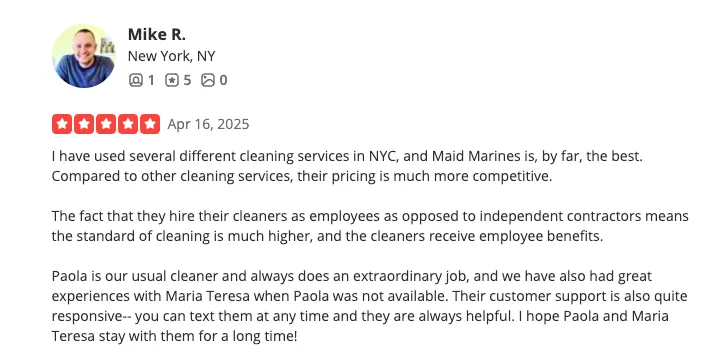
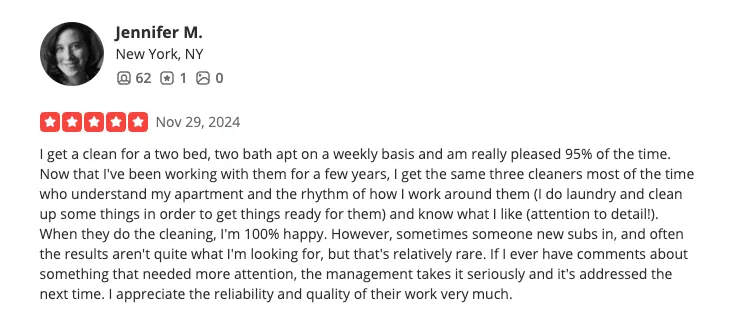
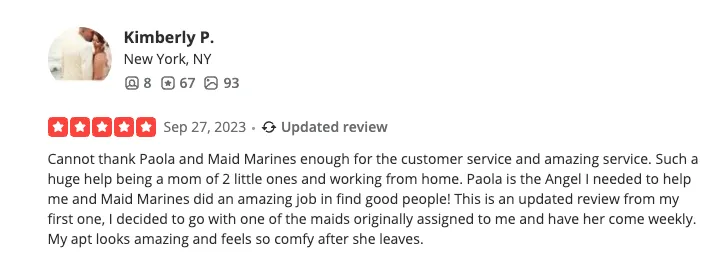
You pick your date and time on our booking page. You see your flat-rate price before you commit to anything. We serve all of 11373 and 11380, as well as the adjacent blocks toward Corona, Rego Park, and Jackson Heights. Our cleaners are W-2 employees, not contractors. They are vetted, insured, and they show up with everything they need.
If you are in a two-family home where the owner lives downstairs, tell us when you book. If your walkup has a specific entry protocol, we handle it. If your kitchen has accumulated significant grease buildup from months of cooking and you want a deep clean first, that is the right call for your first visit. If you are moving in or out and need a thorough clean that meets your landlord’s deposit requirements, we do that too.
We also serve nearby Jackson Heights, Forest Hills, and Corona. Your apartment cleaning covers everything from the radiator covers to the grout lines. You spend the time on Broadway while we handle the rest.