
The name came from a real estate promoter who wanted it to sound like a crown. Latin for crown, applied to a hamlet growing up around a Long Island Rail Road stop in the 1860s, marketed to buyers the way all suburban hamlets were marketed in that era: with classical grandeur and the suggestion of distinction. The original station had been called West Flushing. They renamed it Corona Station in 1872, and the name stuck to everything around it.
What actually grew up around that station was not particularly crown-like. It was working-class, immigrant, physically modest, and built in the material idiom of that working-class reality: two-story brick attached houses on tight lots, four-story walkup apartments above commercial strips, the occasional single-family home in the southern blocks where Italian families planted fig trees and grapevines in the yards. The neighborhood that exists today is not dramatically different from the neighborhood that existed in 1945, except that the Italian-American families who built and owned those brick houses have been largely replaced by Colombian and Ecuadorian families who have maintained and extended the same tradition of immigrant working-class homeownership. The houses look the same. The gardens are tended the same way. The rhythms of ownership and rental and family succession follow the same patterns.
This continuity is one of the most remarkable things about Corona. It is not a neighborhood that reinvents itself. It is a neighborhood that absorbs successive waves of people who are looking for the same things: stable housing, proximity to the city’s labor markets, community infrastructure, and good transit. The 7 train delivers all of that.
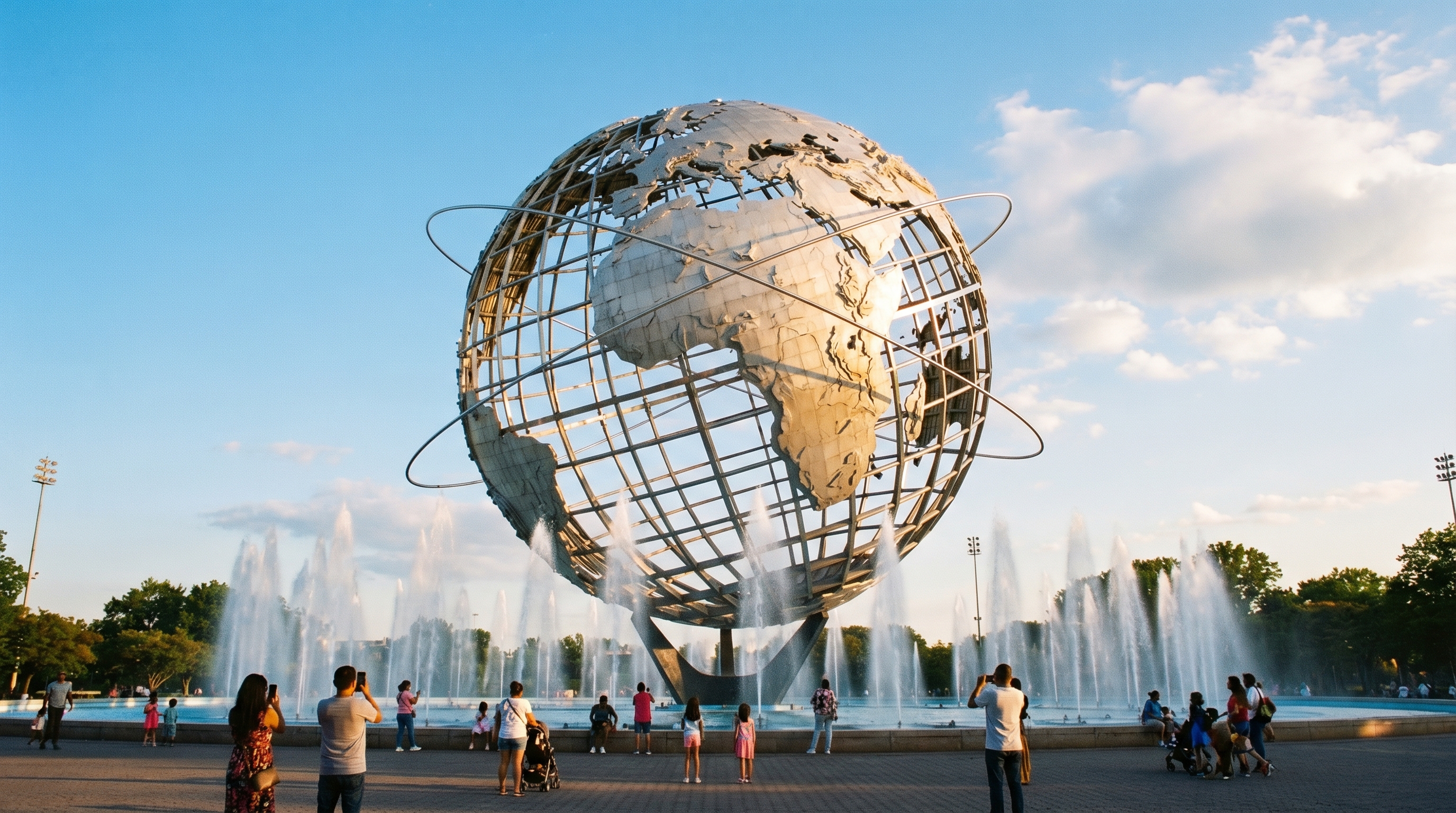
The park defines the eastern horizon and the neighborhood’s daily life
Flushing Meadows-Corona Park sits directly on Corona’s eastern edge. It is 1,255 acres, the largest park in Queens, and it begins where the residential blocks end at 108th and 111th Streets. The park is free, always open, flat enough for cycling and strolling with children, and large enough that you can walk for an hour without crossing the same path twice. On warm weekends it fills with the entire neighborhood: Colombian and Ecuadorian families with portable grills and coolers, soccer games running across the vast flat fields, couples walking the lake path, and groups of older men gathered under the plane trees.
The park’s centerpiece is the Unisphere, a 12-story stainless steel globe built for the 1964 World’s Fair as a symbol of global peace. It stands ringed by fountains and visible from miles in every direction. The same fair left behind the New York State Pavilion, Philip Johnson’s three-towered modernist pavilion whose terrazzo floor map of New York State is slowly returning to nature inside a structure that has not been fully used since 1965. The 1939 World’s Fair left behind the building that is now the Queens Museum, which contains the Panorama of the City of New York, a 9,335-square-foot scale model of every building in all five boroughs built at 1:1200 scale. These World’s Fair remnants give the park a quality of historical depth that most urban green spaces do not have.
The park accessible daily from the back door of a typical Corona rowhouse is a significant quality-of-life advantage that the neighborhood’s modest incomes and dense streetscapes would not suggest from the outside. Families with children have a thousand acres of open space at the end of the block. This fact shapes the cleaning calendar here in ways it does not in neighborhoods farther from major green space. In spring, mud comes in on shoes and jackets at a rate that surprises people who moved here from tighter urban environments. In summer, the sunscreen and picnic residue that a family brings back from a weekend in the park becomes a regular cleaning challenge on floors and upholstered furniture.
The housing stock requires care that generic cleaning ignores
The residential interior of Corona is composed primarily of attached and semi-detached two-family and three-family brick houses built between 1920 and 1955. These are durable structures. The brick is load-bearing, the construction is sound, and many of these houses have been maintained by owner-occupants for multiple generations without major structural alterations. What changes over time is the accumulation of surfaces that require specific attention.
Brick construction means radiator heat in most units, and steam radiators that have been in service since the 1940s carry years of paint buildup on their fins, collect dust in the cavities between fins that a standard vacuum attachment cannot reach, and produce the burning smell every October when the heat comes on because the accumulated dust is cooking off for the first time since the previous spring. A thorough radiator cleaning at the start of heating season is one of the most impactful single cleaning tasks in a Corona apartment and one of the least commonly performed.
The tile work in these buildings reflects the construction era. Bathrooms in houses built between 1920 and 1940 often have original hex tile floors and subway tile walls. The grout is Portland cement, which is hard and dense and does not respond well to acidic cleaners that would etch it over time. Kitchens may have original penny tile, black-and-white checkerboard floors, or later vinyl laid over original tile. Knowing which surface is beneath the mop matters. Our house cleaning teams approach each floor and bathroom as a specific surface problem rather than a uniform room to be processed.
The multi-family structure of most Corona homes adds another layer. Owner-occupied units frequently have been personalized over decades with religious imagery, family photographs, and decorative touches that indicate what matters to the occupant. We clean around these details the same way we clean around any irreplaceable object: carefully and with attention to what cannot be replaced if it breaks.
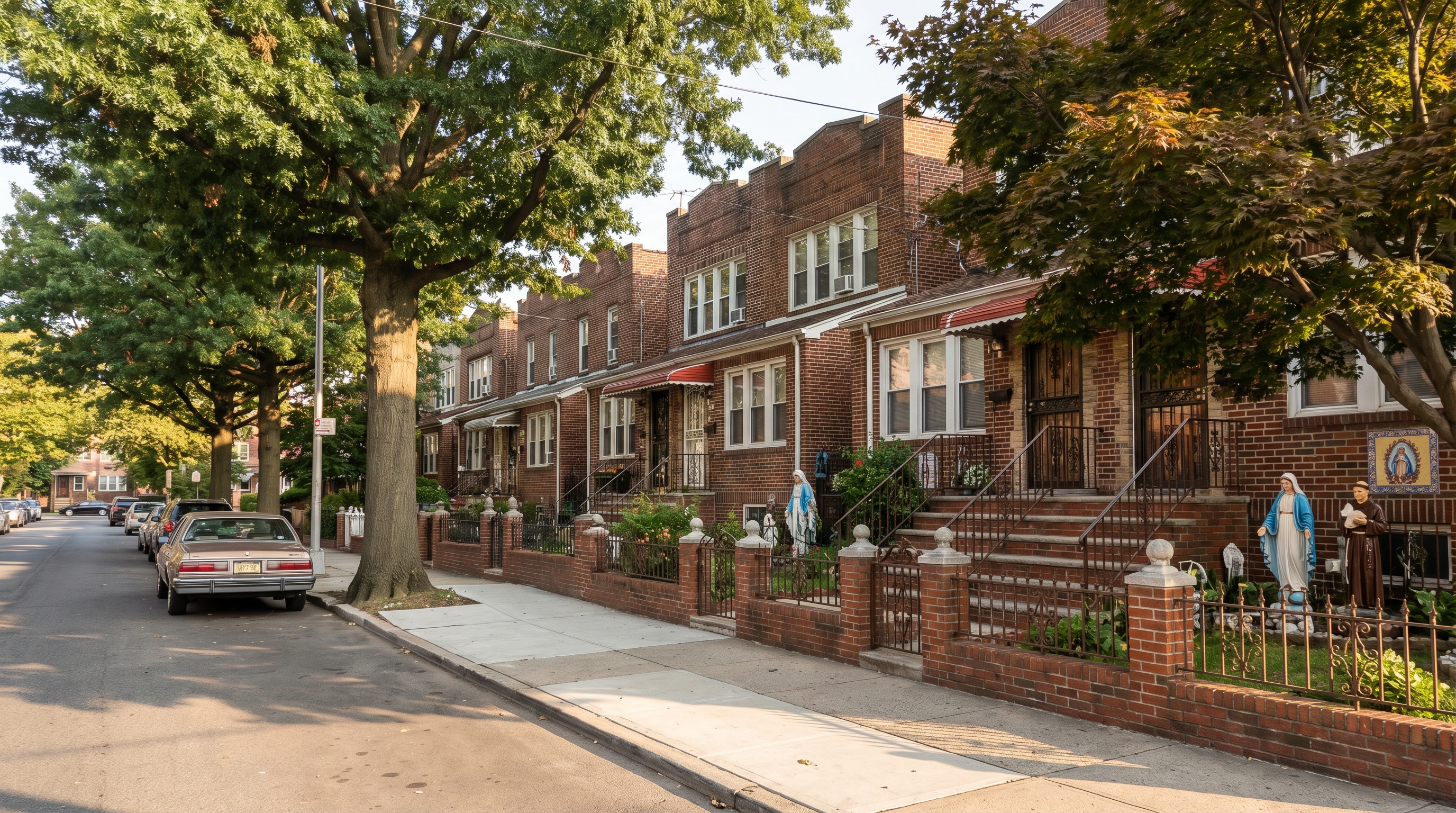
Louis Armstrong chose this neighborhood specifically, and that choice means something
Louis Armstrong was the most famous jazz musician who ever lived and one of the most famous Americans of the 20th century. He could have lived anywhere. He chose to buy a house on 107th Street in Corona in 1943 and to stay in that house for the remaining 28 years of his life. He was not hiding from fame or retreating from the world. He talked to his neighbors on the stoop. He recorded himself chatting with friends in the kitchen and with his wife Lucille in the evenings. He walked to the corner store. He was a member of the community in the most literal sense, and when he died in 1971, he asked to be buried in Queens.
The Louis Armstrong House Museum at 34-56 107th Street is now a National Historic Landmark. The interior has been preserved largely as it was when Armstrong lived there, including Lucille Armstrong’s bold mid-century design work: a gold-tiled bathroom, custom furniture, and decor that reflected the tastes of a woman who loved beauty and was not interested in restraint. The archive in the house contains 650 home-recorded tapes and 5,000 photographs. Jazz concerts are held in the garden in summer. The museum draws visitors from around the world, but it is also genuinely a neighborhood institution, on a block of similar brick houses, in a working-class Queens neighborhood, which is exactly the context Armstrong chose and would have wanted preserved.
Apartment cleaning for the walk-up buildings on the commercial corridors
The apartment buildings along Roosevelt Avenue and the major commercial streets are different in character from the interior rowhouses. They are four-to-six-story pre-war brick walk-ups with no elevator, narrow stairwells, and units that absorb the ambient intensity of life below an elevated subway line. The 7 train runs above Roosevelt Avenue, and units facing the street receive a combination of vibration, noise, and particulate from the train and from the dense street traffic below.
Window sills in these units collect more dust and grime than comparable units in quieter locations. Window AC units accumulate both fine particulate from the street and biological growth on the interior coils from summer moisture. The kitchen and living room surfaces of a street-facing apartment in a building above a commercial strip need more frequent attention than the same surfaces in a quieter interior block. Our apartment cleaning service for these buildings is calibrated to this reality. We clean every window sill and exterior AC surface, vacuum upholstered furniture with HEPA filtration to remove fine particulate, and pay particular attention to the kitchen where commercial cooking from businesses below can penetrate into residential units above.
Move-in and move-out cleaning for a neighborhood that moves frequently
Corona has a tenant turnover rate that reflects its population: working-class families who move when circumstances change, younger adults who rent for a few years before moving to a larger space or a different neighborhood, and multi-generational households that consolidate or separate as families grow. The rental market in the two-family and three-family houses turns over at a pace that makes move-in and move-out cleaning a regular request in this neighborhood.
A proper move-out clean in a Corona apartment means cleaning inside every cabinet and drawer, the full interior of the oven and refrigerator, the bathroom grout, all baseboards, window sill tracks where dust and insect matter accumulate, and the ceiling fan blades and light fixtures that are typically left for the very end of a lease and then forgotten. Landlords in this neighborhood know what their units look like when they are clean and what they look like when a cleaning service only cleaned the visible surfaces. We clean all of it.
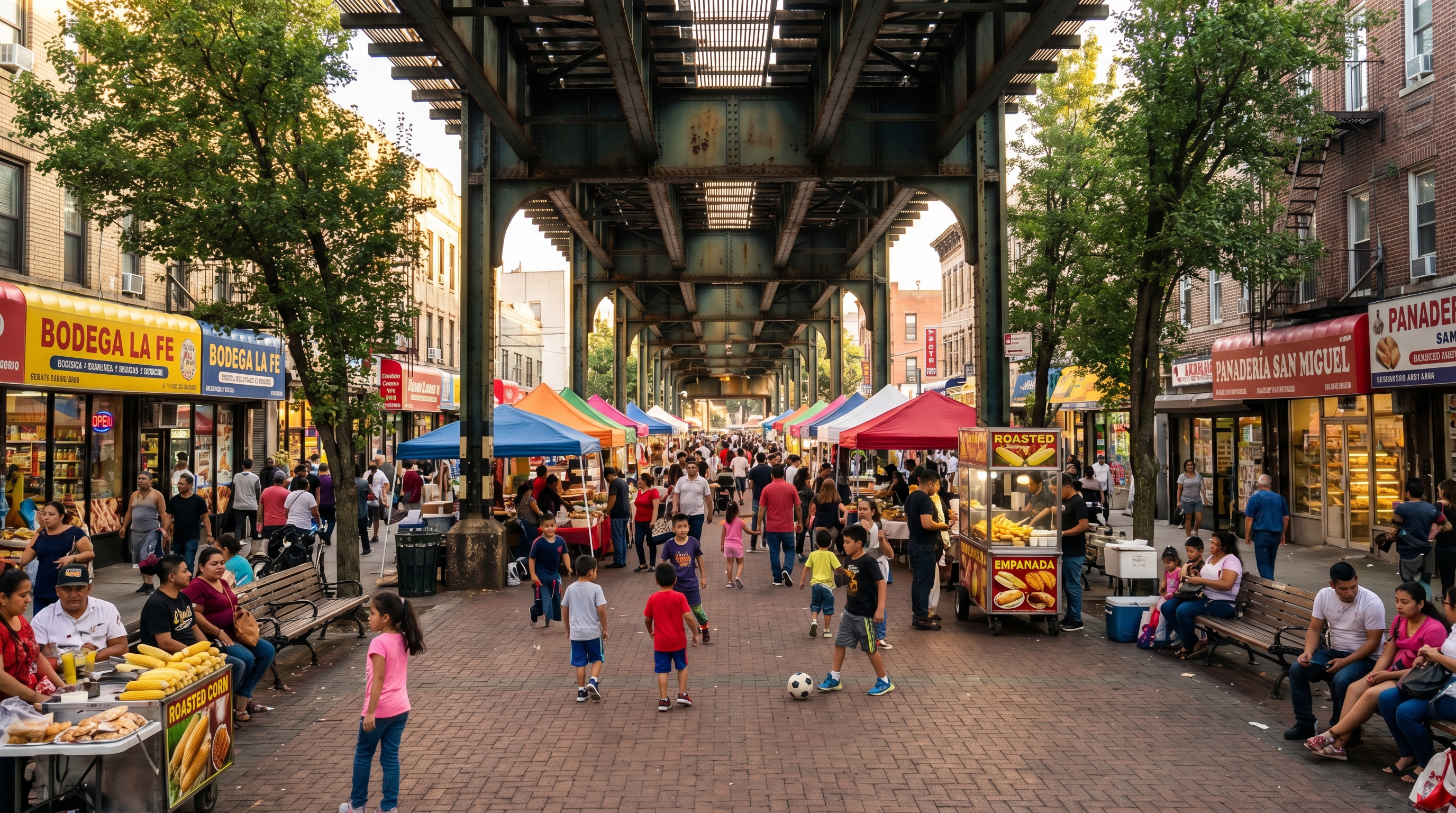
The food corridor and the civic life of 103rd Street
The block where 103rd Street meets Roosevelt Avenue is the functional civic center of the neighborhood. Corona Plaza, the pedestrian space created from a former parking lot under the 7 train, is where the neighborhood gathers on weekend afternoons. Elderly men play dominoes. Children run on the brickwork. Vendors sell elotes and raspados. The smell of grilling meat and cut fruit mingles with the exhaust of buses turning off Roosevelt. The 7 train thunders overhead at intervals. None of this stops anything. It is simply the ambient condition of the place, and the people who have lived here for twenty or thirty years carry it as background the way other people carry the sound of ocean or traffic.
Four blocks away on Corona Avenue, Leo’s Latticini has been making fresh mozzarella the same way since 1920. The sandwich that comes out of that counter, with the mozzarella still warm and the prosciutto folded correctly on a semolina roll, is the best single food item available for under $10 in New York City. Food writers have been making that argument for decades. The counter itself does not argue. It just makes the sandwich. This is a neighborhood with that kind of anchor, the kind that has been there longer than anyone alive can remember and that does not appear to be going anywhere.
Deep cleaning for homes that carry decades of history
We have cleaned over 100,000 homes across New York City, and the two-family and three-family rowhouses of Corona occupy a specific place in that experience. These are homes that have been passed down through families, sometimes Italian-American families who built them and maintained them through three generations, sometimes immigrant families who bought them and embedded their own histories into the walls and floors. The houses carry this accumulation in the way all lived-in buildings do: in grout that has darkened over decades, in paint layers built up around window frames, in kitchen exhaust fans that have processed thirty years of cooking, in bathroom tiles that have been cleaned with whatever products were available at the time.
A deep cleaning in one of these homes is not the same as a routine cleaning performed twice as carefully. It is a systematic pass through surfaces that have not been reached in months or years: behind and under major appliances, the interior of kitchen exhaust systems, the grout throughout all bathrooms, the accumulated matter in window tracks and door threshold channels, the dust built up on ceiling fan motors, and the baseboards on every floor. We carry the products appropriate to each surface and we do not use acidic cleaners on original grout or abrasive compounds on original tile. These surfaces survived decades because they were built well and because the people who lived here took care of them. Our job is to continue that care and then return the home to the family who lives in it.
What booking looks like for Corona
You book online, select your date and time, and see your flat-rate price before you commit. If your two-family house needs both floors cleaned, you enter both units as separate appointments. If you need a one-time deep clean before the summer or a recurring weekly or biweekly service, the booking page handles both. Our cleaners are W-2 employees, not contractors, and they show up with the products appropriate for your specific home.
Book your Corona cleaning here. We also serve nearby Astoria, Long Island City, Forest Hills, and Sunnyside across Queens.