

Rego Park is a neighborhood that does not exist because anyone planned a community. It exists because a real estate company in the 1920s needed a name for a tract of central Queens farmland they wanted to sell, and they took the first two letters of their own company name to make one up. The Real Good Construction Company. RE from Real, GO from Good. Rego. They added Park because Park sounded pleasant, even though there was no park anywhere near the development. The name worked. It stuck. It became official. And then over the next hundred years, waves of immigrants who knew nothing about the Real Good Construction Company turned a developer’s marketing brand into one of the most culturally specific neighborhoods in New York City.
That progression is the whole story: a name invented for commerce becomes a place, a place becomes a community, a community becomes something no developer could have planned. The families now living on the residential side streets north of Queens Boulevard, cooking plov in their apartments or buying medovik from the Russian bakery on the corner, did not arrive because of the Real Good Construction Company’s vision. They arrived because the subway made central Queens accessible and the apartment buildings were spacious and the community that came before them had already made the neighborhood feel like home.
A real estate brand that became a borough landmark
The ground under Rego Park spent most of recorded history as agricultural land. The Matinecock and Rockaway bands of the Lenape people moved through the wooded upland, maintaining paths and clearings, before European settlers arrived in the 17th century and organized the territory as part of the Town of Newtown under English colonial administration. Through the Dutch and English colonial periods, through the Revolution, through the 19th century, the land was farmland. Market gardens grew produce for Manhattan. Scattered estates sat on the flatter stretches. The Long Island Rail Road passed through to the south, but the area that would become Rego Park had no station and no reason to develop quickly.
The subway changed everything. When the IND Queens Boulevard Line opened in the 1930s, reaching Forest Hills by 1936 and putting central Queens within 20 minutes of Midtown Manhattan, developers understood what they had. The Real Good Construction Company had already moved ahead of that calculation. In the 1920s, before the IND was complete, they purchased a substantial tract and started grading streets, installing utilities, and building the first attached two-family homes and apartment buildings in what they were marketing as a new residential community. The infrastructure they built before the subway arrived meant the neighborhood was ready to absorb the wave of new residents the subway would send.
The first generation of residents was heavily Jewish, drawing primarily from Manhattan and Brooklyn. German Jewish refugees arrived in the late 1930s, fleeing the situation in Europe. After the war, Holocaust survivors settled here in significant numbers. Russian Jewish families came through later waves. By the postwar decades, Rego Park had the character of Forest Hills to the south: prosperous, organized, focused on education and professional achievement, with the social density that comes from a community that has been through something terrible and knows the value of being surrounded by people it trusts.
The apartment buildings that tell four decades of Queens construction history
Walk the Queens Boulevard corridor through Rego Park and you are walking through a compressed history of outer-borough apartment construction from the late 1920s through the early 1960s. The prewar buildings came first: Art Deco and Renaissance Revival structures with red brick facades, terra cotta cornices, and lobbies that were genuinely ornate. These were not afterthoughts. They were built to attract families who had options and chose Rego Park because the construction was good and the finishes were respectable.
The postwar buildings that went up in the 1940s and 1950s simplified the ornamentation but kept the scale. Six to fourteen stories of solid brick, with large apartment layouts that reflected the era’s assumption that families needed two and three bedrooms and did not plan to share walls with their unit for only a year or two. These buildings gave Rego Park its defining residential character: not the crammed studio density of Manhattan, but genuine apartment living with room for a family to spread out and a living room large enough for a dinner table.
The street grid behind Queens Boulevard holds a different scale entirely. Attached two-family brick homes from the 1920s and 1930s line the interior residential streets, often housing extended families across both floors. Owner-occupied, well-maintained, and largely unchanged in form since they were built, these homes represent a different kind of Rego Park: quieter, lower-rise, with small front stoops and the particular social texture of blocks where people have lived for decades.
The prewar buildings along Queens Boulevard have significant plaster detail work, oak parquet floors, and cast-iron radiators that were designed to last. They have lasted. The plaster shows cracks in some units, and the parquet needs careful attention because the individual wood blocks swell and separate if they are cleaned with too much water. A cleaning service that does not understand how these floors work will damage them. We use a flat microfiber mop with a pH-neutral hardwood solution, damp only, dried immediately. The floors are 80 years old and we plan to keep them going that way.
Queens Boulevard earned its nickname before safety improvements arrived
There is nothing else in New York quite like Queens Boulevard at the Rego Park stretch. The road is twelve lanes wide in some sections. The median strips are wide enough to strand a pedestrian between two moving walls of traffic. The apartment buildings on both sides are enormous. The whole corridor operates at a scale that feels less like a neighborhood street and more like a highway that city planners decided to run through the middle of a residential community, because that is essentially what happened.
The “Boulevard of Death” nickname was not invented by critics or journalists as hyperbole. Over a 14-year period ending in 2007, 186 pedestrians were killed trying to cross Queens Boulevard in the Queens area. The crossings are wide, the signal timing was designed for vehicle throughput rather than pedestrian safety, and the traffic moves fast. The city has made substantial investments in safety improvements since then, including extended signal phases, raised medians, and dedicated turning lanes. The situation has improved significantly. The road is still challenging.
What has not changed is the density of life along the boulevard. The buildings on both sides hold thousands of apartments. The ground floors have a continuous run of storefronts: Russian bakeries, Bukharan delis, medical offices, pharmacies, nail salons, and the kind of small grocery operations that serve a dense immigrant community. The Rego Center complex at the corner of Junction Boulevard adds a full-scale mall to the mix. The whole corridor functions as both a neighborhood main street and a regional shopping destination simultaneously.
The Soviet wave that made this neighborhood impossible to replicate anywhere else
The defining transformation of Rego Park came in two overlapping waves. The first began in the late 1970s and accelerated sharply after the Soviet Union’s collapse in 1991: Russian Jewish families arrived in enormous numbers, drawn by existing community connections and the availability of spacious apartments at rents below Manhattan and the closer-in boroughs. They came as engineers, doctors, musicians, scientists, and academics whose credentials often did not transfer directly to the American professional system. The first generation worked in whatever was available. Their children and grandchildren moved into the professions the parents had trained for in the Soviet Union.
The second wave was less expected and more remarkable. Bukharan Jews, whose community traces to the ancient Jewish diaspora in Central Asia (Uzbekistan, Tajikistan, Kazakhstan), had almost no presence in the United States before the 1970s. They arrived in Queens in numbers that grew steadily through the 1980s and 1990s, drawn by the same factors that brought the Russian Jewish community: affordable housing, subway access, and a community already established. Today Rego Park and Forest Hills together constitute the largest Bukharan Jewish community in the United States outside of Israel, somewhere in the range of 100,000 people.
Walk into a supermarket on Queens Boulevard and the PA system makes announcements in Russian. The Bukharan deli counter has plov and stuffed grape leaves under glass. At the checkout, three generations of a family are loading a cart: grandmother in a headscarf, daughter in office clothes, grandchildren in school backpacks. The social fabric here is dense and inward-facing in the way immigrant communities often are. People take care of each other. They trust their own networks. The synagogues, both Ashkenazi Orthodox and Bukharan, function as major social infrastructure, not just religious buildings.
The Bukharan presence adds something that has almost no equivalent in American urban life. Bukharan Jewish culture is a synthesis of Persian, Uzbek, and Jewish traditions that has existed for centuries in Central Asia and has been largely transplanted in its entirety to central Queens. The food alone is worth understanding. Plov, a lamb-and-rice dish cooked in enormous cast-iron pots, is the community’s central communal food and is made the same way it has been made for generations. Samsa, baked pastries stuffed with lamb or pumpkin. Lagman, hand-pulled noodle soup. Manti, large steamed dumplings. Chebureki, deep-fried meat-filled pastries. Cheburechnaya on 108th Street is the neighborhood’s most famous Bukharan restaurant, and it does not need to advertise because the community that it serves already knows exactly where it is and what to order.
Woody Allen grew up here and has spent his career writing about it
The filmmaker was born Allen Stewart Konigsberg in Brooklyn in 1935 but moved to Rego Park as a child and attended P.S. 99. His formative years were spent in these apartment buildings, on these streets, absorbing the particular flavor of outer-borough Jewish Queens in the 1940s and early 1950s: the intellectual aspiration, the social anxiety, the claustrophobia of dense family life in a two-bedroom apartment, and the persistent sense that Manhattan, visible across the water, represented a different and more real existence.
That sensibility runs through his early comedy and his films. The humor is not abstract. It comes from a specific place and a specific community experience. The jokes about neurotic Jewish families, about professional ambition thwarted by fate, about the gap between how intelligent you feel and how smoothly life actually proceeds. These are Rego Park observations translated into comedy. He has said that growing up in Queens shaped his entire worldview. Walk P.S. 99’s block on a school day and the connection is not hard to imagine.
Allen is by far the neighborhood’s most famous product, but Rego Park has always generated a high concentration of professional achievers in fields from real estate to medicine to music, driven by the same community values that produced him: education is not optional, professional success is expected, and failure to pursue both is explained at the dinner table.
The cleaning reality in a neighborhood built from prewar brick
The housing stock in Rego Park creates specific cleaning needs that differ from what you would encounter in a newer building or in a neighborhood with more varied construction. Almost everything here is brick apartment construction from the 1930s through the 1960s, which means plaster walls, original parquet or strip hardwood floors, cast-iron radiators, and kitchens and bathrooms that have often been renovated once or twice without replacing the underlying bones of the space.
The radiators are worth understanding before anyone touches them. A cast-iron unit traps dust throughout the cooling season, and when the steam heat comes on in October that accumulated dust burns off and fills the apartment with a smell you cannot miss. On every visit the radiator covers get dusted along with the vent covers above them, which is the half of the problem a cleaning crew can actually reach. Holding the room’s dust load down through the summer is what makes October less noticeable.
The plaster walls in the prewar buildings are thicker than drywall and more forgiving of moisture, but they crack along the stress lines in ways that collect dirt. Cleaning along the crack lines without pushing residue deeper into them requires a specific technique. The parquet floors need the light touch we have already described. The bathroom tile grout in an 80-year-old building has been regrouted multiple times and each generation of grout has different porosity, which means some areas clean with a damp cloth and others need a brush.
For pre-Passover cleaning, which is one of the most requested services we do in Rego Park each spring, the standard goes further. Families preparing for Passover need every surface cleaned, every cabinet cleared and wiped out, every appliance interior addressed. We do a full deep cleaning pass that works through the apartment systematically and does not skip the parts that are awkward to reach. For Bukharan households observing Nowruz in late March, the same pre-holiday cleaning logic applies. This neighborhood has multiple communities with strong traditions around home cleanliness before major holidays, and we have built our Rego Park scheduling around knowing when those windows arrive.
What we handle so your weekend belongs to 63rd Drive and Flushing Meadows
Rego Park is not a neighborhood that needs its residents to go somewhere else for a good weekend. The 63rd Drive commercial strip has Russian bakeries, Bukharan restaurants, and the full range of services a family needs without crossing Queens Boulevard. Cheburechnaya is open for lunch and dinner and the lamb dishes have been made the same way for as long as anyone currently living in the neighborhood can remember. Flushing Meadows-Corona Park is a ten-minute drive or a short subway ride, 1,255 acres with the Queens Museum, a boathouse, the Unisphere, and enough open space to spend a full day without running out of things to look at.
The E and F express trains from 63rd Drive-Rego Center station reach Midtown Manhattan in about 20 minutes. That commute is one of the best in outer Queens and is the reason these buildings filled up as fast as they were built. For residents who want to spend a Saturday in the city rather than the neighborhood, the infrastructure is there.
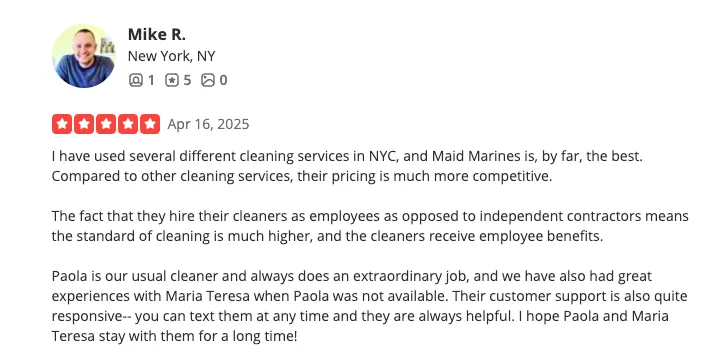
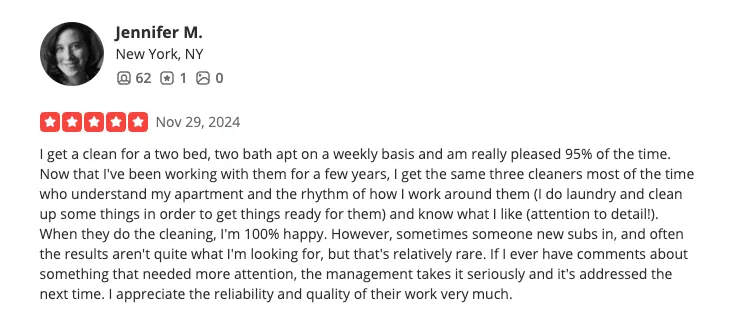
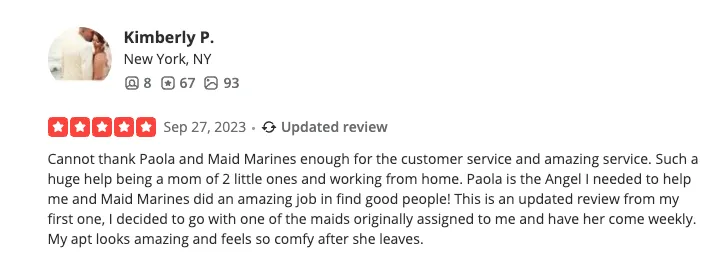
Our approach is simple: you pick your time and date on our booking page, you see your flat-rate price before committing to anything, and we handle the logistics from there. If your building requires a COI or advance notice, you tell us once and we manage it. If you have a kosher kitchen or specific product preferences, you note it when you book and we adjust accordingly. Our cleaners are W-2 employees, not gig workers, and they work in this neighborhood regularly. They know the difference between a prewar co-op on Queens Boulevard and a two-family home on Booth Street, and they clean each one accordingly.
For move-in and move-out cleaning, we know what Rego Park co-op boards mean when they say broom-clean, and we know what management offices look for before releasing a security deposit. Our move-in and move-out cleaning covers the full scope: inside cabinets and drawers, appliance interiors, bathroom grout, baseboards, and window sills. We also serve nearby Forest Hills and Sunnyside with the same approach. If you have been handling the cleaning yourself in a building that requires more than a standard apartment routine, a recurring service is the easier path. Schedule it, let us do it, and spend that Saturday doing something better.