

The name Liberty Park comes from a small park and from Liberty Avenue running just north through the broader Jamaica corridor, but the word liberty carries extra weight in this part of Queens. It landed in a neighborhood where African American families, for most of the 20th century, had systematically been kept out of nearly everywhere else in the city. They came here partly because redlining and steering left them few alternatives, and then they built something durable: a community with its own churches, its own political leadership, its own economy, and its own identity. The name stuck because it meant something.
Liberty Park is a sub-neighborhood within South Jamaica, bounded by Rockaway Boulevard to the south, Sutphin Boulevard to the west, Linden Boulevard to the north, and the interior residential streets running east toward Merrick Boulevard. It is not an official New York City planning designation. It appears on real estate listings and in community documents. Residents use it. That is enough.
A working-class Black neighborhood with a century-old homeownership tradition
The built environment of Liberty Park is one of the most consistently outer-Queens things you will find in the borough. Attached two-family brick row houses, two and three stories, stoops with iron railings, small front yards behind chain-link fences, rear yards where families grow tomatoes in summer and store their things year-round. Aluminum siding added over original brick. Stoops rebuilt or enclosed. Ground-floor security gates. These are the modifications of long occupancy, every one of them a decision made by a family managing their property on a budget and a schedule that left no room for anything inessential.
The typical row house runs 900 to 1,400 square feet per floor. Ground floor: living room, kitchen, sometimes a dining room in homes built with enough width for one. Above: two or three bedrooms and a bathroom, sometimes a second bathroom added by a later owner who found the money and the contractor to squeeze one in. Below: a basement that has been everything from storage to laundry room to finished family space depending on who has lived there and what they needed.
The homeownership rate in Liberty Park and surrounding South Jamaica runs between 35 and 45 percent, dramatically above the New York City citywide average of 32.5 percent and far above what you find in the rental-dominated neighborhoods of northwest Queens or Manhattan. African American families built this by purchasing homes at a time when most of the rest of the metropolitan area was closed to them by official and unofficial policy. The houses on these blocks represent 50 and 60 years of accumulated equity, passed between generations, modified over time, and maintained with the seriousness of people who know what it cost to get here.

Where a Lenape word became a hip-hop origin story
The name Jamaica predates any English presence in this area. The Lenape people who inhabited western Long Island called the region Yameco or Jameco, a word that some translators render as “beaver” and others as “the beaver place,” referring to the many streams and ponds that covered this section of the coastal plain before colonial drainage altered the landscape. When English settlers from Hempstead established the Town of Jamaica in 1656, they adopted the name phonetically without understanding what it meant.
That Lenape-derived name now belongs to one of the most Caribbean neighborhoods in Queens. The borough has the largest West Indian population outside the Caribbean itself, and South Jamaica and Liberty Park sit near its southeastern core. Jamaican, Trinidadian, Guyanese, Haitian, and Barbadian families have been moving into the neighborhood since the 1970s, drawn by affordable homeownership, established Black community infrastructure, and the AirTrain connection to JFK Airport, where many found employment. The result is a neighborhood where Caribbean English, Jamaican patois, and Haitian Creole mix with African American vernacular on front stoops and in church corridors, and where the food tells the whole story of that migration.
The density of talent that emerged from this specific geography is something New York does not fully reckon with. 50 Cent grew up in the Sutphin Boulevard area of South Jamaica, a few blocks from Liberty Park, in public housing. LL Cool J is from the St. Albans border just north. Ja Rule is from nearby Hollis. Run-DMC came from Hollis as well. Within a radius of a few miles around Liberty Park, some of the most important figures in hip-hop’s first two decades were coming up simultaneously in the late 1970s and 1980s. The proximity was not coincidence. It reflected a specific cultural moment in a specific community in a specific place.
The two-family home and what it actually takes to clean one
The attached two-family row house is the defining building type of Liberty Park, and it has a logic that differs from a Brooklyn brownstone or a Manhattan co-op. The stoop leads to a ground-floor unit with a direct street presence. The upper unit has a separate side or rear entrance. Each floor has its own kitchen, its own bathroom, its own accumulated cooking residue and bathroom mineral deposit and dust pattern. When an owner occupies one floor and rents the other, the cleaning needs of the two units may be completely different.
We clean both units in a single visit regularly. You book the total square footage, we price it as one job, and the separate entrances mean neither family has to be in the other’s way. If your tenant prefers a different schedule or day, we set up two independent recurring visits at no extra coordination cost. The most common request we get from Liberty Park homeowners is a different frequency for the two units: biweekly for the owner’s floor, monthly for the rental.
The specific cleaning challenges of these homes are concentrated in a few areas. Kitchen grease is the most significant. Caribbean and African American cooking traditions, which define daily meals in most Liberty Park households, rely on methods that leave substantial residue: braised meats cooked at high temperatures for hours, deep-frying, jerk seasoning applied heavily, curry compounds that contain turmeric and allspice and scotch bonnet oil. These coat range hood undersides, cabinet faces, tile backsplashes, and ceiling paint within six feet of the stove. Standard wiping with an all-purpose spray spreads the film rather than removing it. We carry commercial-grade degreasers for kitchen surfaces in every home we clean in this neighborhood.
The other accumulation point is the cast-iron radiator. Steam heat is standard in these older row houses, and radiators have fins spaced close enough together that dust packs into the gaps all summer and burns off in October when the heat comes on for the first time after months of dormancy. The burning-lint smell that fills old houses in early fall comes entirely from those fins. The radiator covers and the vent covers above them get dusted on every deep clean, not just on the first visit. It is one of those things that takes ten minutes and makes a difference that lasts for months.
The church as architecture and institution
Liberty Park is known for its concentration of Black churches. Not just large, established congregations in purpose-built brick buildings, but a dense variety: storefront Baptist churches occupying converted retail spaces, Pentecostal ministries running services from what used to be a hair salon, Seventh-Day Adventist congregations that have occupied the same corner building for 40 years, Caribbean evangelical churches that run services in English and patois on alternating Sundays. Walk a few blocks in any direction from the neighborhood’s center and you will pass several.
The church has been the central institution of community life in South Jamaica and Liberty Park since the middle of the 20th century, not just spiritually but practically. Churches here run after-school programs, food pantries, senior services, job placement, youth sports leagues, and political organizing. They have served as the community’s administrative infrastructure during every period when municipal services were inadequate, which has been most of the time.
Greater Allen AME Cathedral in Jamaica, a mile from Liberty Park, is the most prominent example. Under the Rev. Floyd Flake, who served simultaneously as Senior Pastor and as a member of Congress from 1987 to 1997, the cathedral developed affordable housing, operated schools, and built a social services network that served tens of thousands of people in the corridor. The civic model of the faith-based institution as a full-service community anchor is something Liberty Park residents have seen close up for generations. The churches are part of why this neighborhood held together during the crack epidemic years, when many comparable communities did not.
Baisley Pond Park and what to do on a Saturday morning while we clean
The 110-acre park on the Liberty Park and St. Albans border is the best green space in southeast Queens and is genuinely underappreciated. Baisley Pond sits at the center of it, a real body of water with waterfowl and a walking loop that takes about 45 minutes at a comfortable pace. The athletic fields on the eastern edge run full every warm weekend with youth baseball and soccer. Roy Wilkins Recreation Center, named for the NAACP leader who worked in Jamaica, sits adjacent and provides an indoor pool and gym that were recently renovated.
The pond has a stillness that does not exist anywhere on Rockaway Boulevard or Sutphin Boulevard. Early mornings in spring, when the light hits the water before the athletic fields fill up, it is genuinely beautiful. The park also serves as neutral ground where Liberty Park’s different communities share space without friction: Caribbean elders on the walking path, teenagers from the Baisley Park Houses on the courts, families with strollers from the private homeownership blocks. Nobody is coordinating this. It just happens.
Book your Saturday morning house cleaning and spend the morning at the pond. Walk the loop, use the recreation center, or sit on a bench and let time pass while we handle the floors, the bathrooms, and the kitchen.
What booking looks like for a Liberty Park home
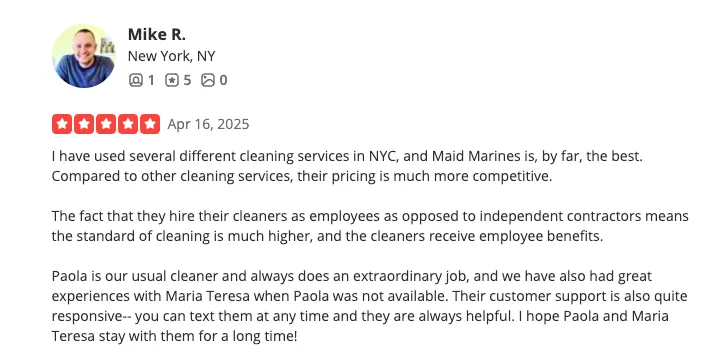
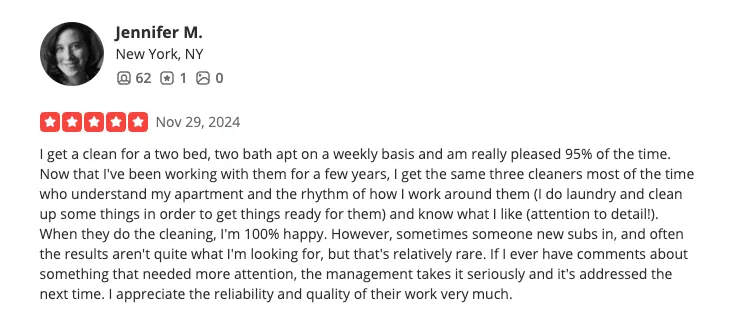
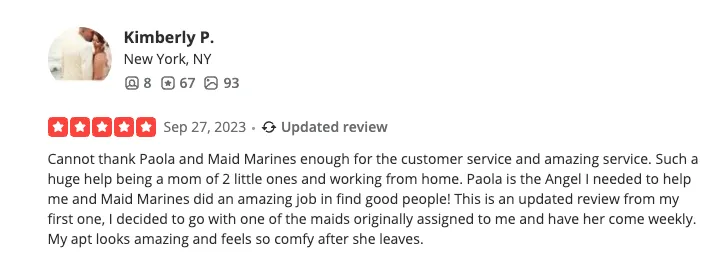
You pick your date and time on our booking page. You see your exact flat-rate price before you commit. If your row house has a two-family layout, a basement that needs attention, or a kitchen that sees serious daily cooking, you note it when you book and we bring the right approach and supplies. Our cleaners are W-2 employees, not gig workers. They are vetted and insured and they show up with everything they need.
For the first visit to a Liberty Park home that has not had professional cleaning recently, we recommend the deep clean option. The radiator covers, the cabinet faces above the stove, the bathroom grout, the window sills that face Rockaway Boulevard. These are the things that a standard maintenance clean maintains but does not reset. The deep clean is the reset. The insides of those cabinets are not part of it, but you can add them at booking. After that, a biweekly or monthly recurring schedule holds the result.
We serve Liberty Park and the full southeast Queens corridor, including nearby South Jamaica, Jamaica, St. Albans, and Rochdale Village. Our teams reach Liberty Park via the J or Z to 121st Street, the A or E to Jamaica Center, or drive from other parts of the borough. We arrive on time.