
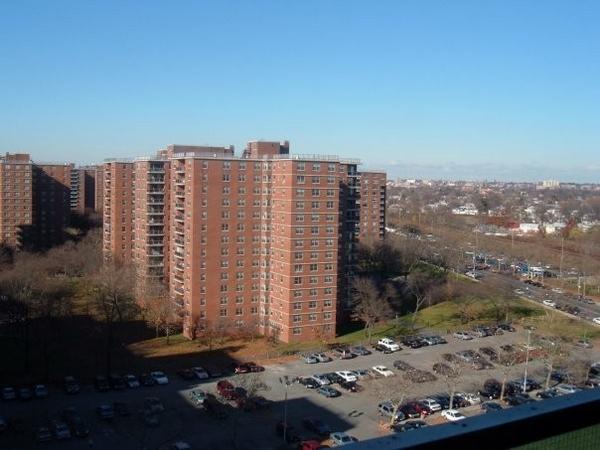
Rochdale Village is not a typical apartment complex. It is a cooperative community of 5,860 units across 20 fourteen-story towers, housing approximately 25,000 residents on a 200-acre superblock in southeastern Queens. Residents are not tenants. They are shareholders in a cooperative corporation, elected to its board, participants in its governance, and owners of the apartments they live in. This is a neighborhood that was built on a philosophical argument about how working-class families deserved to live, and six decades later, that argument is still being made in concrete and brick.
The development began on the site of the Jamaica Race Track, one of the most famous thoroughbred racing venues in the New York area. The track operated from 1903 to 1959, drawing gamblers, celebrities, and racegoers from across the Northeast to this flat, level plain in southeastern Queens. When the track closed, the United Housing Foundation, a coalition of trade unions and cooperative housing advocates, acquired the 200-acre site and built the development that stands today. They named it Rochdale Village, in honor of the Rochdale Pioneers of 1844, the 28 working-class weavers in Lancashire, England who founded the first modern consumer cooperative and established the principles of democratic governance and collective ownership that still define the cooperative movement worldwide.
A neighborhood built on cooperative principles in the civil rights era
When Rochdale Village opened in 1963, it was the largest privately owned cooperative housing complex in the world. The United Housing Foundation, under the leadership of Abraham Kazan, designed it explicitly as a racially integrated development, opening cooperative apartments to Black and white buyers simultaneously in a New York real estate market that was aggressively segregated by custom and restrictive covenants.
The integration experiment attracted serious attention. Academic researchers and journalists documented Rochdale through the 1960s as one of the most successfully integrated large residential developments in the city. The demographic evolution that followed, as white families left for the suburbs through the late 1960s and 1970s in patterns driven by blockbusting and highway-enabled suburbanization, became part of the scholarly literature on residential integration and white flight. By the mid-1970s Rochdale Village was predominantly African American, and today it serves a working- and lower-middle-class population that is approximately 80 to 85 percent Black, with a significant and growing Caribbean American contingent, primarily Jamaican and Haitian families who have arrived since the 1980s.
What has distinguished Rochdale from the public housing projects of the same era is precisely the cooperative structure. The development has faced financial challenges over the decades, including periods of deferred maintenance and governance disputes. But it has survived as a functioning cooperative, governing itself through elected board elections that residents treat as genuine civic events. Monthly maintenance fees have been set below market rate to serve the working-class mission. The apartments have remained affordable not because the market ignored them but because the cooperative structure controls who buys in and at what price.
The architecture of 5,860 apartments across 20 towers
The 20 buildings were designed by architect Herman Jessor, who also designed Co-op City in the Bronx, the only cooperative housing development in New York City larger than Rochdale. Jessor’s approach for the United Housing Foundation was consistently utilitarian: reinforced concrete and brick construction, aluminum-framed windows in repetitive grids, flat roofs, and a scale that prioritized the number of families housed over architectural expression. Standing in the open space between the towers and looking up at the ranked windows of 14 floors, the sense of an entire city-in-miniature is palpable in a way that purely aesthetic architecture rarely produces.
The superblock layout separates the residential towers from the surrounding street grid entirely. The development’s internal road network, the large parking areas serving each building group, the internal shopping center, and the Rochdale Village Community Center all create an environment that functions as a self-contained neighborhood within the larger Jamaica area. This was the planning ideal of the 1960s, when large residential developments were deliberately removed from the traffic and commercial pressure of the street. It creates community cohesion and protects residents from some of the pressures of the surrounding area. It also removes residents from the street-level commercial life that happens organically on traditional block-by-block urban streets.
The apartment layouts reflect a mid-century standard that has proven durable. Studios through three-bedrooms, roughly 550 to 1,200 square feet, with straightforward rectangular floor plans and consistent layouts throughout each building. No brownstone idiosyncrasies, no pre-war plaster ornament, no original hardwood from the 1880s. What these apartments have instead is decades of occupancy, often by the same family, which creates its own kind of cleaning complexity.
What six decades of cooperative living does to an apartment
Many Rochdale residents have lived in the same apartment for 20, 30, or 40 years. Some families have been in the same unit since the development opened in 1963. This generational tenure is one of Rochdale’s defining characteristics, and it creates a specific cleaning reality that is different from a market-rate apartment where tenants cycle through every few years and landlords periodically renovate between leases.
A cooperative apartment occupied by the same family for three decades has accumulated decades of daily life. Grease films on kitchen cabinet faces and range hoods that have been wiped but not fully degreased in years. Radiator fins packed with dust that burns off every October when the steam heat comes on. Bathroom tile grout that has been cleaned but not thoroughly addressed since the last major renovation. Closets and storage spaces that hold the accumulation of a household over time. These are not dirty apartments. They are lived-in apartments, and the difference matters.
We serve over 100,000 homes across New York City, and long-tenured cooperative apartments require a specific approach. The first cleaning is always a deep clean. We work room by room, top to bottom, and reset every surface before any recurring schedule begins. The kitchen gets a full degreasing treatment on every surface within six feet of the stove. Radiator fins get attention between the fins, not just across the tops. Bathroom grout gets a targeted scrub. After that initial reset, a weekly or biweekly apartment cleaning schedule keeps the apartment in the condition the first visit establishes. For Rochdale apartments, the difference between the first deep clean and the second recurring visit is the most dramatic transformation we produce anywhere in Queens.
The kitchens here get used
Rochdale Village’s African American and Caribbean American community cooks seriously. Jamaican oxtail and jerk chicken. Haitian griot and rice and peas. Southern soul food from families who brought their cooking traditions north from Georgia and the Carolinas during the Great Migration and have maintained those traditions in these apartments for two generations. The Guy Brewer Boulevard commercial strip along the development’s western edge, with its Jamaican restaurants, Haitian food counters, and West Indian grocery stores, reflects the same cooking tradition in its commercial form.
Daily cooking of this kind leaves a mark on a kitchen. Grease films on the range hood, cabinet faces above and beside the stove, the backsplash, and the ceiling above the cooktop. Curry and seasoning residue that a weekly surface wipe will not remove. Drip trays that have caught months of cooking overflow. Every kitchen surface within six feet of the stove gets a degreasing solution, the hood exterior included, and the drip trays come out and get cleaned on every visit. Kitchens with significant buildup from extended intervals between deep cleanings get additional time. If you want the oven interior done, that is part of a deep clean, and we handle it.
Cleaning for families with elderly residents and multigenerational households
The aging profile of Rochdale Village is one of its most significant demographic characteristics. Many residents who moved in during the 1960s are now in their 70s, 80s, and 90s. The cooperative has one of the highest concentrations of elderly African American residents of any housing development in Queens. Adult children frequently arrange cleaning service for parents who can no longer maintain the apartment themselves, or supplement what their parents can manage with periodic professional cleaning.
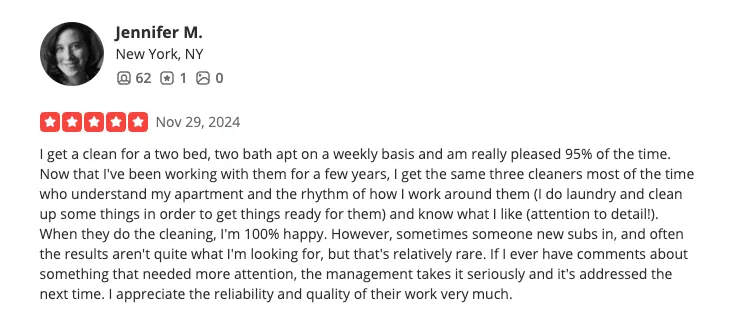
For elderly residents, continuity matters more than it does for younger households. The same cleaner returns for each visit, which is not a premium add-on but our standard operating model for recurring accounts. Mobility equipment, medical devices, and assistive furniture stay where they are. We clean around them carefully rather than moving them out of the way. Fragile items that cannot be disturbed are noted on the account and avoided. If a resident has chemical sensitivities, we substitute products accordingly and note it permanently. Most of our arrangements for elderly Rochdale residents are set up by their adult children, and we treat those accounts with the understanding that the person we are serving every week is someone’s parent.
For multigenerational households, where a grandparent, parents, and children occupy the same cooperative unit, we schedule cleaning to work around the household’s rhythm rather than impose one. If the grandmother naps in the afternoon and the children are home from school by three, the morning slot is the right window and we work accordingly.
Baisley Pond Park and the green space advantage
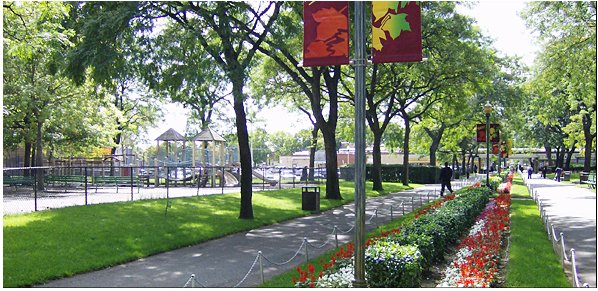
The 109-acre Baisley Pond Park sits directly north of the Rochdale Village complex, separated from the development by Baisley Boulevard. The park contains the historic Baisley Pond, walking paths, athletic fields, and mature tree canopy that provides a significant green space resource for a neighborhood whose superblock design does not produce the same street-level park access as more traditional residential blocks.
For Rochdale residents without cars, Baisley Pond Park is the most accessible large green space in the neighborhood and well worth an afternoon while the apartment is being cleaned. The full loop around the pond takes about 40 minutes. The park rarely feels crowded except on summer weekends, which means a weekday morning visit is essentially private. Pair a Saturday morning booking with two hours at the park and you come home to a clean apartment and an afternoon free.
Moving in, moving out, and transferring cooperative shares
When a Rochdale cooperative apartment changes hands, the incoming shareholder wants a thorough cleaning before moving in and the outgoing shareholder wants the unit left in a condition the cooperative board will find acceptable. Our move-in and move-out cleaning covers the full apartment interior: inside cabinets and drawers, appliance interiors, bathroom tile and grout, baseboards, window sills, and every surface that the next occupant will touch or open on the first day.
Cooperative share transfers at Rochdale sometimes involve apartments that have been in the same family for decades and have not received a thorough professional cleaning in years. These are our most time-intensive move-out jobs and we approach them accordingly. For incoming shareholders, a deep clean before moving furniture in allows us to reach every surface without working around boxes and new belongings.
What booking looks like for Rochdale Village residents
You pick your date and time on our booking page. You see your flat-rate price before you commit. If your cooperative apartment needs a first-time deep clean before going to a recurring schedule, the booking page walks you through that selection. If you are arranging service for an elderly parent in one of the towers, you set up the account with your contact information and your parent’s address.
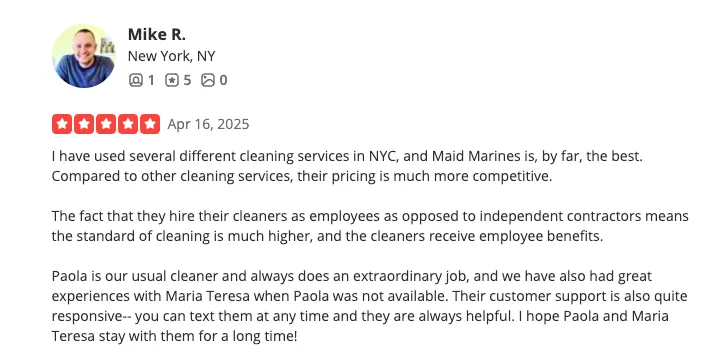
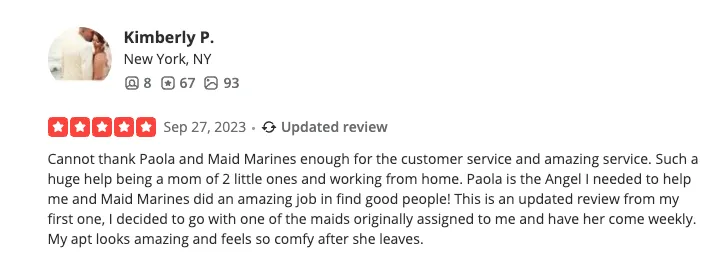
Our cleaners are W-2 employees, not gig workers. They are vetted, insured, and they arrive with the right products for aged cooperative apartment finishes. The same team returns for every recurring visit. We serve Rochdale Village and all of southeastern Queens, including nearby St. Albans, Laurelton, Hollis, and Jamaica. The Q4 bus and the Locust Manor LIRR station both provide transit access for our teams, and many of our southeastern Queens cleaners drive directly. The fact that Rochdale Village has no subway stop does not affect our arrival time or our pricing.