
Queensboro Hill is a neighborhood named after a bridge it barely touches. The Queensboro Bridge, the famous double-decker cantilever span connecting Queens to 59th Street in Manhattan, sits several miles to the west. Real estate developers in the 1910s attached the name to a new residential development of brick two-family homes rising from the Queens glacial plain, and the borrowed prestige held. The bridge it references has since carried a hundred years of meaning in New York. The neighborhood it named has spent that same century doing something quieter and more durable: housing successive generations of immigrant families in the compact brick buildings along 141st Street and Melbourne Avenue, each generation departing for Long Island after a decade or two, another family moving in from somewhere farther away.
The result is a neighborhood that rarely appears in travel writing and does not advertise itself to outside observers. What Queensboro Hill offers is not a scene. It is a structure: a compact grid of well-maintained owner-occupied two-families, a commercial strip on Jewel Avenue with six languages of signage, Queens College sitting directly on the western boundary, and Kissena Park a ten-minute walk north. It is, in the particular way of middle-class immigrant Queens, exactly what it appears to be.
Brick two-family homes from 1920 require different care than anything built after 1960
The two-family brick homes that line Queensboro Hill’s residential streets were built primarily between 1910 and 1940, and they were built well. The construction quality of the interwar period in Queens outer neighborhoods was driven by working-class homebuyers who intended to live in the building for decades, not investors looking for quick margins. These homes have held up. Walk down 141st Street and you are looking at facades that have been standing for over a hundred years, with original brick, limestone trim, and front stoops that still read as dignified rather than worn.
Inside those buildings, the original hardwood floors in many units have never been replaced. They are typically wax-finished rather than sealed with the polyurethane coatings that came into general use later. That distinction matters the moment a mop enters the room. Wax finishes absorb water. A wet mop raises the grain, softens the wax, and leaves the floor looking dull and streaked in a way that only reapplication of wax can fix. We clean these floors with a barely damp microfiber flat mop and a pH-neutral wood cleaner that evaporates quickly without penetrating the wax layer. The principle is the same one that keeps a 1920s floor lasting another hundred years: take nothing away from the surface that should stay.
The brick on the exterior and in some interior details behaves differently from the brick in newer construction. Dense, hard, well-fired brick from this era does not need sealing the way modern brick does, but it also does not tolerate aggressive alkaline cleaners that attack the mortar. We clean brick with a soft brush and vacuum attachment. Never wet. Never chemical. The same approach applies to the plaster walls common in units of this age, which are not drywall and do not respond to the same products.

How the neighborhood absorbed three waves of immigration without losing its physical character
The land that became Queensboro Hill was farmland into the 1890s. Dutch settlers had colonized the Flushing area from 1645, and the surrounding terrain, a flat well-drained glacial outwash plain, supported market gardens and orchards supplying the growing city across the East River. The development that turned farmland into neighborhood happened fast after the Queensboro Bridge opened in 1909. Developers who had acquired Queens land in anticipation of the bridge’s completion began platting street grids and constructing modest brick two-families across the former agricultural plain. The building campaign ran through the 1920s and produced the housing stock that still stands today.
The first residential community that settled those buildings had a solidly middle-class Jewish character. By mid-century, the neighborhood had synagogues, kosher butchers, and a community fabric concentrated along Jewel Avenue. The brick two-families suited the community: modest enough to be affordable for families moving out of the Lower East Side and Brownsville, well-built enough to hold value, and arranged in rows that created the walkable block-by-block social life that dense residential neighborhoods support.
Beginning in the 1970s, Korean immigration transformed Flushing and spread outward into Queensboro Hill. Korean families were drawn by the same things that had drawn the Jewish families before them: two-family brick homes that allowed an owner to live in one unit and collect rent from the other, moderately priced relative to Manhattan-adjacent neighborhoods, and close to the growing Korean commercial district emerging along Union Street in Flushing. By the 1990s, Queensboro Hill had become one of the most densely Korean residential communities in New York City, with Korean Presbyterian churches occupying converted storefronts and Korean-owned businesses on Jewel Avenue.
The Chinese and South Asian expansions followed through the 1990s and 2000s as Flushing’s Chinatown grew outward and Bangladeshi, Indian, and Pakistani families arrived in larger numbers. The neighborhood today is approximately 65 to 70 percent Asian, with Korean, Chinese, and South Asian families representing different arrival cohorts and different relationships to the housing stock. The Jewish community that preceded all of them is still present, smaller but durable, maintaining a few institutions near the Jewel Avenue corridor. The demographic change that would have produced conflict in other contexts has instead produced something more ordinary: a neighborhood where the storefronts on Jewel Avenue change language decade by decade while the brick two-families on 141st Street look exactly as they did in 1935.
Queens College, Kissena Park, and a highway that defines the neighborhood’s edges
Queensboro Hill is bounded by institutions and infrastructure rather than by transitions of character. To the north, the Long Island Expressway forms a hard wall. I-495 is not a quiet boundary. It is eight lanes of sustained freight and commuter traffic producing a noise signature that diminishes but does not disappear on the nearest residential streets. The on-ramps at Main Street give drivers direct highway access to Manhattan and Long Island, which is why car ownership here is relatively high and why the two-family homes come with driveways and garages built into their original construction.
To the west, Queens College’s 80-acre campus sits directly against the neighborhood boundary along Melbourne Avenue. The college, founded in 1937 and enrolling roughly 17,000 students, is a CUNY institution serving primarily commuter students from Queens and the surrounding boroughs. The campus has the Rosenthal Library, the Colden Center for the Performing Arts, athletic facilities, and expanses of open green space that are genuinely accessible to neighborhood residents walking in from the surrounding streets. It is one of the few New York neighborhoods where a full university campus is embedded in the residential fabric at walking distance rather than walled off from it.
To the northwest, Kissena Park’s 221 acres begin within easy walking distance. The park has a lake, wooded paths, picnic areas, and the Kissena Velodrome, a 1,400-meter cycling oval that functions as a dedicated training ground for competitive cyclists from across the borough. On weekend mornings the oval draws riders doing lap work before the rest of the city has started moving. The Kissena Corridor Park, a linear greenway running along the neighborhood’s western edge, connects Kissena Park to Flushing Meadows-Corona Park further south, providing a pedestrian and cycling route through otherwise built-up Queens streets.

The two-family model as a machine for building stability
The homeownership rate in Queensboro Hill sits at roughly 45 to 52 percent, significantly higher than the Queens average and dramatically higher than most New York neighborhoods with large immigrant populations. That number is a direct consequence of the two-family house model. An owner who lives in one unit and rents the other is not just a homeowner. The rental income from the second unit offsets the mortgage, sometimes by a large margin, and turns a housing cost into an asset that appreciates while it pays for itself.
Korean families who purchased these brick two-families for $80,000 in the mid-1970s now hold assets worth eight or ten times that. South Asian and Chinese families running the same calculation today are buying at $900,000 to $1.1 million and renting the second unit for $1,800 to $2,200 per month. The math is tighter but the model is identical. Queensboro Hill represents one of the most consistent applications of this particular wealth-building mechanism in New York City, repeated across consecutive immigrant cohorts with minimal variation in strategy.
The physical condition of the neighborhood’s housing stock is a product of this ownership structure. Owner-occupants maintain buildings differently than absentee landlords. The front stoops are swept. The brick facades are pointed. The small front gardens and rear yards are planted and tended. The result is a residential streetscape that reflects genuine investment rather than minimum maintenance, and it shows in the way the buildings have held up over a century of continuous occupation.
What a cleaning service needs to know about these homes
The house cleaning job in a Queensboro Hill two-family covers surfaces and situations that differ substantially from Manhattan apartment work. These are homes with basements, driveways, small yards, and the particular kind of accumulated use that comes from multi-generational occupation of the same dwelling. A family that has lived in the same unit for thirty years has thirty years of detail in the corners of cabinets and behind furniture that has not moved in a decade.
The kitchen in a home where heavy cooking happens regularly, whether Korean stir-fry or South Asian spice work, accumulates a particular kind of grease on the range hood, the backsplash, and the wall surface above the stove. Fine oil mist from high-heat wok cooking coats surfaces in a way that all-purpose spray products do not address. We bring a degreasing solution that cuts cooking grease specifically and apply it to the hood interior, the filter, and the surfaces around the stove. This is not an extra charge. It is part of what kitchen cleaning means in a neighborhood where the kitchen is used seriously.
For households with a shoes-off policy at the door, which is the norm across much of the Korean, Chinese, and South Asian communities here, floor cleanliness carries more weight than it does in a shoes-on household. We bring clean shoe covers for every visit. Floor cleaning gets careful attention to the entranceway and the high-traffic paths through the apartment, not just the kitchen and bathroom where visible dirt concentrates.
If your building is one of the postwar mid-rise apartment buildings along Jewel Avenue or near Main Street, the access logistics are simpler than a two-family: one entrance, one elevator or stairwell, the superintendent’s contact if needed. If you want us to coordinate with a building manager or leave a key arrangement in place, we handle that once at setup and it stays in your account notes for every visit after.
The deep cleaning service matters most for homes that have been continuously occupied without a thorough pass. Inside cabinets, behind appliances, window tracks, grout lines in older bathroom tile, and the undersides of heavy furniture that only moves for a cleaning. We also handle move-in and move-out cleaning for the rental units in two-family homes when tenants transition. A thorough move-out clean that meets the landlord’s standard means pulling the refrigerator and stove, cleaning inside every cabinet, scrubbing bathroom grout, and leaving the floors ready for the next occupant rather than just presentable.
While the cleaning runs, Kissena Park and the college campus are the obvious moves
A standard cleaning appointment for a two-family unit runs two and a half to four hours depending on size and condition. Kissena Park is a 15-minute walk north and has enough terrain to fill that window without repeating yourself. The lake path, the wooded interior trails, and the cycling oval together give you a genuine park experience that Manhattan residents would recognize as the kind of thing worth an hour on the subway for. You walk out of your door on Melbourne Avenue and you are there.
Queens College’s campus is even closer. Walk in from the Melbourne Avenue entrance and you are on 80 acres of open grounds with the Rosenthal Library visible from the path. The building is open to visitors and has comfortable reading spaces. The Colden Center runs a performance season that is easy to miss if you are not looking for it and genuinely good when you find it.
If you want to eat while you wait, Jewel Avenue has what you need without requiring a car or a long walk. The Korean establishments do not require an introduction. Order the soft tofu soup and the pajeon and ignore the menu sections you do not recognize until you do not have to. The Chinese bakeries north toward Main Street carry egg tarts and cocktail buns that are better than the same item found in Manhattan at three times the price.
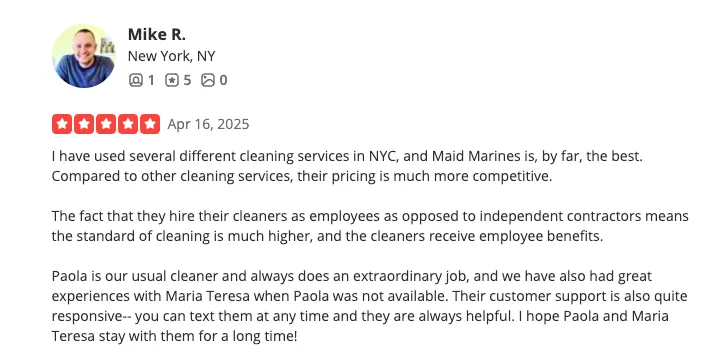
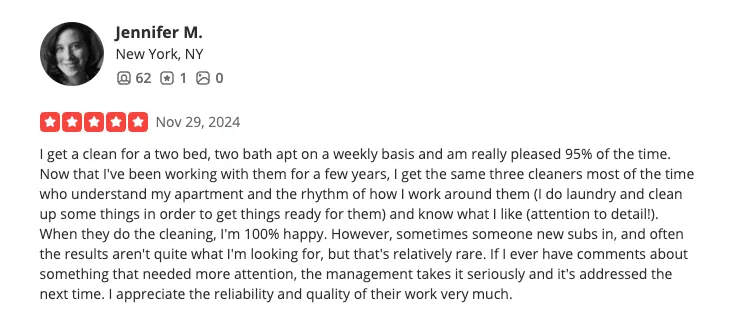
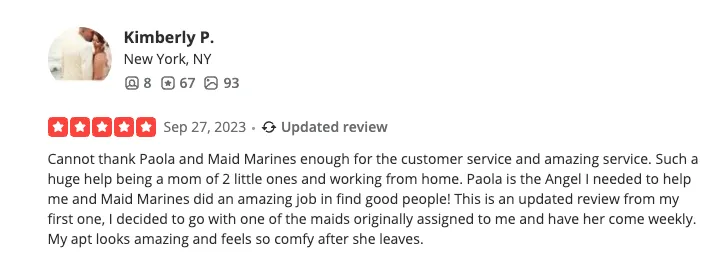
You can book a cleaning and see your flat-rate price before committing to anything. Our teams are W-2 employees, vetted and insured, and they bring everything they need. We serve the full neighborhood: two-family brick homes on the interior residential streets, postwar apartment buildings along the commercial corridors, and the single-family detached homes near the neighborhood’s edges. We also serve nearby Flushing, Kew Gardens Hills, Forest Hills, and Fresh Meadows.