
The name Kew Gardens Hills contains a small historical chain worth following. The neighborhood is named for Kew Gardens, the planned community immediately to its west. That community was named for Kew Gardens in London, specifically the Royal Botanic Gardens at Kew, one of the world’s great botanical institutions, established in 1759 in the London Borough of Richmond. A modest residential neighborhood in central Queens is, in this sense, the final link in a chain that originates in the English aristocratic tradition of botanical science. Most people who live here have never thought about this. The neighborhood does not trade in that kind of self-referential history. It is too busy being itself.
What Kew Gardens Hills is, in 2026, is one of the most internally complex and culturally specific neighborhoods in New York City. The dominant character is Orthodox Jewish: perhaps 65 to 75 percent of residents identify as Jewish, making this one of the most concentrated Jewish communities in America outside of Brooklyn’s Boro Park and Williamsburg. But within that broad designation there is an entire world of internal diversity. Ashkenazi families who have been here since the 1950s. Sephardic families from Morocco, Syria, and Turkey. Bukharan Jews from Uzbekistan and Tajikistan, representing one of the oldest Jewish communities in the world. Russian Jewish immigrants from the Soviet collapse who arrived in the 1970s and 1980s. Modern Orthodox professionals. Haredi families whose lives are organized entirely around religious law and community. Israeli families. American-born Orthodox families in their second and third generations in this neighborhood. They all live here, they all walk the same streets, and they mostly buy from the same kosher butchers and the same Jewel Avenue bakeries.
This is the context in which the cleaning job happens. Understanding it makes the work better.
How a neighborhood in Queens became a center of world Judaism
The land was farmland into the early 20th century. When the Man Brothers development firm built the planned Kew Gardens community beginning in 1910, they extended their project eastward along Jewel Avenue and Union Turnpike to take advantage of the terrain, which is genuinely hilly here by Queens standards. The glacially sculpted hills that give the neighborhood its name were a selling point. The Hills suffix was a deliberate marketing choice to distinguish the new development from the established Kew Gardens district while borrowing its prestige.
The decisive event was the postwar migration. After World War II, Orthodox Jewish families began leaving Brooklyn in large numbers. Brownsville, Crown Heights, and Flatbush were changing. The new highway infrastructure and the expanding transit network opened Queens. Yeshiva Toras Chaim established itself in Kew Gardens Hills. Synagogues followed. Kosher butchers and bakeries opened on Jewel Avenue. The religious infrastructure needed for observant Jewish life assembled itself block by block, and each new institution made the neighborhood more attractive to the next family considering a move.

By the 1960s, Kew Gardens Hills was one of the most concentrated Orthodox Jewish communities in the United States. By some measures it still is. The neighborhood contains more yeshivas and Orthodox day schools per square mile than any comparable area outside of Brooklyn’s haredi enclaves. Walking the residential blocks on a weekday morning, you encounter children in yarmulkes and tzniut dress walking to school in groups. The educational economy of the neighborhood is oriented almost entirely toward Jewish religious instruction.
The housing stock tells you why Orthodox families chose this neighborhood and kept it
The postwar apartment buildings that dominate Kew Gardens Hills were not built to look beautiful. They were built to accommodate families, and by that measure they succeeded completely. Four to seven stories of red brick, with uniform windows and flat or gently articulated facades, these buildings went up in the 1950s and 1960s to house the Orthodox families arriving from Brooklyn and the Bronx. The designers understood their market. Units run to three and four bedrooms because Orthodox families are large. Layouts prioritize functional kitchen space, meaningful separation between areas of the home, and enough room to set up the Shabbat table for eight or ten people on a Friday night.
Many of these buildings remain rent-stabilized from their original construction, which is why you find long-tenured families of two and three generations in the same apartment. The building is not particularly impressive from the street. The apartment inside may be enormous by New York standards, with original hardwood floors, thick plaster walls, and windows overlooking a courtyard that was designed with actual attention to light and air.
The prewar brick homes on the interior residential streets, the semi-detached houses built in the 1920s and 1930s, are a different scale and different character. Narrower lots, modest Colonial Revival or Tudor Revival details, original hardwood throughout, and the kind of compactness that makes a prewar home feel more considered than its postwar successors. Owner-occupied, multi-generational, and often containing decades of accumulated living that a thorough cleaning has to understand before it can address.
The largest single-family detached homes sit toward the Kew Gardens boundary, where lot sizes expand and the architecture has more room to breathe. These are the properties where Modern Orthodox professional families tend to concentrate, the homes with private yards, finished basements, and interiors that have been renovated at various points without losing the underlying structure from the 1930s.
The eruv and what it means for the neighborhood’s physical environment
Running on poles and wires along the boundaries of Kew Gardens Hills is a piece of infrastructure that most New Yorkers have never heard of. The eruv is a boundary constructed under Jewish law that extends the definition of private space, allowing observant Jews to carry objects outside their homes on Shabbat, which would otherwise be prohibited. The Kew Gardens Hills eruv is one of the largest urban eruvs in the United States. It is checked weekly for breaks by a dedicated committee. Its status is broadcast by telephone hotline and text alert. The wires and poles are invisible unless you know to look for them.
The practical effect of the eruv on neighborhood life is enormous. Without it, observant families could not push strollers, carry keys, or bring items to synagogue on Shabbat. With it, the neighborhood’s communal life can function as a genuinely walkable community for an entire day every week. The Shabbat experience in Kew Gardens Hills, the weekly cessation of driving and commerce, the sidewalks filled with families in formal dress walking to shul, is only possible because the eruv makes it feasible. It is a piece of religious infrastructure that shapes the physical character of the neighborhood in a way that has no parallel elsewhere in New York City.

Cleaning a postwar family apartment in Kew Gardens Hills
The house cleaning job in a large Orthodox family apartment requires a few understandings that are specific to this neighborhood. First: the kitchen is the center of the home and sees genuine heavy use. These are not kitchens where someone makes coffee and orders delivery. They are kitchens where Shabbat meals for large families are prepared weekly, where holiday cooking runs multiple days, and where the range hood, backsplash, and cabinet faces accumulate grease at a rate that standard all-purpose products do not address. We use degreasing solutions that cut through cooking residue without damaging the finish on cabinet faces.
Second: kosher kitchens require separate cleaning protocols. Separate utensil zones for meat and dairy preparation get separate cleaning cloths and tools. We do not bring products that could create a kashrut problem. If you have specific product preferences for either zone, we use what you provide. This is not an unusual request in Kew Gardens Hills. It is the standard expectation.
Third: floors in prewar and postwar buildings here are often original hardwood that has been maintained with wax rather than sealed with polyurethane. Water damages wax. We use a barely damp microfiber mop with a pH-neutral wood cleaner, not a wet mop, not a steam cleaner. If you have 1930s original hardwood under you right now, the goal of every cleaning visit is to keep it going another hundred years.
We have cleaned over 100,000 homes across New York City. Many of the most carefully maintained ones are in neighborhoods like Kew Gardens Hills, where families have occupied the same apartment for decades and where the surfaces reflect genuine care. Our job is to match that standard.
The Bukharan Jewish community and what it brings to the neighborhood
The Bukharan Jews of Kew Gardens Hills represent the world’s second-largest population of this community outside Israel. They are descendants of Jewish families that have lived in what is now Uzbekistan and Tajikistan for over 2,500 years, a community so old and so geographically isolated that their language, Bukharian (a Judeo-Tajik dialect), their music, and their food developed in ways entirely distinct from the Ashkenazi and Sephardic traditions most people associate with Jewish culture.
The Bukharan community began arriving in Queens in the 1970s as Soviet emigration opened up, and accelerated sharply after the Soviet collapse in 1991. In Kew Gardens Hills and the adjacent Forest Hills and Rego Park areas, they built a complete community infrastructure: synagogues following the Bukharan liturgical tradition, catering halls for the elaborate multi-night weddings that are a centerpiece of Bukharan Jewish culture, bakeries producing non and lavash, and restaurants serving plov and samsa that are, by any honest assessment, some of the most distinct and underknown food in New York City.
The cultural layer this adds to Kew Gardens Hills is not merely demographic. It is visible in the storefronts on Main Street and Queens Boulevard, in the embroidered textiles in the shops, in the languages spoken on sidewalks, and in the kitchens of the apartments our teams clean. Bukharan cooking involves heavy use of lamb fat, rice, and Central Asian spice combinations that produce a different kind of kitchen cleanup than Ashkenazi Shabbat cooking. Our teams understand the difference and bring the right tools.

Deep cleaning before Passover in a neighborhood where Passover matters intensely
There is no annual cleaning event in New York City more demanding than the pre-Passover chametz removal in an observant Jewish household. The requirement to search for and remove all leavened products before the holiday is a religious obligation that drives a level of thoroughness that would be considered obsessive in any other context but is entirely normal here. Refrigerators, ovens, cabinet interiors, pocket seams, couch cushions, car interiors, and every horizontal surface in the home gets attention.
In Kew Gardens Hills, where a very high percentage of households observe Passover at this level of seriousness, the weeks before the holiday represent the most intense cleaning season of the year. Our deep cleaning service in the weeks before Passover is structured to address the whole home thoroughly: appliance interiors, behind furniture, under the stove and refrigerator as far as we can reach, and the accumulated winter detritus that the holiday deadline forces to the surface. Add the cabinet and drawer interiors at booking — for Passover almost every household here wants them, and putting them on the quote up front means no argument about the invoice in April. Book this several weeks in advance. Availability in April in this neighborhood fills up fast.
The fall holiday season, from Rosh Hashanah through Sukkot, is the other major cleaning cycle. Three weeks of holidays, family gatherings, guests staying over, and substantial cooking leave the apartment in a state that calls for a thorough post-holiday apartment cleaning. We schedule these every year for families in the neighborhood who have learned that the gap between Yom Kippur and Sukkot is the right moment.
What makes this neighborhood distinct to service
Kew Gardens Hills is not a neighborhood that performs its identity for outside observers. The community is organized around its own requirements, its own calendar, and its own institutions. The businesses on Jewel Avenue are oriented toward community members, not tourists. The yeshivas and synagogues are not attractions. The Shabbat walk is not a staged event. It is the natural expression of how 25,000 or more observant Jews have organized their weekly lives in a Queens neighborhood.
For a cleaning service, this specificity is an asset, not a complication. We know this neighborhood. We understand kosher kitchen protocols. We know which buildings have elevator scheduling requirements. We know that large postwar apartments with three and four bedrooms take more time than a studio in Midtown and we price accordingly. We know the difference between a first cleaning of a home that has been occupied by the same family for thirty years and a recurring maintenance clean of a well-maintained co-op.
For move-in and move-out cleaning, the rental market in Kew Gardens Hills moves in cycles tied to the school year and the Jewish calendar. June and August are the peak transition months. A thorough move-out clean that meets the landlord’s standard means cleaning inside every cabinet and closet, pulling appliances to clean behind them, scrubbing grout in bathrooms, and leaving the floors spotless. That is what we do on every move-out job.
The rest of the city does not notice Kew Gardens Hills much
This is intentional. The community has arranged its environment to serve its own needs and, in doing so, has created one of the most self-contained and coherent neighborhood cultures in New York City. If you are part of the community, the neighborhood offers extraordinary density of everything you need: religious institutions, schools, kosher food of remarkable variety, a functioning eruv, and a weekly rhythm organized around the Jewish calendar rather than the secular one.
If you are not part of the community, the neighborhood offers something rarer in New York: a window into how a large, internally complex community maintains its practices against every social pressure toward assimilation. Walking Jewel Avenue on a Friday afternoon is not like walking anywhere else in the five boroughs. The smell, the pace, the languages, the preparations, and the quiet that follows at sundown compose an experience that is genuinely distinct.
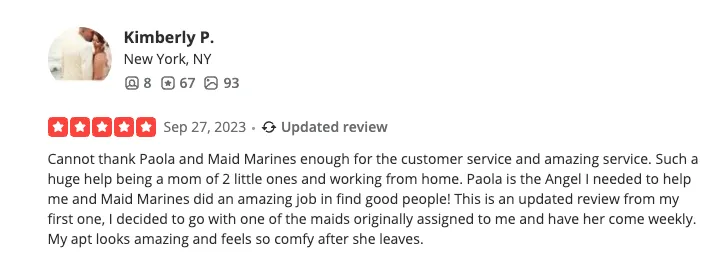
You can book a cleaning for any day that works for your household. See your flat-rate price before you commit. Our cleaners are W-2 employees, not gig workers. They are vetted, insured, and they arrive with the right products for your home. We serve the full neighborhood: postwar brick apartments on the Jewel Avenue corridor, prewar homes on the interior streets, and single-family houses near the Kew Gardens boundary. We also serve nearby Forest Hills, Sunnyside, Astoria, Long Island City, and the rest of Queens.