
Seaside is the neighborhood that named the beach before anyone had a name for the neighborhood. The Seaside House hotel opened on the Jamaica Bay shore of the Rockaway Peninsula in 1856, when the western end of the peninsula was still mainly reachable by boat or carriage from Far Rockaway. Wealthy New Yorkers arrived for sea air and ocean bathing, and the hotel was popular enough that the surrounding land took on its name. The hotel operated for 85 years, closed in 1941, and has been gone long enough that almost no one on the peninsula would know where it stood. But the street running through the neighborhood in place of what would otherwise be Beach 103rd Street is still called Seaside Avenue. The subway station at the western edge still carries the neighborhood’s name as its primary identifier. The name is everywhere and the hotel is nowhere, which is a fairly accurate description of how most of Seaside’s history works.
A resort hotel, a railroad, and 7,000 bungalows that mostly no longer exist
The Lenape people called the Rockaway Peninsula Reckowacky, meaning “place of sands.” They fished and oystered Jamaica Bay for generations before Dutch and then English colonial authority arrived in the 1640s and 1660s. The western-central section of the peninsula, the land that would become Seaside, remained remote and undeveloped through most of the early American period. You got there by boat from the bay side or by long carriage routes from Far Rockaway. Not many people bothered.
Sea bathing changed that. By the 1830s and 1840s, wealthy Manhattan families had decided that salt air and Atlantic water were medicinal, and the Rockaway Peninsula’s proximity to the city made it a practical destination for those with the resources to reach it. Grand resort hotels appeared first on the eastern end of the peninsula. The Seaside House, opening in 1856 on the bay-facing north shore, pushed the resort frontier westward and established the specific stretch of the peninsula that carries the neighborhood’s name today.
The railroad is what opened the area to everyone else. The Long Island Rail Road extended its Rockaway Beach Branch to a station at approximately 102nd Street in 1880, naming it Seaside Station. The LIRR did not just bring wealthy visitors more efficiently. It brought working-class families from Brooklyn, Manhattan, and the Bronx who could not afford hotel stays but could afford to rent a small summer cottage for a week or a season. The bungalow era began. At its peak in the early 20th century, the Rockaway Peninsula had over 7,000 seasonal cottages packed along narrow interior streets, front porches lined with chairs, families returning to the same bungalow summer after summer and forming communities that lasted decades.

Seaside’s bungalows were more modest than those in Belle Harbor and Neponsit to the west. The clientele was working-class rather than middle-class, drawn to the cheap rents and the beach itself rather than the social prestige of the fancier western communities. Beach 98th Street’s proximity to the Steeplechase amusement venue, which eventually gave the subway station its secondary Playland designation, meant that Seaside sat at the intersection of the resort economy and the amusement economy simultaneously. The boardwalk, the bathhouses, the beach, the rides. It was noisy and communal and seasonal, and it worked.
Urban renewal arrived, cleared most of it, and built towers facing the ocean
The decline of the Rockaway resort economy after World War II was swift and difficult to stop. Suburban backyards, cars, and a widening American vacation industry drew summer visitors away from the peninsula. The bungalows lost their economic purpose. The city acquired large sections of the residential fabric, and what followed was one of the sharper episodes of mid-20th century New York urban renewal anywhere in the outer boroughs.
Under the Mitchell-Lama Housing Program, a New York State initiative that provided financing for middle-income rental housing, the south shore beachfront of Seaside was redeveloped with large-scale apartment towers. The 13-story, 265-unit building at 1 Beach 105th Street completed in 1966 was among the first. More followed. The bungalows that had packed the area for 70 years were cleared. In their place came towers of brick and functional modernism, built for middle-income year-round families rather than working-class summer renters, designed to house people who needed affordable housing with stable long-term tenancy rather than people who needed a place to sleep between beach days.
The result was architecturally unusual in one very specific way. Mitchell-Lama housing is normally associated with dense interior neighborhoods far from any coastline. In Seaside, the program built middle-income regulated-rent housing directly on the Atlantic Ocean. Upper-floor apartments in the towers have direct views of the water. Regulated rents for one- and two-bedroom units have historically run $800 to $1,500 per month, a fraction of what oceanfront apartments command anywhere else in the five boroughs. The waiting lists through HPD are long and the vacancies rare, but for the residents who got in, the apartments represent one of the more extraordinary value propositions in New York City housing.
The people in these buildings have been here, quietly, for a long time
The social character of Seaside is shaped by long-term Mitchell-Lama tenancy in a way that is different from most New York City residential neighborhoods. People who enter these buildings through waiting lists and income verification tend to stay. Some residents have lived in the same apartments for decades, entering as young families and aging in place. Children of original tenants have inherited leases. The buildings function as community institutions in the way that parishes and civic associations function elsewhere: tenants know each other, watch each other’s grandchildren, and maintain relationships across years of shared laundry rooms and elevator rides.
The demographic mix in Seaside reflects the Mitchell-Lama program’s original intent and its subsequent evolution. White, Black, Caribbean-American, Hispanic, and a smaller Asian population share the buildings. Irish-American and Jewish-American families with historical ties to the Rockaway summer community have year-round representation alongside Caribbean-American families and Latino households who arrived through later waiting list cycles. The program produces a genuinely mixed community by income and background, which is relatively rare in New York City housing and even rarer in oceanfront property.
Fewer than 400 original bungalows survive across the entire Rockaway Peninsula. Seaside’s share is modest: scattered on interior blocks that the urban renewal clearance bypassed, one- and one-and-a-half-story wooden frame cottages with front porches and the compact footprint of buildings that were never meant for winter. They are among the most visually evocative structures in the neighborhood, direct architectural evidence of the bungalow community that defined the area before the towers arrived.

Two subway stations and a name embedded in the MTA’s signage
Seaside has two IND Rockaway Line stations within its borders, which is notable given the neighborhood’s small footprint and modest population. Beach 98th Street–Playland at the center and Beach 105th Street–Seaside at the western edge both serve the A train at rush hours and the Rockaway Park Shuttle at all times. Travel to Midtown Manhattan runs 65 to 75 minutes via the bay crossing through Howard Beach.
The Beach 105th Street station carries the neighborhood’s name as its primary identifier. It is one of the few stations in the entire MTA system where a neighborhood name functions as the main designation rather than a cross street. The neighborhood it names was itself named after a hotel that has been gone since 1941. The station reopened on June 28, 1956, converted from the former LIRR Seaside Station that the railroad had operated on essentially the same site since 1880. That continuity of name across more than 140 years of changed infrastructure, changed ownership, changed transportation technology, and a demolished hotel is the kind of layered specificity that most neighborhoods never accumulate.
The Beach 98th Street station’s Playland designation traces the same kind of layered history. The LIRR opened the station in April 1903 as Steeplechase, after an amusement venue of that name on the peninsula. It was renamed for Rockaways’ Playland, the amusement park that ran from 1896 to 1987 roughly a mile west at Beach 116th Street. Playland closed. The name stayed on the sign. The subway station in Seaside is, at two removes, named after an amusement park that has not existed in nearly 40 years, which was itself named after an amusement venue that preceded it.
Salt air, bungalow wood, and Mitchell-Lama towers all clean differently
Living on the Rockaway Peninsula means living in proximity to the Atlantic Ocean and Jamaica Bay simultaneously. The salt air is constant. It gets into window tracks, corrodes hardware, and works its way into the porous surfaces of older buildings in ways that interior-neighborhood apartments never have to contend with. On upper floors of the Mitchell-Lama towers, ocean-facing windows accumulate mineral deposits from sea spray that turn streaky when wiped with ordinary glass cleaner. The tracks beneath the windows collect packed salt and grit that, left alone, corrode the metal and eventually jam the windows in their frames.
The surviving bungalows present a different set of challenges. Wood that has weathered decades of salt air and humidity is porous and fragile in ways that new construction is not. Painted trim that looks solid can absorb water quickly if you apply it wrong. Floors that have expanded and contracted through enough New York winters have gaps and surface irregularities that collect dirt in patterns a standard mop will push around rather than lift. These buildings need low-moisture methods and attention to the way their materials actually behave rather than a one-size-fits-all approach borrowed from glass-tower apartment service.
The Mitchell-Lama apartments themselves are broadly similar to any mid-century New York apartment stock: plaster walls, the accumulated wear of long-term tenancy, windows that face the ocean and collect everything the ocean sends. The key difference from typical apartment cleaning services is the building management layer. Mitchell-Lama buildings have management offices, vendor access procedures, and coordination requirements that vary by building. We handle that coordination before the appointment rather than discovering it at the door.
The recurring cleaning model makes particular sense in Seaside because the salt air environment means maintenance intervals matter. An apartment that goes three months without attention in Rockaway accumulates more grime on window sills and tracks than a comparable apartment in Flushing or Forest Hills. The boardwalk and beach traffic that comes through from late May to Labor Day brings sand into hallways and entryways in quantities that reward a regular cleaning schedule rather than an annual push.
The boardwalk is less crowded here than you would expect
The Rockaway Boardwalk runs 5.5 miles along the peninsula’s Atlantic shore. The most visited sections are near Beach 116th Street in Rockaway Park, where the concession stands, surf culture businesses, and the A train terminus concentrate visitors. The sections near the new development in Arverne draw their own crowds. The Seaside stretch, between Beach 90th and Beach 105th Streets, is the quieter middle.
On a weekday morning in July, you can walk the boardwalk in front of Seaside with room to move. The Mitchell-Lama residents who have been here for decades use it the way the bungalow community once used it: not as a destination but as a front yard. They walk it in the early morning before the visitors arrive. They sit on the benches facing the Atlantic in the late afternoon. The boardwalk was rebuilt after Hurricane Sandy damaged it in October 2012, and the new structure is sturdier than what it replaced. The sand is the same sand that has been there for as long as anyone can remember.
The deep cleaning timing that makes the most sense in Seaside follows the boardwalk season. Before Memorial Day, when the beach traffic is about to start, is the best window to reset an apartment or bungalow after the closed-up winter. After Labor Day, when the last of the summer sand has been tracked in and the salt buildup from a full season of open windows has accumulated, is the right moment for another pass. The shoulder seasons reward a cleaning schedule that accounts for them.
Seaside residents heading to Rockaway Park for food and services are a 10 to 15 minute walk or short bus ride from the Beach 116th Street scene. Caracas Arepa Bar, Seany Pizza, and the cluster of restaurants that have built up around the western terminus of the A train are the primary dining destinations for the neighborhood. The seasonal NYC Ferry from near Beach 108th or 116th Street connects to Lower Manhattan during the summer months. The Q22 bus runs east and west along Rockaway Beach Boulevard. The Q35 connects to Howard Beach and cuts travel time to JFK.
The neighborhood you book from, and what happens after
You select your date and time on our booking page. You see the flat-rate price for your apartment, bungalow, or single-family home before you commit to anything. If your Mitchell-Lama building has vendor access requirements, you tell us once and we handle the coordination with management. Our cleaners arrive with everything they need.
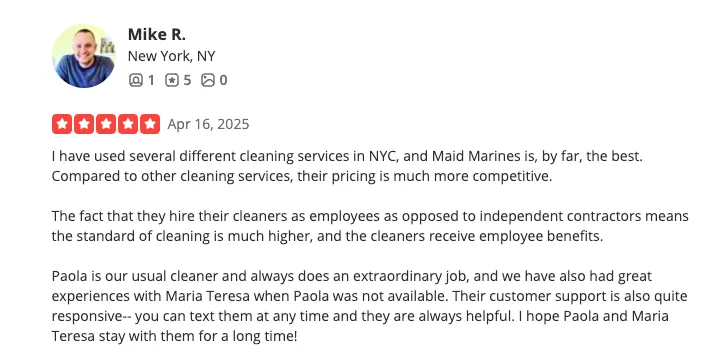
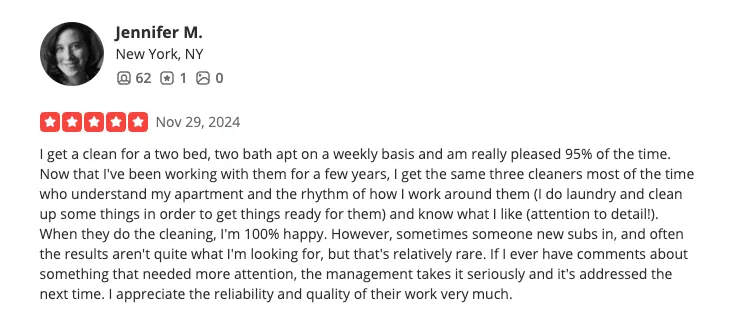
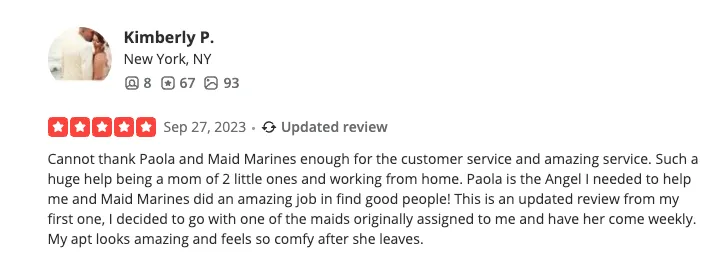
Our cleaners are W-2 employees, not gig workers. They are vetted, insured, and trained for the specific conditions of the Rockaway Peninsula housing stock: the salt air surfaces, the aging bungalow wood, the ocean-view tower apartments with window tracks that deserve attention. For residents of the surrounding areas, we also serve Rockaway Park, Far Rockaway, and Howard Beach.
Seaside does not need to be discovered to know its own value. The residents in the Mitchell-Lama towers have known for decades that they live in one of the stranger and more quietly remarkable situations in New York City: affordable apartments on the Atlantic Ocean, accessible by subway, in a neighborhood that named the beach. That is a place worth keeping clean.