

Sunnyside Gardens sits inside a dense western Queens neighborhood and feels like somewhere else entirely. Walk through the front block of rowhouses on any of the numbered streets between 39th and 50th, and the city noise drops. Mature trees filter the light. A narrow pedestrian lane cuts between rear gardens into an interior courtyard shared by the families on all four sides of the block. Children move between blocks without crossing a street. Someone is weeding. Someone else is reading. The scale contracts to something that does not normally exist two 7 train stops from Times Square.
This is not an accident. Sunnyside Gardens was designed in 1924 by architects Clarence Stein and Henry Wright for the City Housing Corporation, a progressive development organization founded by Alexander Bing with the explicit goal of building quality affordable housing for working-class New Yorkers. What they built on 77 acres of former Queens farmland became the first American application of Ebenezer Howard’s Garden City principles, the most studied planned residential community in American urban history, and in 1984 the first planned residential community in New York City to receive Landmarks Preservation Commission designation. The rowhouses are protected. The courtyard system is protected. The social experiment frozen in brick and shared green space is protected.
The people who live here know all of this. Most of them knew it before they moved in.
A British reformer’s idea crossed an ocean and became a Queens block
Ebenezer Howard published his framework for the Garden City in 1898. His argument was that the industrial city and the empty countryside were both failures and that a third option was possible: planned communities at moderate density, built with abundant green space, shared institutions, and human-scale architecture. Howard’s ideas were idealistic, precise, and enormously influential. Two English Garden Cities, Letchworth and Welwyn, were built directly from his principles in the early 20th century.
In New York, the planners who took Howard seriously were architects and social reformers with a specific agenda. Stein, Wright, and the Regional Plan Association of America wanted to demonstrate that working-class housing in an American city could include what wealthy neighborhoods took for granted: space, light, green, and a community life built into the physical design of the place. They found a 77-acre site in Sunnyside, Queens, bought it at reasonable cost because it sat adjacent to the Long Island Rail Road right-of-way, and started building in 1924.
The design principle that makes Sunnyside Gardens distinctive is the perimeter arrangement. Each block of rowhouses faces outward to the street in the conventional manner, but the interior of the block is left entirely open as shared green space. No fences, no private property lines, no individual gardens claiming the interior. Just open lawn and communal garden plots accessible to every household on the block. The courtyards were not decoration. They were the mechanism of community life, the space where neighbors became neighbors rather than just adjacent strangers.
Construction finished in 1928. The Great Depression hit two years later and bankrupted the City Housing Corporation, forcing sales of the properties to individual owners. The cooperative management model ended. But the physical community survived intact, and the people who bought their homes at Depression-era prices found themselves living in something that could not be replicated at any price.
Lewis Mumford wrote his most important books here and called it the best years of his life
Lewis Mumford is not a household name outside urban planning and architectural history, but he is probably the most important American writer on cities and human settlements in the 20th century. His books, particularly “The Culture of Cities” from 1938 and “The City in History” from 1961, shaped how architects, planners, and politicians thought about what cities were for and what they could become. He won the National Book Award. He wrote for The New Yorker for decades. His collected work on the relationship between human scale and urban form influenced everyone from Jane Jacobs to contemporary New Urbanists.
Mumford moved into Sunnyside Gardens in 1925, one year after construction began. He and his wife Sophie lived at 4002 Skillman Avenue in a two-story brick rowhouse that looks exactly like its neighbors on both sides. He wrote “Sticks and Stones,” “The Golden Day,” and the early chapters of “The Culture of Cities” at that address. He stayed for eleven years. In his autobiography, “Sketches from Life,” he described the Sunnyside Gardens period as the best years of his life and credited the community with forming his thinking about what human-scale urbanism could actually feel like from the inside.
What Mumford was responding to is still there. The rowhouse he lived in is still there. The scale is still there. The morning light in the courtyard behind 4002 Skillman Avenue in late spring is probably not dramatically different from what it was in 1930. Mumford left before the fence controversy began, before the landmark fight, before the community became expensive. He left when the Gardens were simply a working community of intellectuals, labor organizers, writers, and working-class families who had found an unusual place to live.

The fence controversy and the landmark fight that followed
By the 1960s, Sunnyside Gardens residents had lived with open shared courtyards for forty years. The original cooperative management model was long gone, replaced by private ownership, and some homeowners wanted private yards. The City of New York, responding to that pressure, permitted residents to enclose portions of the courtyard interiors with fencing.
Clarence Stein was still alive. Lewis Mumford was still writing. Both were devastated. In their view, the shared courtyards were not an aesthetic feature or a design flourish. They were the functional mechanism of the entire social experiment. Without the shared open interior, the Gardens were just a nice block of rowhouses. The fencing decision, in their reading, was a fundamental betrayal of what the community had been built to demonstrate.
A significant portion of the courtyard interiors were eventually enclosed. The blocks where the original open character has survived are distinguishable from those where private fencing has subdivided the space. Both exist today, side by side.
The landmark campaign that followed was a direct response to what the fences had done. Preservation advocates, working through the 1970s and early 1980s, pushed for a New York City Landmarks designation that would freeze the exterior character of the buildings and protect whatever remained of the courtyard system. The designation was granted in 1984. Sunnyside Gardens became the first planned residential community in New York City to receive that protection, recognized not for architectural grandeur but for planning significance and social history.
All exterior alterations within the district now require Landmarks Preservation Commission approval. New windows must match the originals. Additions are subject to review. The brick facades, the stoop details, the rooflines, the window proportions that give the community its coherent visual character are protected by law. This adds process for homeowners who want modern upgrades. It also means that a home built in 1924 still looks like a home built in 1924, which is why people pay what they pay to live here.
What a 1924 rowhouse actually requires from a cleaning team
The landmark status of Sunnyside Gardens is not just a historic designation. It is a description of the cleaning problem.
The clay tile in the original bathrooms is often unglazed or lightly glazed, depending on which block and which renovation history the home carries. Acid-based cleaners, which includes many standard bathroom sprays, etch the surface permanently. Abrasive scrub pads wear down what remains of the finish. The correct approach is a pH-neutral solution applied with soft cloths and a microfiber mop. The grout lines between original tiles are porous in ways that modern grout is not, and they absorb colored cleaners if left to sit. We clean and rinse quickly, not letting product dwell on surfaces that have no protection left against absorption.
The hardwood floors have been sanded multiple times across a century. On an original floor that has been sanded six or seven times, the wear layer remaining above the tongue-and-groove joint is thin. Standing water raises the grain. Wet mopping with any significant moisture risks cupping the boards over time. We use a barely damp microfiber mop with a wood-safe neutral cleaner, followed immediately by a dry pass. Nothing pools. Nothing sits. On sections where the finish has worn through entirely, we skip product and use only a dry microfiber.
The shared courtyard access means garden soil coming through the rear door from April through October on every cleaning visit. Grit on these original floors is an abrasive, not just a cosmetic issue. The entryway and the path from the back door to the kitchen are the first areas we address, vacuuming before any floor work begins, so we are not spreading what came in from outside across the room.
The cast-iron radiators that run on steam heat through winter collect dust straight through the warm months, and what settles into them burns off when the heat starts in October. That is the smell Gardens residents recognize in the first week of the season. What a cleaning visit reaches is the outside of the unit: covers, enclosure tops, and the vent covers above them get dusted every time we are in the room, which keeps the dust load in the apartment from climbing all summer.
The plaster walls in original rowhouses carry decades of paint layers that are softer and more porous than modern drywall compound. We avoid aggressive scrubbing on wall surfaces and use soft cloths with minimal moisture. The millwork around windows and doors, original trim that has survived a hundred years, gets dry dusting before any damp cleaning, and we never use product directly on bare or thinly painted wood.
None of this requires a specialist or a premium service category. It requires people who have cleaned these homes before and know what they are working on.
The planning legacy that students still study in 2026
Stein and Wright did not stop at Sunnyside Gardens. Their design team moved on to Radburn, New Jersey in 1928, applying the courtyard principle at a larger suburban scale. The British New Town movement of the 1950s and 1960s drew directly from the Stein-Wright model. American federally funded housing projects of the New Deal era were influenced by the Garden City principles first demonstrated in western Queens.
The academic literature on Sunnyside Gardens is substantial. The community appears in essentially every serious American urban planning curriculum alongside Rockefeller Center, Jane Jacobs’s Greenwich Village, and Robert Moses’s housing projects as one of the defining New York City urban design stories of the 20th century. Architecture students make pilgrimages to 4002 Skillman Avenue. Planning professors tour the interior courtyards.
The people who live here are generally aware of all this and wear it without ceremony. The neighborhood functions as a neighborhood. The block associations are active because residents care about the block, not because they are maintaining a museum. The Sunnyside Gardens Preservation Alliance holds regular meetings about specific current issues, not about the history. The history is the context, not the subject.

Two 7 train stops from Times Square, priced like it
The 46th Street and 52nd Street stations on the IRT Flushing Line give Sunnyside Gardens direct access to Midtown Manhattan in roughly 20 minutes. The Woodside LIRR station, one stop east on the 7, reaches Penn Station in nine to twelve minutes. This is one of the fastest Queens-to-Midtown commutes available at a rowhouse price point.
The real estate numbers reflect the combination of landmark protection, transit access, and genuine architectural quality. Single-family and two-family rowhouses trade between $900,000 and $1,800,000 depending on condition, size, and how much of the original material survives. Turnover is low. Homes that come to market sell quickly and often above asking price. The community attracts buyers with long time horizons who are purchasing a neighborhood as much as a house.
The landmark designation means exterior renovation projects involve LPC review, which adds process and sometimes cost. The tradeoff is that the community cannot be gradually altered into something it was not built to be. The brick will stay warm-tan brick. The stoops will stay proportioned to 1924 standards. The scale will stay two and three stories. The physical character of the neighborhood that attracted the buyer is protected from what the next buyer might want to do.
Your Saturday afternoon belongs in the courtyard, not cleaning it
Sunnyside Gardens has some of the most interesting walks available in western Queens. The interior lane system, where you can move between courtyard blocks through pedestrian paths that no car has ever used, is available to residents and their guests. In spring and early summer, when the mature trees are fully leafed and the garden plots are active, the interior of the Gardens is genuinely quiet in a way that requires experience to fully believe is two subway stops from Times Square.
Skillman Avenue is immediately adjacent along the northern boundary. The full commercial strip, from Korean groceries to Colombian bakeries to a wine bar that opened last year, covers about six blocks. Quaint at 46-10 Skillman is the best dinner option in the immediate neighborhood, with a seasonal menu and a room that does not rush you. Cositas Ricas does Colombian home cooking without any of the performance. The Romanian butcher has been in the same storefront since 1978.
Lou Lodati Park at 43rd and 48th has shaded benches and enough space to spend a morning. The Phipps Garden Apartments, Clarence Stein’s 1931 follow-up to Sunnyside Gardens, is worth walking past to see how the courtyard model scaled up to apartment-building density.
The 7 train puts you at Flushing Meadows-Corona Park in fifteen minutes or Times Square in twenty if you want to run errands in Manhattan. Or stay in the neighborhood. The courtyard will be quiet. The floors will have been cared for properly. The garden soil tracked in from the back door will be gone.
We also serve nearby Sunnyside, Woodside, and Long Island City. When you are ready to book a cleaning, you will see your flat-rate price on the booking page before you commit to anything.
What a recurring cleaning protects in a 102-year-old home
The case for a regular cleaning service in a Sunnyside Gardens home is more straightforward than in a newer building. Original surfaces age faster under neglect than under careful maintenance. The clay tile grout absorbs soap and mildew incrementally. The hardwood floors accumulate grit that acts on the wood grain between cleanings. The radiator fins fill with dust that the next heating season will burn off. The garden soil that tracks in from the shared courtyards builds up in the entryway and gets carried further with every pass through the front door.
A regular cleaning appointment addresses each of these things on a schedule that keeps them from compounding. A house that has been consistently maintained is not just cleaner than one that receives one annual deep clean. It ages better. The surfaces that have survived since 1924 survive longer when they are cleaned correctly on a regular basis.
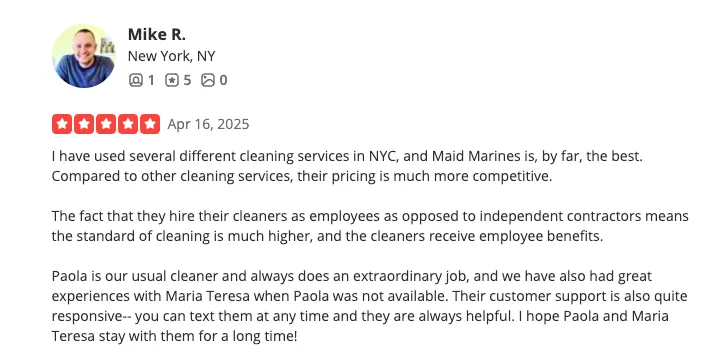
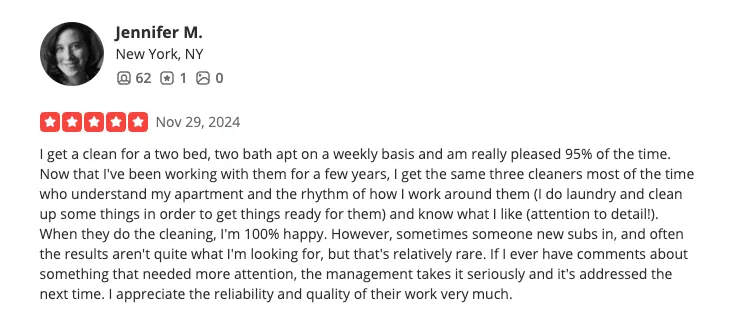
Our cleaners are W-2 employees, vetted and insured, and they bring everything they need. If you have preferences about specific rooms, surfaces, or products, you tell us once and we follow them on every visit. If the Landmarks designation makes you particular about how exterior-facing materials are treated on your interior, we understand why. We have worked in these homes before.
For a deep clean before a sale, after a renovation, or before the heating season begins in fall, we schedule the time the home requires. A pre-listing deep clean in a landmark rowhouse is different work than a deep clean in a new construction condo, and we price and staff it accordingly.