
Woodside got its name from a real estate developer in 1857, the year Benjamin Hitchcock subdivided the farmland around the new Long Island Rail Road station and needed something to put on the marketing maps. The land was wooded in patches, which was enough. The name described a fact about the landscape and it worked. It is 170 years later and the name has outlasted the woods, outlasted the farms, outlasted the Irish construction workers who built the first rowhouses, and outlasted every wave of change that followed them. Under the 7 train on Roosevelt Avenue, with Filipino BBQ smoke in the air and a Colombian cumbia playing from a restaurant down the block and Tagalog and Spanish and Bengali audible from three different conversations on the sidewalk, the name Woodside still sounds right.
This is one of the most quietly extraordinary neighborhoods in New York City, and it has been since well before anyone in Manhattan noticed.
The railroad came first, then the Irish built everything else
The Long Island Rail Road established a station in the area in 1857 and the neighborhood name followed almost immediately. But real development came slowly. The Victorian cottages that went up in the 1860s and 1870s were modest and scattered, middle-class families willing to commute into Manhattan on the early LIRR service. The terrain was gentle, the drainage was good, and the connection to Manhattan was real if not fast.
The Irish changed everything. Beginning in the 1880s and accelerating through the turn of the century, Irish immigrants found Woodside’s modest rowhouses and affordable rents suited exactly to what they needed. They were construction workers, transit workers, civil servants, and small businesspeople who needed to reach Manhattan daily and needed a neighborhood that fit a working-class wage. The Catholic parishes organized community life: Sacred Hearts of Jesus and Mary on 61st Street and Woodside Avenue became the neighborhood anchor. St. Sebastian’s followed. The Ancient Order of Hibernians established chapters. Gaelic football leagues formed. The Irish bars that opened along Roosevelt Avenue in these decades were not decorative. They were where people gathered after work and on weekends and after funerals, which is what Irish bars have always been for.
By the 1920s, Woodside was as Irish as any neighborhood in Queens and more Irish than most. The community was at its peak between the wars, filling the rowhouses that kept going up on every side street and the apartment buildings rising along the major corridors.

The 7 train arrived in 1917 and the rowhouses went up block by block
When the IRT extended the Flushing Line to Woodside in 1917, the elevated structure went up along Roosevelt Avenue and the construction boom that followed was fast and consistent. The attached brick rowhouses that define the neighborhood today were built in dense rows between roughly 1917 and 1940. Two stories, three stories, brick facades, stoops, modest cornices. Plain compared to the grander rowhouses in Mott Haven or Bedford-Stuyvesant, but honest about what they were: working-class homes built quickly for working-class families who needed them.
The result is one of the most coherent residential fabrics in western Queens. Block after block of consistent brick scale, warm-toned fronts, stoops with iron railings, cornices that have survived a century of weather. Walk the side streets between 52nd and 69th Streets from roughly Woodside Avenue down to 54th Avenue and the architectural character rarely breaks. The commercial corridors on Queens Boulevard and Roosevelt Avenue scale up to four, five, six, and seven-story prewar brick apartment buildings with one- to three-bedroom units and lobbies that still have their original tile. The elevated 7 train structure over Roosevelt Avenue gives the street its particular covered-arcade quality, iron columns creating partial shelter along the sidewalk while the trains rattle through overhead.
This housing stock is what it is: durable, well-built for its era, and now carrying a century of use. The rowhouses that went up in the 1920s have plaster walls, original ceramic tile in the bathrooms, hardwood floors that have been sanded and refinished with varying levels of care, and cast-iron radiators on the steam-heat system that most buildings still run. The radiators are worth a word before any conversation about cleaning services. Dust works its way into the fins all spring and summer, and when the steam heat kicks on in October it burns off and fills the apartment with a particular smell every long-term Woodside resident knows. What we clean is everything on the outside: the radiator covers, the tops of the enclosures, and the vent covers, dusted on every visit instead of skipped because they sit low and out of the sightline.
The Clinton administration named the 7 train a National Heritage Trail for running through Woodside
In 2000, the Clinton administration designated the 7 train corridor an official National Millennium Trail, one of sixteen named across the country. The reason was straightforward: the line runs through one of the most ethnically concentrated corridors on earth, with significant immigrant communities from dozens of countries within a few stops of each other. From Flushing’s Chinese and Korean commercial districts through Jackson Heights and Woodside to Hunters Point and the East River, the 7 train passes through communities representing dozens of nations in a thirty-minute ride.
Woodside sits in the middle of this corridor, and what the designation recognized was something the neighborhood has known for decades. This is not a diversity that is performed or marketed or maintained for any external audience. It is what happens when immigrants keep arriving, keep finding affordable housing, keep building communities, and keep staying long enough to establish something real.
The Filipino community, arriving in significant numbers after the 1965 Immigration and Nationality Act removed national-origin quotas that had previously limited Asian immigration, transformed the neighborhood more visibly than any group since the Irish. By the 1990s, the blocks around 69th Street and Roosevelt Avenue had developed a concentration of Filipino businesses, restaurants, bakeries, remittance agencies, nursing recruitment offices, and Catholic churches with Tagalog masses dense enough to earn the designation Little Manila. It was not a marketing term. It was a geographic fact.
Ihawan at 40-06 70th Street is the restaurant that puts Little Manila on the map for food writers and adventurous eaters from across the city. Filipino BBQ over live coals, crispy pata that has been cited in more best-of lists than any other Filipino dish in New York, and the kind of festive, smoky, loud dining room that makes you feel like you arrived at the right party. The Colombian and Bangladeshi and Mexican communities that followed built their own institutions along the same corridor. A Bangladeshi halal cart parks near a Mexican taqueria near a Colombian lunch counter near a Filipino bakery. The Emerald Isle Immigration Center is three blocks up Skillman Avenue, still serving Irish immigrants and their descendants and hosting community events as it has for decades.

What rowhouses and prewar apartments actually need from a cleaning team
Walk from a two-family rowhouse on 58th Street to a prewar co-op on Queens Boulevard and you are covering a century of construction in four blocks. The cleaning approach changes with the building.
The rowhouses are where the original materials survive longest. The ceramic tile in the bathrooms of a 1920s Woodside rowhouse is often lightly glazed or unglazed in sections, which means an acidic cleaner will etch it and leave a dull spot that no amount of scrubbing removes. The hardwood floors in these buildings have been refinished a variable number of times across a hundred years. Some are in good condition. Some have thin finish layers. A wet mop that pools and sits will raise the grain in ways that cannot be undone without sanding. We use a flat microfiber mop with a wood-safe solution and we never let water stand.
The kitchens in these rowhouses reflect the cooking habits of the families who live there, and in Woodside that means heavy use. Filipino households with daily rice cooking, adobo, and fried fish. Colombian households with arepas, bandeja paisa, and daily stovetop cooking. Bangladeshi households where mustard oil and spice-heavy preparations build a film on cabinet faces and range hood undersides that all-purpose spray will not cut. We use a food-safe degreaser on those surfaces. We know the difference between a kitchen that sees twice-weekly cooking and one that runs a full dinner production six nights a week.
The prewar apartment buildings along Queens Boulevard and the Roosevelt Avenue corridor present a different set of considerations. Tiled lobbies, steam radiators, high ceilings in good-sized rooms, and occasionally a co-op management office that wants advance notice and a Certificate of Insurance before any vendor enters. We deal with Queens co-op buildings regularly and handle the paperwork when buildings require it. You tell us once when you book and we take it from there.
For the two-family rowhouses where different households share a building, we work exactly within the unit you book. Different families on different floors, different cleaning schedules, nothing confused between them. The lockbox or key arrangement that makes the most sense for your building is the one we use.
Your Saturday morning belongs under the 7 train, not in the bathroom
Roosevelt Avenue from the 52nd Street station to the 69th Street station is one of the best commercial strips in western Queens and one of the most interesting two-mile walks in the outer boroughs. The 7 train rattles overhead. The iron elevated columns create a covered arcade along the sidewalk. Every other storefront is serving something you have not tried.
Start at Valerio’s bakery near 69th Street for pandesal and coffee before the morning rush cleans out the display case. Walk west toward Ihawan if you want to put your name in for lunch, because the wait is worth planning for. The Colombian spots between 58th and 65th Streets are where the workers on their break are eating, which is the only recommendation that matters for a lunch counter. Doughboy Park at 61st Street and Woodside Avenue is a ten-minute walk from almost anywhere in the neighborhood and has enough shade and bench space to read through a cleaning appointment.
The 7 train connects you to Times Square in twenty minutes if you need to run errands in Manhattan. The Q47 bus runs to LaGuardia Airport if you are a frequent flyer or want to meet someone arriving. The Woodside LIRR station at 61st Street is nine minutes from Penn Station, which means you could theoretically spend the first half of your cleaning appointment having brunch at a Midtown restaurant and still be back before we finish.
When you are done and you walk back into your apartment, the radiator fins will be dust-free, the kitchen degreased, the bathroom tile cleaned with products that will not damage what has survived since 1924, and your floors mopped with something that dries without residue underfoot. That is what a recurring apartment cleaning looks like when it is done properly.
The neighborhood that keeps absorbing new arrivals without losing its character
Woodside is changing, and it has been changing continuously since the 1880s. Young professionals priced out of Long Island City and Sunnyside are discovering that the LIRR to Penn Station takes nine minutes from the Woodside station, which is a faster commute than large parts of Manhattan. Incremental rent increases are following. New coffee shops with reclaimed wood counters are opening between the Colombian bakeries and the Filipino grocery stores.
What has not happened is the single-wave transformation that flattened the character of other western Queens neighborhoods. The Filipino community in Little Manila is not dispersing. Second- and third-generation Filipino-Americans are staying, investing in businesses, and building institutions rather than moving to the suburbs. The Irish community is numerically smaller than its peak but still culturally coherent in a way that few ethnic communities manage after 140 years of urban change. The Bangaldeshi and Nepali and Mexican communities that have arrived in the 21st century are adding their own layers without displacing what came before.
This is what makes Woodside worth knowing. The density of human variety is not performed for visitors. The Emerald Isle Immigration Center is not a heritage museum. Ihawan is not a fusion restaurant. Sacred Hearts of Jesus and Mary Church still runs services in English and Spanish and increasingly Tagalog. The 7 train does not care what language you speak.
The rowhouses will be here in another hundred years. The brick is solid, the stoops are intact, the original tile in the bathrooms of buildings constructed in 1923 has survived this long because the materials were well made. What they need is the same thing all durable surfaces need: people who understand what they are cleaning and use the right product on the right surface. We have been doing house cleaning in western Queens long enough to know the difference.
Getting your first cleaning scheduled takes sixty seconds
You pick your date and time on our booking page. You see your flat-rate price before you commit to anything. If your building has paperwork requirements, you tell us when you book and we handle the management office. If you have original tile or hardwood floors you are protective of, you tell us and we adjust our products and tools accordingly.
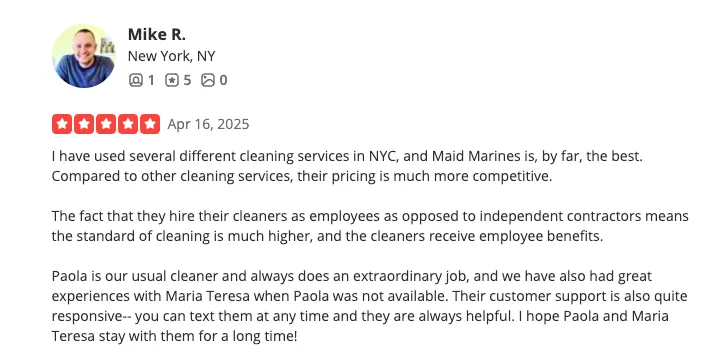
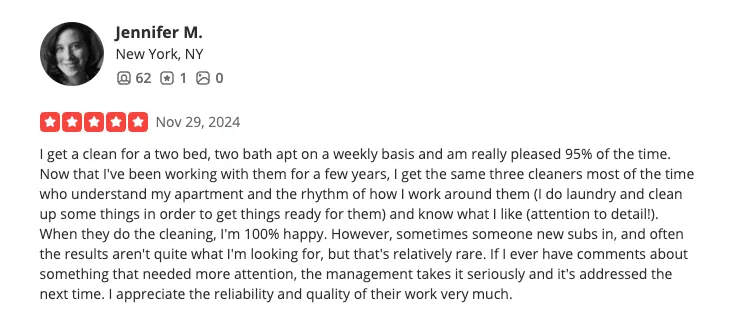
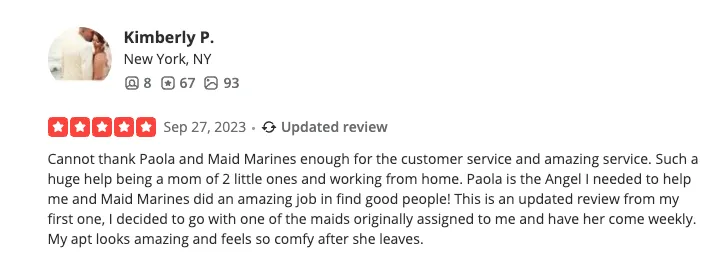
Our cleaners are W-2 employees, not gig workers. They are vetted, insured, and they arrive with everything they need. They do not need you to be home. They do not need instructions in writing unless you want to provide them. Most Woodside clients hand off a lockbox code or leave a key with a neighbor and come back to a clean apartment.
We also do deep cleaning before renovation work or after a tenant moves out, move-in and move-out cleaning for the active rental market in the rowhouses and walkups, and full apartment cleaning on a recurring weekly or biweekly schedule. We serve nearby Sunnyside, Jackson Heights, and Astoria.