
Greenpoint sits on a narrow peninsula between the East River and Newtown Creek, a finger of land that has been reinventing itself for nearly four hundred years. The Lenape called it Keskachauge. Dutch farmers planted orchards here in the 1660s. By the 1870s it was producing more oil, glass, and iron than almost anywhere else in America. Today it holds wood-frame row houses from the 1850s on the same blocks as 41-story glass towers that opened last year, and the cleaning challenges shift just as dramatically between them. Clapboard siding and original plaster walls on Milton Street require a completely different approach than the engineered stone countertops and floor-to-ceiling glass at Greenpoint Landing. Our teams work across this full range daily, and they know what each building type demands.
How a grassy bluff visible to sailors became Brooklyn’s Little Poland
The name Greenpoint comes from a grassy promontory at the tip of the peninsula that river pilots used as a navigation landmark. The Dutch called it Hout Hoek, meaning Wood Point, for the dense forest covering the land. The first European settler, a Norwegian named Dirck Volckertsen whose name was Dutchified under colonial rule, arrived in 1645. Jan Meserole followed in 1663. For the next two centuries, five Dutch farming families dominated what was essentially agricultural land far from any city center.
Everything changed in 1834 when a Connecticut businessman named Neziah Bliss surveyed the peninsula and saw something the farmers had missed. In 1839 he built a turnpike, now Franklin Street, to connect the ferry landing to the interior. That road opened the gates for what came next.
Between the 1850s and 1890s, Greenpoint became one of the most productive industrial districts in the country, known for the Five Black Arts: printing, oil refining, cast iron manufacturing, glassmaking, and pottery. By the 1880s, eighteen of Brooklyn’s twenty glass factories operated here. Charles Pratt opened his Astral Oil Works in 1867, producing kerosene so pure it became a household name. He sold to John D. Rockefeller’s Standard Oil in 1874, and within a few years more than fifty petroleum plants lined Newtown Creek and the waterfront. The environmental cost of that industrial frenzy would take more than a century to reveal itself.
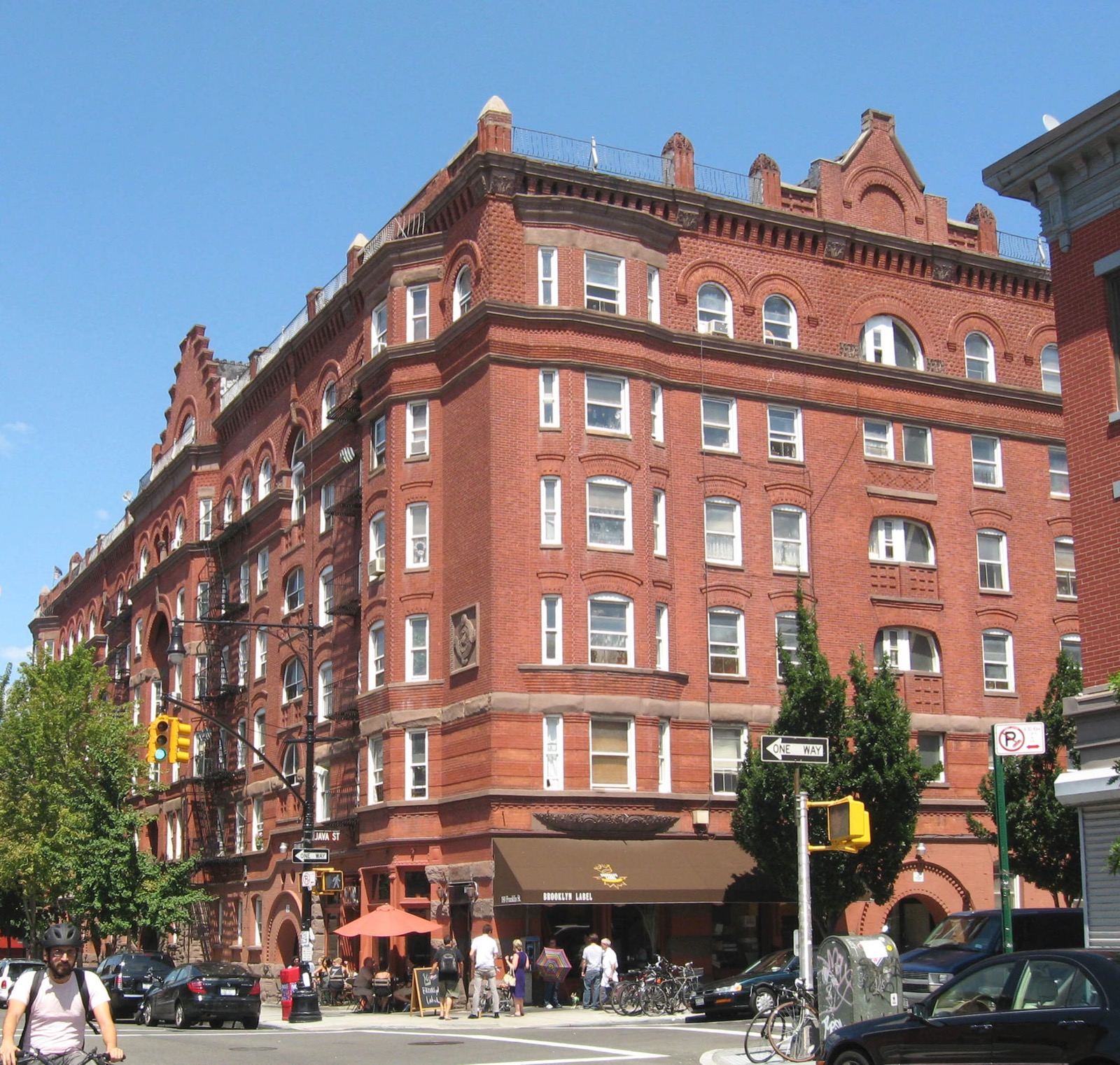
Pratt did something uncommon for a Gilded Age industrialist. In 1886, aware that many of his workers lived in overcrowded tenements, he commissioned the Astral Apartments at 184 Franklin Street. Designed by Lamb and Rich in the Queen Anne style, the block-long building featured terra cotta detailing, a grand central arch, and decorative grotesques along the roofline. The ground floor originally housed a branch of the Pratt Institute Free Library. Today it is a 118-unit walk-up listed on the National Register of Historic Places, and the terra cotta facade still needs the same gentle hand it demanded in 1886.
Polish immigrants began arriving in the 1880s. They established churches, social clubs, butcher shops, and bakeries that would define the neighborhood for over a century. The community grew so large that Greenpoint became known as Little Poland, the second-largest Polish concentration in the United States. At its peak, Polish families made up as much as 80 percent of the neighborhood population.
The Polish presence is not just historical. Walk Manhattan Avenue today and you can still hear Polish on the sidewalk outside Lomzynianka, a counter-service restaurant that has been serving borscht, golabki, and potato pancakes since the 1990s. Polka Dot bakery on Driggs Avenue sells poppy seed rolls, babka, and paczki that draw Polish families from across the borough. Karczma on Greenpoint Avenue feels like it was transported whole from the countryside outside Krakow, dark wood booths, charcoal-grilled kielbasa, and a menu written in Polish first and English second. These are not nostalgia businesses. They are working institutions that serve a community that still lives here, even as the blocks around them transform into something unrecognizable.
The ironclad warship that changed naval history was built on this waterfront
In 1862, at the Continental Iron Works on Bushwick Inlet, a Swedish-born engineer named John Ericsson oversaw the construction of a vessel that would change the course of both the Civil War and naval warfare forever. The USS Monitor, the Union’s first ironclad warship, was built in just 101 days and launched into the East River on January 30, 1862. Less than two months later, it fought the Confederate ironclad CSS Virginia at Hampton Roads in the first battle between ironclad warships in history. The engagement rendered every wooden naval vessel in the world obsolete overnight.
Thomas F. Rowland’s Continental Iron Works went on to build six more monitor-class warships during the war. The shipyard occupied the waterfront at what is now Bushwick Inlet Park, and during peak wartime production it employed hundreds of workers who lived in the surrounding blocks. The Monitor’s turret design, a rotating armored gun platform that could fire in any direction, was so revolutionary that “monitor” became the generic term for an entire class of warship. Ericsson himself never received the recognition he felt he deserved from the Navy, and he spent years in bitter correspondence over unpaid invoices. The company’s assets were not liquidated until 1928.
Today, a heroic bronze statue in McGolrick Park, sculpted by Antonio de Filippo in 1938, depicts a figure pulling a capstan rope in honor of the Monitor and its crew. McGolrick Park is the civic heart of residential Greenpoint, a four-acre rectangle bounded by Driggs Avenue, Nassau Avenue, Monitor Street, and Russell Street. The 1910 Shelter Pavilion at its center is a Beaux-Arts open-air structure with Doric columns that hosts a farmers market and community events. The park also holds a World War I memorial and mature London plane trees that canopy the walking paths in summer. It is a quieter, more neighborhood-scaled green space than McCarren Park to the south, and it reflects the residential character of the blocks that surround it.
Milton Street preserves a timeline of American architecture you can walk in fifteen minutes
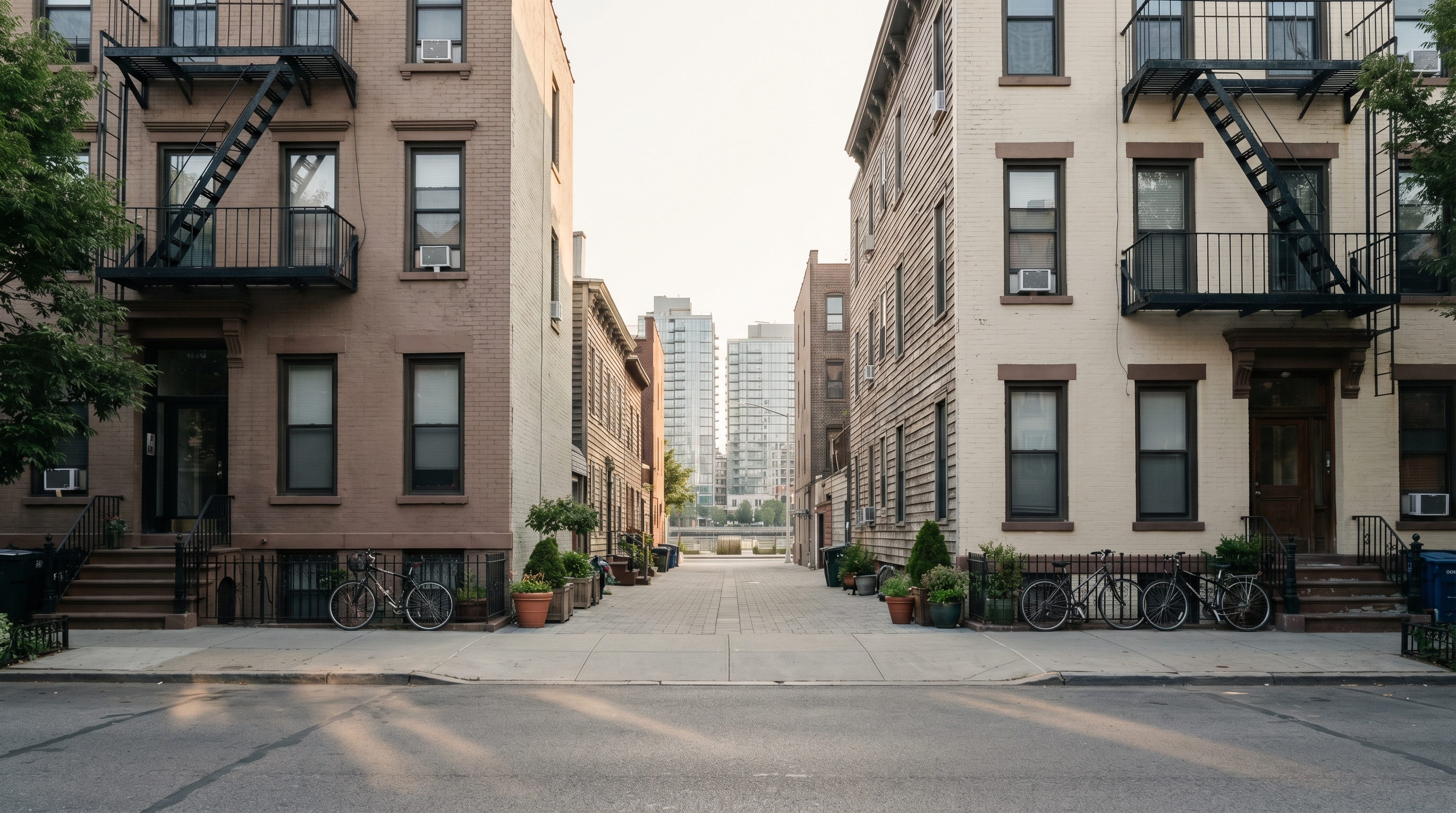
Most of Brooklyn is synonymous with brownstone. Greenpoint is different. The oldest residential blocks here are lined with two- and three-story wood-frame row houses with Italianate details, bracketed cornices, arched windows, and painted clapboard siding dating to the 1850s and 1860s. The Greenpoint Historic District, designated in 1982, encompasses 28 blocks and 363 contributing buildings preserving this distinctive fabric.
Milton Street is the crown jewel. Walk from one end to the other and you pass through Greek Revival, Italianate, French Second Empire, Neo-Grec, Queen Anne, and Romanesque Revival houses standing shoulder to shoulder. Thomas C. Smith, a porcelain manufacturer whose Union Porcelain Works operated on Eckford Street, built most of the houses along Milton and designed them in pairs to appear as larger single homes. The row at 119 to 125 Milton Street, built in 1876, features brick Neo-Grec residences that retain their original ironwork. At 139 to 151 Milton, a row of 1894 Queen Anne houses have oriels, cantilevered bay windows, that catch the afternoon light.
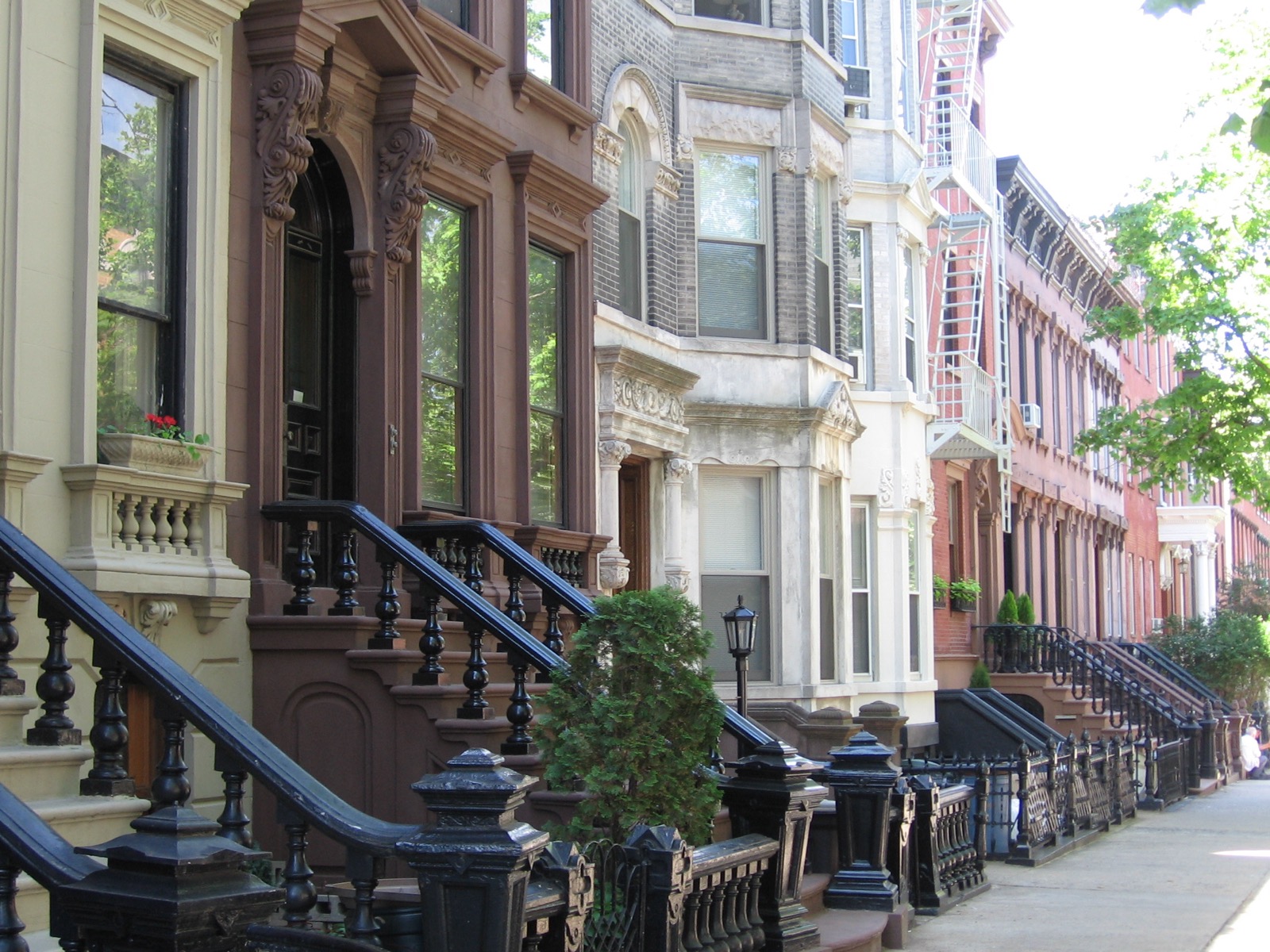
Wood siding and plaster walls are softer and more porous than brownstone and brick. Water leaves permanent marks on old plaster. Abrasive cleaning pads scratch century-old pine flooring that cannot be refinished without significant expense. The windows in these houses are often original double-hung units with painted wood frames that need a gentle hand and a dry cloth on the sash. Our teams use pH-neutral products on all original surfaces in the historic district, and they know not to bring anything acidic, abrasive, or ammonia-based into a house that predates the Civil War.
At the end of Milton Street, twin church spires frame the view. St. John’s Lutheran Church and Greenpoint Reformed Church face each other across the block, creating one of the most photographed compositions in the neighborhood. The Greenpoint Reformed Church, built in 1867 in the Early Gothic Revival style, has a rough-cut stone facade and a square bell tower that anchors the corner of Milton and Noble Streets. The congregation dates to the 1840s, making it one of the oldest continuously active Protestant churches in Brooklyn. Its interior retains original stained glass and woodwork that survived the 20th century largely untouched because the congregation was too small and too devoted to the building to renovate it into something modern. These steeples are not the tallest in Greenpoint, though. That distinction belongs to St. Anthony of Padua, designed in 1874 by the prolific architect Patrick Charles Keeley. Its 240-foot Victorian Gothic spire of red brick with white limestone trim is one of the most elegant church towers in all of Brooklyn.
Five copper cupolas and a pencil factory tell the story of who built this neighborhood
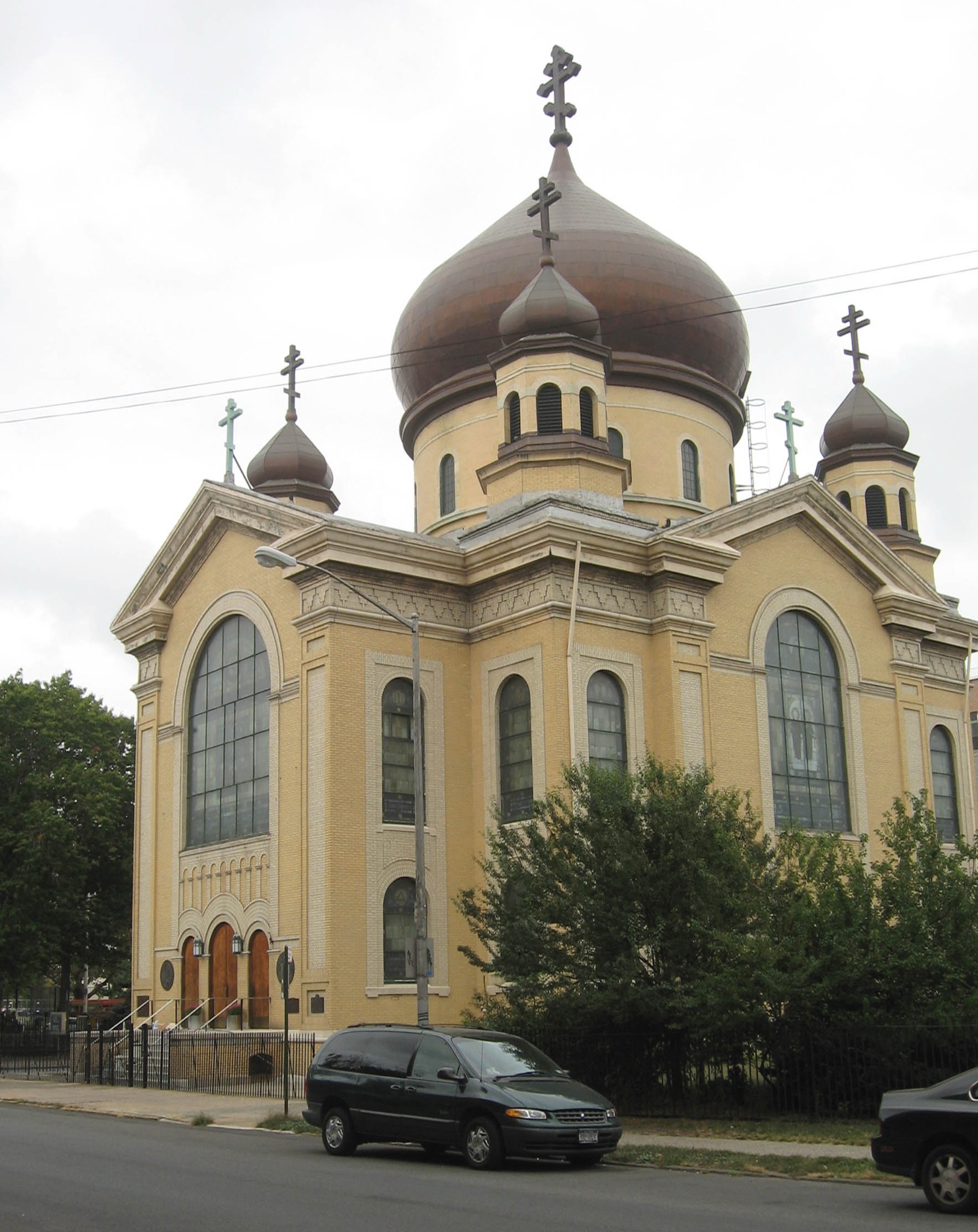
The Russian Orthodox Cathedral of the Transfiguration, built between 1916 and 1921, is the only example of Byzantine Revival architecture in New York City. Designed by Louis Allmendinger and modeled on the Kremlin in Moscow, its five copper cupolas topped with Patriarchal crosses are visible for miles. It was designated a New York City landmark in 1969 and listed on the National Register of Historic Places in 1980. The exterior appeared as a Latvian Orthodox church in the Seinfeld episode “The Conversion.”
St. Stanislaus Kostka, completed in 1904, is the largest Polish Catholic church in Brooklyn, with a capacity of 1,250 worshippers and nine weekend masses, five in Polish and four in English. In 1969, Cardinal Karol Wojtyla, the future Pope John Paul II, visited the church and spoke from its marble pulpit to hundreds of Polish parishioners. The church still holds Polish-language services, and its bells remain one of the defining sounds of the neighborhood.
The Eberhard Faber Pencil Factory complex, spanning nine buildings across two blocks, operated from 1872 to 1956. Faber relocated here from Manhattan after a fire destroyed his original facility, and the Greenpoint operation grew into the largest pencil manufacturer in the United States. The company introduced colored pencils to the American market from this factory. The complex was landmarked in 2007 and has been converted to condominiums and commercial space. The star-topped building on West Street, with Faber’s original mark still visible on the brickwork, anchors Franklin Street’s identity as a corridor where industry became art.
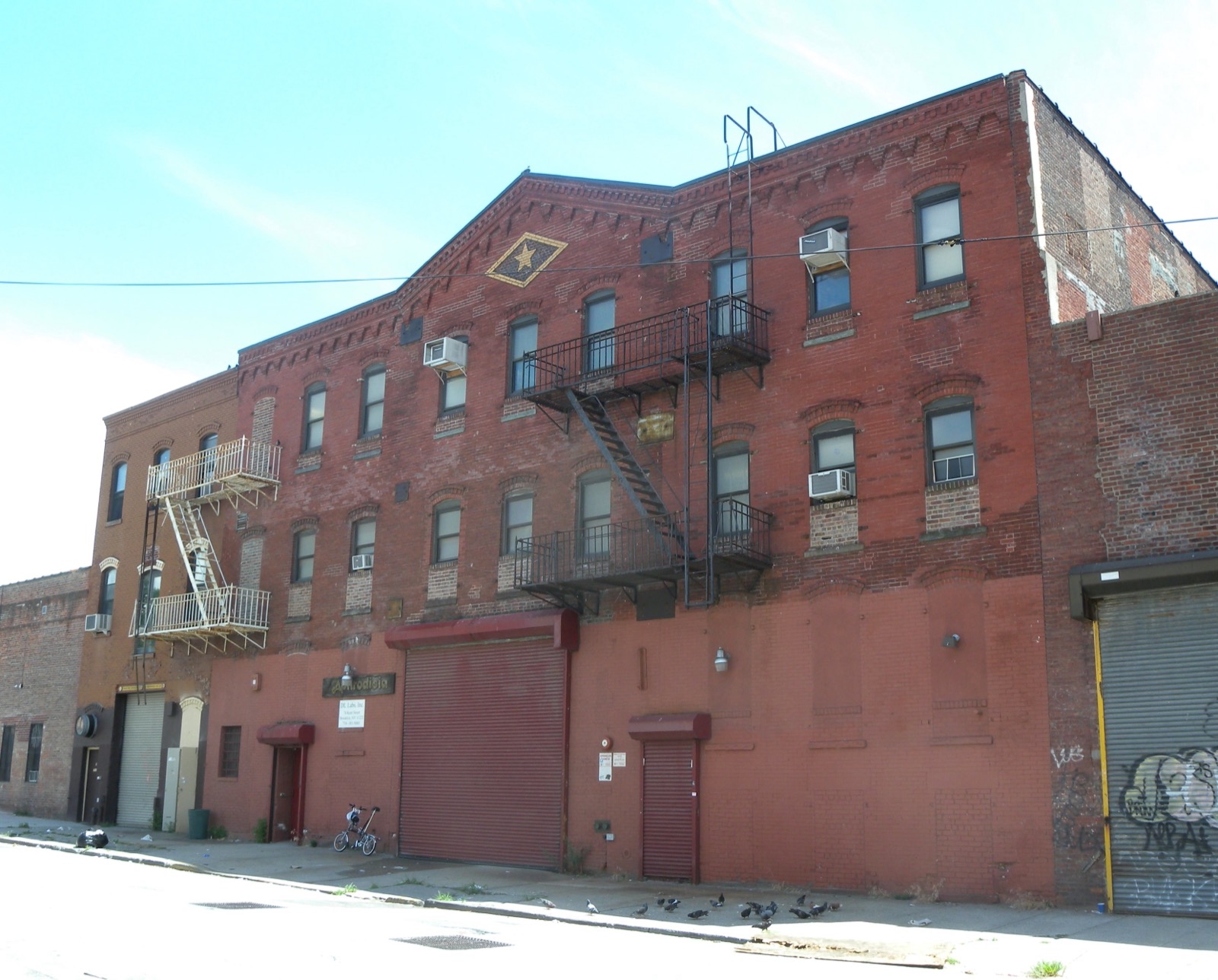
These factory conversions present their own cleaning challenges. Units in the Pencil Factory complex often have 10 to 14 foot ceilings, oversized industrial windows, exposed brick, and either polished concrete or reclaimed wood underfoot. Dust moves freely in open floor plans with no hallways to contain it. The exposed brick needs a soft brush only. Water pushes dirt deeper into old mortar joints and causes permanent staining. We bring extension poles for the upper window frames that most cleaning services never touch because they simply do not have the reach.
The Greenpoint Savings Bank and a sidewalk clock mark a vanished era of prosperity
At the corner of Manhattan Avenue and Calyer Street, the Greenpoint Savings Bank stands as a monument to the neighborhood’s early twentieth-century confidence. Designed by Helmle and Huberty and completed in 1908, its Neo-Classical limestone facade sits on a granite base, all columns and carved detail work that suggests a community investing in permanence. A few blocks north, at 733 Manhattan Avenue, the Bomelstein Jewelers sidewalk clock, manufactured around 1870 by the E. Howard Clock Company of Boston, is the last surviving sidewalk clock in Brooklyn and one of only seven landmarked sidewalk clocks in the entire city.
PS 34 Oliver H. Perry School, built in 1867 and named for the naval hero of the Battle of Lake Erie, is the oldest continuously operating public elementary school in New York City. Its Romanesque Revival facade with Italianate motifs has stood on Norman Avenue for over 150 years.
From Mae West to Goodnight Moon and four consecutive Grammys
Mae West was born in Bushwick in 1893 but grew up in Greenpoint, where her father was raised. Before she became one of the most iconic and controversial performers of the twentieth century, she was a Greenpoint girl walking these same blocks. Mickey Rooney was born at 696 Leonard Street in 1920, just blocks from the waterfront, before his mother moved them to Hollywood when he was four. He became an Academy Award winner and one of the biggest box office stars of the 1930s and 1940s.
Margaret Wise Brown, the author of Goodnight Moon, was born in Greenpoint in 1910 and lived on Milton Street, the same block that now preserves a century of American architectural history. Pat Benatar, born in 1953, grew up in the area and went on to win four consecutive Grammy Awards, one of the most dominant streaks in music history. Charles Evans Hughes, who served as Chief Justice of the United States and came within a few thousand votes of winning the 1916 presidential election, grew up on Milton Street as well.
Peter J. McGuinness, the last Tammany Hall political boss of Brooklyn, ran Greenpoint’s politics for decades. McGuinness Boulevard, the five-lane arterial that splits the neighborhood in two, was renamed in his honor in 1964. More recently, Dagmara Dominczyk, who played Karolina on HBO’s Succession, grew up in Greenpoint’s Polish community. Kieran Culkin moved his family here around 2022. And Lena Dunham set her HBO series Girls in Greenpoint and Williamsburg, turning the neighborhood into a national symbol of Brooklyn gentrification.
Kielbasa and omakase coexist on the same commercial strip and that tells you everything
Greenpoint’s food scene is layered in the same way as its architecture. The Polish foundation endures on Manhattan Avenue. Nassau Meat Market, established in 1982, is a neighborhood institution for kielbasa and smoked meats. Lomzynianka serves traditional Polish home cooking. Karczma offers charcoal-grilled kielbasa in a rustic setting with dark wood paneling that transports you to the old country. Pierozek, a Michelin-listed pierogi specialist, represents the refinement of the Polish tradition without abandoning its roots.
A significant Japanese wave has arrived. Taku Sando serves tonkatsu sandwiches on milk bread. Rule of Thirds combines a sake bar with Japanese-inspired dishes. U Omakase offers a high-end sushi counter. A Japanese marketplace at 50 Norman Avenue anchors a small but growing cluster.
At the top of the dining hierarchy, Ilis, opened by Noma co-founder Mads Refslund, offers tasting menus at $225 to $325. It earned Michelin recognition and signaled Greenpoint’s arrival as a culinary destination. Paulie Gee’s, the beloved wood-fired pizza restaurant on Greenpoint Avenue, is famous for the Hellboy pie topped with soppressata and drizzled with Mike’s Hot Honey, a combination that spawned a national condiment trend. The restaurant is dine-in only and remains a pilgrimage site for pizza obsessives.
Taqueria Ramirez draws lines for its suadero tacos. Di An Di serves Hanoi-style pho. Radio Bakery is known for its ‘nduja croissant, with lines forming before doors open. Acme Smoked Fish, operating from a 65,000-square-foot facility on Gem Street since 1906, processes 30,000 pounds of seafood daily and holds the Guinness World Record for producing a 200-pound lox bagel. It is the largest single-plant smoked fish producer in the country.
Your Saturday morning belongs at the McCarren Park Greenmarket or in line at Taqueria Ramirez, not scrubbing tile grout in your bathroom. That is the practical math of hiring a cleaning service in a neighborhood where there is always somewhere better to be.
The digester eggs glow blue at night and the G train creates a psychological moat
The Newtown Creek Wastewater Treatment Plant, on the eastern edge of the neighborhood, processes the sewage of nearly a million New Yorkers. Its eight 140-foot stainless steel digester eggs, designed by Ennead Architects, glow blue at night and have become one of the most photographed industrial structures in the city. The plant has a free visitor center. It is the kind of place that could only exist in Greenpoint, where Superfund remediation and accidental public art share the same zip code.
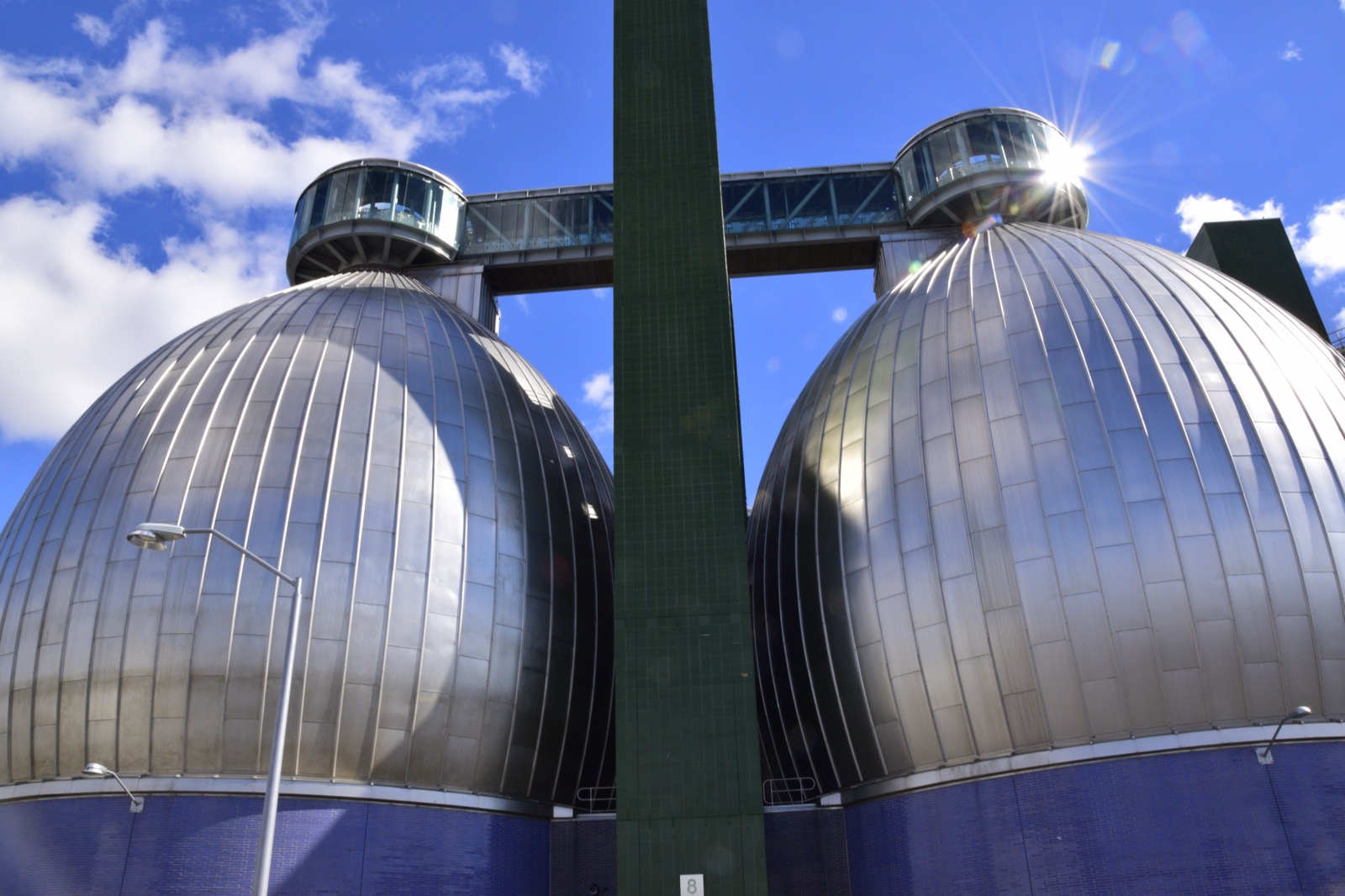
Newtown Creek itself is a 3.8-mile tidal estuary that forms the border between Brooklyn and Queens. For most of its history it was an open sewer and industrial dump. More than 50 refineries, chemical plants, and fertilizer factories operated along its banks during the peak industrial era. The creek was so polluted by the 1880s that Walt Whitman wrote about its stench. In the 1950s, a massive underground petroleum plume began spreading beneath Greenpoint from decades of leaks and spills at the ExxonMobil and other refinery sites. The Greenpoint Oil Spill, discovered in 1978 when a Coast Guard helicopter spotted an oil sheen on the creek’s surface, turned out to be an underground plume of 17 to 30 million gallons of petroleum products, roughly twice the volume of the Exxon Valdez disaster. The contamination dates back to the 1850s. Newtown Creek was designated a federal Superfund site in 2010. The Greenpoint Terminal Market, a massive waterfront warehouse complex at 73 West Street built in 1904, sits right in the middle of this remediation zone. It operated as a cold storage and distribution center for a century before being partially converted to artist studios and small businesses. The building’s future remains uncertain as the Superfund cleanup reshapes the creek corridor around it.
The ongoing remediation work along the creek means airborne particulate on the eastern blocks settles faster than in neighborhoods further from the water. Clients east of McGuinness Boulevard consistently tell us their windowsills and radiator tops accumulate a visible film within days. We focus extra attention on horizontal surfaces near windows in these apartments. Sills, radiator tops, built-in shelving, and any ledge facing an exterior wall gets wiped every visit. For clients on biweekly schedules, this keeps the accumulation under control without requiring a full deep clean every time.
Greenpoint is served by only one subway line, the G train, which runs between Brooklyn and Queens but never crosses the East River. There is no direct subway connection to Manhattan. The two stations, Greenpoint Avenue and Nassau Avenue, sit on the IND Crosstown Line. Getting to Midtown requires a transfer at Court Square in Long Island City. This isolation creates what residents describe as a psychological moat. Greenpoint feels further from Manhattan than its geography suggests, and that distance has historically kept it more insular and self-contained than neighborhoods with better subway access.
The NYC Ferry changed the equation. From the India Street pier, the East River Route reaches East 34th Street in four minutes at a $5 fare. The ferry fundamentally altered Greenpoint’s relationship with Manhattan, at least for those who live near the waterfront. Cycling is another major transit mode. The Kent Avenue protected bike lane and the Brooklyn Waterfront Greenway connect the neighborhood to the rest of the borough, and a popular workaround for the G train’s Manhattan gap is biking twelve to fifteen minutes south to the L train in Williamsburg.
The 2005 rezoning reshaped the waterfront and the cleaning playbook changed with it
The rezoning of 175 blocks along the Greenpoint and Williamsburg waterfront in 2005 was the turning point. Greenpoint Landing, a 22-acre megaproject, has introduced towers up to 41 stories with 5,500 planned residential units. Monitor Point, a separate 1,150-unit development with towers up to 600 feet, received Community Board 1 approval in early 2026. Rents that sat at $2,600 for a studio in 2015 now command $4,587. Median household income stands at $115,720, nearly half again above the citywide median.
The mechanism of change has been described as displacement by dispossession. Polish homeowners, many of them elderly, sold their properties not because they were evicted but because the asset appreciation made selling irresistible. Two- and three-family homes worth $300,000 in the 1990s became $2 million properties by the 2010s. The community did not so much dissolve as liquidate. Scholars have also called Greenpoint’s transformation a case of “Just Green Enough,” where environmental cleanup of contaminated industrial sites cleared the way not for parks and community resources but for luxury residential development.
The waterfront towers have engineered stone countertops that show water rings, floor-to-ceiling glass that shows every streak, and building management offices that require a Certificate of Insurance before any vendor enters the lobby. Our dispatch team handles the COI paperwork and service elevator scheduling before your first appointment. When you book your cleaning, tell us your building and we coordinate the rest.
The prewar walkups between Manhattan Avenue and McGuinness Boulevard are the other half of Greenpoint’s housing stock. Four to six stories, no elevator, plaster walls, hardwood floors, hex tile in the bathrooms, and cast-iron radiators that collect a summer’s worth of dust. When steam heat kicks on in October, that dust burns off and fills the apartment. Every visit, our teams dust the radiators, the AC units, and the vent covers, so there is less of it sitting there waiting for the first cold night.
Greenpoint holds its contradictions without resolving them and that is part of the appeal
Ninety-four percent of Greenpoint residents lived in the same home as the previous year. By that measure, the neighborhood is stable. But stability of residence and stability of character are different things. The Polish delis that defined Manhattan Avenue for decades are closing one by one, replaced by businesses serving a different clientele at different price points. Artists who arrived before the coffee shops are now being priced out themselves.
On Manhattan Avenue, the Little Poland spine survives in Polish delis, butcher shops, and bakeries where the staff still speaks Polish and the kielbasa is made on site. Two blocks west on Franklin Street, the scene shifts to pour-over coffee, indie bookshops, and curated boutiques. WORD Bookstore is one of the best independents in the city. Archestratus Books and Foods combines a rare cookbook collection with prepared dishes. The converted Pencil Factory condos anchor the street.
Stand in Transmitter Park at dusk and you see the Chrysler Building catching copper light across the East River, the Manhattan skyline framed by low-slung Greenpoint rooflines and the skeletal silhouettes of waterfront cranes. It is one of the most beautiful views in the city. The golden late-afternoon light that results from low buildings and water on two sides of the peninsula has made Greenpoint a favorite of photographers and cinematographers for years.
The Superfund creek and the luxury towers. The 240-foot church spire and the 41-story residential building. The kielbasa and the omakase. The G train’s maddening isolation and the four-minute ferry to Midtown. Greenpoint does not pretend these things fit together neatly. It simply contains them all, on a narrow peninsula between two bodies of water, in a light that residents describe as home.
We clean all of it. The wood siding and the engineered stone. The century-old pine floors and the polished concrete. The walkup with the radiator fins full of dust and the waterfront tower with the COI requirement. Different products, different tools, same standard. Apartment cleaning, deep cleaning, and move-in and move-out cleaning for a neighborhood that gives you better things to do with your time than scrub your own floors.