
Morningside Heights is the closest thing New York City has to a European university neighborhood. It occupies an elevated plateau between 110th and 125th Streets on Manhattan’s west side, bounded by Morningside Park’s rocky cliff to the east and Riverside Drive to the west. Columbia University, Barnard College, Teachers College, the Manhattan School of Music, Union Theological Seminary, the Jewish Theological Seminary, and Bank Street College of Education all sit within this fifteen-block stretch. The Cathedral of St. John the Divine anchors the southern end. Riverside Church and Grant’s Tomb face the Hudson at the northern end. By 1930, the concentration of institutions had earned the neighborhood a nickname that still holds: the Acropolis of New York.
The housing stock follows from the institutions. Roughly 64 percent of the buildings in Morningside Heights were constructed between 1900 and 1910, during the same construction surge that brought Columbia uptown and the IRT subway to Broadway. These are six-to-twelve-story limestone and brick apartment buildings with deep ornamental cornices, formal lobbies, herringbone parquet, plaster crown molding, and the nine-to-ten-foot ceilings that define pre-war Manhattan. The Riverside Drive buildings are among the finest residential architecture in the city. The Colosseum at 435 Riverside and the Paterno at 440 Riverside have curved facades that follow the arc of the street.
Cleaning these apartments is not the same job as cleaning a new condo in Hudson Yards. The surfaces are older, the layouts are more complex, and the materials require a different approach. But before we get into what makes cleaning here different, this neighborhood deserves a proper introduction. Most people know Morningside Heights as “the Columbia area.” That undersells it by a century.
The Battle of Harlem Heights was fought across this plateau before Columbia existed
The rocky schist bluffs that give Morningside Heights its elevation have been strategically significant for a long time. The Lenape used the terrain as a vantage point for thousands of years before European settlement. On September 16, 1776, General George Washington’s Continental Army repelled a British advance across this same elevated ground in what became known as the Battle of Harlem Heights. It was one of the first American military victories of the Revolution, coming just days after the disaster at Brooklyn. Washington’s forces held the high ground, and for one afternoon the war looked like it might be winnable.
The plateau sat mostly empty after the Revolution. For most of the 19th century, the heights were occupied by the Bloomingdale Insane Asylum, established in 1821 on the land that would become Columbia’s campus, and the Leake and Watts Orphan House nearby. The steep terrain, the distance from downtown, and the difficulty of access kept private developers away. The asylum grounds sat undisturbed for decades, surrounded by open farmland and rocky outcrops.
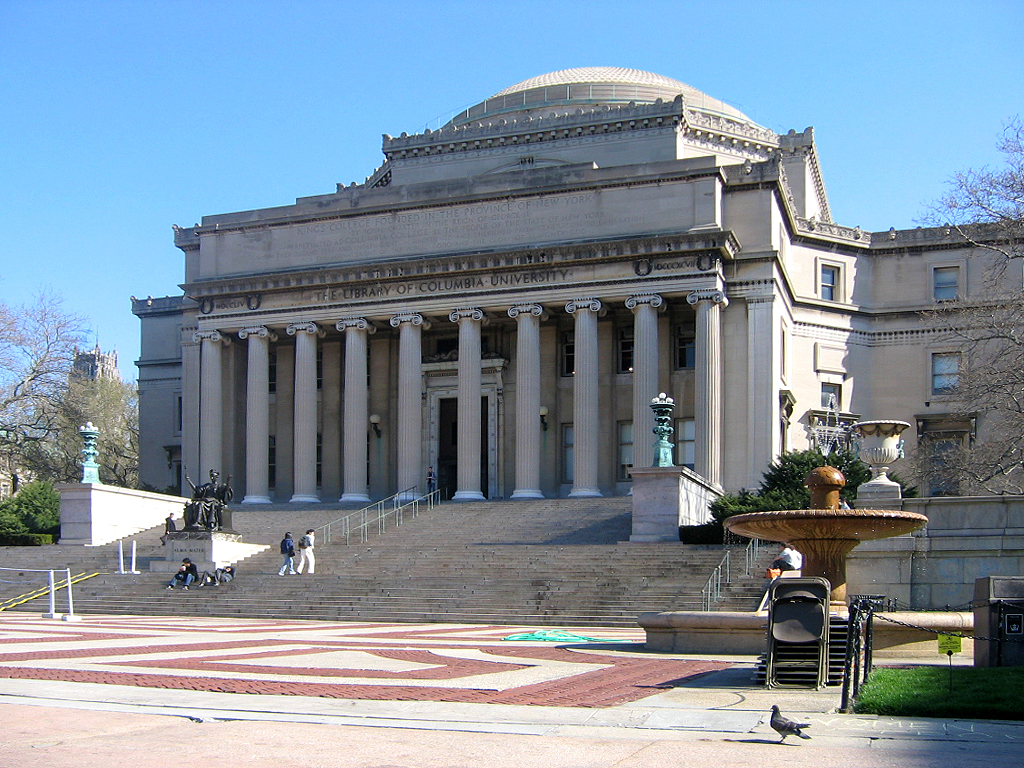
That changed in 1893 when Columbia University purchased the former Bloomingdale Asylum property and commissioned McKim, Mead and White to design a new campus. McKim, Mead and White was the most prestigious architectural firm in America at the time. Charles McKim modeled the campus plan on Thomas Jefferson’s academical village at the University of Virginia. A unified ensemble of Beaux-Arts buildings arranged around a central quadrangle, executed in limestone and brick, with Low Memorial Library at the center, modeled on the Pantheon in Rome. Columbia broke ground in 1897 and relocated from its Midtown campus at 49th Street and Madison Avenue.
The same decade saw speculative developers fill the surrounding blocks with the apartment buildings that still define the neighborhood. The 1904 opening of the IRT subway’s Broadway line gave Morningside Heights a direct connection to Midtown, and construction accelerated. Within ten years the plateau had transformed from asylum grounds and open land into a dense residential neighborhood wrapped around an Ivy League campus.
The Cathedral of St. John the Divine has been under construction for over 130 years
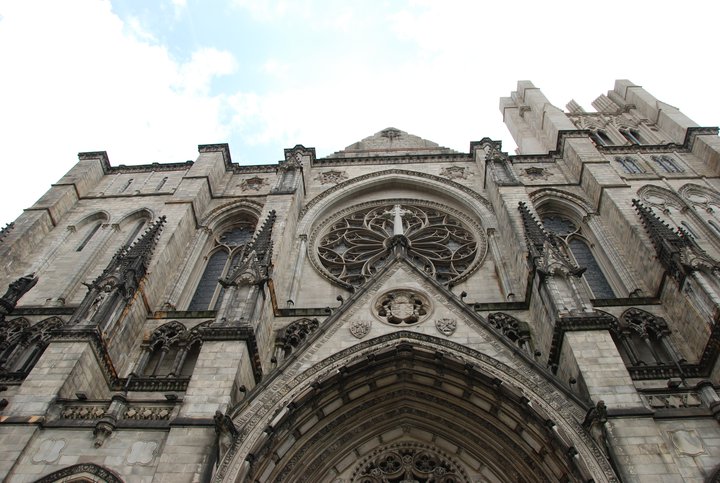
The Cathedral of St. John the Divine broke ground in 1892 at Amsterdam Avenue and 110th Street, the same era as Columbia’s arrival. It was originally designed by Heins and LaFarge in the Byzantine-Romanesque style. After LaFarge’s death, the firm of Cram, Goodhue and Ferguson redesigned the nave in Gothic style beginning in 1909. The result is a building that switches architectural languages midway through its interior. The crossing and choir are Romanesque. The nave is Gothic. At 601 feet long and 174 feet wide, it is the largest cathedral in the Anglican Communion and the fourth-largest Christian church in the world.
It is still not finished. The southwest tower remains unbuilt. Construction has paused and restarted through fires, financial crises, two world wars, and changes in church leadership. New Yorkers call it St. John the Unfinished. The commitment to eventual completion is essentially a civic article of faith at this point. Whether it will be finished in anyone’s lifetime is an open question, but the cathedral functions fully in its current state. It hosts concerts, art installations, and the annual Blessing of the Animals during the Feast of St. Francis, when elephants and camels have walked down the nave alongside dogs and cats.
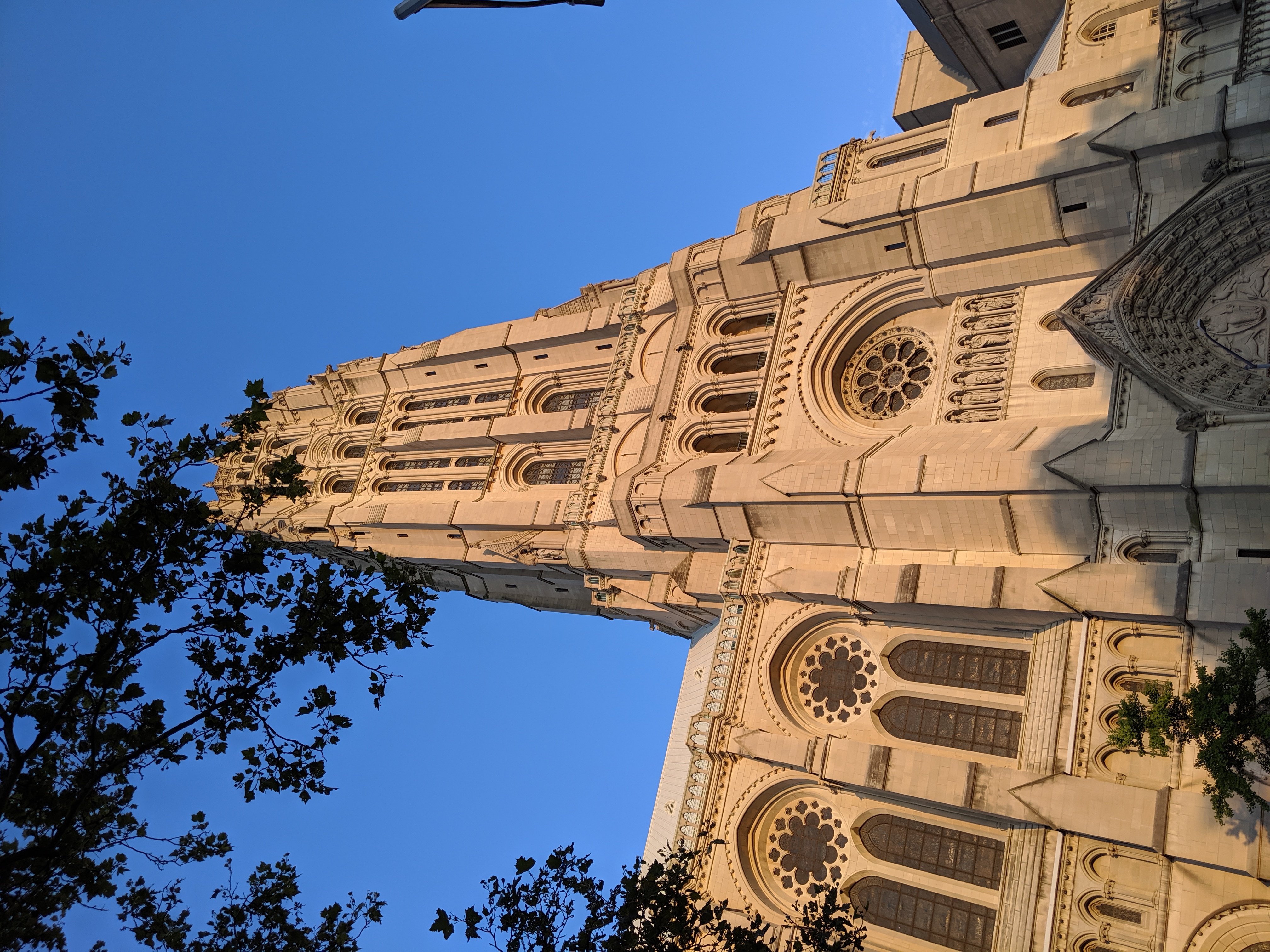
The cathedral is one of several religious and intellectual institutions that clustered in Morningside Heights during the late 19th and early 20th centuries. Riverside Church, completed in 1930 and funded by John D. Rockefeller Jr., was designed in the French Gothic style modeled on Chartres Cathedral. Its 392-foot tower houses the Laura Spelman Rockefeller Memorial Carillon, 74 bells, the largest tuned carillon in the world. On April 4, 1967, exactly one year before his assassination, Martin Luther King Jr. delivered his “Beyond Vietnam: A Time to Break Silence” speech from the Riverside Church pulpit. The speech connected the civil rights movement to opposition to the Vietnam War and alienated King from the Johnson administration and much of the liberal establishment. It is now considered one of the most important American speeches of the 20th century.
The Beat Generation, Barack Obama, and 93 Nobel laureates all trace through Morningside Heights
The institutional density of Morningside Heights attracted an extraordinary roster of writers, intellectuals, and public figures. Jack Kerouac enrolled at Columbia in the early 1940s. Allen Ginsberg met Kerouac in the neighborhood. William S. Burroughs lived on West 115th Street during his Columbia years. The three of them, along with Lucien Carr, formed the nucleus of what would become the Beat Generation. In August 1944, Carr stabbed David Kammerer in Riverside Park, and Kerouac was briefly held as a material witness. The incident catalyzed the social bonds among the Beat writers who would go on to reshape American literature in the 1950s.
F. Scott Fitzgerald lived on Claremont Avenue. Isaac Asimov lived in the neighborhood during his association with Columbia. Langston Hughes was briefly enrolled at the university before leaving, and Zora Neale Hurston studied at Barnard College. Thurgood Marshall, the first Black Supreme Court Justice, lived in Morningside Gardens, the cooperative housing complex on 123rd Street. Dwight Eisenhower served as Columbia’s president from 1948 to 1953 and lived in the President’s House on Morningside Drive before becoming president of the country.
Barack Obama graduated from Columbia College in 1983, having transferred from Occidental College in Los Angeles. He lived in the neighborhood for two years and has described it as a period of intense reading and self-reflection that shaped his political thinking. Art Garfunkel attended Columbia. Lou Gehrig attended Columbia. Warren Buffett attended Columbia Business School under Benjamin Graham. As of 2025, 93 Nobel laureates have been affiliated with Columbia as faculty, students, or researchers, making Morningside Heights arguably the most academically dense square kilometer in North America.
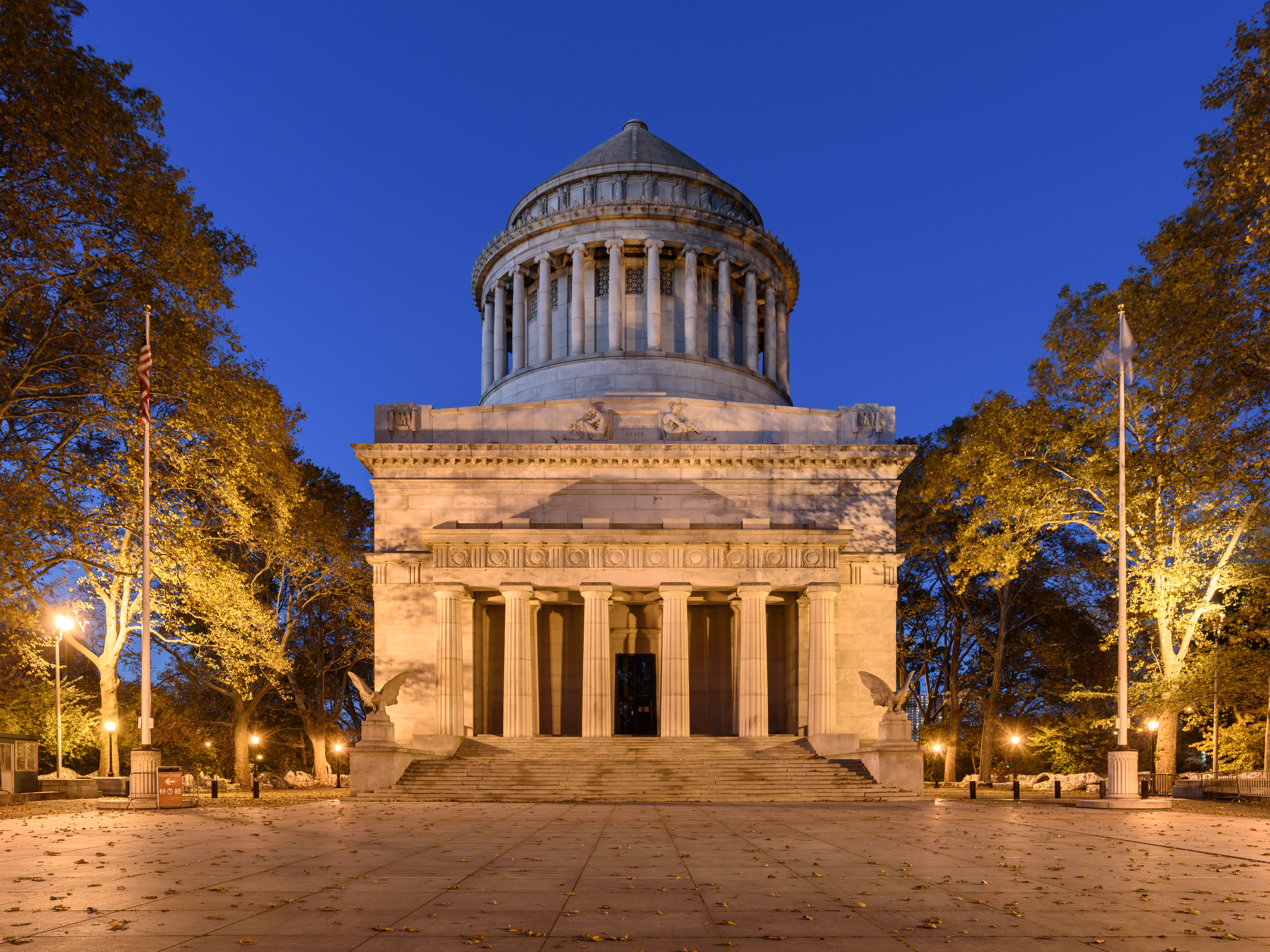
Grant’s Tomb sits at Riverside Drive and 122nd Street, a classical domed granite mausoleum completed in 1897. It is the largest mausoleum in North America and the final resting place of Ulysses S. Grant and his wife Julia Dent Grant. The mosaic benches surrounding the monument were added in the 1970s as a community art project. Free admission. Administered by the National Park Service.
Tom’s Restaurant is real and you can eat there while your apartment gets cleaned
Tom’s Restaurant at Broadway and 112th Street is probably the most famous diner facade in American television history. The exterior was used as Monk’s Diner on Seinfeld from 1989 to 1998. The interior was never filmed for the show. They built a set. But Tom’s is a real, operating neighborhood diner that has been serving breakfast since the 1940s. Suzanne Vega wrote her 1982 song “Tom’s Diner” about sitting in the restaurant watching the world go by on Broadway. The DNA remix of that song became an international hit in 1990.
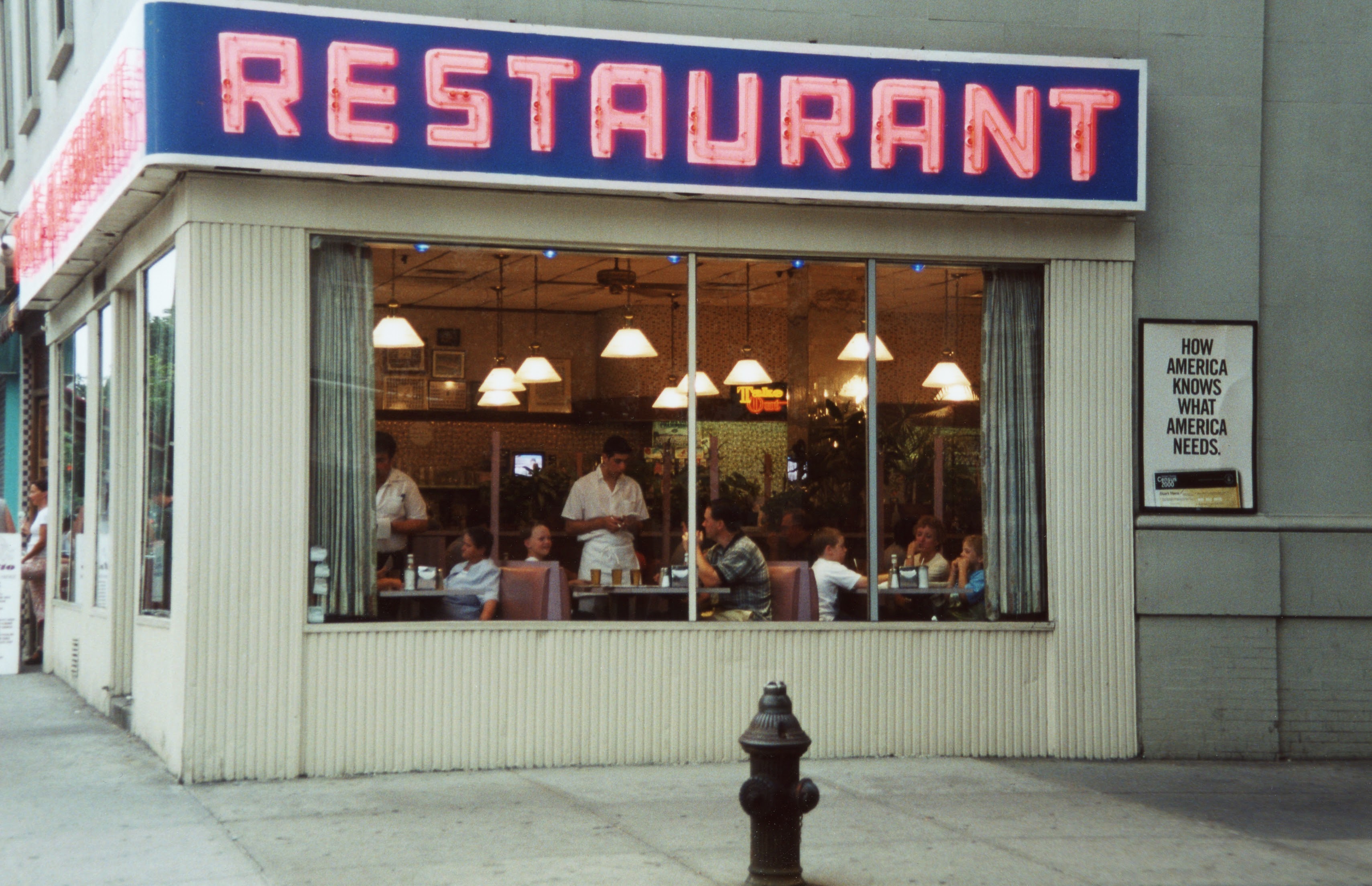
The tourists photograph the neon sign. The regulars order the oatmeal. Both things happen at the same time. That coexistence pretty much sums up Morningside Heights. The performed city and the lived city occupy the same space here in a way that feels more balanced than most of Manhattan.
Broadway between 110th and 125th Streets is one of the most pleasant commercial corridors in upper Manhattan. The scale is right. Six-to-ten-story buildings, varied storefronts, bookstores and coffee shops mixed in with hardware stores and nail salons. The constant flow of students and professors gives it a European university-town energy that most New York commercial streets lack. Amsterdam Avenue runs parallel one block east as a secondary commercial strip with some of the neighborhood’s best restaurants. The Hungarian Pastry Shop at 1030 Amsterdam has been serving coffee and pastries in an unpretentious European cafe setting since 1961. Writers and students have been working at those tables for decades. It is the kind of place where nobody tells you to buy something else after two hours.
V and T Pizzeria on Amsterdam has been a Columbia neighborhood institution since 1945. Koronet Pizza on Broadway sells slices so large that a single one can qualify as dinner. Community Food and Juice on Broadway near 113th Street does farm-to-table brunch that draws lines on weekends.
The 1968 Columbia strike reshaped how universities govern themselves
In April 1968, student protesters occupied five Columbia University buildings for a week. The two catalysts were the university’s planned construction of a gymnasium in Morningside Park, which the surrounding community saw as a land grab, and the university’s ties to military research during the Vietnam War. The occupation was forcibly ended by a police raid. The strike became one of the defining events of the 1968 student protest wave in America.
The gymnasium plan was abandoned. The university eventually reformed its governance structures to include greater student and faculty input. The episode accelerated anti-war sentiment nationwide and altered the relationship between universities and their surrounding communities. In Morningside Heights specifically, the 1968 strike set the terms for a tension that still defines the neighborhood today: the balance between Columbia’s institutional growth and the residential community’s need for stability, affordable housing, and a say in how the neighborhood changes.
The Morningside Heights Community Coalition, formed in 2016, has advocated for community-led rezoning to protect affordable housing and preserve the neighborhood’s social character against university expansion and market-rate redevelopment. Columbia is the largest private landowner in New York City. It owns a large share of the residential stock in Morningside Heights and operates many buildings as below-market housing for faculty and staff. That institutional presence both drives the neighborhood’s prestige premium and limits the most aggressive forms of gentrification. The neighborhood is not developing a luxury condo corridor. But it is not as affordable as it was in 2010 either.
Pre-war apartment cleaning in Morningside Heights requires knowing what not to do
The residential buildings in Morningside Heights were mostly built during a single construction surge between 1900 and 1910. That means the interior surfaces are consistent across the neighborhood: hardwood floors with original shellac or polyurethane finishes, plaster walls and crown molding, cast-iron steam radiators, deep window casings, tile bathrooms from the early 20th century, and the kind of heavy interior millwork that nobody installs anymore.
Cleaning these apartments means knowing what each surface can tolerate. Water-heavy mopping on old hardwood warps the boards and clouds the finish. Abrasive pads on original tile scratch through the glaze. Spray cleaners near plaster molding leave residue that darkens over time. Silicone-based furniture polish on woodwork builds up into a cloudy film. We use pH-neutral solutions on the floors, dry microfiber on the plaster and woodwork, and a dry cloth on the radiator covers and the vent grilles above them. The approach is the same whether the apartment is on Riverside Drive or Broadway. The materials are from the same era and need the same care.
The Riverside Drive buildings present their own logistics. Many have doorman lobbies that require advance vendor notice and a Certificate of Insurance. The Colosseum and the Paterno, with their distinctive curved facades, have large apartments with complex layouts and high ceilings. We coordinate with doormen and building management regularly in Morningside Heights and can have COI paperwork ready before the first visit.
Columbia-owned buildings have their own access protocols that vary by property. Some have front desk staff, some use building-specific entry systems, and some require notice to the housing office. We work with all of them. If you are Columbia faculty or a graduate student in university housing, tell us your building when you book and we handle the logistics.
For the rent-stabilized walk-ups on Amsterdam and the side streets, access is usually a lockbox on the door or a key left with a neighbor. Our teams serving Morningside Heights take the 1 train to the 116th Street station, the same station that opened on October 27, 1904 as part of New York’s first subway line, and they are at your building in minutes.
The apartment cleaning we do in Morningside Heights covers everything from studio units on Broadway to large three-bedrooms on Riverside Drive. If you want the oven interior, refrigerator interior, inside cabinets, and window tracks, that is a deep clean. If you are moving in or out and need every surface reset for a walkthrough, our move-in and move-out cleaning handles the full scope. And if you are in Morningside Gardens or one of the cooperative buildings and want recurring weekly or biweekly service, our house cleaning teams return on a consistent schedule with the same crew each time.
You can book on our booking page and see your flat-rate price before you commit. Our cleaners are W-2 employees, vetted and insured. They know pre-war Manhattan apartments because that is what they clean every day.
The neighborhood around your apartment has 130 years of unfinished cathedral, the tomb of a president, the diner from Seinfeld, the birthplace of the Beat Generation, and one of the most beautiful university campuses in America. You should be out walking it while we clean. That is the whole point of what we do. Head to the Hungarian Pastry Shop with a book, or walk Riverside Drive from Grant’s Tomb to the 96th Street rotunda. Your apartment will be done when you get back.