

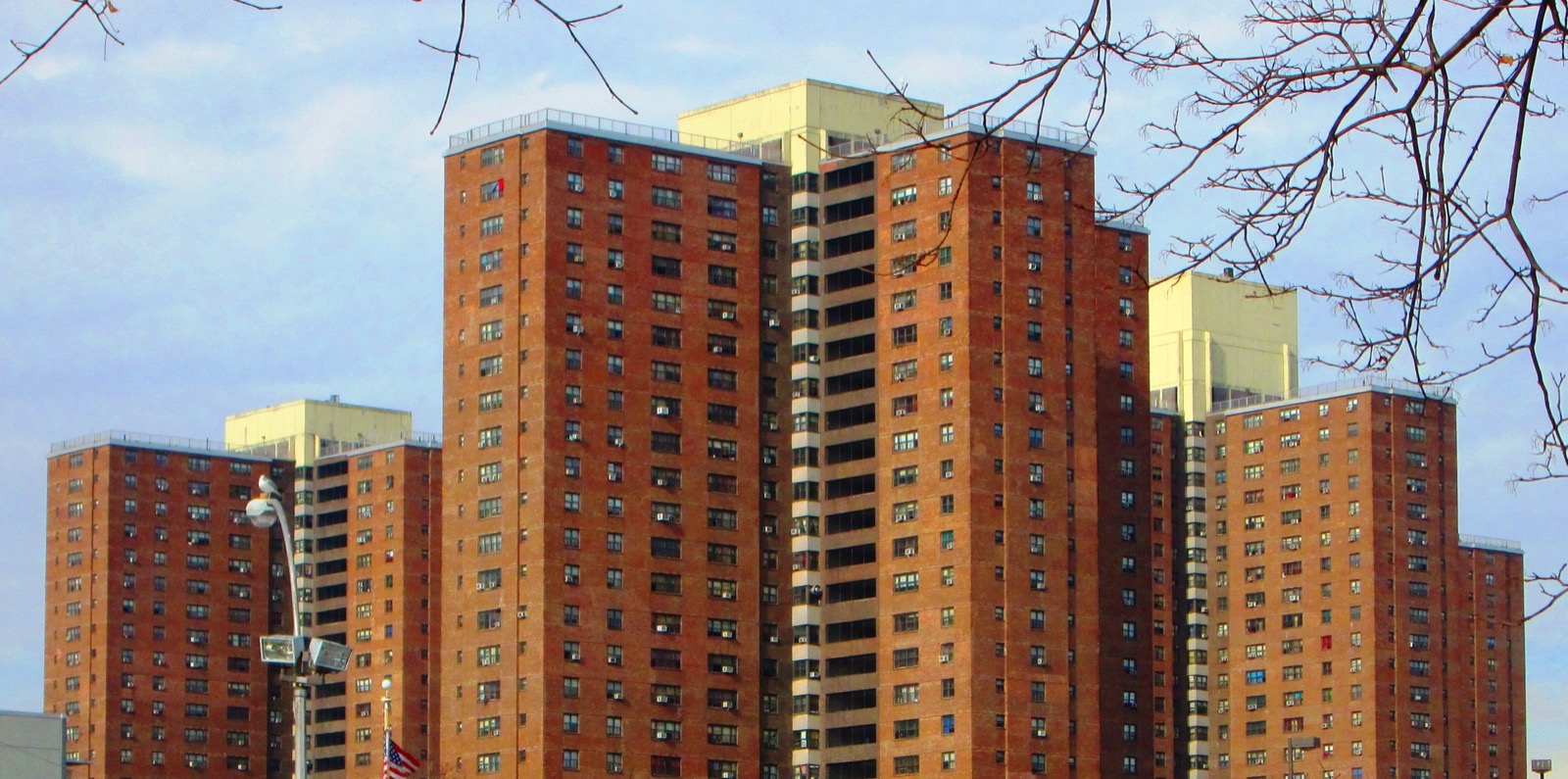
The Polo Grounds is a neighborhood named after a stadium that no longer exists, built on land named after a man most New Yorkers have never heard of, in a hollow most Manhattanites do not know is there. Four 30-story brick towers rise from the flat ground at the base of Coogan’s Bluff, tucked between a 175-foot rocky escarpment and the Harlem River. From the streets above on Edgecombe Avenue, the towers look like they are sitting in a bowl. From the highway along the river, they fill the hollow wall to wall. It is one of the most geographically unusual residential sites in New York City, and the story of how it got here involves polo, baseball, public housing, and one of the most famous home runs ever hit.
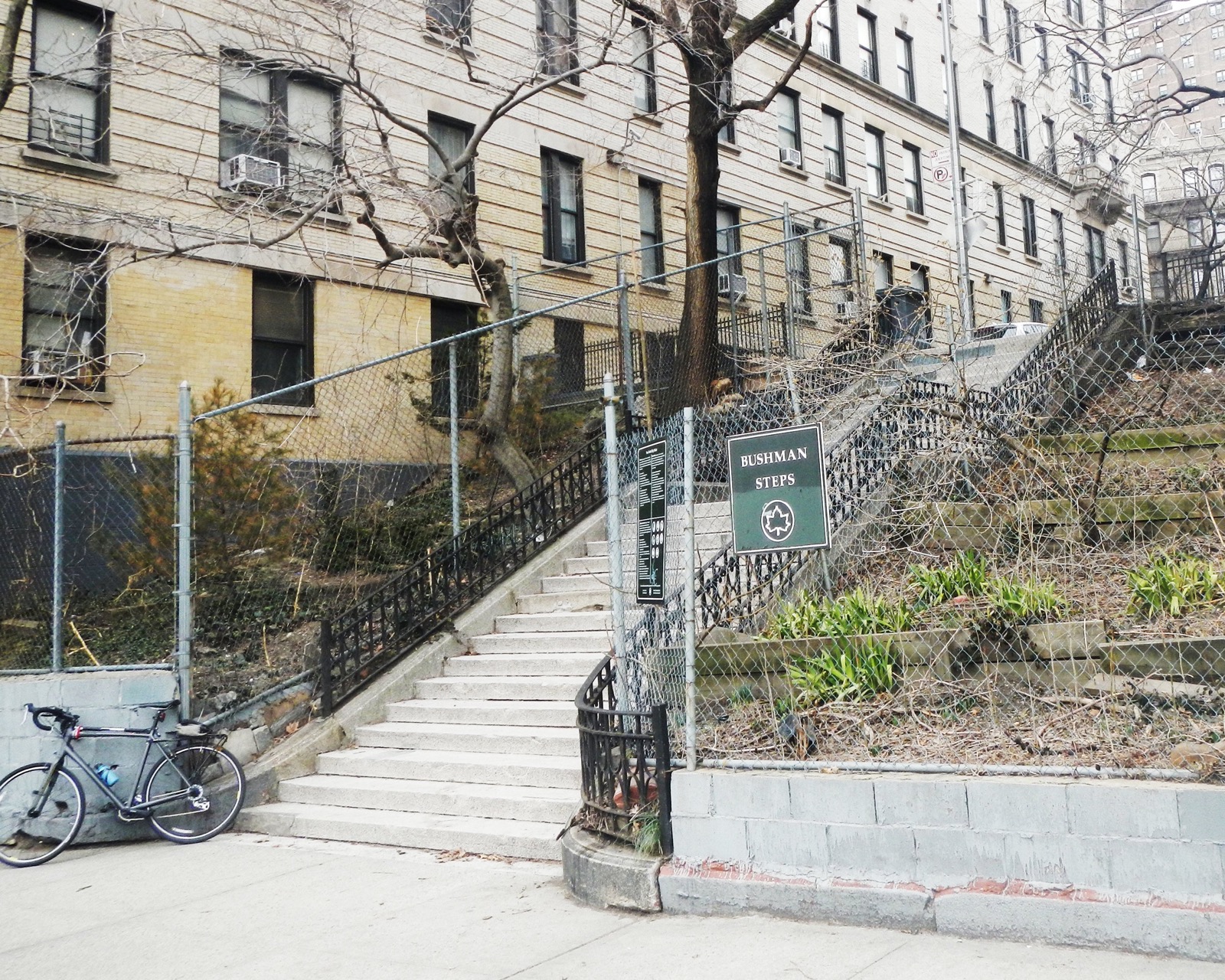
The neighborhood sits in upper Manhattan, roughly between West 155th Street to the south, Harlem River Drive to the east, the slopes of Highbridge Park to the north and west, and Frederick Douglass Boulevard on the western edge. The 155th Street B and D subway station is the primary connection, sitting at the top of the bluff. Getting from the subway to the hollow means walking downhill, a descent that baseball fans made for decades on the John T. Brush Stairway and that residents still make today.
Coogan’s Bluff gave this neighborhood its geography and baseball gave it a name
The escarpment that defines the Polo Grounds neighborhood is called Coogan’s Bluff, after James J. Coogan, a real estate developer and Manhattan Borough President who owned the land in the late 1800s. The bluff is a rocky promontory rising 175 feet above the Harlem River, and the flat ground at its base, Coogan’s Hollow, was low-lying marshland that nobody particularly wanted to build on. The Lenape had used the hollow for fishing and the heights above it as a lookout. During the American Revolution, the British and Americans both recognized the strategic value of the high ground. After the war, the heights became country estates and farms, while the hollow stayed empty.
The name “Polo Grounds” came from somewhere else entirely. The original polo grounds were at 110th Street and Fifth Avenue, where a polo field had been converted into a baseball venue in the 1870s. The New York Giants baseball team played there starting in 1880. When that site was repurposed, the Giants moved north to Coogan’s Hollow in 1889 and brought the name with them. No polo was ever played at the Harlem River site. The name was pure inheritance, a label carried from one location to another by a baseball team looking for a new home. It stuck for 75 years.
The stadium that rose in the hollow became one of the most famous sports venues on Earth. Four successive versions of the Polo Grounds were built on the site. The final steel-and-concrete version, completed in 1911 after a fire destroyed the previous wooden structure, could hold 54,000 spectators. Its shape was distinctive and strange. The horseshoe configuration created the most asymmetrical dimensions in Major League Baseball. It was 483 feet to straightaway center field but only 257 feet down each foul line. Fly balls that were routine outs in center field were home runs down the lines. The dimensions shaped careers and warped statistics for half a century.
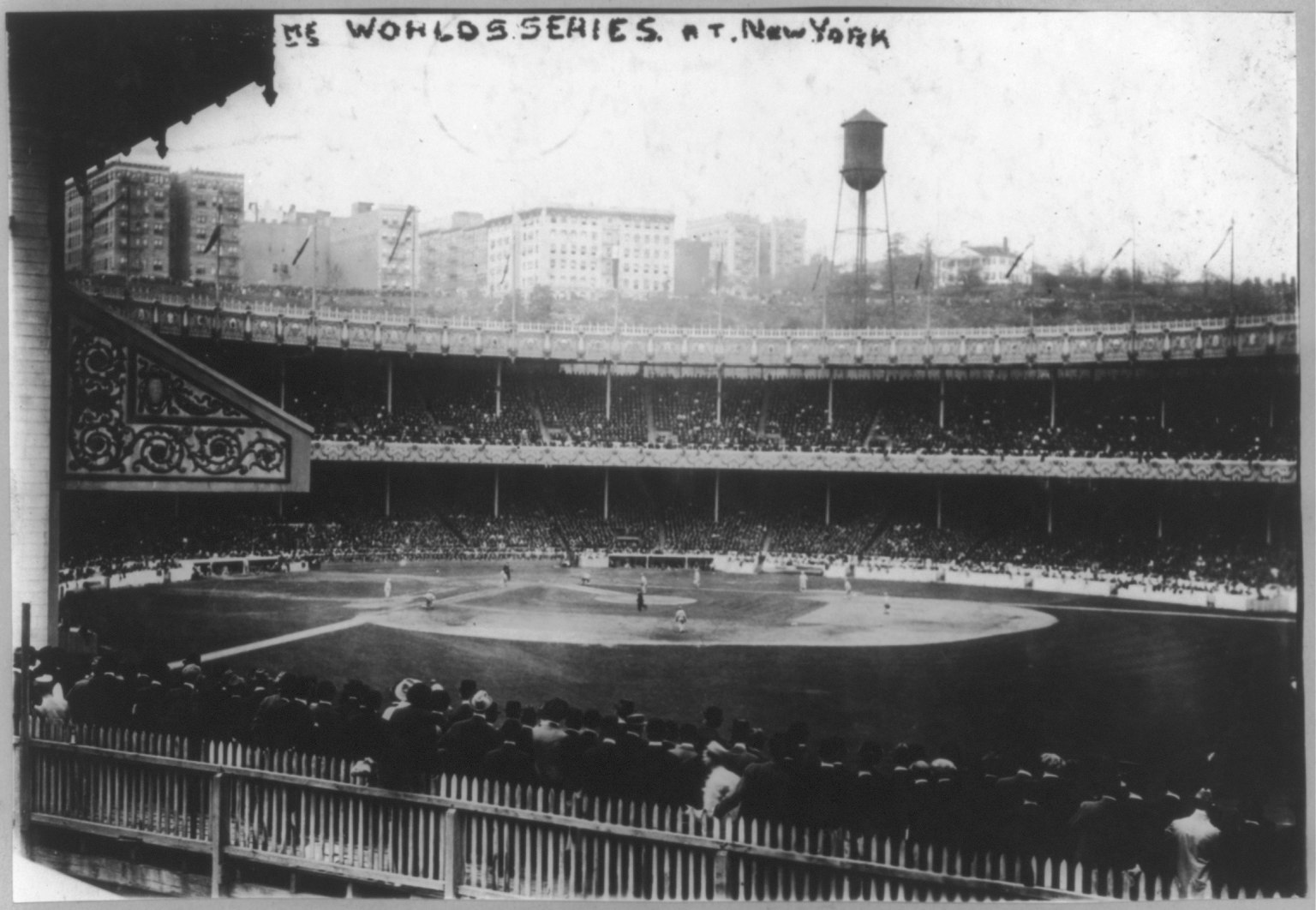
The New York Giants played at the Polo Grounds from 1891 to 1957. Their roster across those decades included Christy Mathewson, Mel Ott, Carl Hubbell, and Willie Mays. The stadium also hosted the New York Cubans and New York Black Yankees of the Negro Leagues, a fact that connects the Polo Grounds to the full breadth of American baseball history, not just the white professional game. The New York Football Giants played their NFL games there from 1925 to 1955. And from 1913 to 1922, the New York Yankees were tenants of the Giants at the Polo Grounds, playing in someone else’s stadium while waiting for their own to be built across the Harlem River.
That arrangement ended badly. Babe Ruth joined the Yankees in 1920 and immediately started outdrawing the Giants. Ruth’s enormous popularity as a Polo Grounds tenant made the Giants’ ownership furious. They evicted the Yankees after the 1922 season, forcing them to build Yankee Stadium in the Bronx. The most famous ballpark in American history was built partly as revenge for being kicked out of someone else’s hollow.
Bobby Thomson’s home run landed where apartment towers stand today
The most famous moment in Polo Grounds history happened on October 3, 1951. The New York Giants and the Brooklyn Dodgers were playing a playoff game to decide the National League pennant. The Dodgers led 4-2 in the bottom of the ninth inning. Bobby Thomson stepped to the plate against Ralph Branca with two runners on base. He hit a three-run home run into the lower left field seats. Radio broadcaster Russ Hodges lost his composure entirely, repeating “The Giants win the pennant” four times into his microphone in one of the most replayed moments in sports broadcasting history. The home run was later called the Shot Heard ‘Round the World. Don DeLillo opened his 1997 novel Underworld with a 60-page recreation of that game, and the section, published separately as “Pafko at the Wall,” became one of the most celebrated pieces of American sports writing.
Baseball historians have calculated the approximate landing spot of Thomson’s home run. It is now occupied by Tower B of the Polo Grounds Towers housing complex. Residents of certain apartments in that building live at the exact site of the most famous moment in baseball history. Most of them have no particular reason to think about that on a daily basis.
Three years later, on September 29, 1954, Willie Mays made what is universally considered the greatest defensive play in the history of baseball. In Game 1 of the World Series against the Cleveland Indians, with runners on base and the score tied, Vic Wertz hit a 460-foot drive to straightaway center. Mays turned his back to home plate, ran at full speed toward the bleachers, and caught the ball over his shoulder at a dead sprint. The play preserved the Giants’ lead and they swept the Series in four games. Sports Illustrated later called it the greatest baseball play of the 20th century. It happened in the same hollow where four apartment towers now stand.
The Giants left and the wrecking ball followed
After the 1957 season, the Giants announced they were leaving for San Francisco. The decision devastated a fanbase that had watched baseball in Coogan’s Hollow for nearly seven decades. The Polo Grounds sat empty for four years until the expansion New York Mets used it for their first two seasons in 1962 and 1963 while Shea Stadium was under construction. The Mets were historically terrible, losing 120 games in their first season, and the aging Polo Grounds was a fitting backdrop for the worst team in modern baseball history.
On April 10, 1964, a wrecking ball swung into the Polo Grounds for the first time. A crowd gathered to watch. People came to see the end of an era, the demolition of a stadium where Mathewson pitched, Ruth hit his first home runs as a Yankee, Mays made The Catch, and Thomson changed the course of a pennant race with one swing. The horseshoe came down in pieces, and Coogan’s Hollow was flat again.
The Polo Grounds Towers replaced a stadium with 1,616 apartments
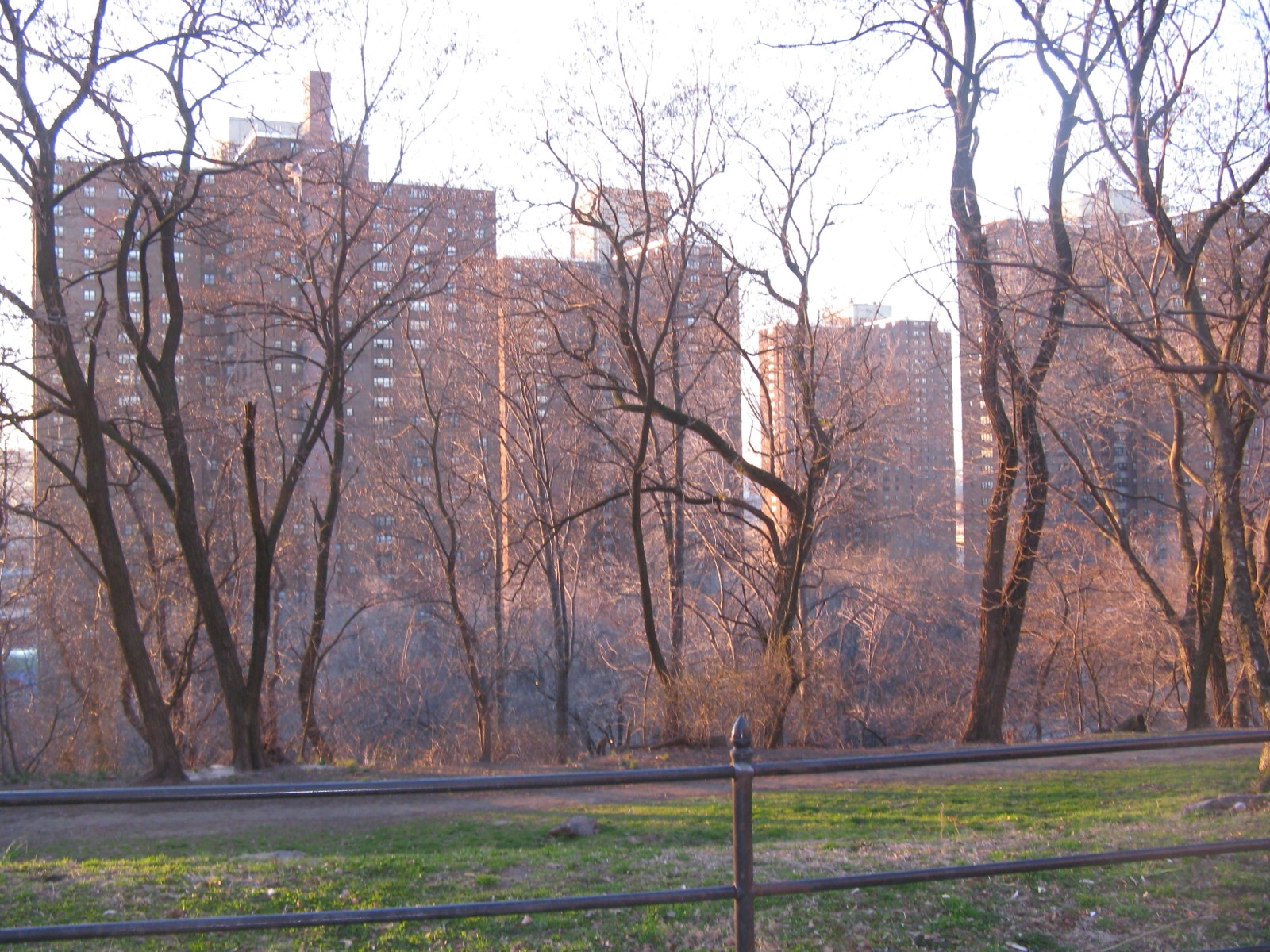
On the cleared land, the New York City Housing Authority built the Polo Grounds Towers. Four identical 30-story brick towers were completed on June 30, 1968, containing 1,616 apartments housing approximately 3,942 residents. The towers sit on exactly the footprint of the old ballpark. The third baseline of the Polo Grounds runs beneath Tower B. The development is a 15.15-acre superblock with limited internal street connectivity, designed in the mid-century public housing style that prioritized unit count over urban design.
The architecture of the towers is straightforward NYCHA construction. Load-bearing concrete frame with brick cladding, flat roofs, uniform window openings, ground-floor community spaces. They are not architecturally remarkable on their own. What makes the site visually striking is the geography. The towers rise from the bottom of a natural bowl, surrounded by the 175-foot walls of Coogan’s Bluff on the north and west, the Harlem River to the east, and the urban grid of upper Manhattan to the south. From Edgecombe Avenue at the top of the bluff, you look down on the rooftops of 30-story buildings. From the Harlem River Drive, the towers fill the hollow like four massive columns planted in the floor of an amphitheater.
The population of the Polo Grounds Towers is approximately 51 percent Black and 47 percent Hispanic, predominantly Dominican and Puerto Rican. About 31 percent of residents are under 18, and 14 percent are between 18 and 24. Nearly half the population is under 25, making it one of the youngest demographic profiles of any NYCHA development in Manhattan. Median household income is approximately $23,635, among the lowest of any NYCHA development in the borough. The neighborhood is defined by concentrated disadvantage and geographic isolation, separated from the broader urban grid by the escarpment, the highway, and the river.
Cleaning apartments in NYCHA high-rises means knowing the building before you arrive
The Polo Grounds Towers present specific cleaning realities that differ from most Manhattan apartment buildings. These are 30-story towers with elevator service that is not always reliable. NYCHA buildings across the city face deferred maintenance and capital repair backlogs, and elevator downtime is a practical concern for anyone who needs to reach an upper floor carrying equipment. Our teams arrive with portable cleaning kits that can be carried up stairs if necessary, and we build buffer time into the schedule for buildings where elevator waits are common.
The apartments themselves are standard NYCHA layouts. One-, two-, and three-bedroom units ranging from roughly 450 to 900 square feet. The kitchens are compact and heavily used. The bathrooms have the tile and fixture configurations common to mid-century public housing construction. The walls are painted surfaces that mark easily. The floors are a mix of original tile, linoleum, and in some units, replacement flooring installed during renovations.
For a first cleaning in one of these apartments, we start with a deep clean. Years of daily use in a compact space concentrate grime in predictable places. Kitchen grease on range hoods and cabinet faces. Bathroom tile grout that has darkened over time. Dust packed into radiator fins that burns off every fall when the steam heat comes on. Baseboards and corners where cleaning tools do not normally reach. We work room by room, top to bottom, and reset every surface. After that first visit, recurring apartment cleaning on a biweekly or monthly schedule keeps it maintained.
The surrounding blocks on Frederick Douglass Boulevard and Amsterdam Avenue have prewar walk-up apartment buildings and some newer construction. These are rental apartments in the 550 to 1,100 square foot range, mostly one- and two-bedrooms, with the typical prewar challenges of high ceilings that collect dust, old window frames that trap grime, and radiator systems that distribute dust every heating season. Standard house cleaning service covers all of it.
The kitchens here reflect the food culture of Dominican and Puerto Rican New York
The Polo Grounds corridor sits at the southern edge of Washington Heights, the center of Dominican New York. Walk up the hill from the towers to St. Nicholas Avenue or Broadway and you are in one of the densest concentrations of Dominican food in the Western Hemisphere. Mofongo, mangu with the three meats, pollo guisado, chicharrones de pollo, sancocho, and the lunch counter tradition of a full plate for under ten dollars. The Puerto Rican food culture of East Harlem extends into the neighborhood as well. Pernil, pasteles, arroz con gandules, and tostones are kitchen staples.
That cooking leaves evidence. Sofrito base cooked daily leaves an oily film on every surface near the stove. Frying builds up on range hoods, cabinet faces, and the ceiling. Rice pots leave starch residue. Stewed meats produce splatter patterns that reach backsplashes and countertop edges. A standard wipe-down does not address this kind of daily accumulation.
We degrease every kitchen surface within six feet of the stove. We pull drip trays, scrub down the exterior of the range hood, and address the grease film on cabinet faces that builds up over weeks of daily cooking. If you want the oven interior done, add a deep clean and we handle that as well. The goal is to let you cook the way your kitchen is meant to be used without the maintenance falling behind.
The Brush Stairway is still the most interesting walk in upper Manhattan
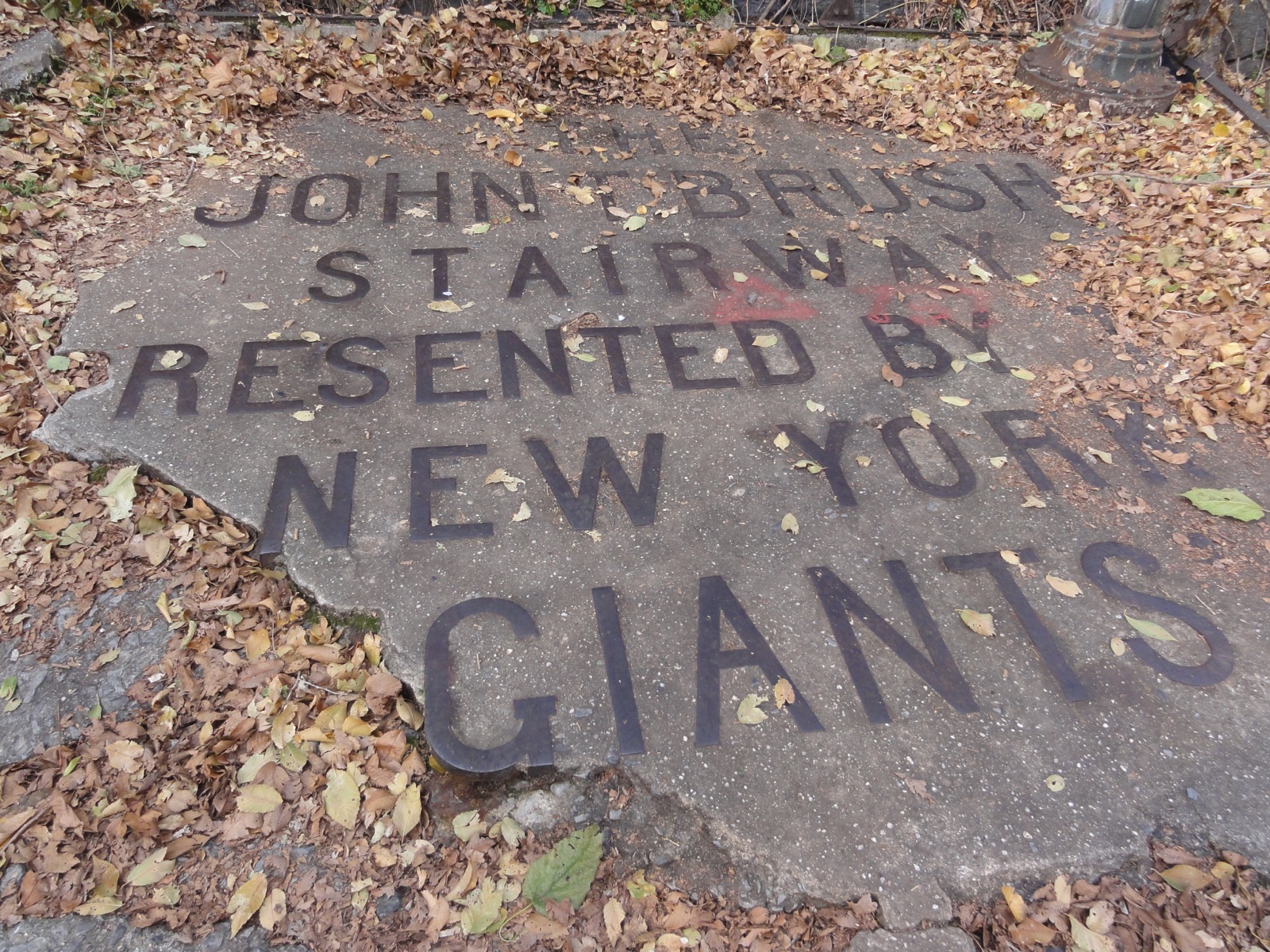
The John T. Brush Stairway is the only surviving physical structure from the Polo Grounds era. Named after the Giants owner who commissioned it in 1913, the concrete staircase descends from West 157th Street between St. Nicholas Avenue and Edgecombe Avenue down the face of Coogan’s Bluff to the level of the hollow. The vertical drop is approximately 120 feet. The stairway was built for a simple practical reason. The 155th Street subway station sat at the top of the bluff. The stadium sat at the bottom. Fans needed a way down. For 50 years, millions of people descended these stairs to watch baseball.
The stairway is now a designated New York City scenic landmark and listed on the National Register of Historic Places. It is still intact and accessible. Baseball fans make the walk regularly, descending the same steps that carried spectators to the Polo Grounds on the afternoon of the Shot Heard ‘Round the World. At the bottom, instead of a stadium, there are apartment towers. The transition from one era to another is compressed into a 120-foot vertical drop.
From the upper landing, the view across the hollow is worth the climb even if you have no interest in baseball. The four towers of the Polo Grounds development are directly below. The Harlem River runs past them to the east. The Bronx skyline fills the background. On clear days, you can see well into the South Bronx and beyond. It is one of the most dramatic shifts in elevation anywhere in Manhattan, a place where the vertical geography of the island reveals itself in a way that flat Midtown never does.
Moving in or out of this neighborhood has its own logistics
The Polo Grounds Towers have regular turnover as NYCHA manages its housing inventory. Apartments are inspected between tenants, and the condition of the unit matters. For tenants moving out, our move-in and move-out cleaning handles the full reset. Inside cabinets, appliance interiors, baseboards, window tracks, bathroom fixtures, and every surface that will be opened or checked during a walkthrough. We leave it inspection-ready.
For the surrounding rental apartments on Frederick Douglass Boulevard and Amsterdam Avenue, the same move-out service applies. Landlords in upper Manhattan expect units returned clean. We handle that standard whether the apartment is a studio or a two-bedroom, whether the building is a five-floor walk-up or a mid-rise with an elevator.
If you are moving into the neighborhood, a move-in clean before you unpack is the practical way to start. The apartment is empty, every surface is accessible, and our team can reach corners and cabinet interiors that will be blocked by furniture within hours. Starting clean and maintaining with recurring service is simpler than trying to deep clean around a fully furnished home later.
Two histories occupy the same hollow and rarely see each other
Every year, baseball fans from across the country come to the Polo Grounds Towers. They walk the Brush Stairway. They photograph the towers from Edgecombe Avenue. They try to calculate where home plate was, where Thomson’s home run landed, where Mays started his sprint toward the centerfield wall. Some of them ask residents for directions. The residents, for the most part, do not think about baseball history on a daily basis. They think about elevators, grocery runs, school pickups, and the realities of living in one of the most geographically isolated public housing developments in Manhattan.
Both histories are real. One is remembered by millions of people who never lived here. The other is lived by thousands of people who may not know why their address is famous. The Polo Grounds is a place where those two versions of New York occupy the same ground and mostly pass each other without connecting. The stadium is gone. The hollow is still there. The bluff still rises 175 feet above the apartments. And the neighborhood, whatever name you give it, still needs the same things every neighborhood needs. Groceries, transit, schools, safety, and a clean home to come back to.
We clean apartments across upper Manhattan, including the Polo Grounds, Hamilton Heights, Harlem, Manhattanville, and Inwood. Our teams know this part of the borough. You can book your cleaning online and see your flat-rate price before you commit. We send W-2 employees, not gig workers. They arrive with the right products for your specific apartment, whether that is a 30th-floor NYCHA unit or a prewar walk-up on Amsterdam Avenue. Check our full list of cleaning services to find what fits.