
SoHo is the neighborhood where the cleaning job changes depending on which floor you are standing on. A converted commercial loft on Greene Street has 14-foot ceilings, exposed brick from the 1860s, cast-iron columns holding up the building, and factory windows that are 10 feet tall. The apartment above a boutique on West Broadway has polished concrete floors that show every streak and an open floor plan where dust travels freely from one end to the other with nothing to stop it. These are not standard apartments. They are former industrial spaces that were built for commerce and light manufacturing over a century ago, and cleaning them requires understanding what the surfaces actually are and what they cannot tolerate.
That is what makes SoHo different from almost anywhere else in the city. But the architecture is only part of the story. The neighborhood itself is worth knowing, because the buildings you are living in were nearly demolished, were saved by artists who were technically breaking the law by living in them, and hosted the most significant concentration of visual art talent in American history before the galleries left and the fashion brands moved in.
SoHo’s cast-iron buildings survived Robert Moses and became the most protected industrial architecture in the world
The name stands for South of Houston. Before anyone called it SoHo, the area was known as Hell’s Hundred Acres, a firefighters’ nickname for the blocks of cast-iron commercial buildings packed with flammable dry goods, textiles, and printing supplies. The name was earned. Through the late 19th century, these buildings housed the dry goods, textile, printing, and light manufacturing industries that powered lower Manhattan’s commercial economy. The density of combustible materials in six-story buildings with no fire escapes and no sprinkler systems made the district a firefighter’s nightmare. In 1911, the Triangle Shirtwaist Factory fire three blocks to the north killed 146 workers, most of them young women from the Lower East Side. The SoHo garment industry continued through the early 20th century, and the nickname stuck.
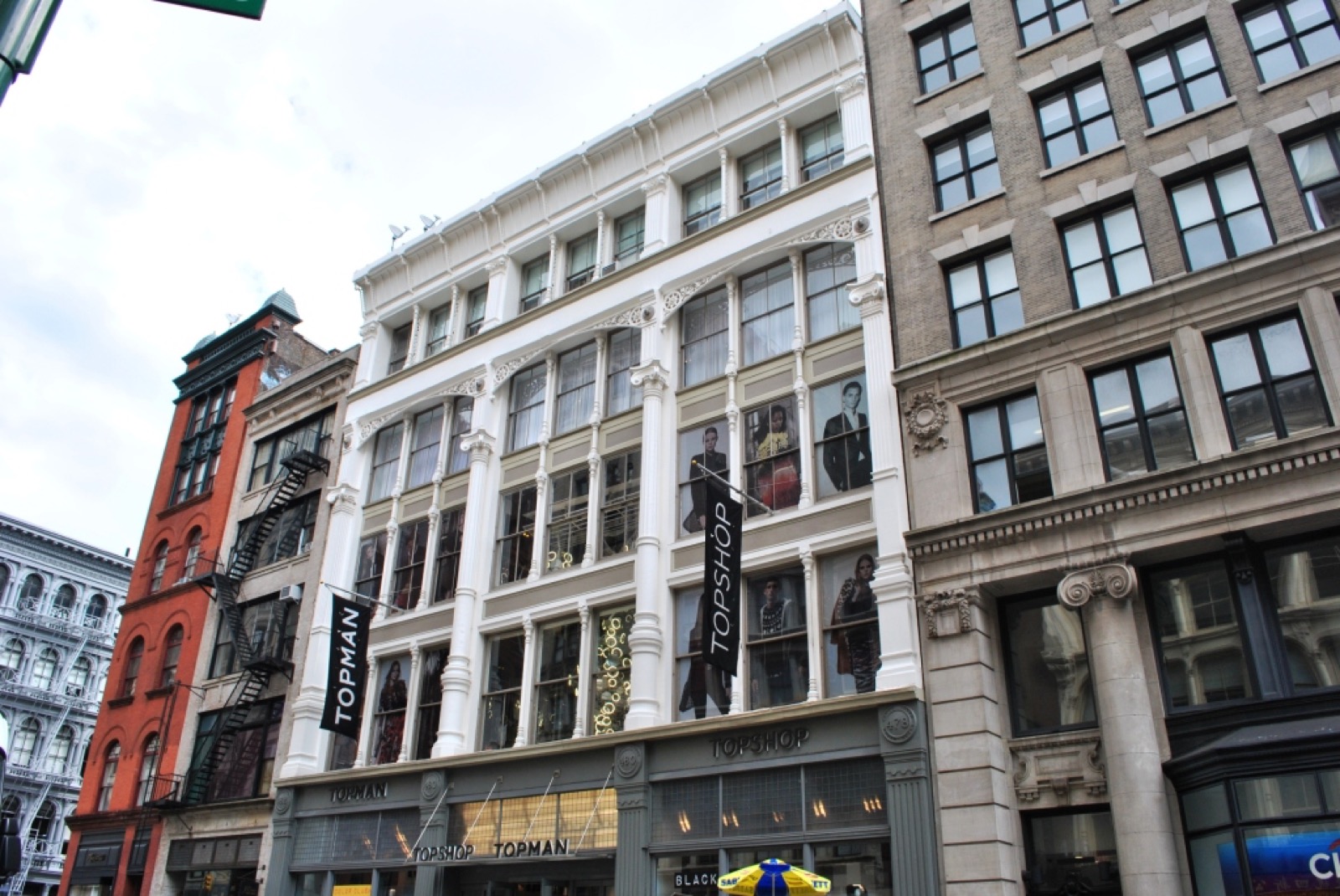
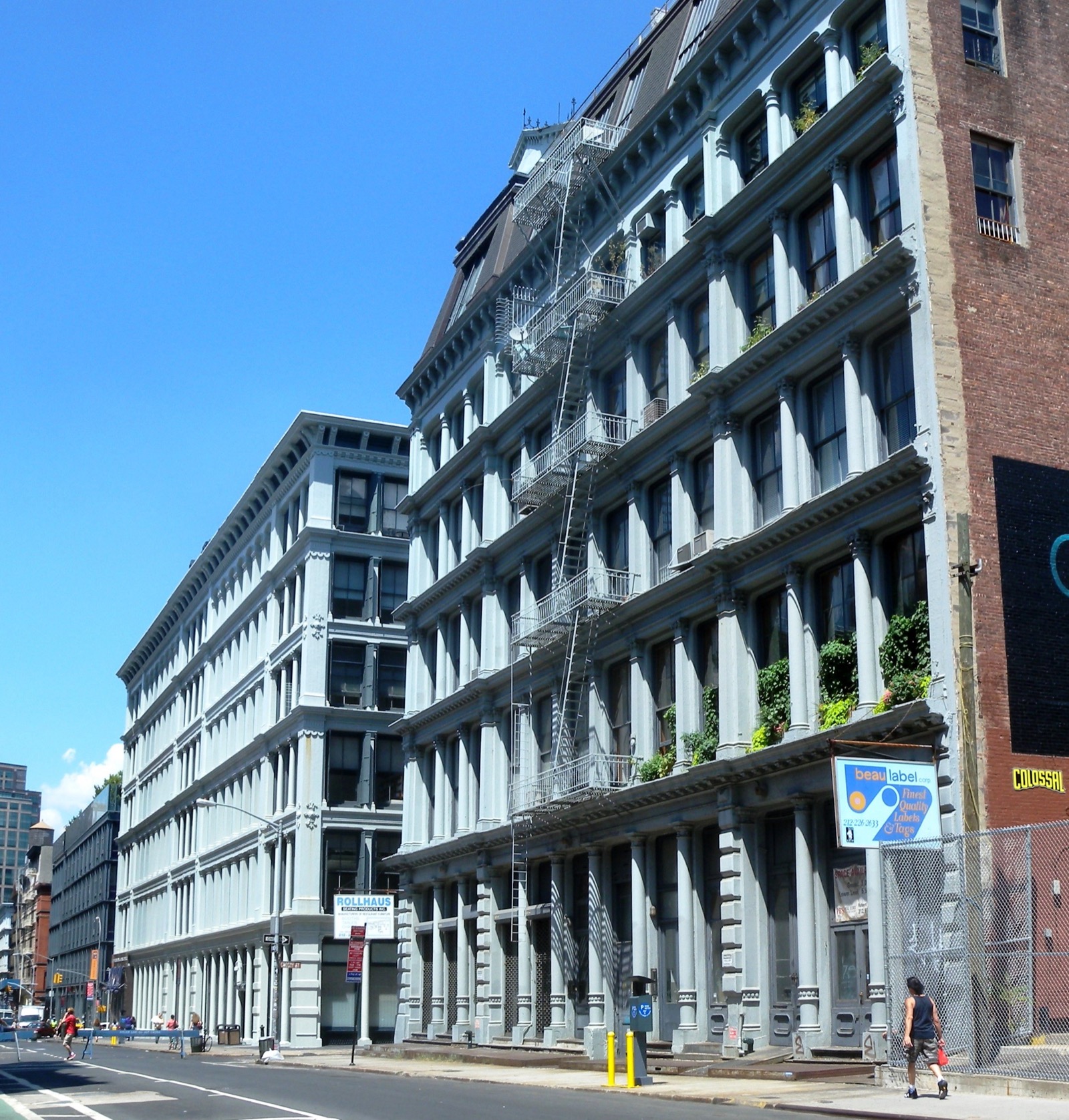
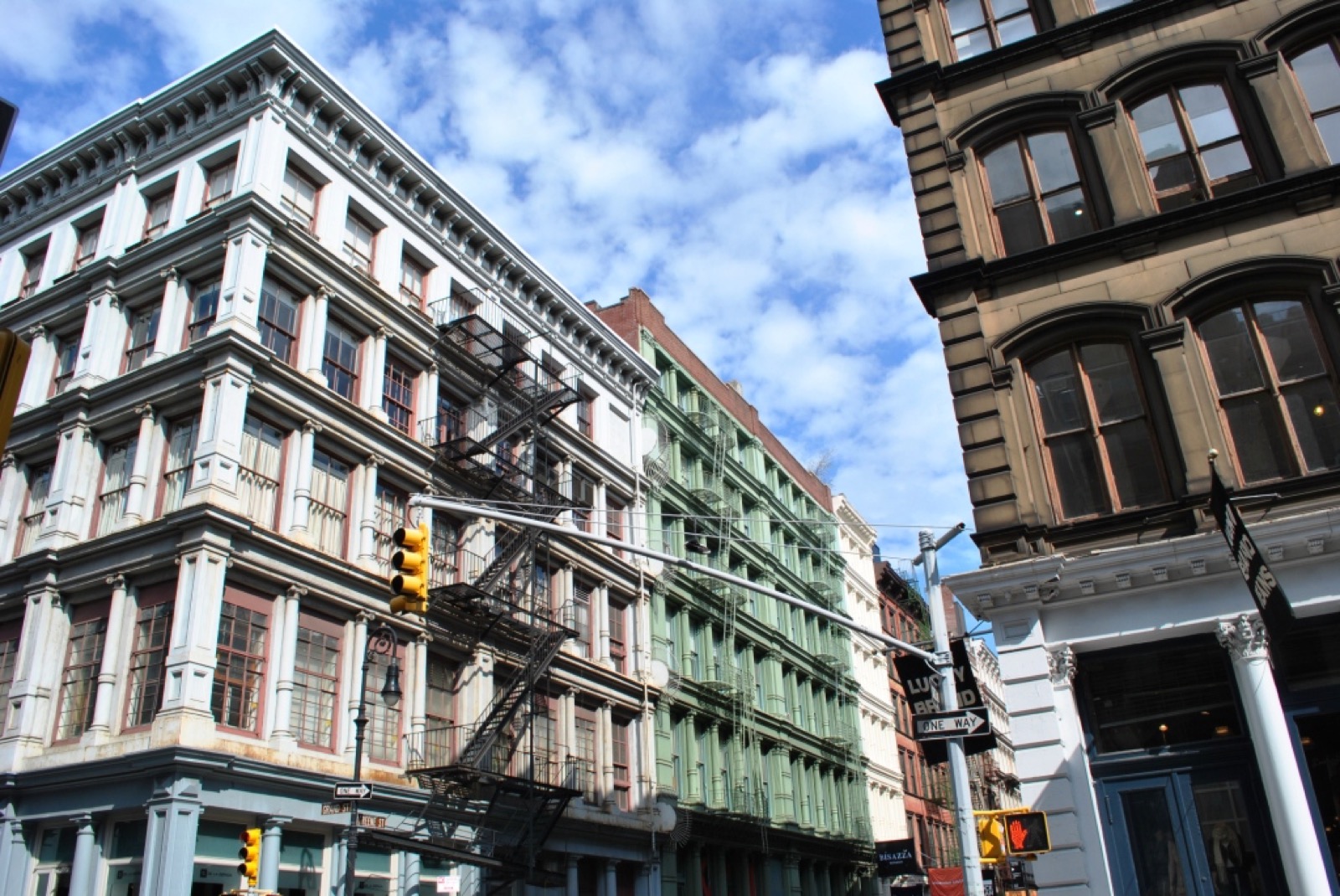
The buildings themselves were constructed between the 1860s and 1890s during a uniquely American architectural experiment. Manhattan builders discovered that prefabricated cast-iron facades, columns, arches, cornices, and ornamental details cast in iron could be assembled far faster and at far less cost than carved stone, while producing buildings of similar visual grandeur. The system was essentially printed architecture. Builders could order ornamental elements from manufacturers’ catalogs, Corinthian columns, egg-and-dart moldings, arched window frames, cornices, and have them shipped and assembled like building blocks. No two buildings are identical, but all share a family resemblance born of the same catalog system. The result was a streetscape of five-to-seven story commercial lofts with enormous windows, painted iron facades, and the kind of decorative ambition that typically required a cathedral budget.
Greene Street between Canal and Houston contains the longest continuous run of cast-iron architecture anywhere in the world. Thirteen blocks of it. The King of Greene Street at 28-30 Greene is a Second Empire building with a mansard roof and the most ornate individual cast-iron facade in the neighborhood. The Queen of Greene Street at 72-76 Greene is an Italian Renaissance palazzo rendered entirely in iron. The cobblestones beneath them are original 19th-century Belgian block granite paving, protected by the historic district designation from removal. Walking Greene Street on a quiet morning is one of the best experiences available in New York City.
The Haughwout Building at 488 Broadway and Broome Street, built in 1857, is the most celebrated cast-iron building in the country. Designed by architect John P. Gaynor as a Venetian Renaissance palazzo in cast iron, it was the first building in the world to install a commercial passenger elevator, manufactured by Elisha Otis. That elevator made multi-story commercial buildings viable and directly enabled the construction of modern skyscrapers. SoHo was the laboratory for that world-changing technology. The Haughwout earned landmark status in 1965 as part of New York City’s first-ever landmark designations.
But the Haughwout and Greene Street and the entire cast-iron district nearly disappeared. Before SoHo became the most protected industrial architecture in America, it was almost a highway. Robert Moses, the city planner who reshaped New York through infrastructure projects and forcible demolitions, proposed the Lower Manhattan Expressway in the 1950s. The plan called for a ten-lane elevated highway connecting the Manhattan Bridge to the Holland Tunnel, and the route would have cut directly through the heart of what is now the historic district. Twelve blocks of SoHo would have been demolished. Thousands of people displaced. The Haughwout Building, Greene Street, the King and Queen, all of it reduced to rubble beneath an overpass.
The community organized against Moses for over a decade. Public hearings. Political resistance. The critical opposition came from Jane Jacobs, who had already defeated Moses’s proposed highway through Washington Square Park in the Village. Jacobs understood that neighborhoods like SoHo had value precisely because of the density and texture that Moses wanted to bulldoze. The LOMEX was killed in 1969. It is one of the most consequential victories in American urban planning history, and the reason Greene Street still exists. Every loft apartment in the historic district owes its existence to the people who fought that battle.
The artists who made SoHo famous were squatting in buildings they were not legally allowed to live in
As commercial tenants vacated the cast-iron lofts through the 1950s and 1960s, artists began moving in. The appeal was obvious. Huge windows flooding deep floor plates with natural light. Ceilings at 12 to 16 feet. Raw industrial floors with enough space to build, paint, and sculpt at a scale that a normal apartment could never accommodate. The problem was that living in these buildings was illegal. The zoning was commercial. The artists were squatters.
The city largely looked the other way. By the late 1960s, an estimated 300 to 500 artists were living and working in SoHo, and the list of names reads like a syllabus for 20th-century American art. Robert Rauschenberg. Jasper Johns. Roy Lichtenstein. Donald Judd. Dan Flavin. These were not minor figures working in obscurity. They were the people who defined American Minimalism, Pop Art, and the subsequent movements that shaped international art for the next 30 years. The lofts of SoHo were the physical incubators for that work.
Donald Judd purchased 101 Spring Street in 1968 for what was then a trivial sum. He spent the next 25 years restoring the five-story cast-iron building and installing his own work and pieces from his collection throughout every floor. The result is one of the most significant artist environments in American art history and is now managed by the Judd Foundation as a historic house museum open for tours. Judd’s approach to 101 Spring was a statement about how art and architecture should coexist, and the building itself is the argument.
The 1971 Artists in Residence zoning legislation legalized live-work space in SoHo, but only for certified working artists. In 1973, the Landmarks Preservation Commission designated the SoHo-Cast Iron Historic District, protecting approximately 26 blocks and over 250 cast-iron buildings. It was the first large-scale industrial historic district in the United States and a model for preservation worldwide. The name “SoHo” was formalized with that designation, coined by residents who needed a geographic shorthand for the territory they had claimed.
West Broadway was the gallery capital of the world before Chelsea took over
Through the 1970s and 1980s, SoHo’s art world grew from an artist colony into the most commercially significant gallery district on the planet. West Broadway became Galerie Row. Leo Castelli, the dealer who showed Jasper Johns, Robert Rauschenberg, Roy Lichtenstein, and Andy Warhol, had his gallery there. Paula Cooper, the first gallery in SoHo when she opened in 1968, was there. Mary Boone, who became the art world’s most powerful dealer of the 1980s Neo-Expressionist movement, was there. An opening night at a major SoHo gallery was the social event of the New York creative world.
The success of the gallery scene was the beginning of the end for the artist colony. Rising rents pushed artists out of their own neighborhood. Galleries, facing the same pressure, began migrating to Chelsea in the mid-1990s, and Chelsea became the dominant gallery district by 2000. Fashion retail followed the art world’s cachet. Prada, Chanel, Helmut Lang, and Alexander McQueen opened flagship stores in vacated gallery spaces. Rem Koolhaas designed the Prada SoHo store at 575 Broadway in 2001 with an undulating wooden floor that doubles as seating for performances. It is one of the most discussed retail interiors in New York. Apple opened its landmark store at 103 Prince Street. The transition from galleries to flagships was complete within a decade.
SoHo also coined a naming convention that spread worldwide. The portmanteau formula, taking South of Houston and compressing it to SoHo, has been applied to hundreds of urban neighborhoods globally. NoHo, north of Houston, came first. Then London’s South Bank tried SoBa. Chicago has NoHu for North of Huron. “SoHo” itself has been slapped onto upscale mixed-use developments from Scottsdale to Singapore. The naming was branding before anyone in the neighborhood was thinking about brands.
The irony is that SoHo invented the gentrification template that has been repeated in Williamsburg, in Shoreditch in London, in Le Marais in Paris, and in neighborhoods in Berlin and Melbourne. Artists move into cheap industrial buildings. They make the neighborhood desirable. They get priced out. The buildings remain. SoHo was the original.
What is left is still extraordinary. The art world is the ghost, but the physical settings that hosted the most important exhibitions in American postwar art history are unchanged in their bones. The cast-iron facades are beautiful. The cobblestones are genuine. The Little Singer Building at 561 Broadway, designed by Ernest Flagg in 1904, marks the end of the cast-iron era with a composition of terra cotta, glass, and structural steel so delicate it looks like it should not be standing. The dining scene, anchored by Balthazar at 80 Spring Street and Raoul’s at 180 Prince, is world-class. On a Saturday afternoon in July, the stretch of Broadway between Houston and Prince is a river of tourist foot traffic and brand shopping bags. But come on a weekday morning in February. The cobblestones on Greene Street are slick from the previous night’s rain. The cast-iron facades are deeply detailed in the flat gray winter light, historically honest and strange in a way that demands attention. The buildings have been standing for 160 years. They will stand for 160 more. SoHo is one of the most genuinely beautiful urban environments in the United States.
Cast-iron loft apartments in SoHo need cleaning that treats surfaces as irreplaceable
The cleaning problem in SoHo is architectural. The converted loft apartments that make up the majority of the neighborhood’s housing stock were built as commercial and light industrial spaces between 1860 and 1890. When they were converted to residences starting in the 1960s, the resulting apartments inherited industrial proportions that do not exist anywhere else in Manhattan. Open floor plans of 1,200 to 4,000 or more square feet with no hallways and no interior walls. Ceilings at 12 to 16 feet. Oversized factory windows. Exposed brick, cast-iron columns, and heavy timber beams incorporated as design features rather than hidden behind drywall.
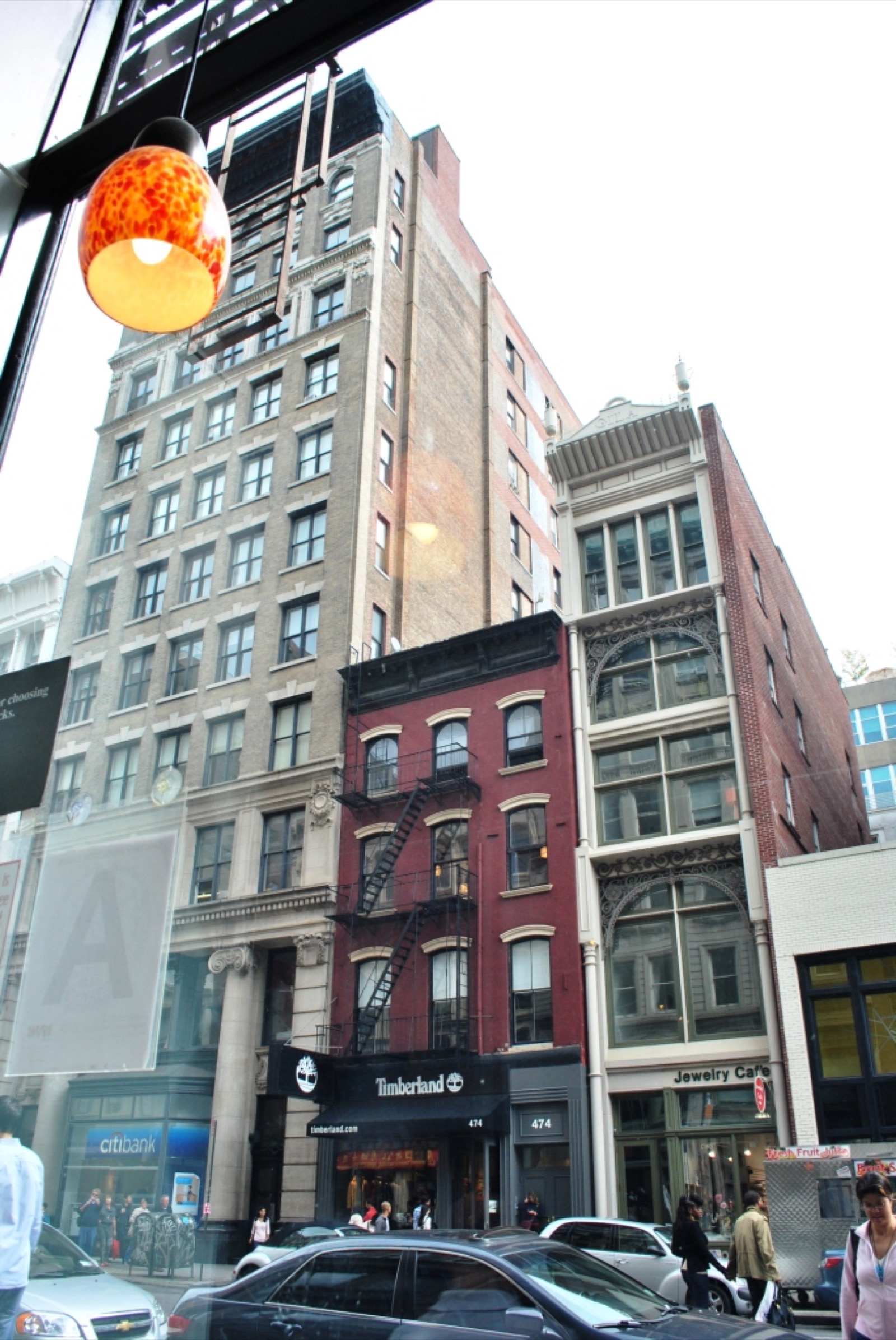
A small number of purpose-built luxury residential buildings have been introduced since the 1990s, designed to be contextually compatible with the historic district. And many SoHo buildings combine retail or restaurant use at street level with residential lofts on upper floors, the prototypical mixed-use building of the neighborhood. But the dominant residential type is the converted commercial loft, and that is what defines the cleaning job here.
The exposed brick in these lofts is 160 years old. The mortar is lime-based and softer than anything used in modern construction. A wet cloth pushes dirt deeper into that mortar and leaves permanent marks. Water stains that surface through old brick are essentially irreversible. Our cleaners use a soft dry brush on all exposed brick. Nothing wet, nothing abrasive.
The cast-iron columns that run through these living spaces are decorative as well as structural. They show every fingerprint and dust mark against their original painted patina. Dry microfiber only. No liquid products that could streak or lift the finish. The factory windows, often 8 to 10 feet tall with multi-pane frames, collect grit on their tops and sills that most cleaning services never check because they cannot reach them. We bring extension poles and step ladders sized for these ceilings.
The polished concrete floors that many lofts have installed show every streak and scratch permanently if cleaned with the wrong pad or product. We use pH-neutral solution with flat microfiber mops on sealed concrete. If the loft has original wide-plank hardwood instead, we switch to soft-bristle attachments and wood-appropriate products. These are surfaces that do not tolerate error, and the open floor plan means that dust migrates freely across the entire living space and settles on every horizontal surface. A 3,000-square-foot loft with no walls accumulates particulate matter at a rate that a compartmentalized apartment does not.
This is apartment cleaning at a scale and complexity that most services are not equipped for. Ours is.
The co-op boards in SoHo’s historic district have their own rules and we track them
Many SoHo co-ops retain the 1971 AIR zoning designation that originally required residents to be certified working artists. In practice, this requirement has not been enforced since the 1990s, but the co-op boards that govern these buildings often have their own vendor requirements that are very much enforced. Certificates of Insurance naming the co-op board as additional insured. Advance notice periods. Service entrance protocols. Some buildings require vendors to be on an approved list that takes days to process.
The newer purpose-built luxury residences that have been introduced since the 1990s have their own logistics entirely. Service elevator scheduling. Security sign-in at the front desk. Specific cleaning hours that do not overlap with building maintenance windows. This is the single most common logistical complaint we hear from SoHo residents who have tried other cleaning services. The cleaning itself might have been acceptable, but the coordination of getting a cleaner into the building fell apart because no one managed the paperwork.
After your first booking, our dispatch team coordinates notice periods, elevator scheduling, and any paperwork your management office requires for every recurring appointment. You do not need to remember to call the front desk or email the management company before each visit. We handle it.
Your cleaning takes about three hours so spend them at Balthazar or walking Greene Street
Balthazar at 80 Spring Street is Keith McNally’s Paris brasserie transplant that opened in 1997 and has been the most reserved restaurant in Manhattan for three consecutive decades. The mirrored walls, zinc bar, and steak frites are the platonic ideal of the classic brasserie. Raoul’s at 180 Prince has been the bohemian French bistro since 1975, predating everything that happened to SoHo afterward. Le Coucou at 138 Lafayette serves classical French cuisine at the highest level in one of the most beautiful dining rooms in Manhattan. Jack’s Wife Freda at 224 Lafayette does Mediterranean brunch so well that the line on weekends has become part of the neighborhood scenery.
If you would rather walk, Greene Street from Canal to Houston covers the entire 13-block cast-iron run and takes about 30 minutes at a pace where you actually look at the facades. The Judd Foundation at 101 Spring Street offers tours of Donald Judd’s five-story building-as-installation. The NYC Fire Museum at 278 Spring Street fills about 90 minutes and is housed in a 1904 Beaux-Arts firehouse. Apple’s landmark store at 103 Prince Street is worth seeing for the architecture even if you are not shopping.
None of this happens while you are on your hands and knees trying to reach the grit on top of your factory windows or deciding whether you should risk using water on 160-year-old brick. That is our job. We handle deep cleaning for lofts that have not been properly reset in years, recurring apartment cleaning on a schedule that works around your life, and move-in and move-out cleaning for the neighborhood’s active real estate market. You see your flat-rate price on our booking page before you commit. No hourly billing, no surprises.
Our cleaners are W-2 employees, vetted, insured, and trained to work in homes where the surfaces are historic and the expectations are high. We also serve nearby Tribeca, Greenwich Village, Little Italy, Chelsea, and the rest of Manhattan.