
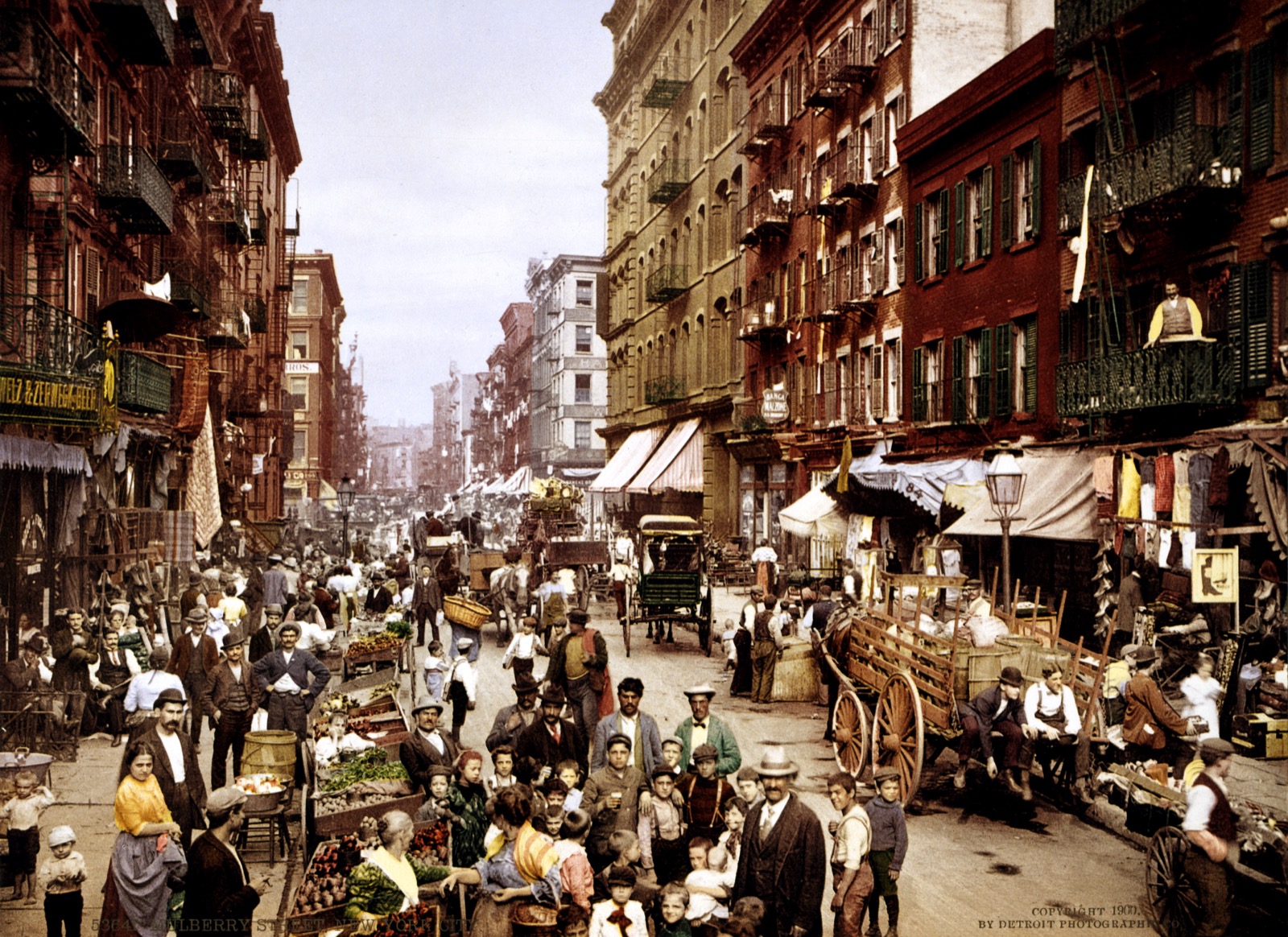
Little Italy is one of the smallest neighborhoods in Manhattan. That is not how it started. In 1910, the blocks around Mulberry Street housed nearly 10,000 Italian-born residents packed into tenements across 30 or more blocks. The Italian quarter stretched from Canal Street to Houston, from the Bowery to Lafayette, and every building on the grid was full. Today the neighborhood has contracted to roughly five blocks of Mulberry Street north of Canal, a strip of Italian-American restaurants with checkered tablecloths and photos of Sinatra on the walls, surrounded on all sides by Chinatown, SoHo, and NoLIta. The Italian population of the census tracts that make up Little Italy has fallen below 10 percent. By the 2010 Census, not a single person born in Italy lived in those tracts.
The tenement buildings are still here. The architecture did not leave when the families did. And that architecture, more than the restaurants or the feast or the mythology, is what determines how these apartments need to be cleaned.
The tenement walk-ups that built Little Italy still define how apartments clean today
The structural foundation of Little Italy is the 19th-century tenement building. Four to six stories of brick construction, flat-roofed, narrow-windowed, built between the 1860s and 1910s to house the maximum possible number of people in the minimum possible space. The 1901 Tenement House Act required new construction to meet standards for light, air, and sanitation, producing what historians call the “new-law” tenement. Both the old-law and new-law versions survive in Little Italy, and both present the same cleaning realities.
These apartments are small. Studios and one-bedrooms run 350 to 700 square feet. The kitchens are galley-style or alcove arrangements pushed against one wall of a combined living space. The bathrooms are tight. The hallways are narrow. The ceilings are 8 to 9 feet, lower than the lofts you find in Tribeca or SoHo. The windows are small and often face an airshaft rather than the street, which limits natural ventilation and means that cooking residue, dust, and moisture have fewer places to go.
That limited ventilation is the single biggest cleaning challenge in a Little Italy tenement. In a modern apartment with central air and oversized windows, airborne grease from cooking dissipates quickly. In a 130-year-old tenement with one window facing a lightwell, that grease lands on every surface within 10 feet of the stove and stays there. Kitchen cabinets, the wall behind the range, the underside of shelving, the ceiling above the burners. It builds up slowly enough that you stop noticing it, but run a white cloth across the top of your cabinet doors and you will see exactly how much has accumulated.
Our teams degrease the entire kitchen zone on every visit, including the run of wall above the backsplash that most cleaning approaches skip. The drip trays come out and the outside of the range hood gets scrubbed. The cabinet faces and fronts get wiped down, the greasy handles included. The wall beside the stove and the stretch above the burners gets treated with a degreasing solution that breaks down the film without damaging paint or old plaster. This is standard apartment cleaning for us in lower Manhattan, but the tenement layout of Little Italy makes the kitchen work especially critical because the cooking area is never separated from the living area by more than a few feet.
Four million Italians arrived between 1880 and 1920 and the tenements absorbed all of them
The story of why these buildings exist in this particular form starts with the largest migration in Italian history. Between 1880 and 1920, over four million Italians emigrated to the United States. The overwhelming majority came from the impoverished south, from Sicily, Calabria, Campania, and the villages of the Mezzogiorno where the land was exhausted and the ruling class was indifferent. Tens of thousands settled in lower Manhattan, concentrating on the blocks around Mulberry Street.
The neighborhood organized itself along regional lines with a precision that would be impossible to imagine today. Immigrants from Sicily concentrated on Elizabeth Street. Genovese families clustered on Baxter Street. Neapolitans took Prince Street and the blocks around it. Calabrians settled further south. Families from a single village in the mountains sometimes occupied a single building together. “Italian” was not one identity in Little Italy. It was a mosaic of regional cultures, often mutually incomprehensible, who had America in common.
The reformer Jacob Riis photographed the most densely packed section, Mulberry Bend, in the late 1880s for his book “How the Other Half Lives.” The photographs showed families of eight in single rooms, children sleeping on fire escapes, and garbage piled in alleys where sunlight never reached. The city demolished the worst tenements in 1897 and built Mulberry Bend Park, which is now Columbus Park at the northern edge of Chinatown. The buildings that survived the demolition are still standing. Many of them are the same buildings people live in today.
Martin Scorsese grew up at 241 Elizabeth Street, the son of Sicilian immigrant parents. His earliest films are essentially documentaries of the neighborhood he knew. “Mean Streets,” shot partly on location in Little Italy in the early 1970s, captures the texture of the place with the accuracy of someone who spent his childhood looking out the window of a tenement apartment at this exact grid of streets. The social clubs, the church, the feast days, the ambient threat of violence in the background of everything. It is the most faithful portrait of Little Italy ever committed to film, and it was made by someone who lived it.
The neighborhood shrank from 30 blocks to five in a single generation
The Italian families left after World War II. The postwar economic boom, the GI Bill, and the rapid acceptance of Italian-Americans into mainstream American life enabled the neighborhood’s residents to do what immigrants had always come to America hoping to do. They moved to the suburbs. They moved to Long Island, to New Jersey, to Staten Island. The children and grandchildren of the families who had crowded into Mulberry Street tenements at the turn of the century now had cars, lawns, and mortgages on single-family houses.
From the other direction, the Immigration and Nationality Act of 1965 reopened immigration from Asia and dramatically accelerated the expansion of Chinatown to the south. As Chinese immigrants filled the blocks south of Canal Street and then crossed it, they moved into the tenements vacating below Grand Street. The border between Little Italy and Chinatown, which had been Canal Street, was effectively dissolved. By the 1990s, Chinatown had absorbed most of what had once been the Italian neighborhood’s southern half.
From the north, the blocks above Spring Street on Elizabeth, Mott, and Mulberry developed a separate identity in the 1990s as artists, boutique retailers, and independent restaurants moved into the still-affordable spaces. The nickname NoLIta, North of Little Italy, crystallized the area’s new identity. Fashionable, expensive, and largely disconnected from the Italian-American community it was named after.
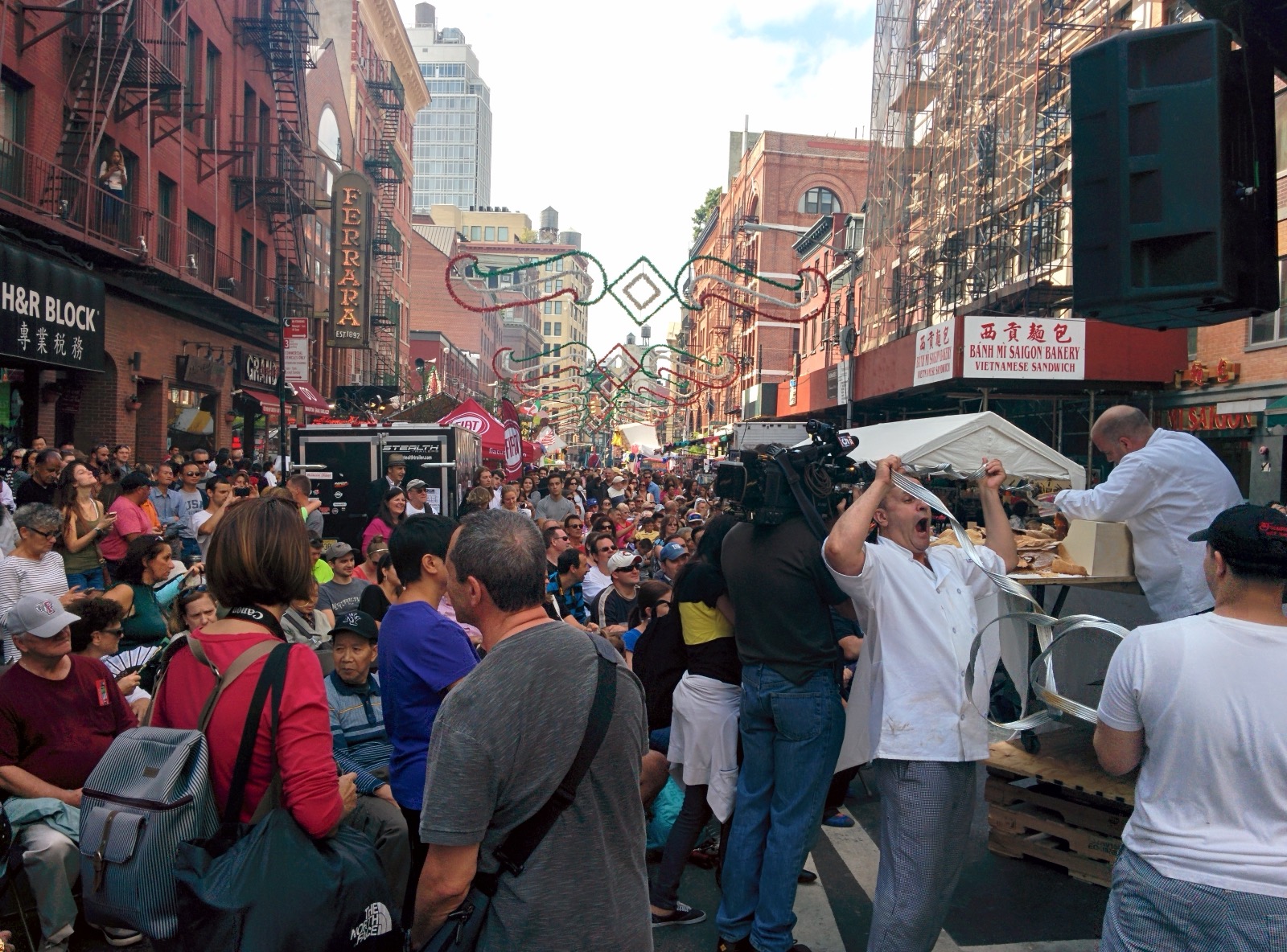
What remains of the Italian neighborhood today is a strip of Mulberry Street between Canal and Broome, anchored by the restaurants and by the Feast of San Gennaro every September. The feast has run continuously since 1926 and now stretches for 11 days. It is the longest-running and largest Italian-American street festival in the United States. Over a million visitors walk through each year. The sausage and peppers, the zeppole, the cannoli from Ferrara, the accordion music from speakers strung between buildings. It is a performance of Italian-American identity that draws people from around the world, and it takes place on a block where almost no Italian-Americans actually live anymore.
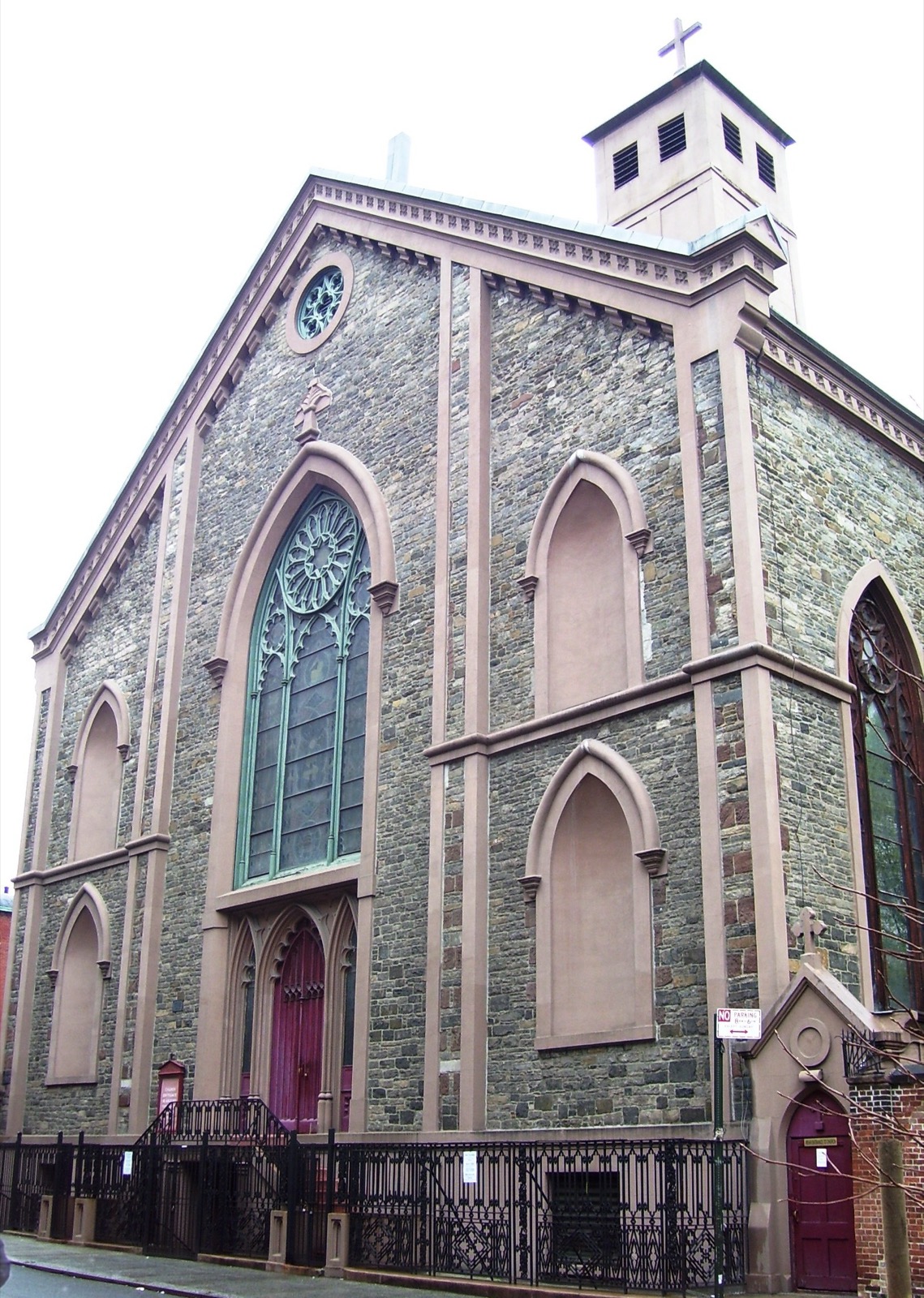
St. Patrick’s Old Cathedral has anchored Mulberry Street since before the Italians arrived
The most architecturally significant building in the neighborhood is St. Patrick’s Old Cathedral at 260 Mulberry Street. Built between 1809 and 1815 to a Gothic Revival design by Joseph-Francois Mangin, it was the original Catholic cathedral of New York, the first Gothic Revival church in the city. The walled cemetery still encloses graves dating to the early 19th century, and the catacombs beneath the cathedral contain additional burials from the city’s early Catholic families. The church served Italian-language masses for over a century and was designated a New York City Landmark in 1966 and elevated to a Minor Basilica in 2010.
The cathedral’s presence on Mulberry Street is older than Little Italy itself. It predates the Italian immigration by 70 years. It served the Irish immigrants before the Italians, and it now serves a mixed congregation that reflects the neighborhood as it actually is rather than as nostalgia remembers it. The building is one of the most important ecclesiastical structures in New York City, and its cemetery wall, constructed in 1815, is one of the few places in lower Manhattan where you can touch something built before the Erie Canal existed.
Ferrara Bakery and Di Palo’s are the last authentic food institutions standing
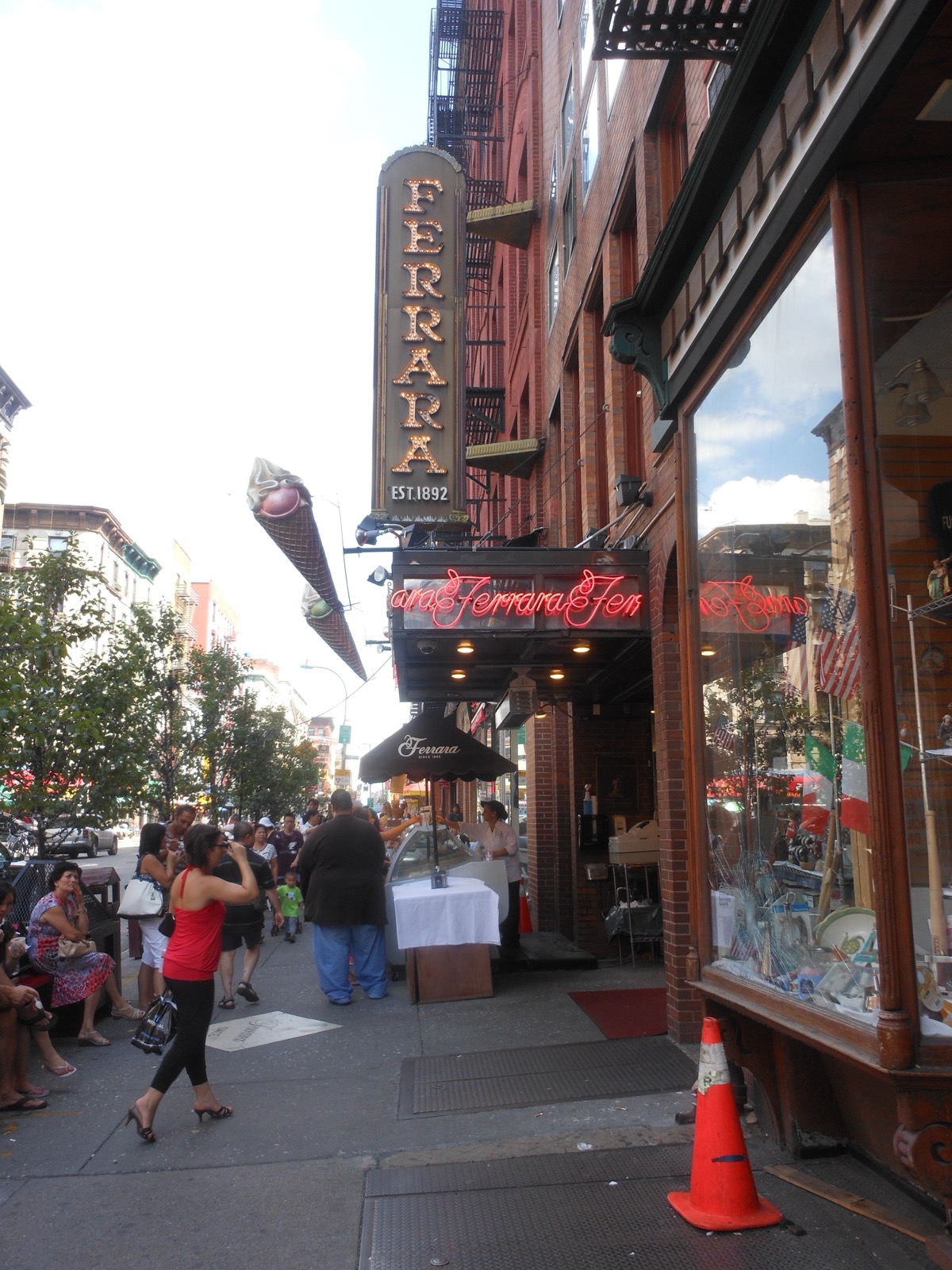
Ferrara Bakery at 195 Grand Street has been operating continuously since 1892. Mario Ferrara opened the shop to serve the Italian immigrant community, and his descendants have run it through four generations. The cannoli, filled to order with fresh ricotta, are the standard against which all other New York cannoli are measured. The sfogliatelle and the espresso are serious. During the Feast of San Gennaro, the line extends around the block. The rest of the year, you can walk in and sit down.
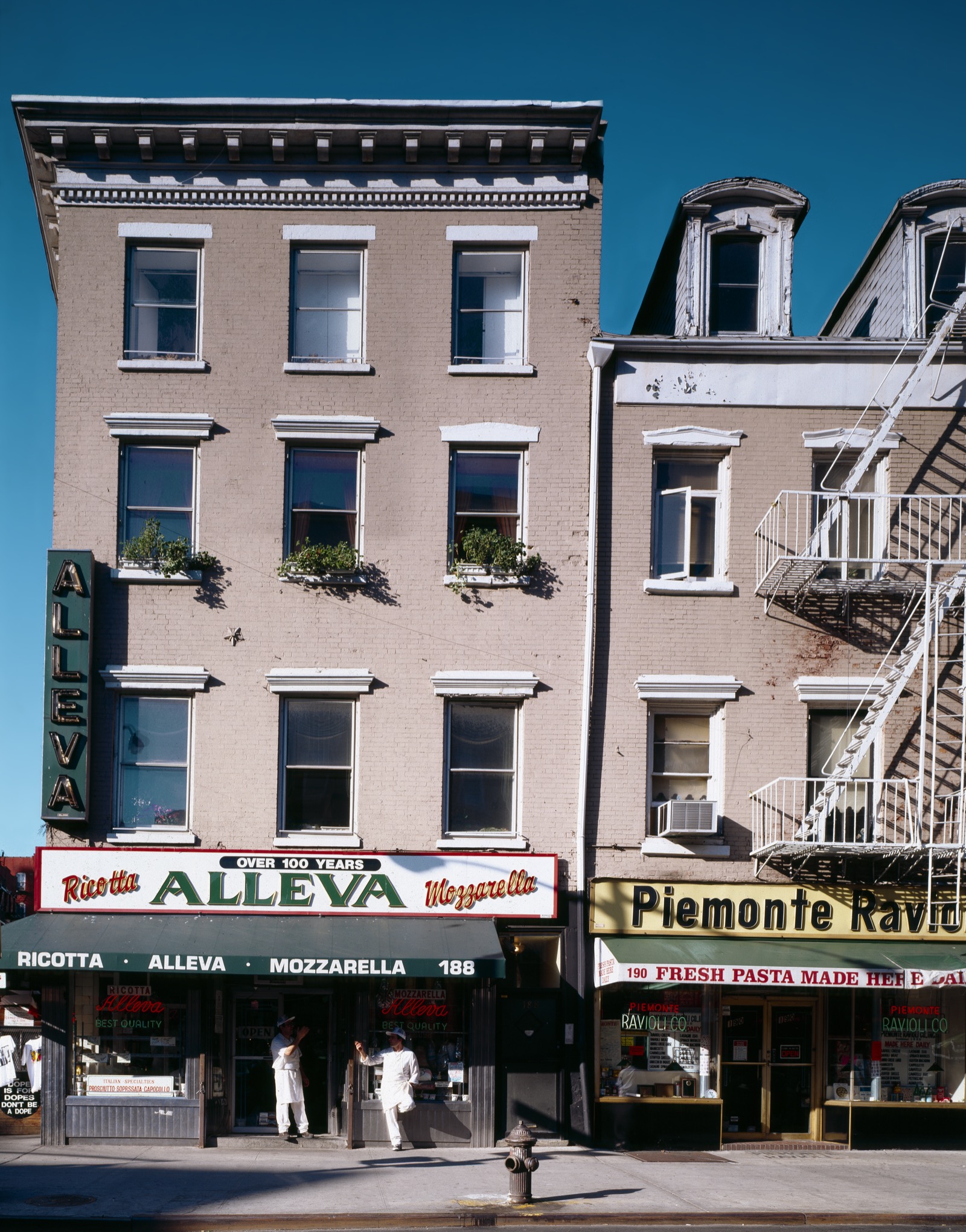
Di Palo’s Fine Foods at 200 Grand Street is the most important Italian specialty food shop in the city. Founded by Luigi Di Palo in 1925 and now run by the fourth generation, the shop carries imported cheeses, cured meats, and prepared foods of extraordinary quality. The mozzarella is made fresh from curd every morning. The relationships with small Italian producers, particularly in Sicily and Puglia, allow Di Palo’s to carry aged cheeses that are legally unavailable elsewhere in North America. It is a last living link to the neighborhood’s authentic culinary culture.
Lombardi’s at 32 Spring Street opened in 1905 and is the oldest pizzeria in the United States. Gennaro Lombardi learned to make pizza in Naples and largely created what we now call New York-style pizza. The coal-fired oven has been in continuous operation for over 120 years. No slices, whole pies only. The basic mozzarella pie is the benchmark.
These three institutions, Ferrara’s, Di Palo’s, and Lombardi’s, represent over 350 combined years of continuous operation on the same blocks. They are the reason this neighborhood still has a genuine food culture rather than just a tourist one. Your three-hour cleaning window is enough time to eat cannoli at Ferrara’s, pick up fresh mozzarella at Di Palo’s, and still have time to walk through Columbus Park before heading home.
Old tenement plaster and prewar fixtures need cleaners who know what not to touch
The cleaning challenge in a Little Italy tenement is not complexity. It is restraint. These apartments are old. The plaster walls in an unrenovated unit may be original to the 1880s or 1890s. Water on unsealed plaster leaves marks that do not come out. Abrasive contact chips decorative molding. The wood trim around windows and doors in the older units is often softwood that has been painted over dozens of times across a century, creating a layered surface that flakes if you scrub too hard.
Our cleaners use dry microfiber on plaster walls. No spray, no wet cloth on unsealed surfaces. The painted trim gets a gentle wipe with a damp microfiber. The hardwood floors, where they exist under layers of carpet or linoleum, get a pH-neutral solution with a flat mop. The cast-iron radiators that heat most of these apartments get special attention because dust packed into radiator fins burns off every October when the steam heat kicks on, filling the apartment with that scorched-lint smell for a week. We clean the fins in detail, pulling dust out from between them rather than pushing it further in.
For tenement kitchens with original or older cabinetry, we use a degreasing solution that cuts through the film without stripping paint. The range hood, the cabinet faces, the backsplash, and the wall above the stove all get treated. In a galley kitchen that shares air with the living space, this is the difference between an apartment that smells clean and one that smells like Tuesday’s dinner permanently.
If you need a full reset on an apartment that has not been professionally cleaned in years, that is a deep clean. We work top to bottom, surface by surface, and bring the apartment back to a baseline. After that, recurring apartment cleaning on a biweekly or monthly schedule keeps it there.
NoLIta condos and loft conversions are a different job from the tenements
The blocks north of the shrinking Italian core, Elizabeth, Mott, and Mulberry between Houston and Spring, have become NoLIta. The ground-floor spaces that were Italian delis and social clubs are now boutiques, galleries, and cafes. The upper floors remain residential, but the market has shifted dramatically. New condominiums have been built on the edges of the neighborhood, and older buildings have been fully renovated into loft-style apartments with higher ceilings, open floor plans, and modern finishes.
These apartments present different cleaning needs than the unrenovated tenements a few blocks south. Engineered hardwood, quartz countertops, glass shower enclosures, and stainless steel appliances are standard finishes. The spaces are larger, typically 800 to 1,800 square feet, and the layouts are more open. Dust behavior in an open-plan loft follows the same pattern as in Tribeca or SoHo: without interior walls to contain it, particulate matter circulates freely and settles on every horizontal surface from shelving to light fixtures.
Our teams adjust products and techniques based on the specific home. A renovated NoLIta condo with honed marble countertops and a glass-walled bathroom is a different job from a fifth-floor Mulberry Street walk-up with 130-year-old plaster and a galley kitchen. We handle both. The notes we keep on your specific apartment mean the same protocols apply every visit regardless of which team member comes.
What booking looks like for Little Italy residents
You pick your date and time on our booking page. You see your flat-rate price before you commit. If your tenement has plaster walls that need careful handling, you tell us once and we note it permanently on your account. If your fifth-floor walk-up has no elevator, we plan for it. Our cleaners are W-2 employees, not gig workers. They are vetted, insured, and they arrive with the right products for your specific apartment.
We serve Little Italy and all of lower Manhattan, including nearby Tribeca and FiDi. Our teams use the Spring Street 6 station, the Prince Street N/R/W, or the Broadway-Lafayette B/D/F/M to reach the neighborhood. For move-in and move-out cleaning in the neighborhood’s active rental market, we handle every surface a landlord will check. You see your price, you book, and we show up.