
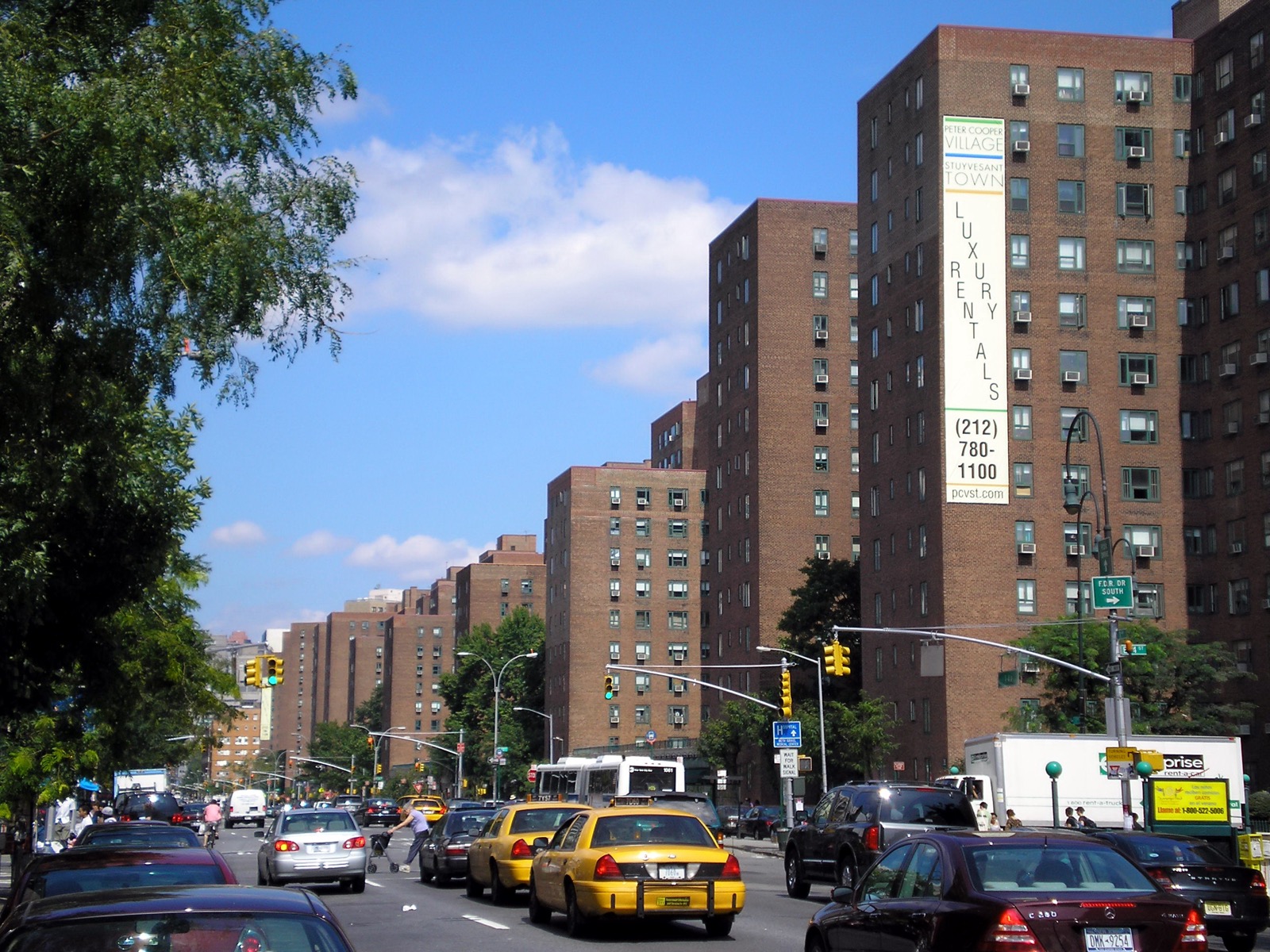
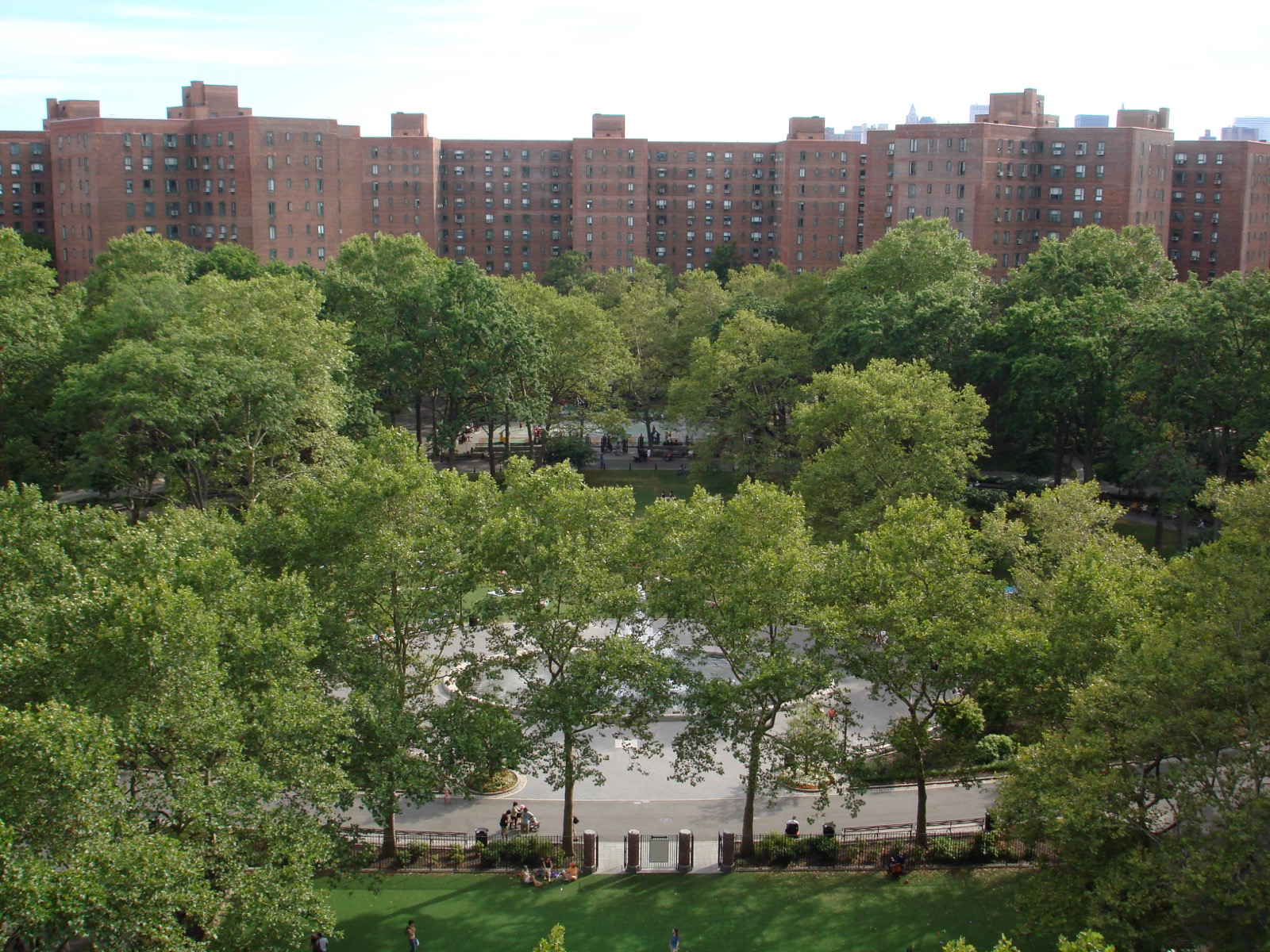
Stuyvesant Town is 35 identical red-brick towers on 80 acres of land between 14th Street and 20th Street on the East Side of Manhattan. It houses roughly 27,000 people in 8,757 apartments. No city streets run through it. No cars pass through it unless they are making a delivery. The buildings are arranged around open lawns and pedestrian paths, all centered on a communal green called the Oval where people gather on Sundays for the farmers market and walk their dogs the other six days of the week.
It is one of the most densely occupied residential developments in the United States, and for most of its 79-year history it has been one of the most fought-over pieces of real estate in New York City. The fights have been about race, about rent, about who gets to live in Manhattan on a middle-class income, and about whether a community built by displacing 11,000 people can become something worth defending. The answer, based on what the tenants have actually done, is yes.
The Gashouse District was demolished to build this complex and 11,000 people lost their homes
Before Stuyvesant Town existed, this stretch of the East Side between roughly 14th and 23rd Streets was called the Gashouse District. The name came from the Consolidated Edison gas storage tanks that dominated the skyline. Massive cylindrical tanks, some over 200 feet tall, loomed over tenement buildings where Irish, Italian, Eastern European Jewish, and Puerto Rican immigrant families lived alongside gas works, slaughterhouses, and light manufacturing. The smell of coal gas was constant. The neighborhood was dense, poor, and functioning. People lived there because they had to, and they built a community because that is what people do.
In 1943, Robert Moses championed a plan to clear approximately 18 blocks of the Gashouse District and hand the land to Metropolitan Life Insurance Company for a new residential development. The State of New York granted MetLife eminent domain authority. The displaced residents, 11,000 of them, received relocation payments of $200 to $500 and were scattered to other neighborhoods. It was the largest single displacement of residents by a private developer in New York City history at that point.
Moses called it urban renewal. The families who were cleared out called it something else. Most could not afford the apartments that were built on the land where they had lived. The Gashouse District’s legacy survives in an unexpected place. The 1934 St. Louis Cardinals baseball team, one of the most famous teams in the sport’s history, was nicknamed “The Gashouse Gang” after this neighborhood’s rough reputation. Dizzy Dean, Leo Durocher, and Joe Medwick took their team’s identity from a place that no longer exists.
MetLife opened Stuyvesant Town in 1947 and explicitly refused to rent to Black tenants
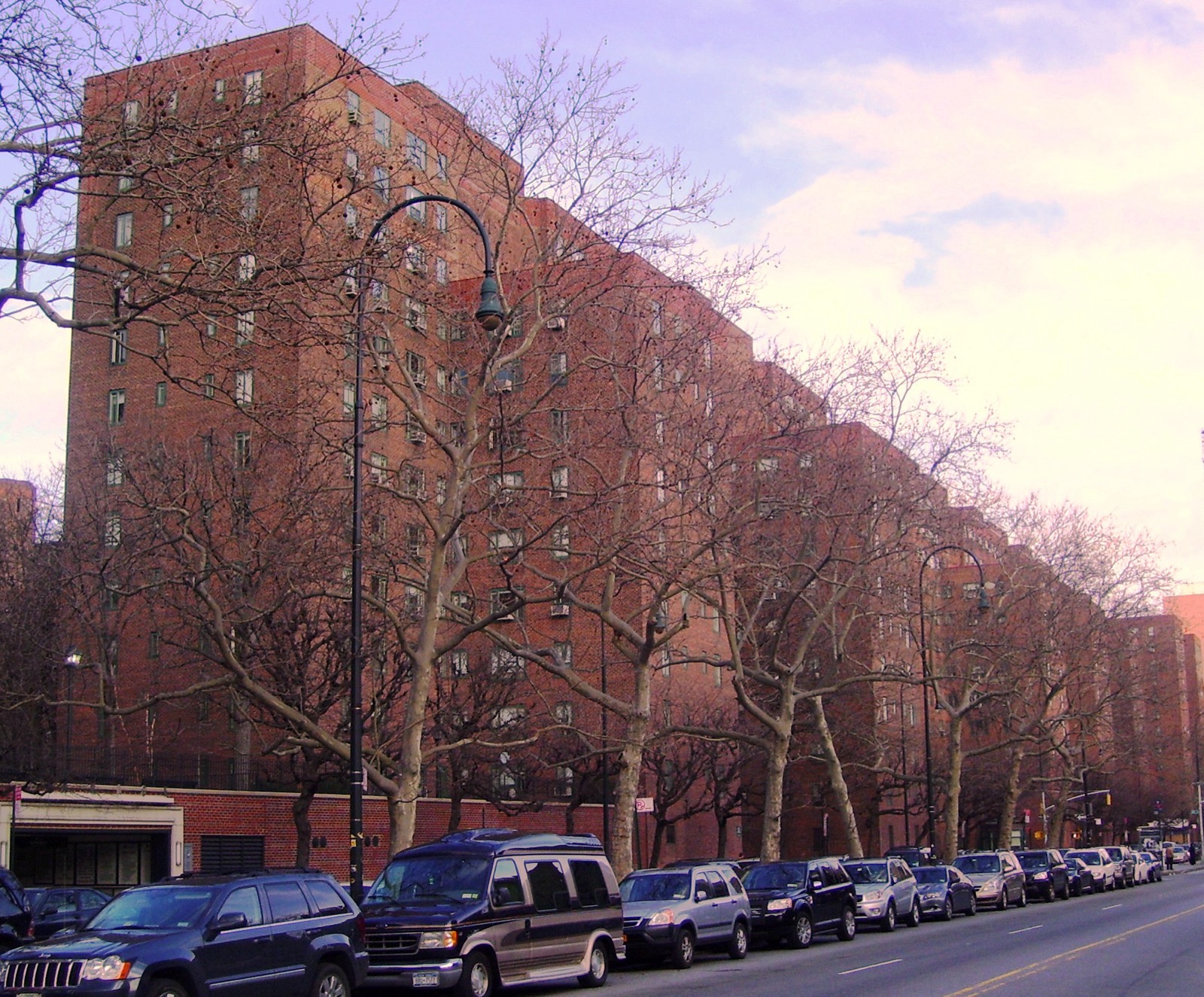
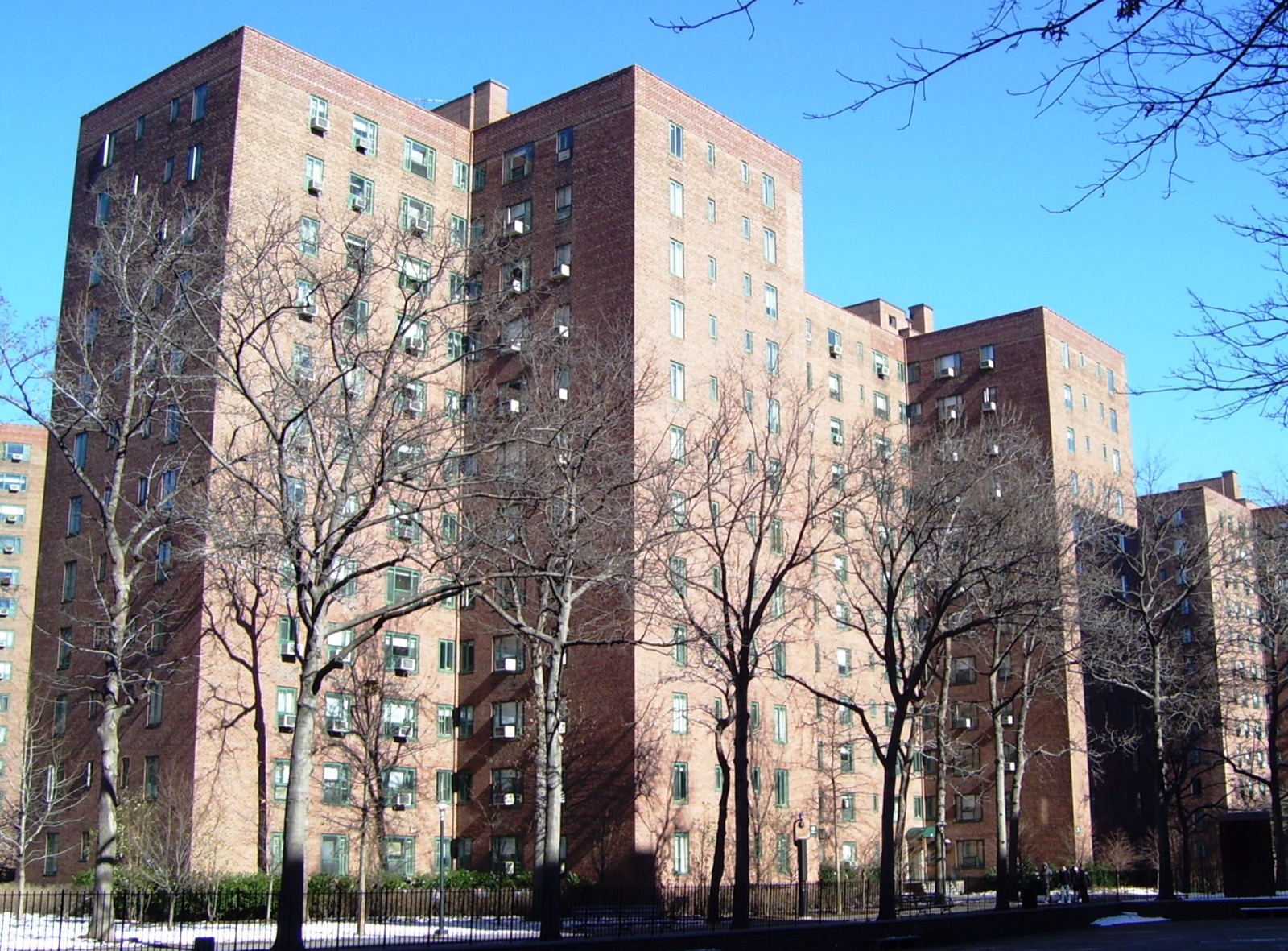
The complex was designed by Irwin Clavan and Gilmore Clarke and built between 1945 and 1947. It opened in August 1947 with 35 red-brick towers of 11 to 13 stories. The sister development, Peter Cooper Village, opened simultaneously to the north with a slightly more upscale positioning. Together they housed over 25,000 people in what was, at the time, the most ambitious private residential project in American history.
MetLife’s rental policy was openly, explicitly racist. The company refused to rent to Black applicants. This was not a quiet exclusion or a matter of selective enforcement. It was policy. The NAACP, labor unions, and civil rights organizations picketed and litigated. City Councilman Stanley Isaacs introduced legislation to prohibit discrimination in publicly assisted housing. The fight reached the courts.
The landmark case was Dorsey v. Stuyvesant Town Corp. in 1949. The New York Court of Appeals upheld MetLife’s right to discriminate as a private company, despite the company having received city tax benefits to build the complex. The decision was devastating. It helped establish a legal framework that fair housing advocates spent the next two decades tearing down. The complex was not fully opened to Black and other non-white tenants until the Federal Fair Housing Act of 1968 and subsequent enforcement changed the legal landscape.
That history is part of the address. Every tenant in Stuyvesant Town lives in a development that was built by displacing one community and then deliberately excluding another. What happened in the decades after is what makes the story more complicated and, in some ways, more interesting.
For fifty years this was the most stable middle-class community in Manhattan
From the 1950s through the 2000s, Stuyvesant Town was the place where New York City’s middle class actually lived. Teachers, firefighters, nurses, city employees, and small-business owners waited years on waiting lists for apartments. Families raised children in the playgrounds between the towers. The Oval hosted community gatherings. The tenant newsletter was one of the most widely read community publications in Manhattan.
The stability was partly design and partly economics. The superblock layout, with no through-traffic and generous open space between buildings, created a sense of safety and community that is unusual in Manhattan. The rent-stabilized leases made it possible for families to stay for decades. Some tenants have lived in the same apartment for 40 or 50 years. Their children grew up here and, in some cases, inherited the lease.
The community was also, for most of its history, overwhelmingly white. The demographics have shifted gradually since the late 1960s, and today the complex is meaningfully more diverse, with approximately 65 to 70 percent white residents, 12 to 15 percent Asian American, 8 to 10 percent Hispanic, and 5 to 7 percent Black. But the legacy of the original exclusion still shows in who lives here and who does not.
The $5.4 billion sale in 2006 nearly destroyed what the tenants had built
In October 2006, MetLife sold Stuyvesant Town and Peter Cooper Village to Tishman Speyer Properties and BlackRock for $5.4 billion. It was the largest single real estate transaction in American history at the time. The purchase price represented roughly 35 times the property’s annual net operating income, a valuation that only made sense if the new owners could convert thousands of rent-stabilized apartments to market rate.
Tishman Speyer’s strategy was aggressive. The company used owner-occupancy enforcement and building inspections to pressure long-term tenants out of their stabilized apartments. The tenants organized and fought back. The Stuyvesant Town-Peter Cooper Village Tenants Association, already one of the strongest tenant organizations in New York, became the center of a legal and political battle that would shape housing law for years.
In 2009, the New York Court of Appeals ruled in Roberts v. Tishman Speyer that the owners had illegally deregulated thousands of apartments while receiving J-51 tax benefits. The ruling required the company to repay overcharged rent to thousands of tenants and effectively voided the deregulation of approximately 4,000 apartments. Tishman Speyer defaulted on its $3 billion mortgage in January 2010 and surrendered the property, losing $1.7 billion in equity entirely.
The Roberts decision is one of the most consequential tenant victories in New York housing law. Legal scholars and housing advocates rank it alongside the foundational cases of the American tenant protection movement. The tenants who won it were the children and grandchildren of people who had moved into a complex that had been built by clearing one community and refusing another. They fought for their homes and they won.
Blackstone bought the complex in 2015 and the affordability agreement is what holds things together now
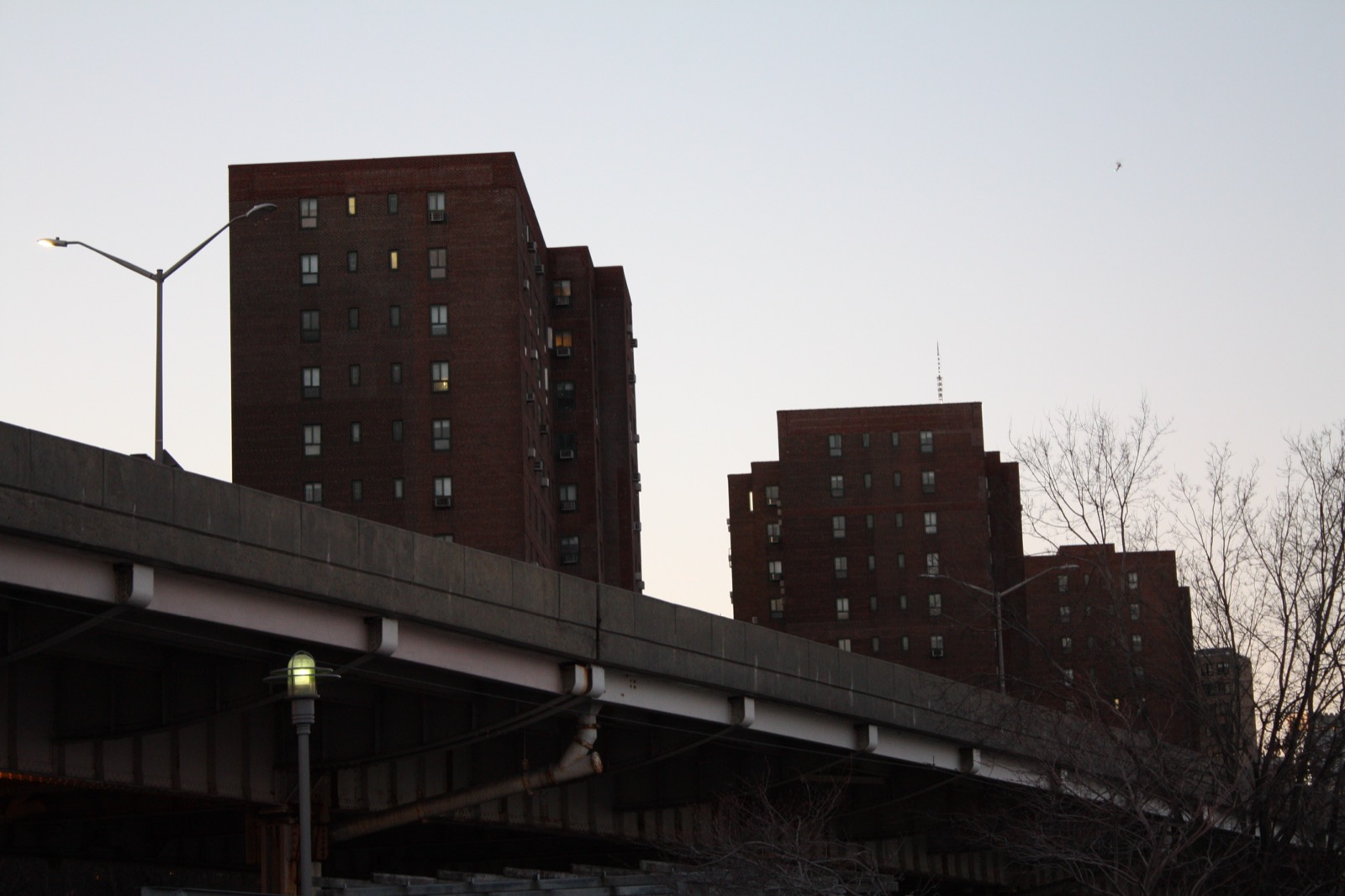
After several years of creditor management, the Blackstone Group acquired Stuyvesant Town and Peter Cooper Village in 2015 for approximately $5.3 billion. The city’s approval came with conditions. Blackstone committed to maintaining 5,000 apartments at affordable rents for 20 years and offered protections for existing rent-stabilized tenants. The agreement was negotiated between the new owners, the de Blasio administration, and the Tenants Association.
The complex today is economically bifurcated in a way that is visible in the hallways. Long-term stabilized tenants, many of them elderly and on fixed incomes, pay as little as $800 to $1,500 a month for apartments that would rent for $3,500 to $5,000 at market rate. Newer market-rate tenants, predominantly young professionals in their 20s and 30s, pay those higher rents. The median income among stabilized tenants runs around $50,000 to $80,000. Among market-rate tenants, it runs $100,000 to $150,000 or more.
The slow conversion from stabilized to market-rate continues as long-term tenants depart. Each one who leaves takes a below-market apartment with them permanently. The affordability agreement provides a 20-year floor, but the overall trajectory is toward higher rents and a younger, more transient population. The Tenants Association remains organized and watchful. The history of this place has taught its residents that preservation requires active participation.
Jane Jacobs used Stuyvesant Town as an example of everything wrong with superblock planning
If you have any interest in urban planning, the name of this complex comes up in the first chapter of the most important book on the subject. Jane Jacobs used Stuyvesant Town as a central example in “The Death and Life of Great American Cities” in 1961. Her argument was that the superblock design, which eliminated the city grid and replaced it with towers in a park, destroyed exactly the kind of street life and mixed-use energy that makes neighborhoods function.
The original Gashouse District had streets, sidewalks, shops, bars, and the messy overlap of residential and commercial life that Jacobs believed was essential to a healthy neighborhood. Stuyvesant Town replaced all of that with a self-contained residential complex deliberately insulated from the surrounding city. The buildings turn inward. The pedestrian paths are internal. The commercial activity happens at the edges, on First Avenue and 14th Street, not within the complex itself.
Jacobs was right about a lot of things, and the superblock model has been criticized by urban planners for decades. But Stuyvesant Town also works in ways that Jacobs’s critique does not fully account for. The Oval is a genuine communal gathering space. The absence of traffic makes the complex safe for children and dog walkers. The open lawns between the buildings create a sense of space that is almost impossible to find elsewhere in Manhattan. The design has problems, but the community that formed within the design has been remarkably durable.
The superblock approach shaped urban planning across the country and you can see its influence in housing projects everywhere
The design philosophy behind Stuyvesant Town, separating pedestrians from cars, maximizing open green space, and creating self-contained residential communities, was based on Radburn, New Jersey and British garden city planning principles. It was enormously influential. After Stuyvesant Town’s success as a privately managed residential complex, similar superblock designs were adopted for public housing projects across the country.
The results varied enormously. The difference between Stuyvesant Town and the public housing projects built using the same design principles is not primarily architectural. It is economic. Stuyvesant Town was privately managed, well-maintained, and housed a population that included working- and middle-class families with stable incomes. Many public housing projects built on the same tower-in-the-park model were underfunded, poorly maintained, and concentrated poverty in ways that compounded every other problem. The design was similar. The investment was not.
This history matters because it shaped how Americans think about density, public housing, and urban living. Stuyvesant Town is simultaneously a success story and a cautionary tale, depending on which part of the story you focus on.
The apartments are 79 years old and the cleaning needs are specific to what 1947 construction looks like today
The 8,757 apartments in Stuyvesant Town are all rental units in 35 buildings built in 1947. There are no condos, no co-ops, no townhouses. Studios run around 450 square feet. One-bedrooms run 600 to 700 square feet. Two-bedrooms run 800 to 950 square feet. The units are not large by modern standards but they were designed efficiently for the postwar era, and the layouts still work.
The 1947 construction means specific cleaning considerations. Cast-iron steam radiators collect dust in their fins for months and then burn it off every October when the heat kicks on. That scorched-lint smell that fills the apartment for the first week of heating season is the result. Keeping the covers, the grilles and the floor around the unit dusted all summer will not stop it outright, but it shortens it. Original bathroom tile, when it survives, needs careful treatment. The grout is decades old and responds poorly to aggressive chemical cleaners. Window hardware from the original construction is functional but needs gentle handling.
Long-tenured stabilized apartments often carry years of accumulated maintenance gaps. Kitchen grease buildup behind ranges that have not been pulled out in a decade. Bathroom grout that has not been properly scrubbed in years. Closets and storage spaces packed with decades of belongings that create dust traps in every corner. The first cleaning in an apartment like this is always a deep clean. We work room by room, top to bottom, and reset every surface. After that initial visit, a regular apartment cleaning schedule keeps it maintained.
Market-rate units that turn over between tenants are a different job. The previous tenant’s cleaning is usually superficial. Our move-in and move-out cleaning covers every surface a new tenant will touch or open. Inside cabinets, appliance interiors, baseboards, window sills, light fixtures, and the full bathroom including grout lines.
Peter Stuyvesant’s pear tree survived for 200 years a few blocks from the complex named for him
The complex is named for Peter Stuyvesant, the last Director-General of the Dutch colony of New Amsterdam before the English takeover in 1664. He governed for 17 years, built the wall that became Wall Street, tried to exclude Jews and Quakers from the colony (and was overruled by the Dutch West India Company), and ran his farm, the “Bouwerie,” on land several blocks south of the current complex. The Bowery takes its name from that farm.
His pear tree is the detail that sticks. Stuyvesant reportedly planted a pear tree on his farm in the 1600s. The tree stood at Third Avenue and 13th Street, a few blocks from the development that now bears his name, until it was knocked over by a cart in 1867. It had survived for more than 200 years. A pear tree outliving the colony that planted it by two centuries and then getting taken out by a delivery cart is about as New York as it gets.
MetLife chose the Stuyvesant name to evoke the Dutch colonial heritage of the Lower East Side. There is some irony in naming a residential complex after a man known for anti-democratic and exclusionary governance, and then opening that complex with a whites-only rental policy. The irony was probably not intentional, but it is hard to miss.
The Oval is the center of daily life and the closest thing the complex has to a town square
The Oval is an oval-shaped communal green at the center of the superblock, ringed by mature trees and connected to every building by pedestrian paths. It is the site of the Sunday farmers market, summer concerts, the holiday tree lighting, and the daily traffic of dog walkers, joggers, and parents with strollers. In a complex with no commercial street life and no mixed-use ground floors, the Oval serves the function of a village green or a town square.
The East River Greenway runs along the eastern edge of the complex, providing a dedicated cycling and pedestrian path that connects to the 32-mile Manhattan Waterfront Greenway system. Residents can step out from the FDR Drive side of the complex and be on a running path that extends the full length of Manhattan.
Transit access is strong. The L train at 14th Street and First Avenue is the most convenient subway station, providing fast connections west to Union Square and east to Williamsburg in Brooklyn. Union Square, a ten-minute walk from the southern edge of the complex, is one of Manhattan’s most important transit hubs with the 4, 5, 6, L, N, Q, R, and W trains. The M15 bus runs along First Avenue on the complex’s western boundary.
Booking a cleaning in Stuyvesant Town is straightforward because the buildings are all the same
One of the advantages of cleaning in Stuyvesant Town is that the buildings are architecturally identical. Once our team has cleaned one apartment in the complex, they understand the layout, the fixtures, the radiator placement, and the window hardware for every other unit in every other building. The floor plans vary by unit size but the construction details are consistent across all 35 towers.
You pick your date and time on our booking page. You see your flat-rate price before you commit. If your radiators need pre-season cleaning, you tell us once and we note it on your account. Most buildings do not have doormen, so we coordinate key access on the first visit and use the same arrangement going forward. Our cleaners are W-2 employees, not gig workers. They are vetted, insured, and they bring the right products for 1947 construction.
We serve Stuyvesant Town and the surrounding neighborhoods, including nearby Gramercy Park, East Village, Kips Bay, and Alphabet City. Our teams use the L train to 14th Street and First Avenue or the M15 bus along First Avenue. We arrive on time.