

Lindenwood is the kind of Queens neighborhood that does not announce itself. There is no famous restaurant, no arresting skyline, no dramatic waterfront. What there is, compressed between the Belt Parkway and Linden Boulevard on the southwestern edge of the borough, is one of the most complete expressions of the outer-borough homeownership ideal that New York City produced in the two decades after the Second World War. A tight grid of two-story brick row houses, most built between 1945 and 1965, owner-occupied by Italian-American families who bought them as a life project. The streets are quiet on weekday mornings. The driveways are clean. Someone’s grandmother has a garden in the back. The linden trees that gave the neighborhood its name still flower in June and fill the air with something unexpectedly sweet for a street in south Queens.
This is not the New York that shows up in travel magazines. It is the New York that most New Yorkers actually live in.
Linden trees, GI Bills, and a developer’s pastoral dream
Lindenwood got its name from a real estate decision, which is a genuinely honest origin story for an outer-borough neighborhood. When developers began filling in the blocks north of the Belt Parkway corridor in the 1920s and 1930s, they planted linden trees along the residential streets and named the community after them. The practice was standard for the era: outer-borough developments across Queens, Brooklyn, and Staten Island reached for tree names and pastoral imagery to signal that this was a place of substance, a step away from tenement density, a place where a working family could aspire toward something green and stable. Woodhaven. Elmhurst. Laurelton. Lindenwood. The names tell you exactly what the developers were selling and what the buyers were buying.
The linden tree was a sensible choice for that pitch. Tilia, the genus name, covers a family of trees native to temperate Europe and North America that grow quickly, cast dense shade, and produce small cream-colored flowers in early June with a scent that carries half a block. In European cities, particularly in Germany, the linden is almost synonymous with civic dignity. Planting them on new residential streets in south Queens in 1935 was a statement: this is a neighborhood worth caring for.
The decisive moment of Lindenwood’s physical development came after the war. The GI Bill and the pent-up housing demand of a decade-plus of Depression and wartime shortage produced a building surge in the late 1940s and through the 1950s that filled Lindenwood in almost completely within a twenty-year window. Italian-American veterans and their families arrived from Brooklyn and from the older immigrant neighborhoods of lower Manhattan, purchased newly constructed two-story brick homes, and built the community that defines the neighborhood today. Block by block, the street grid filled in with an architectural consistency that is almost unique in New York: you can walk most of Lindenwood and see a single continuous building tradition. It looks like what a skilled set designer would produce if asked to construct “working-class Italian-American Queens,” because it was essentially built all at once, by the same cohort of buyers, from the same available housing types, in the same compressed era.
The linden trees on some of those original streets are mature now, old enough to be genuinely large, and they still flower in early summer.
The Belt Parkway made Lindenwood an island
Most Queens neighborhoods are defined by what they are near. Lindenwood is defined by what it is between. The Belt Parkway forms a hard southern boundary, separating the neighborhood from the Howard Beach waterfront and Jamaica Bay beyond. Linden Boulevard and Conduit Avenue form the northern and northeastern edge. The result is an enclosed residential grid that has the quality of a neighborhood with defined walls: quiet in the interior, contained, oriented inward.
This geography was not accidental. Robert Moses constructed the Belt Parkway as part of the West Side Improvement Project in the 1930s, connecting Brooklyn to Queens along the Jamaica Bay waterfront and continuing to the Nassau County border. The parkway was designed to be beautiful, following the bay’s edge through a corridor of parks, and it succeeded at that on the Brooklyn and Queens waterfront segments. What it also did, less poetically, was divide neighborhoods from their waterfronts and seal residential communities between major roads.
For Lindenwood, the Belt Parkway’s presence is a mixed inheritance. It means the neighborhood is not the waterfront community that Howard Beach is, even though Jamaica Bay is visible from the overpass and reachable by bicycle in fifteen minutes from most blocks. It means the community has a sealed, protected quality that residents tend to value. And it means that if you want to get anywhere by subway, you are walking or busing to the Howard Beach-JFK Airport A train station, which is a ten to twenty minute trip from the deeper interior streets.
The A train from Howard Beach reaches Penn Station in roughly forty minutes. This is a long commute by Manhattan standards and a reasonable one by the standards of outer-borough homeownership, which has always involved a trade: more space and equity in exchange for a longer ride to work. Lindenwood residents have been making that trade for seventy years.
What the houses actually look like, and why it matters for cleaning

The dominant housing type in Lindenwood is the attached or semi-detached two-story brick row house from the postwar era, and understanding these buildings specifically is how a cleaning service either earns a long-term relationship with a household or loses it after the first visit.
These are tight, well-constructed homes. The typical floor plan runs 1,100 to 1,400 square feet across two floors: a living and dining room on the ground floor, kitchen in the rear, two or three bedrooms upstairs, one full bathroom. Some have been expanded over the decades with rear additions, finished basements, or converted attic space. Many have a second bathroom added sometime in the 1970s or 1980s. Private driveways are common, which means tracked-in grit from the driveway surface is a permanent entryway reality.
The building materials in these homes have a specific maintenance logic. The original 1950s bathroom tile is typically ceramic with a fired glaze. It is durable, but the glaze dulls permanently with abrasive cleaners or scrubbing pads. The grout is the vulnerable element: original grout from this era is often softer and more porous than modern formulations, which means it needs a stiff brush and a pH-neutral cleaner, not an acid-based spray that will etch the surrounding tile and leave a chemical residue. The cast iron baseboard radiators that heat most of these homes collect dust along the fins, and it burns off when the heat comes on in October, filling the house with an unmistakable smell. What we clean is the outside of the unit. Radiator covers, enclosure tops, and the vent covers above them get dusted on every visit, which keeps the loose dust in the room from feeding straight back into the heating element all summer.
The detached single-family homes on the outer blocks tend to be Colonial Revival or ranch-style construction from the same era, with more square footage and sometimes a full finished basement with its own cleaning requirements. Two-family homes add the basement apartment to the equation, a space with lower light, higher moisture, and the particular grime accumulation pattern of below-grade living.
None of these are difficult surfaces to clean correctly. But they require a team that knows what they are working with and uses products and tools appropriate to 1950s and 1960s construction, not a one-size-fits-all apartment routine designed for modern finishes.
Aqueduct, the last track in New York
The Aqueduct Racetrack complex sits directly on Lindenwood’s northern border, and its presence is one of the more distinctive facts about living in the neighborhood. Aqueduct is the oldest continuously operating thoroughbred track in the United States, opened in 1894 and rebuilt to its current configuration in 1959. Racing season runs from October through May, which means that for half the year, the landscape just north of Lindenwood’s residential streets fills with the activity of one of New York’s oldest sports traditions: the grandstand crowds, the racing forms on the car seats in the parking lot, the particular focused energy of post time.
For Lindenwood residents who grew up in the neighborhood, the track is background furniture. For newcomers and visitors, it is a genuine surprise. On a cold Saturday in November, the Aqueduct grandstand offers a thoroughbred racing experience that has been essentially unchanged for decades, a crowd that is authentically outer-borough and not self-conscious about it, and one of the odder combinations of tradition and ordinariness that New York produces.
Resorts World NYC opened at the Aqueduct complex in 2011 as New York State’s first Las Vegas-style casino. It occupies part of the racetrack grounds and added a different kind of commercial activity to the neighborhood’s northern edge. The complex’s food hall has become a genuine dining option for the surrounding community. Whether the casino’s presence has been good or indifferent for Lindenwood depends entirely on whom you ask.
The parish, the feast, and the social calendar that runs through both
Lindenwood’s social infrastructure is primarily organized through the Catholic parish network, which is the correct historical framing for an Italian-American outer-borough neighborhood of this era. Saint Helen Roman Catholic Church serves the Lindenwood and eastern Howard Beach community, and the parish structures built around it have been the primary social institution for the neighborhood’s founding cohort since the postwar years.
The annual parish feast in summer is Lindenwood’s most visible community event. Street food, carnival games, music, the extended sidewalk gathering that gives these neighborhoods their character. The feast is not a performance for visitors or a destination for food tourists from Manhattan. It is an internal event organized by and for the community that lives here, which is precisely what makes it worth understanding if you want to understand the neighborhood.
The Catholic school network extends from the parish institutions. Our Lady of Grace and Saint Helen have provided the educational and social infrastructure for generations of Lindenwood families, and the networks formed through these institutions are a primary mechanism of community cohesion across the Howard Beach and Lindenwood corridor.
This social structure has been the neighborhood’s asset and its source of stability for seventy years. It is also, slowly, expanding to incorporate the Latino and South Asian families who have been arriving since the 1990s. The process is not dramatic. It accumulates year by year in the gradual shift of who sits in the pews, whose kids are in the same classroom, and what languages are spoken at the summer feast.
What Saturdays are actually for in Lindenwood
The belt Parkway cycling path runs along the neighborhood’s southern edge and connects to Jamaica Bay Wildlife Refuge in roughly fifteen minutes by bicycle. The refuge is a 9,155-acre unit of Gateway National Recreation Area where more than 330 bird species pass through or nest annually. The West Pond Trail is a 1.6-mile loop through tidal marsh and open water, free, and almost never crowded in the way Manhattan parks are crowded. Horseshoe crabs spawn on the shoreline during May full-moon high tides, which is one of those ancient natural events that New York City happens to host and most people in the city do not know about.
Closer in, the Cross Bay Boulevard corridor provides daily needs: the pizzeria, the deli, the pharmacy, the hardware store. These are not destination dining experiences. They are the commercial fabric that a functioning residential neighborhood requires to stay functional, and Lindenwood has maintained that fabric through the decades when other outer-borough commercial corridors lost it.
The belt Parkway itself, and the AirTrain JFK accessible from the A train station, make Lindenwood one of the more conveniently located neighborhoods in south Queens for anyone who travels frequently. The airport is close in a way that matters in practical life, even if it rarely makes the list of neighborhood selling points.
Your Saturday, in other words, has options. The wildlife refuge, the track if it is racing season, a long bicycle ride on the greenway, a morning of home cooking that does not rush. What it should not require is spending the morning scrubbing tile grout or cleaning between radiator fins. That is what a recurring cleaning handles, and it is a straightforward arrangement once you have set it up.
Booking a cleaning in Lindenwood
The booking page shows your flat-rate price upfront before you commit to anything. You enter your address, number of bedrooms and bathrooms, and select your date and time. No phone calls, no estimates that change when the cleaner arrives.
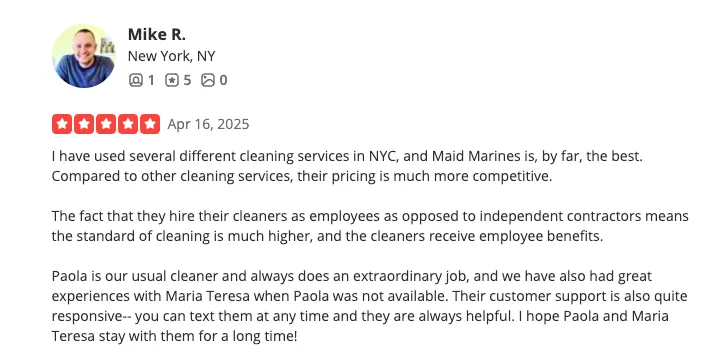
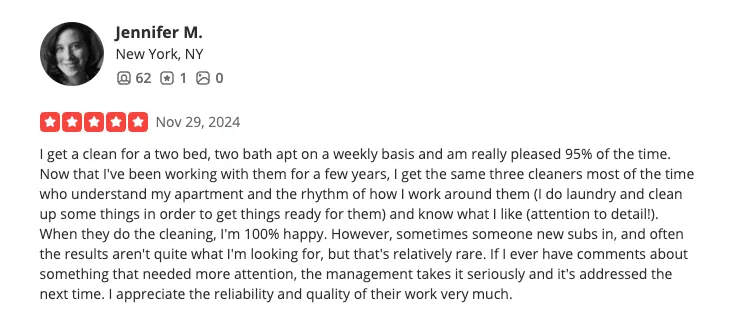
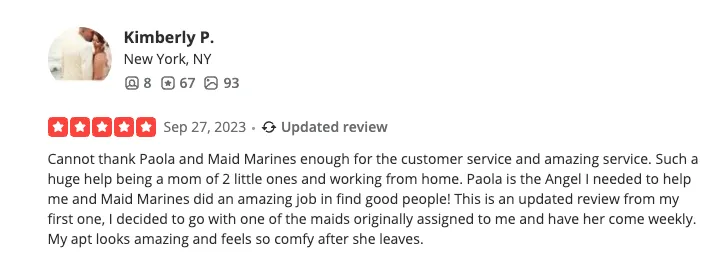
Our cleaners are W-2 employees, not gig workers dispatched through an app. They arrive with everything they need, they know how to work in postwar brick row houses, and they do not use abrasive products on original tile. If you have specific areas you want handled carefully (original grout lines, old hardwood floors, a basement apartment), you can note that when you book.
Lindenwood is a regular service area for our south Queens teams. We also serve neighboring Howard Beach, Ozone Park, and South Ozone Park. For households with deeper accumulated buildup or post-renovation work, a deep cleaning is the right starting point. For move-ins, move-outs, or transitions in the neighborhood’s active two-family home market, move-in and move-out cleaning is a separate booking with its own checklist.
The neighborhood is easy to reach and easy to schedule for. Most first appointments are available within a few days.