

Brownsville is the neighborhood where Aaron Copland heard the rhythms that would become the sound of America, where Margaret Sanger started the birth control movement in a two-room clinic on Amboy Street, and where three different men from the same few blocks became heavyweight champions of the world. It is also one of the most misread neighborhoods in New York City, often reduced to its poverty statistics while the full story of the place gets left out. The full story is extraordinary, and it starts with a land developer who named a neighborhood after himself in 1858.
A real estate man named Brown built the densest Jewish neighborhood on earth
Charles S. Brown was not trying to make history. He was a developer who bought a large tract of undeveloped farmland in 1858 and wanted to sell it. He targeted Jewish factory workers from the Lower East Side of Manhattan who needed affordable housing within reach of the garment district. He subdivided the lots, named the development after himself, and started marketing. The land was remote, the streets were unpaved, and transit connections to the rest of Brooklyn were poor. It grew slowly.
Then the railroads came. The Brighton Line and the elevated BMT Canarsie Line made Brownsville accessible to Manhattan commuters, and the neighborhood exploded. Between 1880 and 1920, Brownsville transformed from a modest settlement into the most densely populated Jewish neighborhood in the Western Hemisphere. By 1910, 66% of residents were born outside the United States, and 80% of those were from Russia, fleeing the pogroms and poverty of the Czarist Empire. By the 1930s, nearly 250,000 people lived within two square miles. Over 70 Orthodox synagogues served the community. Pitkin Avenue, lined with kosher butchers, Yiddish-language newspapers, pushcart markets, and movie palaces, was known as the “Fifth Avenue of Brooklyn.” The neighborhood earned a simpler nickname: Little Jerusalem.
The people who packed those pre-war tenements between Sutter Avenue and Livonia Avenue were not quiet about what they believed. Brownsville in the 1920s and 1930s was one of the most politically radical communities in the United States. Labor union meetings drew thousands. Socialist and anarchist gatherings filled halls on Rockaway Avenue. The immigrant generation had come from a world of persecution and they were not inclined to accept suffering as natural. That political consciousness produced some remarkable people. Howard Zinn grew up in these tenements and eventually wrote “A People’s History of the United States,” the book that sold two million copies and permanently changed how Americans think about whose stories get told. Alfred Kazin was born here and wrote “A Walker in the City,” one of the most beautiful urban memoirs in American literature, about growing up on these exact streets. Aaron Copland was born in 1900 on Dean Street, the son of a Jewish immigrant family, and grew up to write “Appalachian Spring” and “Fanfare for the Common Man,” the pieces that defined what American classical music sounds like.
The Three Stooges were from Brownsville. Moe, Shemp, and Curly Howard grew up as the Horwitz brothers in a Russian Jewish immigrant family a few blocks from Pitkin Avenue. Their anarchic, slapstick, working-class comedy was forged in the tenement culture of Little Jerusalem, and it shows in every pie throw and eye poke. Larry King grew up here as Lawrence Harvey Zeiger, the son of a bar owner, and eventually became the man who interviewed every American president from Gerald Ford to Barack Obama. Danny Kaye was born David Daniel Kaminsky in Brownsville in 1911 and went on to star in “The Secret Life of Walter Mitty” and become a UNICEF ambassador who earned the Presidential Medal of Freedom.
The birth control movement started at 46 Amboy Street
On October 16, 1916, Margaret Sanger opened the first birth control clinic in the United States at 46 Amboy Street, along with her sister Ethel Byrne and Fania Mindell. The clinic was two small rooms in a Brownsville tenement building, and Sanger chose the neighborhood deliberately. She wanted to serve working-class immigrant women who had few options for family planning and who were having more children than they could feed or house. Hundreds of women visited in the first days. Nine days after opening, police arrested Sanger, her sister, and Mindell for violating the Comstock Law. The arrest and subsequent trial generated national media coverage and became the founding moment of the American birth control movement. The direct line from that Amboy Street clinic to Planned Parenthood is not metaphorical. It is institutional history.
A plaque marks the building today. It sits a few blocks off Pitkin Avenue, unremarkable from the street, and most people walking past it have no idea what happened there. That is true of a lot of Brownsville.
Pre-war railroad flats and NYCHA towers that define how we clean here

The housing stock in Brownsville is layered across three distinct eras, and each one presents a different set of conditions for a cleaning team. The oldest fabric is the pre-war tenement buildings that lined the blocks around Pitkin Avenue and Sutter Avenue from the 1880s through the 1920s. These are five- and six-story brick walk-ups with narrow floor plans, low ceilings, and the kind of railroad flat layout where every room connects directly to the next. The building at the corner of Sutter and Rockaway Avenues looks like it was built for the garment workers who moved in during Woodrow Wilson’s presidency, because it was. Stairwells are tight. There are no service elevators. Plaster walls, original hex tile in bathrooms where the tile has survived, and wood floors that in some units have not been refinished since the 1940s. These apartments need apartment cleaning by people who understand what a century-old wood floor requires and what it cannot survive.
Then there is the dominant architectural reality of modern Brownsville: the NYCHA towers. Eighteen developments, over 100 buildings, roughly 10,000 units, all within approximately one square mile. Van Dyke Houses, Tilden Houses, Brownsville Houses, Howard Houses, Marcus Garvey Village. No neighborhood in the United States has a higher concentration of public housing per capita than Brownsville. The towers were built in waves between the late 1940s and the mid-1970s, and the interior conditions vary widely depending on which era a given building was constructed and how well the renovation funding has flowed. Some units have been recently renovated with new appliances and flooring. Others have not been meaningfully updated in decades. Grout lines in kitchens and bathrooms, in particular, tend to accumulate years of buildup in apartments that have had maintenance deferred. A proper deep cleaning in a NYCHA unit means working the grout, not skipping past it.
The third layer is the residential side streets between the major corridors, where two- and three-story brick rowhouses sit behind stoops and iron railings. These are mostly owner-occupied. Families who have been in Brownsville for two or three generations holding onto their houses through the hard decades. The cleaning needs here are different: multiple floors, often a basement that needs attention, backyards in some cases. A rowhouse on Chester Street or Thomas S. Boyland Street is not an apartment job and should not be treated like one.
Three heavyweight champions from the same neighborhood in eleven years
The boxing culture of Brownsville is not a historical footnote. It is the living center of the neighborhood’s identity. The gyms in Brownsville have been producing fighters for over 50 years, and what those gyms produced between 1986 and 2006 is statistically remarkable. Mike Tyson grew up in the Brownsville Houses and the surrounding blocks, kept pigeons on rooftops, and was discovered by trainer Bobby Stewart while detained at a juvenile facility upstate. Stewart introduced him to Cus D’Amato. In 1986, at age 20, Tyson became the youngest heavyweight champion in boxing history. Riddick Bowe grew up in the same neighborhood and in 1992 defeated Evander Holyfield to become undisputed heavyweight champion, holding the WBO, WBA, and IBF titles simultaneously. Shannon Briggs grew up here, overcame homelessness on the streets of Brownsville, and won the WBO heavyweight title in 2006. Three men, one neighborhood, eleven years, three world championship belts. No neighborhood of comparable size anywhere on earth has produced three separate heavyweight world champions within that kind of window. Daniel Jacobs, born here in 1987, survived stage-two bone cancer and came back to become WBA middleweight champion. The fighting tradition is ongoing.
The boxing legacy and the neighborhood’s Caribbean community are the two strongest threads in Brownsville’s current cultural fabric. The West Indian immigrant population, predominantly Jamaican, Trinidadian, Haitian, and Guyanese, has layered its own music, food, and religious traditions onto the Brooklyn Black culture that defines the neighborhood. On Labor Day weekend the West Indian American Day Carnival parade runs along Eastern Parkway just north of Brownsville, and the neighborhood’s Caribbean families are central to it. The Haitian community has made Lakou Cafe on Pitkin Avenue a genuine destination, serving joumou pumpkin soup and griot to a room that is always full. Ali’s Roti Shop runs Trinidadian doubles and goat curry roti for the neighborhood’s West Indian community. The Pitkin Farmstand sets up Saturday mornings on Pitkin near Amboy Street, bringing fresh produce directly into a neighborhood that has historically had limited supermarket access.

The Brownsville Plan and what a billion dollars actually looks like
The 2018 Brownsville Plan is the largest coordinated city investment in the neighborhood in the modern era: over a billion dollars committed to 2,500 new affordable homes on city-owned land, park improvements, NYCHA renovation funding, commercial corridor investment on Pitkin Avenue and Rockaway Avenue, and job training programs. The plan was developed in partnership with the local community board and tenant advocates, which is why it looks different from the urban renewal of the Robert Moses era. Moses built the NYCHA towers without asking anyone who lived here. The Brownsville Plan was at least nominally a conversation.
The tensions around it are real. “Affordable” units priced for households earning $90,000 to $227,000 per year do not serve a community where median household income sits around $22,000 to $27,000. Critics have argued that some of the new development framework is designed to bring in middle-income newcomers rather than house the people who are already here. The NYC Housing Preservation Trust taking over management of some NYCHA buildings, including Nostrand Houses, under a public-private partnership model has generated serious concern from tenant advocates about the long-term protection of rents.
What the Brownsville Plan means practically, if you live here now, is that new buildings are going up on formerly vacant lots. The construction activity is concentrated near transit stops, particularly around the A and C train at Rockaway Avenue and the L train stations along Livonia Avenue. New affordable units with modern appliances and updated layouts, post-construction move-in cleaning for tenants arriving in newly completed buildings, and the general churn of a neighborhood that is, for the first time in decades, adding housing rather than watching it sit vacant.
Your cleaning window and what Brownsville offers inside it
The Stone Avenue Library at 581 Mother Gaston Boulevard is one of the most unexpectedly beautiful public buildings in Brooklyn. William B. Tubby designed it in Jacobean Revival style and it was built between 1913 and 1914 as one of the Carnegie library branches in Brooklyn. The turrets, the ornamental brickwork, the arched windows, the reading room. It is a New York City Landmark and it is completely free to use. A cleaning appointment runs two to three hours and the library is a 10-minute walk from most of the Pitkin Avenue corridor.
Betsey Head Park and its WPA-era pool at Dumont Avenue and Thomas S. Boyland Street are the other anchor. The outdoor pool, opened in 1936, is one of the largest in New York City and has been renovated. It is free, it is city-run, and in July and August it is one of the better places to spend an afternoon in Brooklyn. The park surrounding it is 10 acres and includes athletic fields and courts.
For the transit-willing, Prospect Park is approximately 20 minutes northwest via the subway. The 585-acre Olmsted and Vaux masterpiece is Brownsville’s primary major green space, and it is worth the trip when the alternative is sitting in the apartment while we work.
What booking looks like when you’re in Brownsville
You pick your date and time on our booking page, you see your flat-rate price before committing, and you tell us once about any building-specific access requirements. NYCHA buildings have check-in procedures and sometimes require advance notice to management. Pre-war tenements have narrow stairwells that our teams navigate with compact equipment. Rowhouses with multiple floors get treated as the multi-level jobs they are.
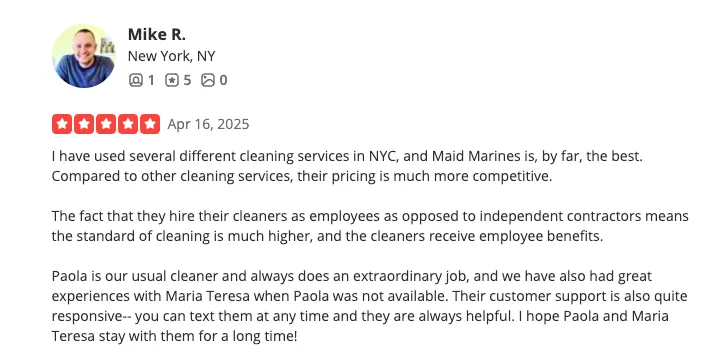
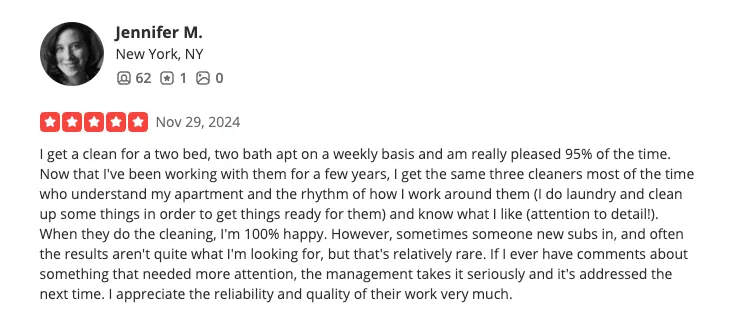
Our cleaners are W-2 employees with background checks, not gig workers. They show up with everything they need and they know what pre-war Brooklyn floors require versus what new construction can handle. We do house cleaning for Brownsville’s rowhouse owners, recurring apartment cleaning for NYCHA and private rental tenants, and deep cleaning for units that have had maintenance deferred for too long. We also handle move-in and move-out cleaning for the neighborhood’s rental market, which has been tighter as new construction comes online.
Brownsville residents also connect with our team in East New York and Crown Heights. The neighborhoods are different in their building stock and cleaning demands, but the approach is the same: show up knowing what the housing type requires and do it right.