
East New York has one of the most dramatic origin stories of any neighborhood in New York City. A Connecticut shoe manufacturer named John Pitkin arrived in eastern Brooklyn in 1835, bought approximately a thousand acres of flat farmland from the former Town of New Lots, built a factory, laid out a street grid, and named his development East New York. He believed, with apparent sincerity, that he was building a city that would rival Manhattan itself. He envisioned Pitkin Avenue as Brooklyn’s Fifth Avenue. Two years after his grand announcement, the Panic of 1837 collapsed the economy, his factory closed, and Pitkin died in poverty. The name he gave to someone else’s dream is the only thing that survived him.
That combination of ambition, failure, and stubborn persistence is woven into everything East New York has been since.
From Dutch farmland and a failed developer’s dream to one of Brooklyn’s most storied neighborhoods
Before John Pitkin arrived, before the street grid, before any of the buildings that now cover every square foot of the neighborhood’s flat terrain, the Lenape people’s Canarsie band farmed and fished here. The land was low, sandy, and covered in oak and pine, sloping gently toward Jamaica Bay at the southern edge. Dutch settlers from New Netherland began farming the area in the mid-17th century and, as the original Flatbush farmland became overworked and subdivided, carved out “new lots” of agricultural land from the eastern wilderness for the next generation of settlers. The literal meaning of the name New Lots is just that: new parcel divisions distributed to farmers who needed fresh ground.
Pitkin’s scheme ended with the Panic of 1837, but the streets he surveyed and the name he coined outlasted him. The territory was reorganized in 1852 into the independent Town of New Lots, the youngest of Brooklyn’s original six towns, with its Town Hall at 109 Bradford Street. For a generation after, it remained quietly agricultural. Then in 1886, the rapidly expanding City of Brooklyn annexed the Town of New Lots as its 26th Ward, and within years the farms gave way to the brick and wood rowhouses that still shape the neighborhood today.
The elevated railroads did the real work of transformation. The Fulton Street El arrived in 1889 and the IRT subway reached New Lots Avenue in 1922, turning pastoral farmland into dense working-class city within a single generation. German, Irish, Italian, and Eastern European Jewish immigrants flooded the tenements and rowhouses that rose along the new transit corridors. By the 1920s and 1930s, East New York had become one of Brooklyn’s most densely Jewish neighborhoods, with synagogues on nearly every block, pushcart markets on Pitkin Avenue, and a reputation for the close-knit insularity of the working-class immigrant enclave. Danny Kaye, born David Daniel Kaminsky at 250 Bradford Street in 1911, grew up in this East New York. He credited the neighborhood’s dense polyglot immigrant culture for giving him his gift for languages and accents and his instinct for physical comedy. Jerry Stiller, who a later generation would know as Frank Costanza on Seinfeld, grew up here in the same era.
The postwar crisis, blockbusting, and the decades the city gave up on East New York
The postwar years brought catastrophe. The GI Bill sent white working-class families to the suburbs. Robert Moses-era urban renewal projects destroyed housing stock in neighboring communities and pushed displaced families into East New York. And then there were the landlords and real estate agents who ran the blockbusting operations that systematically dismantled the neighborhood’s existing community. The playbook was well documented: spread panic about racial change to white homeowners, buy their properties at depressed prices, resell them at inflated rates to Black and Puerto Rican families who had few other options in a city that had redlined them out of most neighborhoods. Within fifteen years, a neighborhood that had been predominantly Jewish and Italian became predominantly Black and Latino. The transition was not organic. It was manufactured for profit.
By the late 1960s, East New York was in genuine crisis. Factories closed. Unemployment climbed. Arson became common as landlords torched buildings rather than pay taxes on properties they had already stripped. Entire blocks that had held dense tenements emptied into rubble-strewn lots. At its worst, East New York had one of the highest murder rates of any neighborhood in the United States. The city government had essentially written the neighborhood off.
The turnaround came not from government programs or developers but from the neighborhood’s own churches. East Brooklyn Congregations, a faith-based coalition founded in 1979 and built on the organizing principles of the Industrial Areas Foundation, mobilized thousands of residents to demand something the city had stopped offering: basic investment. Their most visible achievement was the Nehemiah Housing Program, launched in 1983. Working with city government and a revolving fund held by the participating churches, EBC built thousands of affordable single-family brick rowhouses on East New York’s abandoned lots. Simple, solid, owner-occupied homes at prices that working families could afford. The program was studied and replicated in cities across the country. It proved that organized communities could rebuild a neighborhood that every institution with power had given up on.
The housing stock that defines how people actually live here
East New York is a neighborhood that looks different on almost every block, because it was built in several completely distinct eras, each with its own logic and its own relationship to the street.
The oldest surviving residential structures are the modest two- and three-story frame houses and brick rowhouses built in the 1880s through the 1920s on streets like Bradford and Barbey. Simple, utilitarian, close to the sidewalk. A handful show traces of Italianate or Queen Anne detailing, but most are the plain vernacular of working-class Brooklyn construction. The four- to six-story brick walk-up tenements built between 1900 and 1940 form the backbone of the apartment stock, the standard New York railroad layout with front and rear fire escapes and shared stair halls that you find all over the outer boroughs. Many are rent-stabilized, many have had decades of deferred maintenance, and most have the kind of original interior details that a certain type of cleaner either handles correctly or destroys: hex tile floors, plaster walls, cast-iron radiators, penny-round tile in the bathroom.
Then there are the NYCHA towers. East New York contains some of the most significant concentrations of public housing in Brooklyn: the Pink Houses on New Lots Avenue, 22 eight-story brick towers completed in 1959 and named for Louis Heaton Pink, a civic reformer who helped create NYCHA in the first place. The Cypress Hills Houses near the western edge. The Linden Houses, Howard Houses, Glenmore Plaza, and Fiorentino Plaza, which is the rarest kind of public housing landmark: a development listed on the National Register of Historic Places as a significant example of mid-century design. These buildings together house tens of thousands of residents and represent a substantial share of the neighborhood’s total housing.
And then there are the Nehemiah rowhouses, the ones the churches built. Two stories, brick, simple and solid, spread across blocks that were rubble in the early 1980s. Owner-occupied, affordable, deliberately unglamorous. The sight of a Nehemiah block still reads as a small miracle when you know the history. For apartment cleaning and house cleaning in East New York, this diversity of housing types means the right approach in one building is completely wrong in another. We price based on what your home actually is, and we clean it based on what the surfaces actually need.
The oldest building in East New York has been standing since the neighborhood was farmland
At 630 New Lots Avenue at the corner of Schenck Avenue stands a small white clapboard country church that was built in 1823. The New Lots Dutch Reformed Church was constructed to serve the farming community of the Town of New Lots, when this part of Brooklyn was still agricultural land traversed by dirt roads. It is one of the oldest surviving structures in Brooklyn. When the New York City Landmarks Preservation Commission was established in 1965, this church was among the first individual buildings designated. The congregation that now holds services here worships under the African Methodist Episcopal Zion denomination, and the adjacent cemetery dates to the same era as the church, with 19th-century tombstones still standing on the grounds.
Three blocks away, at Bradford Street between Pitkin and Glenmore Avenues, a handful of 19th-century structures survive on the block where the original Town Hall of the Town of New Lots once stood and where, at number 250, Danny Kaye spent his childhood. These buildings are not landmarks in the official sense, but they are anchors to a time before the apartment buildings, before the NYCHA towers, before the elevated trains. They are what the neighborhood looked like when the settlement was new and the farms had only recently been subdivided into lots.
The New Lots area also carries a harder history. In 2013, the City of New York designated the African Burial Ground Square between New Lots and Livonia Avenues, after pre-Civil War burial remains of enslaved Africans were discovered in the area. The designation placed the discovery in a permanent public context, adjacent to the New Lots Branch of the Brooklyn Public Library. Brooklyn’s history of slavery is not abstract. It is in the ground beneath the neighborhood.
A park built on a garbage dump with views better than most of Manhattan
Shirley Chisholm State Park opened in 2019 on 407 acres of former landfill along the Fountain Avenue corridor near the Belt Parkway. The entire park sits on compacted municipal waste. The elevation, which rises to 130 feet above sea level at its highest point, is entirely artificial. From the top of those hills, you can see the Manhattan skyline, Jamaica Bay, and the Verrazano-Narrows Bridge simultaneously. It is one of the best views in Brooklyn, and very few people from outside the neighborhood know it exists.
The park is named for Shirley Chisholm, who grew up in nearby Brownsville and became the first Black woman elected to Congress in 1968 and the first Black presidential candidate of a major party in 1972. Ten miles of bike paths and hiking trails run through the park, along with a pier on the western peninsula that extends into the bay. The park is uncrowded in a way that Prospect Park or Riverside Park can never be. Go on a clear afternoon in late spring and you will have the view almost to yourself.
That combination of the extraordinary and the underappreciated is true of East New York more generally. Spring Creek Towers, in the southeastern corner of the neighborhood off Flatlands Avenue, was the largest affordable housing complex in the United States for decades after its 1974 opening: 46 towers, 5,881 apartments, its own ZIP code (11239), and roughly 15,000 residents living in what is effectively a self-contained community with its own internal bus loop and commercial spaces. The Gateway Center mall, which opened in 2002 on former wetlands near the park, brought a ShopRite supermarket to a neighborhood that had been designated a fresh produce desert for years. That ShopRite was a milestone. The neighborhood had been without reliable grocery access for a generation before it opened.
What cleaning in East New York actually involves
The diversity of housing stock in East New York means there is no standard cleaning protocol that works across the whole neighborhood. A prewar walk-up tenement near the elevated A train on Fulton Street has different needs than a Nehemiah rowhouse on a quiet side street off Pennsylvania Avenue, which has different needs than a NYCHA apartment in the Pink Houses on New Lots Avenue.
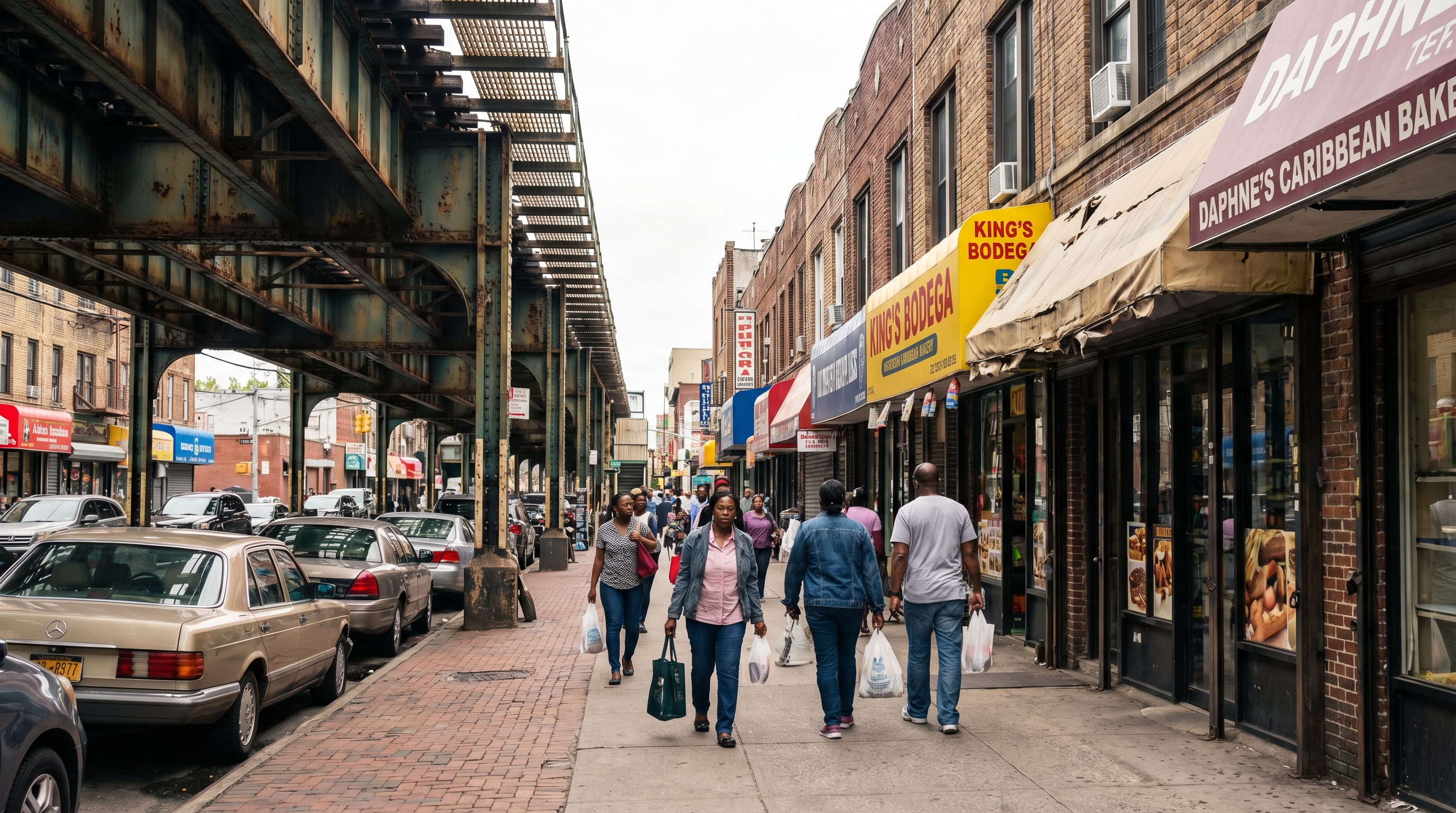
In the walk-ups, the recurring challenge is the accumulated particulate from the elevated rail lines overhead. Dust from the tracks settles through windows onto every horizontal surface and works itself into grout lines, radiator fins, and window tracks faster than in neighborhoods without overhead rail. Cast-iron radiators in these buildings trap dust all summer and burn it off in a smell you cannot ignore when the steam heat kicks on in October. What we can do about that is dust the covers, the grilles, and the sills above them on every visit, before the rail dust turns into next October’s problem. The hex tile floors in the older bathrooms and kitchens need pH-neutral cleaner and a grout brush in the lines, not the acidic products that work fine on modern surfaces but eat old grout over time.
The Nehemiah rowhouses are straightforward to clean because they are well-built, unpretentious homes: two stories, brick, no unusual finishes or surfaces that require special handling. The scope is bigger than a one-bedroom apartment, because you are cleaning a full two-story home with a staircase and sometimes a basement level, but the surfaces are standard. We price on bedrooms, bathrooms, and square footage, so the price on our booking page reflects what the job actually involves before you commit to anything.
For the NYCHA buildings, access matters as much as technique. Visitor sign-ins, elevator protocols, and time windows for vendors vary by development. We have cleaned in NYCHA buildings across Brooklyn and we know how to coordinate with building staff and work within whatever rules a specific development has in place. Tell us when you book that it is a NYCHA building and which one.
The neighborhood that refuses to be written off is still here
The 2016 rezoning that the de Blasio administration made famous as the first neighborhood rezoning of its housing agenda added new development pressure to a neighborhood that community organizations had spent forty years stabilizing. New mid-rise buildings are rising along the transit corridors. Market rents have climbed, though East New York remains one of Brooklyn’s most affordable neighborhoods by a significant margin. The same East Brooklyn Congregations network that organized the Nehemiah program in the 1980s is still active and still fighting to shape the rezoning’s outcomes on residents’ terms.
East New York moves at the tempo of a working neighborhood with no pretensions and deep roots. The elevated A train shakes apartment windows along Fulton Street. Reggae and soca come out of barbershop speakers on Pitkin Avenue in summer. The men playing dominoes outside are not a lifestyle aesthetic. The churches, dozens of them, Baptist and Pentecostal and AME Zion and Catholic, function as social anchors as much as spiritual ones and have since before the crisis years.
The neighborhood has been written off more than once. John Pitkin’s dream of a rival Manhattan collapsed in two years. The blockbusting operations of the 1950s and 1960s were designed to extract value and leave ruins. The abandoned lots of the late 1970s looked, by many accounts, like a war zone. And yet the community that the East Brooklyn Congregations built in the 1980s is still here, the Nehemiah houses are still standing, the New Lots Dutch Reformed Church has been holding services for over two centuries, and Shirley Chisholm State Park opened on the landfill in 2019 with views that would make any neighborhood proud.
We serve East New York residents for deep cleaning before and after renovation work, move-in and move-out cleaning for the neighborhood’s rental market, and recurring house cleaning on a schedule that fits around your life. Our cleaners are W-2 employees, vetted and insured, and they bring everything they need. We also cover nearby Brownsville, Cypress Hills, and Canarsie.